
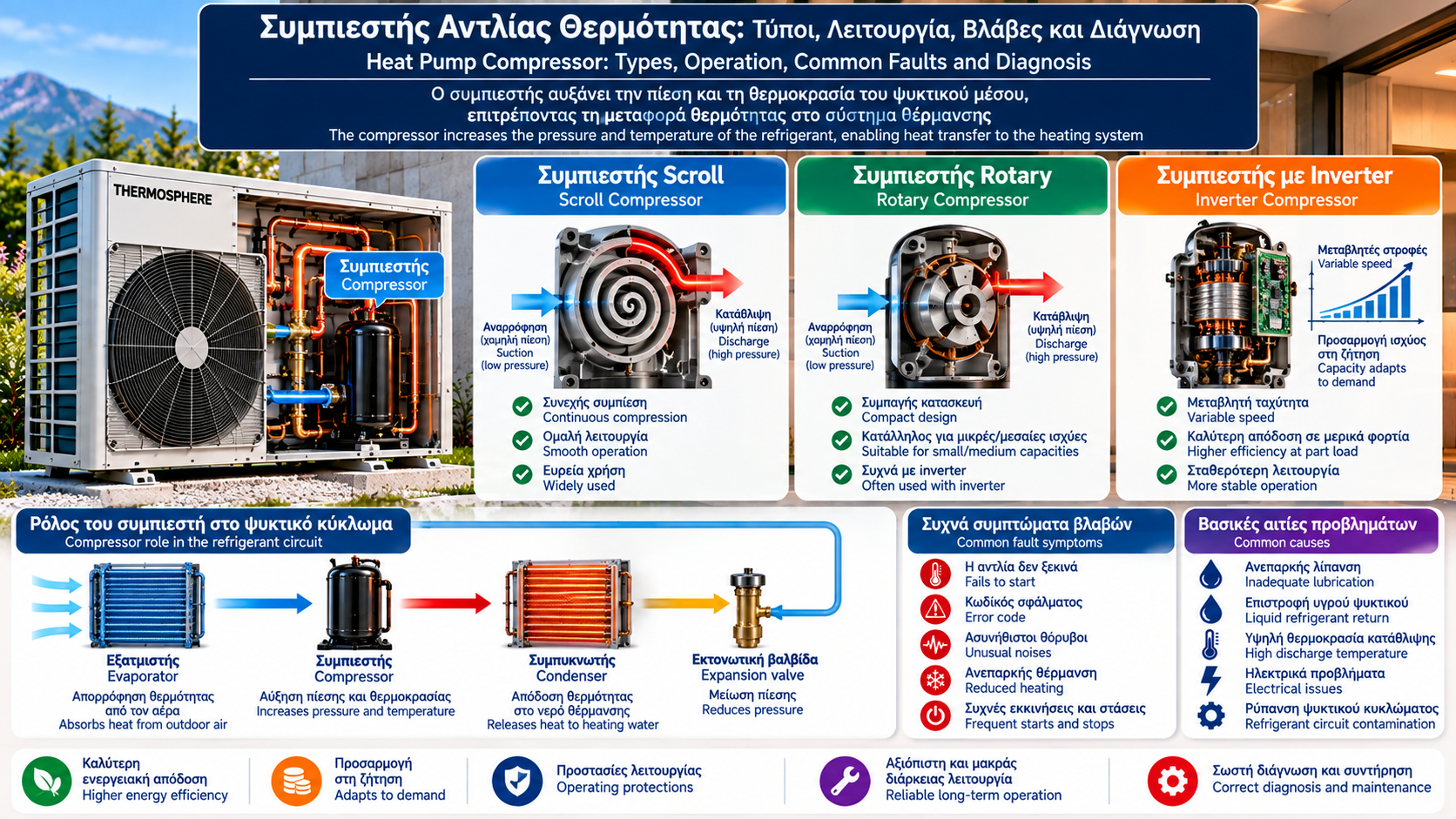
Heat Pump Compressor: Types, Operation, Common Faults and Diagnosis
The compressor is one of the most important components in a heat pump’s refrigeration circuit. Its operation directly affects the system’s ability to transfer heat, its energy efficiency and its reliability.
A compressor fault can lead to reduced heating performance, repeated shutdowns or complete failure to start.
However, not every performance problem or unusual noise indicates compressor failure. Proper diagnosis must consider the refrigeration circuit, electrical system and hydraulic installation.
1. What Is a Heat Pump Compressor?
The compressor draws in refrigerant vapour at relatively low pressure and compresses it to a higher pressure.
During compression, the refrigerant vapour temperature also increases.
This creates the conditions required for the refrigerant to release heat in the condenser.
The compressor does not heat the system water directly. It drives the refrigeration cycle that transfers heat from the source to the heating circuit.
2. How Does It Work in the Refrigeration Cycle?
In an air-to-water heat pump operating in heating mode, the main stages are:
1. Evaporation: The refrigerant absorbs heat from outdoor air in the evaporator and vaporises.
2. Compression: The compressor raises the pressure and temperature of the refrigerant vapour.
3. Condensation: The refrigerant releases heat to the heating water and condenses.
4. Expansion: The expansion device reduces refrigerant pressure so the cycle can repeat.
The compressor consumes electrical energy to perform compression work.
3. Main Types of Heat Pump Compressors
Scroll Compressors
A scroll compressor uses two spiral-shaped elements: one stationary and one moving in an orbital motion.
Refrigerant vapour is trapped in chambers that progressively decrease in volume.
Scroll compressors are widely used in heat pumps and other refrigeration applications.
Advantages include:
A relatively continuous compression process.
Smooth operation.
Suitability for many heating applications.
Availability across different capacity ranges.
Rotary Compressors
Rotary compressors use rotating mechanical elements to compress refrigerant vapour.
They are commonly found in smaller and medium-sized applications.
Different configurations exist, including single-rotary and twin-rotary designs.
Advantages include:
Compact construction.
Compatibility with variable-speed operation in suitable designs.
Suitability for selected small and medium-capacity systems.
Other Compressor Technologies
Other compressor designs may be used in specialised applications, depending on system capacity and operating requirements.
No mechanical compressor type is universally superior in every application.
4. What Is an Inverter Compressor?
The term inverter does not describe a separate mechanical compression principle.
It primarily refers to electronic control of motor speed through a variable-frequency drive or similar power electronics.
A scroll or rotary compressor may use inverter control when designed for variable-speed operation.
Changing compressor speed allows the heat pump to adjust its heating capacity to match demand.
Benefits of Variable-Speed Control
Better adaptation to part-load conditions.
Reduced unnecessary starts and stops when operating within the modulation range.
Potential improvements in seasonal efficiency.
More stable temperature control.
Inverter technology alone does not guarantee low electricity consumption. Correct sizing and control settings remain essential.
5. How Does the Compressor Affect COP?
COP is the ratio of useful heating output to electrical input under specified operating conditions.
Compressor efficiency is important, but it is not the only factor.
COP also depends on:
Outdoor temperature.
Heating-water supply temperature.
Heat exchanger design.
Pressure losses.
Fan operation.
Circulation pumps.
Refrigeration circuit controls.
A larger required temperature lift generally increases the work required from the compressor.
6. Symptoms That May Indicate a Problem
Possible symptoms include:
The heat pump fails to start.
A compressor-related or inverter fault appears.
Repeated shutdowns occur.
Heating performance is inadequate.
Unusual metallic or pronounced mechanical noises develop.
Electrical protection devices trip.
Abnormal operating temperatures or pressures are recorded.
These symptoms do not confirm compressor failure.
Other components and installation problems can produce similar behaviour.
7. Common Causes of Compressor Problems
Inadequate Lubrication
The compressor requires appropriate lubrication to protect its moving parts.
Oil return problems or unsuitable operating conditions can accelerate wear.
Liquid Refrigerant Return
Significant liquid refrigerant entering the compressor can cause mechanical stress or lubrication problems.
Excessive Discharge Temperature
High discharge temperatures may result from excessive compression ratios, inadequate compressor cooling or other system faults.
Electrical Problems
Power supply faults, inverter electronics failures, motor problems or wiring defects can prevent starting or normal operation.
Refrigeration Circuit Contamination
Moisture, foreign particles and degradation products can damage components and lubricants.
8. Why Does the Compressor Start and Stop Frequently?
Frequent starts and stops, known as short cycling, may result from:
Heat pump oversizing.
Insufficient system water volume.
Restricted water flow.
Incorrect control settings.
Frequently closing heating zones.
Limited minimum capacity modulation.
Short cycling does not necessarily indicate mechanical compressor failure.
Diagnosis should include the heat pump and the heating-water circuit.
9. How Is Compressor Diagnosis Performed?
Diagnosis should be carried out by a suitably qualified technician following the specific manufacturer’s service procedures.
It may include:
Reviewing stored fault codes.
Checking electrical supply conditions.
Evaluating inverter electronics.
Testing relevant sensors.
Assessing operating temperatures.
Checking refrigerant pressures where specified.
Inspecting fan and heat exchanger operation.
Checking heating-water flow.
Verifying safety controls and operating commands.
Refrigerant pressure testing and electrical measurements must not be attempted by unqualified individuals.
10. What Can the Owner Check?
The owner should perform only non-invasive checks permitted by the equipment manual.
Examples include:
Recording the displayed error code.
Noting when the problem occurs.
Checking operating information on the display.
Looking for visible airflow obstructions.
Reviewing normal user-accessible settings.
Electrical and refrigerant compartments must not be opened, and safety protections must never be bypassed.
11. When Does a Compressor Need Replacement?
Replacement may be considered when a serious electrical or mechanical failure has been confirmed and repair is not technically or economically reasonable.
Before deciding, assess:
Equipment age.
Spare-part availability.
Labour costs.
Condition of the remaining refrigeration circuit.
Root cause of the original failure.
Warranty coverage.
Cost of replacing the entire heat pump.
Replacing the compressor without correcting the underlying cause may lead to another failure.
12. How Is the Compressor Protected?
Modern heat pumps may include:
Discharge temperature monitoring.
Refrigerant pressure protection.
Overcurrent protection.
Electrical supply monitoring.
Minimum restart intervals.
Protection against operation outside permitted limits.
Available protections vary by model.
Bypassing them can cause serious damage.
13. Maintenance and Prevention
The compressor in a hermetically sealed heat pump generally does not require routine opening or internal maintenance.
Prevention focuses on maintaining proper operation of the complete system.
Important measures include:
Keeping heat exchangers clean.
Maintaining unobstructed airflow.
Ensuring adequate water flow.
Using appropriate weather compensation settings.
Investigating unusual noises.
Addressing fault codes promptly.
Following the manufacturer’s maintenance schedule.
14. Frequently Asked Questions
Is a Scroll Compressor Better Than a Rotary Compressor?
Neither is universally better. Suitability depends on capacity, refrigerant, operating range and overall equipment design.
Is an Inverter Compressor a Different Mechanical Type?
Not necessarily. Inverter describes variable-speed electronic control.
Why Does My Compressor Make Noise?
Some operating noise is normal. New, unusually loud or abnormal noise should be investigated.
Can the Fan Run While the Compressor Is Off?
Yes, depending on the operating phase, control strategy or possible fault condition.
How Long Does a Heat Pump Compressor Last?
There is no guaranteed lifespan. Service life depends on design, operating conditions and maintenance.
Is Replacing Only the Compressor Worthwhile?
It depends on equipment age, failure severity and total repair costs.
Conclusion
The compressor plays a central role in heat pump operation and efficiency.
Scroll and rotary technologies serve different applications, while inverter control allows variable-speed operation in compatible designs.
Reliable diagnosis requires assessing the refrigeration circuit, electronics and hydraulic installation together to identify the actual cause of the problem.
Technical References and Further Reading
ASHRAE Handbook — Refrigeration.
EN 378 — Refrigerating Systems and Heat Pumps: Safety and Environmental Requirements.
Official heat pump installation and service manuals.
Compressor technical documentation from manufacturers such as Copeland and Danfoss.
Thermosphere.gr — Technical knowledge for heating and building systems.