
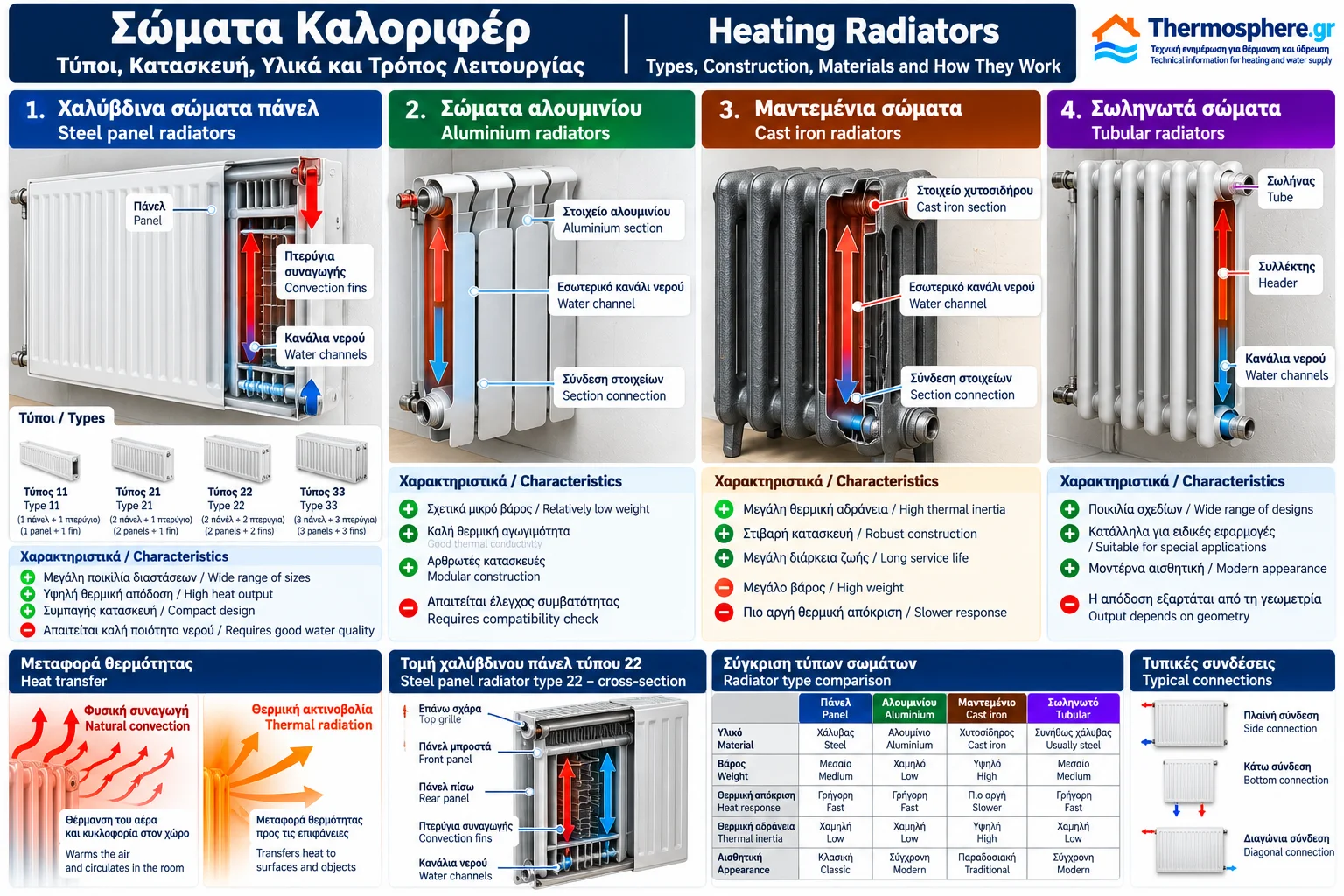
Heating Radiators: Types, Construction, Materials and How They Work
Heating radiators are among the most widely used heat emitters in central and individual hydronic heating systems. Their main purpose is to transfer thermal energy from circulating hot water into an indoor space.
Although their external construction may appear simple, radiator performance depends on geometry, material, heat transfer surface, water temperature, flow rate and installation conditions.
Common radiator types include steel panel radiators, aluminium sectional radiators, cast iron radiators and tubular radiators.
Selecting the correct radiator requires consideration of the building's heating requirements and system operating conditions, rather than appearance alone.
1. What Is a Heating Radiator?
A heating radiator is a water-to-air heat exchanger.
Hot water enters the radiator, transfers thermal energy to its metal surfaces and returns to the heating circuit at a lower temperature.
Heat is transferred to the room through two main mechanisms:
Natural convection.
Thermal radiation.
The relative contribution of each mechanism depends on radiator design and operating conditions.
2. How Does a Heating Radiator Work?
The process can be described in five stages.
Stage 1 — Heat Generation
A boiler, heat pump or another suitable heat source heats the water.
Stage 2 — Circulation
A circulation pump moves the water through the heating network.
Stage 3 — Heat Transfer
Water flows through the radiator's internal channels and heats the metal surfaces.
Stage 4 — Room Heating
The radiator transfers heat to the surrounding air and nearby surfaces.
Stage 5 — Water Return
The cooler water returns to the heat source for reheating.
Most modern hydronic heating systems use a closed water circuit.
3. Natural Convection and Thermal Radiation
Natural Convection
Air near the warm radiator surface heats up, becomes less dense and rises.
Cooler air moves toward the lower part of the radiator and is heated in turn.
This creates natural air circulation within the room.
Thermal Radiation
The radiator emits thermal radiation toward surrounding surfaces and objects.
Radiative heat transfer does not require direct contact with the surrounding air.
Which Mechanism Is More Important?
The relative contribution depends on radiator geometry, surface temperatures and installation conditions.
Panel radiators equipped with convection fins are designed to increase convective heat transfer.
4. Steel Panel Radiators
Steel panel radiators are among the most common hydronic heat emitters.
They are generally manufactured from formed steel sheets welded together to create internal water channels.
Depending on the model, they may contain one or more water-filled panels and additional convection fins.
Advantages
Wide range of dimensions.
Different available heat outputs.
Relatively compact construction.
Suitable for many residential applications.
Availability of larger models for lower-temperature heating systems.
Limitations
Appropriate water quality is required.
Corrosion can become a problem under unsuitable operating conditions.
Heat output depends strongly on operating temperatures.
5. Steel Panel Radiator Types: 11, 21, 22 and 33
Common panel radiator designations describe their construction.
In the typical numbering system:
The first digit indicates the number of heating panels.
The second digit indicates the number of convection fin rows.
Type 11
One panel and one convection fin row.
Type 21
Two panels and one convection fin row.
Type 22
Two panels and two convection fin rows.
Type 33
Three panels and three convection fin rows.
For the same basic height and length, additional panels and fins generally allow higher heat output, while increasing radiator depth.
Actual performance must be confirmed using the manufacturer's data.
6. Internal Construction of a Panel Radiator
A typical steel panel radiator may include:
Front heating panel.
Rear or additional heating panels.
Internal water channels.
Convection fins.
Side covers.
Top grille.
Connection ports.
Air vent.
Blanking plug.
Mounting brackets.
The convection fins are thermally connected to the panels to increase the heat transfer area.
Internal construction varies between manufacturers.
7. Aluminium Radiators
Aluminium radiators are manufactured from aluminium alloys.
Many models consist of individual sections connected together.
Other models use one-piece construction.
Advantages
Relatively low weight.
Good thermal conductivity of the material.
Availability of modular designs.
Different styles and dimensions.
Technical Considerations
The high thermal conductivity of aluminium does not automatically mean that every aluminium radiator delivers more heat than a steel radiator.
Performance depends on overall design, surface area and operating conditions.
Water chemistry and compatibility with other system materials must follow manufacturer requirements.
8. Cast Iron Radiators
Cast iron radiators are manufactured from cast iron.
They often consist of individual connected sections.
Many traditional designs have substantial mass and relatively high water content.
Advantages
Robust construction.
High thermal inertia.
Traditional appearance.
Potentially long service life with suitable maintenance.
Limitations
High weight.
More demanding handling and installation.
Slower thermal response in many designs.
High thermal inertia means the radiator may continue releasing heat after the hot water supply stops, but it also takes longer to heat up.
9. Tubular Radiators
Tubular radiators consist of metal tubes connected to headers.
They may have vertical or horizontal arrangements.
They are frequently selected where appearance is an important consideration.
Heat output depends on:
Tube diameter.
Number of sections.
Height and width.
Total surface area.
Operating temperatures.
Not all tubular radiators should be classified as bathroom towel radiators, although the construction principles may be similar.
10. Towel Radiators
Towel radiators are specialised heat emitters commonly installed in bathrooms.
They may connect to a hydronic heating system.
Electric and dual-fuel models are also available.
Selection should consider:
Bathroom heat losses.
Available dimensions.
Required heat output.
Moisture conditions.
Appropriate electrical protection where electric heating is provided.
A towel radiator does not necessarily provide enough output to meet the entire heating requirement of a bathroom.
11. Radiator Construction Materials
The main materials include:
Steel
Widely used in panel and tubular radiators.
Aluminium
Used in sectional and one-piece radiator designs.
Cast Iron
Common in traditional and decorative radiators.
Other Materials
Specialised applications may use other metals or material combinations.
Material selection should consider mechanical strength, corrosion resistance, thermal behaviour, weight and heating water compatibility.
12. What Is Radiator Heat Output?
Heat output describes the rate at which a radiator transfers thermal energy to a room.
It is commonly expressed in watts (W).
For example, a radiator rated at 1,500 W delivers that output only under the specified rating conditions.
It does not necessarily produce 1,500 W at every water temperature.
Actual heat output depends on:
Supply water temperature.
Return water temperature.
Room temperature.
Water flow rate.
Radiator geometry.
Installation conditions.
13. What Does Radiator ΔT Mean?
Radiator ΔT describes the temperature difference between the heating water and the room air.
For common approximate calculations, the arithmetic mean water temperature is used:
ΔT = [(T_supply + T_return) / 2] − T_room
For example:
Supply temperature: 75°C.
Return temperature: 65°C.
Room temperature: 20°C.
The arithmetic mean water temperature is 70°C.
Therefore:
ΔT = 70 − 20 = 50 K.
These are commonly used ΔT50 nominal rating conditions.
For more accurate performance assessment, the applicable standard method and manufacturer data should be used, particularly when the supply-to-return temperature difference is large.
14. Radiators and Low-Temperature Heating
A radiator that delivers a specified output at high water temperatures will generally deliver less heat when supply temperature decreases.
This is particularly important for heat pump installations and condensing boiler systems.
For example, a radiator selected for 75/65/20°C operation may not cover the same room heat losses when operating at 45/40/20°C.
Lower-temperature heating may require:
Greater radiator surface area.
Increased radiator height or length.
A different panel configuration.
Additional radiators.
Another suitable heat emission solution.
Correct selection requires a heat output calculation.
15. Radiator Dimensions
The main geometric characteristics are:
Height.
Length.
Depth.
Connection spacing.
Connection position.
Two radiators with the same height and length may have different heat outputs due to differences in depth or internal construction.
For example, a Type 22 panel radiator differs from a Type 11 radiator even when their basic external dimensions are identical.
16. Radiator Installation Position
Radiator placement affects heat distribution.
Radiators are often installed beneath windows or near external walls.
This arrangement can help counteract downward cold air movement near glazing.
However, the most suitable position depends on room layout and building characteristics.
Manufacturer installation clearances must be respected.
17. Why Should Radiators Not Be Covered?
Furniture, restrictive covers and heavy curtains can reduce heat transfer.
When natural airflow is obstructed, the radiator's useful heat output to the room may decrease.
Obstructions may also interfere with the temperature measurement of a thermostatic radiator valve head.
Adequate clearance around the radiator is therefore important.
18. Operating Pressure and Mechanical Strength
Every radiator has defined operating limits.
Important characteristics include:
Maximum allowable pressure.
Maximum allowable temperature.
Test conditions.
Water quality requirements.
Permitted values vary by manufacturer and model.
A radiator must not be operated beyond its specified pressure or temperature limits.
19. Corrosion and Heating Water Quality
Corrosion is an important factor affecting radiator reliability.
It may be influenced by:
Dissolved oxygen.
Frequent water replenishment.
Unsuitable pH.
Material incompatibility.
Inappropriate chemical additives.
Poor heating water quality.
Acceptable water characteristics depend on the materials and manufacturer requirements.
Proper water management protects both radiators and other system components.
20. Which Radiator Type Is Best?
There is no single radiator type that is best for every heating installation.
Steel panel radiators offer a wide range of dimensions and outputs.
Aluminium radiators provide relatively low weight and different design options.
Cast iron radiators often provide greater thermal inertia.
Tubular radiators offer distinctive design possibilities.
Final selection should consider:
Room heat losses.
Operating water temperatures.
Available installation space.
Hydraulic connections.
Operating pressure.
Water quality.
Cost and maintenance.
Appearance.
21. Comparison of Main Radiator Types
Radiator Type | Main Material | Key Characteristic |
|---|---|---|
Panel radiator | Steel | Compact design with optional convection fins |
Aluminium radiator | Aluminium alloy | Relatively low weight |
Cast iron radiator | Cast iron | High thermal inertia in many designs |
Tubular radiator | Usually steel | Wide range of shapes |
Towel radiator | Usually steel | Specialised bathroom application |
22. What Should Be Checked Before Purchasing?
Before selecting a radiator, verify:
Required heat output.
Rating conditions for declared output.
Actual system operating temperatures.
Available dimensions.
Connection type and position.
Compatibility with the heating installation.
Maximum operating pressure and temperature.
Maintenance requirements.
Documented thermal performance.
For radiators within the scope of European standard EN 442, declared heat outputs should be compared using the relevant standardised rating conditions.
Conclusion
Heating radiators are heat exchangers that transfer energy from circulating heating water to indoor spaces through convection and radiation.
Construction, materials, geometry and operating temperatures have a major influence on their thermal performance.
The correct radiator is not necessarily the largest or most expensive model. It is the radiator that meets the calculated heating requirements under the actual operating conditions of the installation.
This article is intended for technical information. Radiator sizing and installation should be based on appropriate engineering calculations and manufacturer specifications.
Thermosphere.gr — Technical information for heating and water supply.