
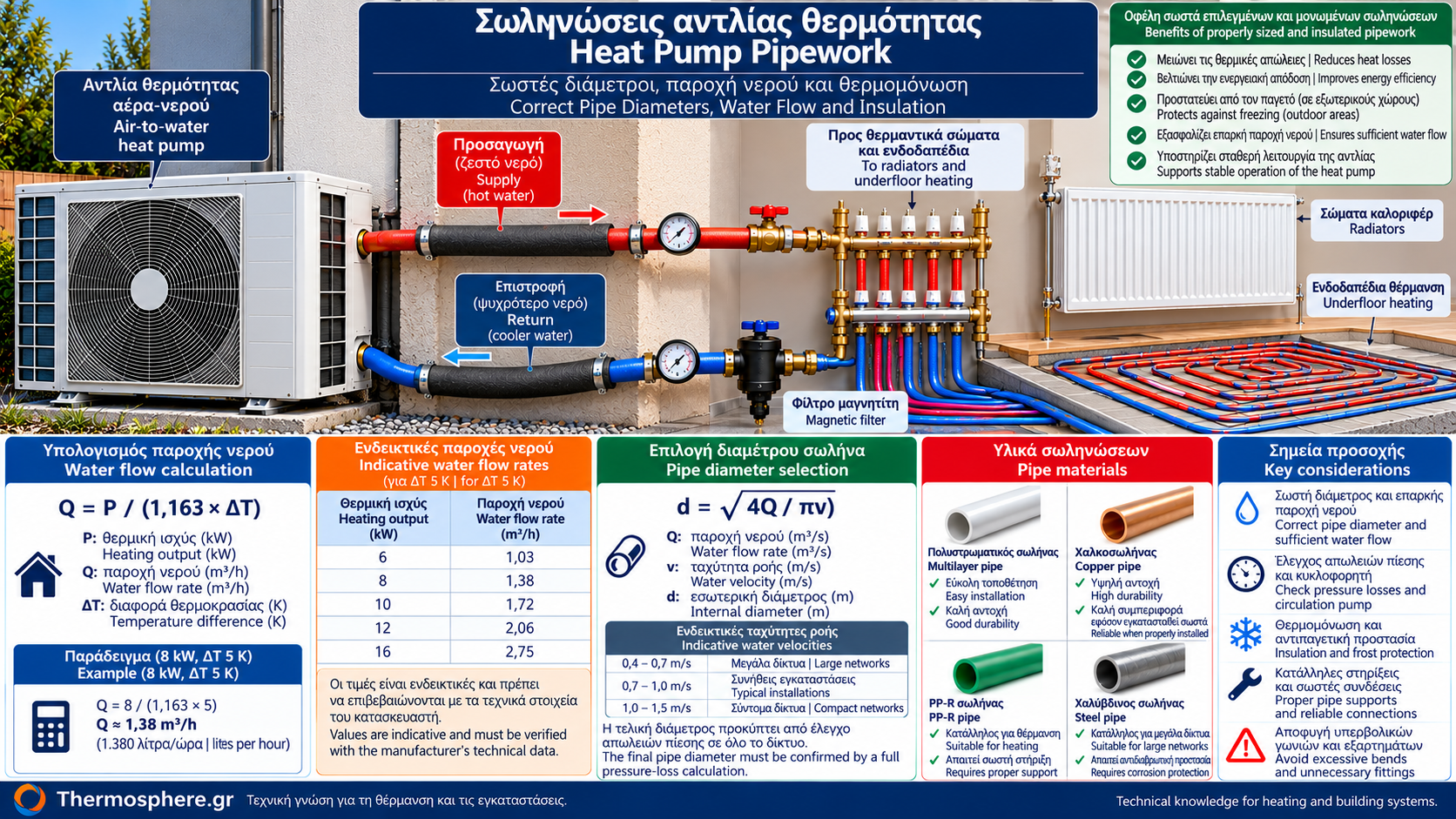
Heat Pump Pipework: Correct Pipe Diameters, Water Flow and Insulation
Correct pipe sizing is essential for the efficient and reliable operation of an air-to-water heat pump.
Even a modern heat pump with a high coefficient of performance can experience operating problems when pipe diameters are incorrect, insulation is inadequate or hydraulic resistance is excessive.
Undersized pipes can restrict water flow and increase pressure losses. Conversely, unnecessarily large pipes may increase installation costs without providing a corresponding operational benefit.
Pipework installed outdoors or in unheated spaces also requires careful consideration of thermal insulation and frost protection.
This guide explains how to calculate required water flow, estimate pipe diameter and avoid common installation mistakes.
1. Why Is Correct Pipe Diameter Important?
Pipework transfers water between the heat pump and the building’s heating circuits.
The installation must maintain the water flow required by the manufacturer.
Pipe diameter affects:
Water velocity.
Pressure losses.
Circulation pump requirements.
Hydraulic noise.
The ability to transfer the required heating output.
Correct diameter depends on more than the heat pump’s nominal capacity.
Pipe length, material, bends, valves and pump characteristics must also be considered.
2. How Is Required Water Flow Calculated?
For water, the approximate relationship is:
P = 1.163 × Q × ΔT
Where:
P is transferred thermal power in kW.
Q is water flow in m³/h.
ΔT is the supply-to-return temperature difference in K.
Therefore:
Q = P / (1.163 × ΔT)
The coefficient 1.163 approximates the volumetric heat capacity of water at typical operating temperatures.
Water-glycol mixtures require adjustment based on the actual thermophysical properties of the fluid.
3. Example: An 8 kW Heat Pump
Consider a heat pump transferring 8 kW of heat.
For a 5 K temperature difference:
Q = 8 / (1.163 × 5)
Q ≈ 1.38 m³/h
This is approximately 1,380 litres per hour.
The result applies to the stated calculation and is not a universal required flow rate for every 8 kW heat pump.
The final value must agree with the manufacturer’s technical specifications.
4. Water Flow Examples for Different Heating Outputs
For an illustrative 5 K temperature difference:
Heating output | Calculated flow |
6 kW | 1.03 m³/h |
8 kW | 1.38 m³/h |
10 kW | 1.72 m³/h |
12 kW | 2.06 m³/h |
16 kW | 2.75 m³/h |
These values describe heat transfer with a 5 K temperature difference.
They are not universal manufacturer flow requirements.
5. How Does ΔT Affect Water Flow?
For the same heating output, a smaller supply-to-return temperature difference requires a higher water flow rate.
For example, at 10 kW:
ΔT | Flow |
3 K | 2.87 m³/h |
5 K | 1.72 m³/h |
7 K | 1.23 m³/h |
10 K | 0.86 m³/h |
ΔT should not be selected arbitrarily simply to reduce pipe diameter.
It must be compatible with the heat pump, heat emitters and control strategy.
6. How Are Water Flow and Pipe Diameter Related?
Water flow, internal pipe area and velocity are connected by:
Q = A × v
Where:
Q is volumetric flow in m³/s.
A is internal cross-sectional area in m².
v is average water velocity in m/s.
For a circular pipe:
A = π × d² / 4
Therefore:
d = √(4Q / πv)
This provides an initial estimate of the required internal diameter.
Final selection requires pressure-loss calculations.
7. Example: Calculating Internal Pipe Diameter
Assume:
Q = 1.72 m³/h
Convert to m³/s:
1.72 / 3,600 ≈ 0.000478 m³/s
For an illustrative design velocity of 0.8 m/s:
d = √[(4 × 0.000478) / (3.1416 × 0.8)]
d ≈ 0.0276 m = 27.6 mm
The estimated internal diameter is approximately 28 mm.
This does not mean that a commercially designated 28 mm pipe must automatically be selected.
The actual internal diameter of the chosen pipe product must be checked.
The 0.8 m/s velocity is an illustrative design assumption, not a universal limit.
8. Why Is Nominal Diameter Different From Internal Diameter?
Pipes are available in different materials and wall thicknesses.
Two pipes with the same external diameter may have different internal diameters.
Differences result from:
Material.
Wall thickness.
Pressure rating.
Product series.
Sizing should therefore use the actual dimensional data provided by the pipe manufacturer.
9. Which Pipe Materials Are Used?
Several materials are commonly used in heat pump hydraulic installations.
Copper
Copper is widely used in heating systems.
It offers mechanical durability and reliable performance under suitable conditions.
Correct fittings, joints and corrosion protection are important.
Multilayer Pipe
Multilayer piping is common in modern installations.
It offers installation flexibility and defined thermal expansion characteristics.
Suitability depends on operating class, temperature, pressure and the connection system.
PP-R
PP-R is also used in hydraulic networks.
Selection must account for operating temperature, pressure, thermal expansion and appropriate support.
Steel
Steel pipes may be used in suitable installations, particularly larger networks.
Corrosion protection and compatibility with other materials must be considered.
No single material is ideal for every application.
10. What Are Pressure Losses?
As water flows through pipes, friction creates hydraulic resistance.
Additional losses arise from:
Elbows.
Tees.
Valves.
Filters.
Heat exchangers.
Manifolds.
Other hydraulic components.
Total pressure losses must remain within the circulation pump’s capability at the required flow rate.
Pipe sizing is incomplete if it considers velocity alone without assessing the complete hydraulic resistance.
11. Why Can Undersized Pipes Cause Problems?
At a fixed flow rate, a smaller internal diameter results in higher water velocity.
This generally increases pressure losses.
Possible consequences include:
Insufficient actual water flow.
Higher circulation pump energy consumption.
Flow noise.
Difficulty maintaining required operating conditions.
Low-flow protection faults.
However, a small pipe diameter is not automatically incorrect.
Suitability depends on flow rate and the complete network design.
12. Why Are Oversized Pipes Not Always Better?
Increasing pipe diameter generally reduces pressure losses at a given flow.
However, it may increase:
Material costs.
Space requirements.
Insulation costs.
Water volume.
Installation complexity.
Selection should balance hydraulic performance, energy consumption and cost.
13. How Does Pipe Length Affect Sizing?
Longer pipes generally produce greater friction losses when other conditions remain unchanged.
A heat pump installed close to the plant room may therefore have different hydraulic requirements from a unit located much farther away.
The calculation must include the total hydraulic path, including both supply and return pipework.
The straight-line distance between the outdoor unit and the building is not sufficient.
14. How Should Pipe Insulation Be Selected?
Pipes carrying heated water can lose energy to their surroundings.
Heat losses depend on:
Water temperature.
Ambient temperature.
Pipe diameter.
Insulation thickness.
Insulation thermal conductivity.
Installation quality.
Insulation must comply with applicable requirements, manufacturer instructions and installation conditions.
15. Why Does Outdoor Pipework Need Special Protection?
Outdoor pipes are exposed to:
Low temperatures.
Solar radiation.
Rain.
Moisture.
Mechanical damage.
Insulation must be suitably protected against ultraviolet radiation and weather exposure.
Thermal insulation alone does not guarantee frost protection when circulation stops for an extended period.
16. Insulation Versus Frost Protection
Thermal insulation reduces the rate of heat loss.
It does not generate heat and cannot indefinitely prevent stagnant water from freezing.
Depending on the unit and system design, frost protection may involve:
Suitable water circulation.
Manufacturer-defined frost protection functions.
Approved antifreeze solution.
Specific frost protection components.
Appropriate outdoor pipework design.
The solution depends on whether the system uses a monobloc or split configuration, its construction and manufacturer instructions.
17. What Should Be Considered at Pipe Connections?
Connections must be compatible with the pipe material and operating conditions.
Important considerations include:
Correct fitting selection.
Material compatibility.
Avoidance of mechanical stress.
Suitable pipe support.
Maintenance access.
Watertight joints.
Thermal expansion allowance.
Incorrect connections can cause leaks or premature deterioration.
18. Why Is Pipe Support Important?
Pipes expand and contract as temperatures change.
The amount of thermal expansion depends on the material.
Without suitable support and movement allowance, problems may include:
Deformation.
Noise.
Joint stress.
Vibration transmission.
Insulation damage.
Support spacing and installation details should follow the piping system manufacturer’s instructions.
19. How Do Filters and Valves Affect Water Flow?
Water flow depends on more than pipe diameter.
A blocked filter can significantly increase hydraulic resistance.
Similarly, a partially closed valve or incorrectly selected component can restrict circulation.
Low-flow troubleshooting must therefore assess the entire hydraulic circuit.
Replacing pipes without first checking other possible causes is not always appropriate.
20. Example: A 12 kW Heat Pump Located Away From the Building
Consider an installation with:
Nominal heat pump capacity: 12 kW.
Design transferred heating output: 12 kW.
ΔT: 5 K.
Distance from unit to connection point: 15 m.
Total supply-and-return pipe length: 30 m.
Calculated flow:
Q = 12 / (1.163 × 5)
Q ≈ 2.06 m³/h
Final pipe sizing requires:
Verification of actual internal diameter.
Water velocity calculation.
Friction pressure-loss calculation.
Inclusion of local resistance.
Circulation pump head verification.
Suitable insulation and frost protection.
A specific pipe diameter cannot be selected reliably from 12 kW capacity and 15 metres of distance alone.
21. Common Installation Mistakes
Mistake 1: Selecting pipes based only on nominal kW.
This ignores actual flow and hydraulic resistance.
Mistake 2: Confusing external and internal diameter.
This can produce incorrect velocity estimates.
Mistake 3: Ignoring return pipe length.
This underestimates pressure losses.
Mistake 4: Insufficient outdoor insulation.
This increases heat losses.
Mistake 5: Treating insulation as complete frost protection.
This creates freezing risks under adverse conditions.
Mistake 6: Excessive bends and fittings.
This increases local resistance.
Mistake 7: Inadequate pipe supports.
This can cause noise and mechanical stress.
Mistake 8: Ignoring circulation pump characteristics.
Required flow must be achieved against the actual hydraulic resistance.
22. What Should Be Checked During Commissioning?
Before normal operation, verify:
Pipework compliance with the design.
Material suitability.
Circuit tightness.
Correct filling and air removal.
Required water flow.
Supply and return temperatures.
Valve operation.
Proper insulation.
Frost protection.
Maintenance access.
Tests should follow manufacturer specifications and applicable regulations.
23. Frequently Asked Questions
What Pipe Diameter Does a 12 kW Heat Pump Need?
There is no universal diameter. Flow, velocity, pipe length and pressure losses must be calculated.
Can Multilayer Pipe Be Used?
Yes, if the selected piping system is suitable for the operating temperatures, pressures and installation conditions.
Is Copper Better Than PP-R?
There is no universal answer. Each material has different characteristics and installation requirements.
What Happens if Pipes Are Too Small?
Pressure losses may increase and actual water flow may be restricted.
Do Pipes Inside the House Need Insulation?
Insulation requirements depend on location, temperatures, energy efficiency requirements and applicable regulations.
Does Insulation Completely Prevent Freezing?
No. It reduces heat loss but cannot guarantee protection during prolonged shutdown.
Why Do Pipes Make Noise?
Possible causes include high flow velocity, trapped air, hydraulic resistance or inadequate support.
Must All Existing Pipes Be Replaced When Installing a Heat Pump?
Not necessarily. The existing network should first be assessed for flow, pressure losses and overall suitability.
Conclusion
Correct pipe sizing is a fundamental part of an efficient heat pump installation.
Selection must consider required water flow, actual internal diameter, pressure losses and circulation pump characteristics.
Suitable thermal insulation, proper support and frost protection also contribute to long-term reliability.
Correct pipework is not simply pipework that connects to the heat pump. It must deliver the required flow with acceptable hydraulic losses and safe operating conditions.
The calculations in this article are illustrative and do not replace hydraulic design or manufacturer instructions.
Thermosphere.gr — Technical knowledge for heating and building systems.