
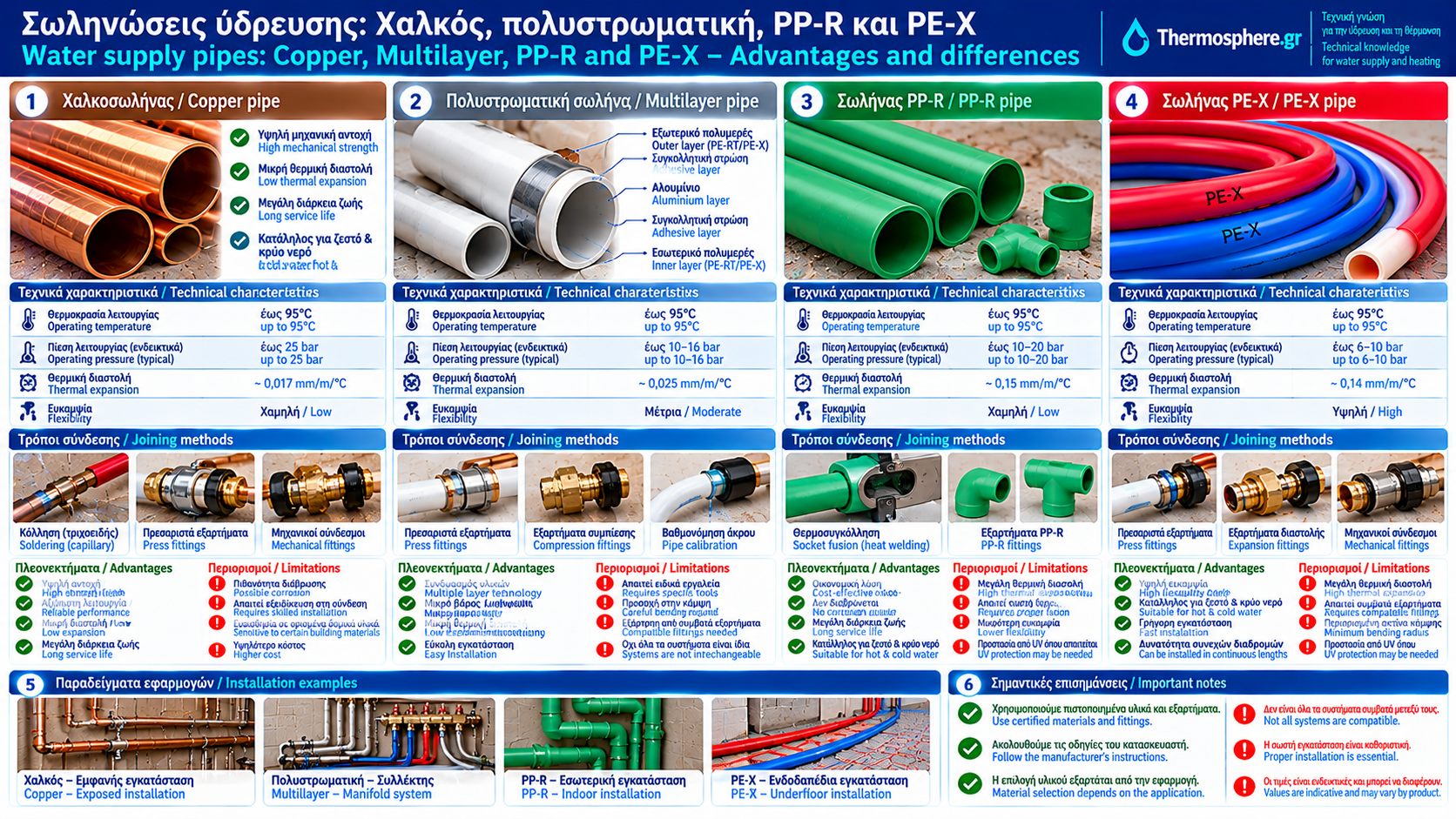
Water Supply Pipes Compared: Copper, Multilayer, PP-R and PE-X
Choosing the right piping system is one of the most important decisions when constructing or renovating a water supply installation.
Water pipes transport cold and hot water to fixtures and must withstand the expected operating pressures, temperatures and mechanical conditions.
Modern plumbing systems use several materials, particularly copper, polypropylene (PP-R), crosslinked polyethylene (PE-X) and multilayer piping.
No single material is ideal for every application. Suitability depends on the intended use, water quality, system specifications and installation method.
This Thermosphere.gr technical guide compares these piping materials and explains the key factors to consider before choosing.
1. What Requirements Must Water Supply Pipes Meet?
A piping system must be suitable for:
Expected operating pressure.
Water temperature.
Drinking water use where applicable.
Installation conditions.
Mechanical and thermal loads.
Compatible joining components.
Assessment must include more than the pipe itself.
Pipes, fittings and joining tools form a complete system.
An incompatible fitting can compromise even a high-quality pipe.
2. Copper Water Supply Pipes
Copper has been used in water supply and heating installations for many decades.
It is a metallic material offering good mechanical strength and suitability for appropriately designed hot and cold water systems.
Advantages
High mechanical strength.
Good temperature resistance within specifications.
Several available joining methods.
Relatively low thermal expansion compared with many plastic pipes.
Extensive industry experience.
Limitations
Corrosion may occur under unfavourable water or installation conditions.
Protection may be required against certain building materials and environments.
Joining requires appropriate skills.
Improper combinations of dissimilar metals may create electrochemical problems.
Copper should not be considered universally suitable regardless of water chemistry.
3. How Are Copper Pipes Joined?
Depending on the system, methods include:
Capillary joints: Using suitable soldering or brazing techniques and compatible fittings.
Press fittings: Using dedicated tools and approved pressing profiles.
Mechanical couplings: Where permitted for the application.
Proper pipe preparation and fitting compatibility are essential.
Flame-based joining requires appropriate fire safety precautions.
4. Polypropylene PP-R Pipes
PP-R is a plastic material used in suitable hot and cold water piping systems.
A key feature is joining through heat fusion using manufacturer-specified tools and fittings.
Advantages
No electrochemical corrosion of the kind associated with metal pipes.
Low weight.
Fusion-welded connections.
Wide availability of pipes and fittings.
Suitability for many water supply applications within the relevant service classes.
Limitations
Greater thermal expansion than copper in many constructions.
Correct fusion procedures are essential.
Poor fusion may reduce the internal flow area.
UV protection may be necessary.
Some PP-R systems contain reinforcement layers that reduce thermal expansion.
Product-specific data must be checked.
5. What Matters During PP-R Socket Fusion?
Connection quality depends on:
Correct cutting.
Clean joining surfaces.
Appropriate tool temperature.
Heating time.
Insertion depth.
Cooling time.
Avoiding inappropriate movement during joining.
Temperatures and times must follow manufacturer instructions.
Incorrect fusion can create weak joints or restrict flow.
6. PE-X Pipes
PE-X stands for crosslinked polyethylene.
It is used in various water distribution systems, often in flexible pipe configurations.
Manufacturing methods include PE-Xa, PE-Xb and PE-Xc.
These names refer to crosslinking processes and do not independently establish the overall quality of a piping system.
Advantages
Flexibility.
Installation in continuous runs.
Potential reduction in intermediate joints.
Suitability for approved hot and cold water applications.
Low weight.
Limitations
UV protection according to product specifications.
Thermal expansion.
Requirement for compatible fittings.
Minimum bending radius and fixing requirements.
Selection should follow the specifications of the particular PE-X system.
7. How Are PE-X Pipes Joined?
Joining methods vary between manufacturers.
They may include:
Press fittings.
Expansion fittings.
Mechanical couplings.
Other approved systems.
Not every fitting is compatible with every PE-X pipe.
Pipes with the same nominal dimension may have different wall thicknesses or joining requirements.
8. What Is a Multilayer Pipe?
A multilayer pipe contains several material layers.
A common structure is:
Polymer → Adhesive → Aluminium → Adhesive → Polymer
The exact construction depends on the product.
Common combinations include PE-X/Al/PE-X and PE-RT/Al/PE-RT.
Advantages
Good shape retention after bending.
Lower thermal expansion than many single-layer plastic pipes.
Low weight.
Suitable for organised manifold distribution.
Widely used in approved hot and cold water systems.
Limitations
Special tools and compatible fittings are required.
Pipe-end preparation is important.
Improper bending can cause damage.
Reliability depends on correct assembly.
The presence of aluminium does not mean all multilayer products have identical properties.
9. How Are Multilayer Pipes Joined?
Press fittings are commonly used.
The procedure may involve:
Cutting the pipe square.
Calibrating or preparing the pipe end where required.
Checking seals.
Inserting the fitting to the specified depth.
Pressing with an approved tool.
Inspecting the completed joint.
The pressing profile must match the fitting.
Identical outside diameters do not guarantee system compatibility.
10. Material Comparison
Feature | Copper | PP-R | PE-X | Multilayer |
Main material | Metal | Polypropylene | Crosslinked PE | Multiple layers |
Flexibility | Limited, depending on type | Low | High | Moderate to good |
Thermal expansion | Relatively low | Relatively high | Relatively high | Usually reduced |
Joining | Capillary, press, mechanical | Heat fusion | Approved mechanical systems | Usually press fittings |
Metal electrochemical corrosion | Possible under certain conditions | Not applicable | Not applicable | Depends on construction and exposed metal components |
Hot water applications | Yes, subject to specifications | Yes, by service class | Yes, by service class | Yes, by service class |
These are general characteristics, not guaranteed performance ratings for individual products.
11. Which Pipe Material Lasts Longest?
There is no universal answer that applies to all products and installations.
Service life depends on:
Temperature.
Pressure.
Water chemistry.
Product quality.
Installation quality.
Mechanical loading.
Correct fitting selection.
A suitable system installed correctly and operated within its specified limits can provide long service life.
Design-life assumptions should not be confused with guaranteed actual service life.
12. Which Material Is Best for Hot Water?
Selection depends on actual operating temperatures and the applicable service class.
For plastic and multilayer systems, the service class and associated pressure ratings are particularly important.
A pipe suitable for cold water is not automatically suitable for continuous operation at higher temperatures.
Potential temperature peaks and water heating equipment requirements must also be considered.
13. What Do PN and SDR Mean?
PN
PN is used in different piping systems as a nominal pressure designation.
It should not be interpreted without considering the relevant standard, temperature and service class.
SDR
SDR represents the ratio of outside diameter to nominal wall thickness:
SDR = outside diameter / wall thickness
For example, a pipe with an outside diameter of 25 mm and wall thickness of 2.3 mm has:
SDR ≈ 25 / 2.3 ≈ 10.9.
This value alone does not establish suitability for a particular temperature or pressure.
14. Why Does Thermal Expansion Matter?
Materials generally expand when temperature increases.
Linear thermal expansion can be estimated using:
ΔL = α × L × ΔT
Where:
ΔL is the change in length.
α is the linear thermal expansion coefficient.
L is the original length.
ΔT is the temperature change.
This is a simplified estimate for appropriate conditions.
Actual values depend on the material and pipe construction.
Failure to accommodate expansion may cause deformation, noise and stress on fittings.
15. Which Pipes Are Suitable for Concealed Installation?
Material selection alone is not enough.
Important considerations include:
Manufacturer approval for concealed use.
Mechanical protection.
Thermal expansion.
Replacement possibilities where designed.
Accessibility of fittings.
Compatibility with surrounding construction materials.
Some systems use protective conduits or sleeves.
However, a protective conduit does not automatically guarantee that the inner pipe can be replaced after construction.
16. Common Installation Mistakes
Typical errors include:
Combining incompatible fittings.
Incorrect heat fusion.
Using the wrong pressing profile.
Excessive bending.
Inadequate pipe support.
Failure to accommodate thermal expansion.
Using products outside their temperature ratings.
Missing UV protection where required.
Omitting leak testing.
Installation quality is as important as material quality.
17. How to Choose Pipes for a Renovation
Consider:
Condition of the existing system.
Required flow rate.
Operating pressure.
Water temperature.
Available pipe routes.
Concealed or exposed installation.
Future maintenance access.
Availability of compatible fittings.
Choosing solely on initial purchase price is not a sound technical approach.
18. Frequently Asked Questions
Is Multilayer Pipe Better Than PP-R?
Neither is universally better. Multilayer piping may offer advantages in flexibility and thermal expansion, while PP-R uses a different joining method. Selection depends on the installation.
Is PE-X Suitable for Hot Water?
Yes, provided the specific system is approved and rated for the intended conditions.
Can Copper Pipes Rust?
Copper does not rust like iron, but it can experience other forms of corrosion.
Can PP-R Be Connected to Copper?
Yes, using suitable transition fittings according to both systems’ specifications.
Are All Press Fittings the Same?
No. They differ in profiles, dimensions, materials and tooling requirements.
Which Material Has the Longest Service Life?
Service life depends on the specific product, operating conditions and installation quality. Material name alone is not sufficient for a reliable ranking.
Conclusion
Copper, PP-R, PE-X and multilayer pipes can all be suitable choices for water supply installations when used within their intended applications.
Their main differences involve mechanical behaviour, thermal expansion, flexibility and joining methods.
The right choice is not necessarily the most expensive or most popular material, but a suitable, compliant and compatible piping system that meets the installation requirements.
Technical References and Further Reading
EN 806: Specifications for installations inside buildings conveying water for human consumption.
EN 1057: Copper and copper alloys — Seamless, round copper tubes for water and gas in sanitary and heating applications.
EN ISO 15874: Plastics piping systems for hot and cold water installations — Polypropylene (PP).
EN ISO 15875: Plastics piping systems for hot and cold water installations — Crosslinked polyethylene (PE-X).
EN ISO 21003: Multilayer piping systems for hot and cold water installations inside buildings.
EN ISO 22391: Plastics piping systems for hot and cold water installations — Polyethylene of raised temperature resistance (PE-RT).
CEN-CENELEC: https://www.cencenelec.eu/
Product characteristics must be verified using the corresponding technical datasheets and installation instructions.
Safety note: Joining and pressure testing require appropriate tools and trained personnel. Drinking water installations must use materials and fittings suitable for their intended use.
Thermosphere.gr — Technical knowledge for water supply and heating systems.