
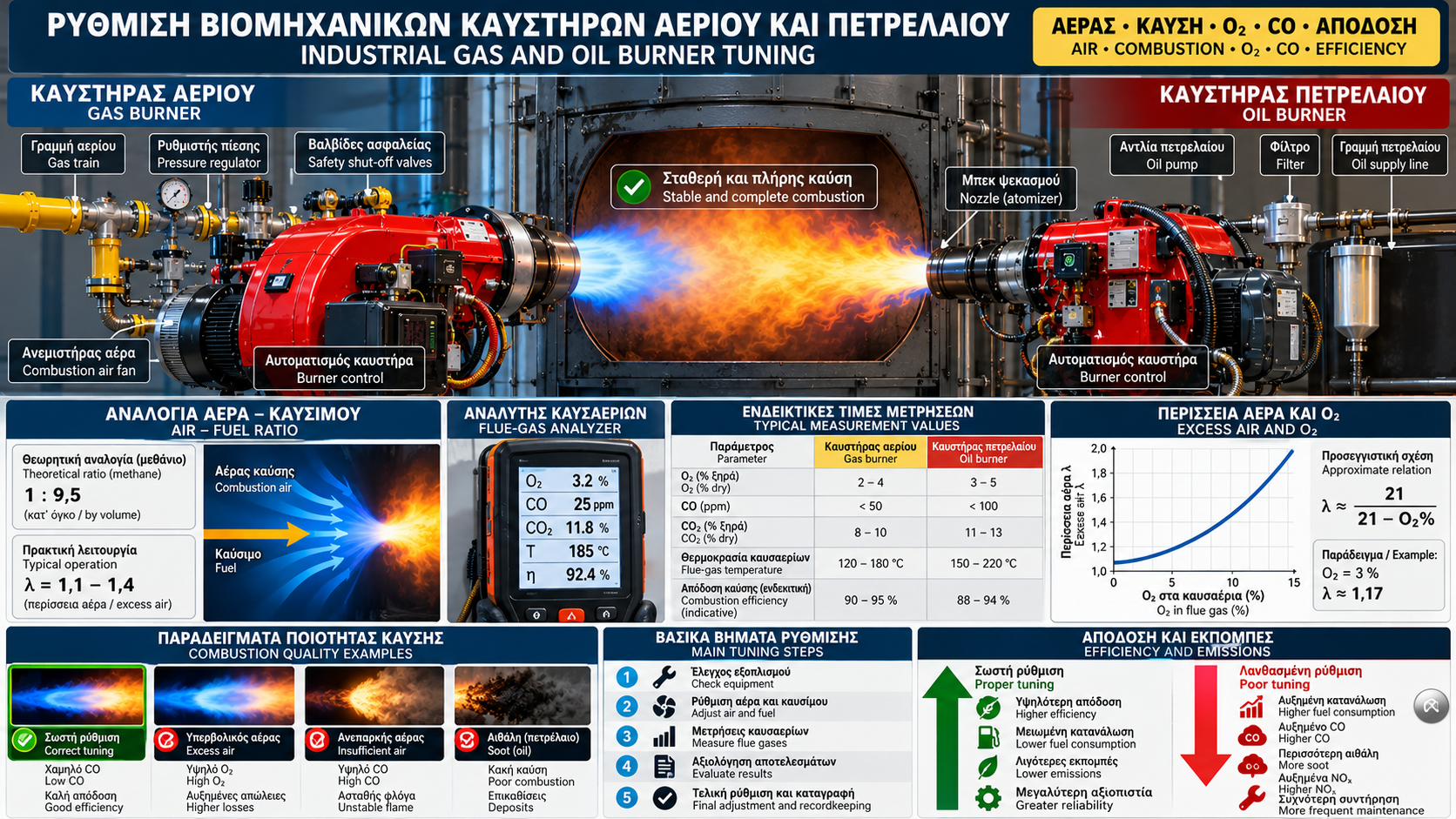
# Industrial Gas and Oil Burner Tuning: Air-Fuel Ratio, O₂, CO and Combustion Efficiency
## Introduction
Proper industrial burner tuning is essential for safe, reliable and energy-efficient operation of thermal installations.
In steam boilers, industrial hot-water boilers and thermal-oil systems, combustion quality affects fuel consumption, pollutant emissions, flame stability and thermal stress on equipment.
Gas and oil burners follow common combustion principles but differ in fuel delivery and preparation.
Tuning must be carried out by authorized personnel using suitable measuring instruments and manufacturer-approved procedures.
## 1. What Does Proper Burner Tuning Mean?
Burner tuning involves checking and adjusting operating parameters to achieve stable and safe combustion throughout the permitted firing range.
The main objectives include an appropriate air-fuel ratio, acceptable emissions, reliable ignition and correct response to changes in thermal demand.
Producing a flame is not sufficient. The burner must operate within the limits specified for the burner, boiler and fuel.
## 2. Fundamental Combustion Principles
Combustion is a chemical reaction between fuel and oxygen that releases thermal energy.
During complete combustion of hydrocarbon fuels, carbon is primarily converted to carbon dioxide and hydrogen to water vapor.
Inadequate mixing, temperature or oxygen availability can increase carbon monoxide, unburned hydrocarbons or soot.
Actual combustion quality must be evaluated through measurements rather than flame appearance alone.
## 3. Stoichiometric Air-Fuel Ratio
The stoichiometric air requirement is the theoretical amount of air necessary to completely burn a given quantity of fuel.
For pure methane, the ideal reaction is:
CH₄ + 2O₂ → CO₂ + 2H₂O
Two moles of oxygen are required for each mole of methane.
Since atmospheric air contains approximately 21% oxygen by volume, the theoretical requirement is about 9.52 moles of air per mole of methane.
Actual natural gas composition varies, so plant calculations must account for the properties of the supplied fuel.
## 4. Excess Air
In practice, many burners operate with an appropriate amount of air above the theoretical requirement.
Excess air helps support complete combustion despite imperfect mixing and changing operating conditions.
The excess-air coefficient, lambda (λ), is the ratio of actual combustion air to theoretical combustion air.
At λ = 1, the supplied air is stoichiometric. At λ > 1, excess air is present.
Too much excess air can increase sensible heat losses through the flue gas.
## 5. Why Insufficient Air Is Dangerous
When combustion air is inadequate, the risk of incomplete combustion increases.
Potential consequences include elevated CO, soot formation, unstable flames and accumulation of unburned products.
Insufficient air is not the only cause of high CO. Poor mixing, atomization problems, flame geometry and burner operating conditions can also contribute.
Combustion air must never be reduced arbitrarily merely to achieve a lower O₂ reading.
## 6. Oxygen in Flue Gas
Residual oxygen measurement is an important tool for evaluating excess air.
O₂ is commonly expressed as a percentage by volume in dry flue gas, depending on the instrument and measurement method.
Low O₂ may indicate less excess air, but it does not independently demonstrate safe combustion.
High O₂ may indicate increased excess air or additional air entering the flue-gas sampling stream.
Oxygen readings should be interpreted alongside CO, firing rate, temperature and plant conditions.
## 7. Carbon Monoxide
Carbon monoxide is a toxic gas and an important indicator of incomplete combustion.
Its concentration may increase due to poor air-fuel mixing, ignition problems, flame instability or unsuitable burner settings.
CO must not be the only tuning criterion.
Acceptable values depend on equipment specifications, manufacturer requirements, reference conditions and applicable regulations.
Elevated CO requires investigation by appropriately trained personnel.
## 8. Carbon Dioxide
CO₂ is a product of the combustion of carbon contained in fuel.
Its flue-gas concentration depends on fuel composition, excess air and combustion conditions.
For a given fuel and suitable assumptions, increasing excess air generally reduces dry flue-gas CO₂ concentration through dilution.
However, a high CO₂ reading does not independently establish complete or safe combustion.
It must be assessed together with other measurements.
## 9. Flue-Gas Temperature
Flue-gas temperature is an important indicator of thermal performance.
High outlet temperature may be associated with greater heat losses, deposits on heat-transfer surfaces, changes in firing rate or equipment design characteristics.
Excessively low temperatures may also create problems where unwanted condensation occurs in equipment not designed for it.
Evaluation must consider combustion-air temperature, fuel type and boiler specifications.
## 10. Flue-Gas Analyzers
Portable flue-gas analyzers are used to measure and record combustion parameters.
Depending on the model, they may measure O₂, CO, flue-gas temperature and other variables or calculate CO₂ and indicative efficiency.
Calculated results depend on the selected fuel category and instrument assumptions.
Sensor condition, required calibration and correct sampling must be verified before use.
## 11. Flue-Gas Sampling Location
The measurement location must provide representative sampling and comply with manufacturer guidance or the applicable measurement method.
Air leakage, inadequate sealing or improper probe positioning can distort results.
Measurements should be taken under stable operating conditions at the specified firing rate.
Recording the firing rate is essential when comparing results from different inspections.
## 12. Gas Burner Tuning
Industrial gas burner tuning includes assessing fuel delivery, combustion-air supply and combustion behavior.
Important factors include appropriate gas pressure, correct operation of approved regulating devices, flame stability and flue-gas measurements.
Modulating burners require verified fuel-air coordination throughout the permitted operating range.
Adjustment of valves, servomotors and combustion parameters is work for authorized personnel.
## 13. Oil Burner Tuning
In oil burners, atomization quality is essential for effective fuel-air mixing.
Relevant factors include fuel pressure, pump condition, nozzle selection, filter cleanliness and, where necessary, fuel temperature or viscosity.
Worn or unsuitable nozzles can cause incomplete combustion, soot formation and flame instability.
Replacement components must meet manufacturer specifications.
## 14. Smoke and Soot in Oil Burners
Soot formation is an important sign of problematic liquid-fuel combustion.
It may result from inadequate air, poor atomization, unsuitable burner-head settings or fuel-delivery problems.
Soot deposits on heat-transfer surfaces can reduce heat transfer and increase thermal losses.
Smoke and soot assessment should use appropriate methods and applicable acceptance criteria.
## 15. Modulating Operation
Modulating burners vary heat input according to demand.
Control may be based on steam pressure, water temperature or another process variable.
Firing-rate modulation requires coordinated changes in fuel and air delivery.
Correct combustion at high fire does not guarantee acceptable performance at low or intermediate firing rates.
## 16. Electronic Fuel-Air Ratio Control
Modern burners may employ electronic systems to control the relationship between combustion air and fuel.
Depending on their design, these systems can operate servomotors, regulating valves and variable-frequency drives.
Fuel-air coordination must be verified at suitable operating points to avoid dangerous deviations.
Safety functions must remain properly protected in accordance with the approved system architecture.
## 17. Oxygen Trim Control
Oxygen trim uses flue-gas O₂ measurements to make limited corrections to the air-fuel ratio.
It can compensate for changes such as variations in fuel composition or combustion-air conditions within permitted limits.
Oxygen trim does not replace fundamental burner commissioning and tuning.
Sensor failure, measurement delay or incorrect calibration must produce the system's specified safe response.
## 18. NOₓ and Environmental Requirements
Nitrogen oxides are important emissions from combustion systems.
Their formation is influenced by flame temperature, oxygen availability, residence time and fuel composition.
Low-NOₓ burner technologies may use specialized combustion geometry, staged fuel or air delivery and other approved methods.
Reducing NOₓ must not lead to uncontrolled CO emissions or impaired flame stability.
## 19. Combustion Efficiency Versus Boiler Efficiency
Combustion efficiency is not identical to overall boiler efficiency.
Combustion assessment primarily considers flue-gas-related losses and combustion quality.
Overall boiler efficiency is additionally affected by radiation losses, thermal losses, boiler blowdown where applicable and other factors.
Reported efficiency values should identify the calculation method and whether the lower or higher heating value of the fuel is used.
## 20. Example of Measurement Evaluation
Suppose a burner shows higher O₂ and flue-gas temperature than during an earlier test at the same firing rate.
These results may indicate increased flue-gas losses, but they do not establish the underlying cause.
Heat-transfer surface condition, sampling quality, actual fuel input and combustion-air control should be examined.
Any corrective adjustment requires verification of CO, flame stability and relevant safety limits.
## 21. Common Tuning Mistakes
Common errors include tuning solely by flame color, using one O₂ target for every firing rate and ignoring CO.
Other problems arise from selecting the wrong fuel in the analyzer, taking unrepresentative samples or using inadequately checked instruments.
Arbitrary changes to safety settings or bypassing protective devices are especially dangerous.
Documenting initial and final measurements is essential.
## 22. Inspection and Recordkeeping
A structured monitoring program records fuel type, firing rate, process pressure or temperature, O₂, CO and flue-gas temperature.
Where required, it also includes CO₂, NOₓ, soot measurements and other parameters.
Comparison with historical readings helps identify deterioration and target maintenance activities.
Inspection frequency depends on plant requirements, regulations, manufacturer instructions and operating experience.
## 23. Conclusion
Proper tuning of industrial gas and oil burners requires a combined assessment of air, fuel, flame behavior, flue-gas composition and performance at different firing rates.
O₂, CO, CO₂ and flue-gas temperature are valuable indicators, but none should be interpreted in isolation.
Safe combustion, emissions compliance and energy efficiency depend on documented measurements, suitable equipment and qualified technical work.