
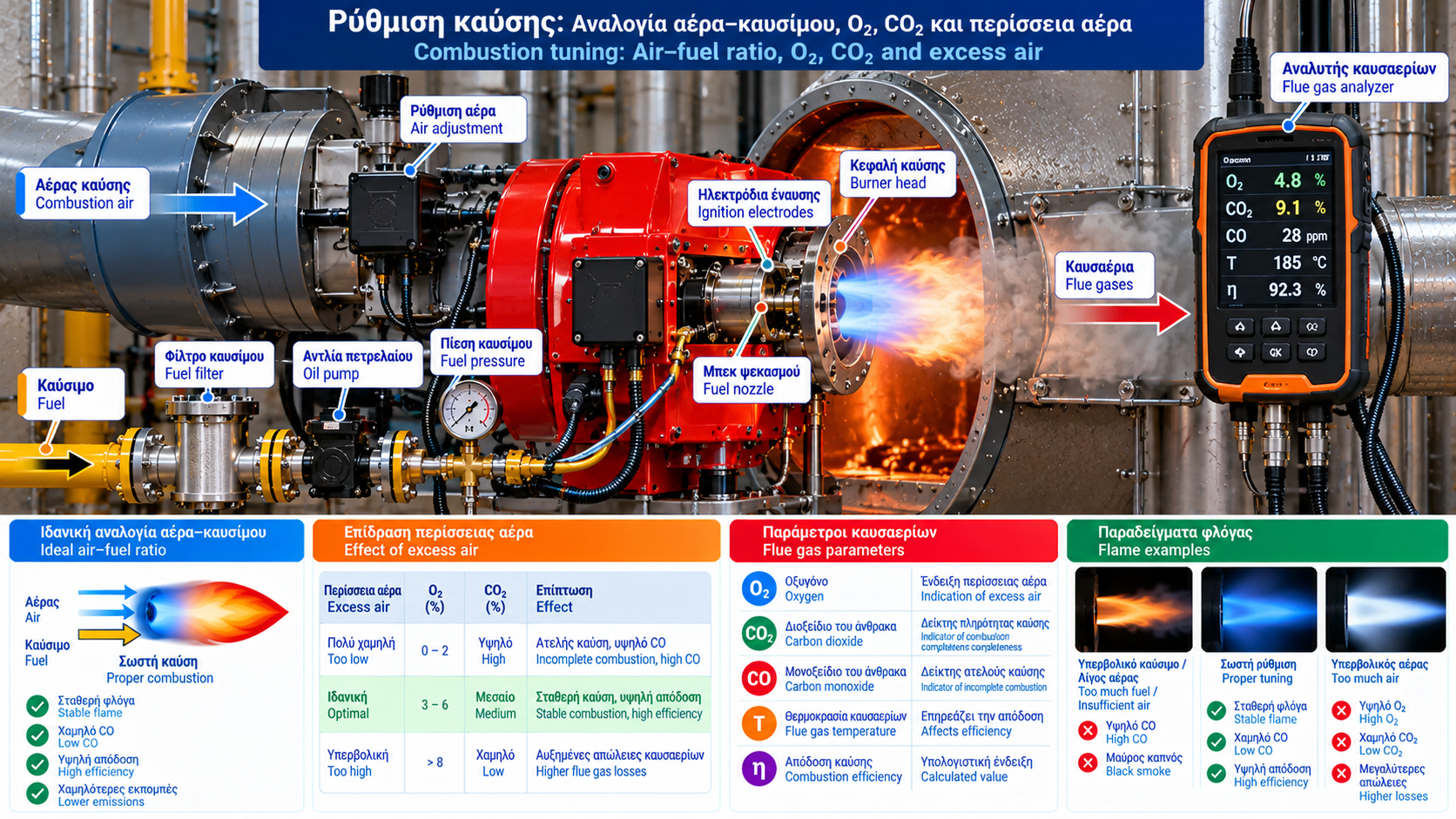
Combustion Tuning: Air–Fuel Ratio, O₂, CO₂ and Excess Air
Correct combustion tuning is essential for energy efficiency, safe operation and emissions control in oil and natural gas burners.
Combustion tuning involves more than adjusting an air damper or changing fuel flow. It requires evaluating the air–fuel ratio, measuring flue gas composition and verifying flame stability throughout the intended operating range.
The most important parameters include oxygen (O₂), carbon dioxide (CO₂), carbon monoxide (CO), excess air and flue gas temperature.
1. What Is the Air–Fuel Ratio?
The air–fuel ratio describes the quantity of combustion air supplied relative to the amount of fuel.
Complete combustion requires a theoretical amount of oxygen.
Because atmospheric air contains approximately 21% oxygen by volume, the required air quantity is considerably greater than the oxygen quantity participating in the reaction.
In practice, burners generally operate with more air than the theoretical minimum.
This helps combustion proceed despite imperfect mixing under real operating conditions.
2. What Is Stoichiometric Combustion?
Stoichiometric combustion is the theoretical condition in which exactly enough oxygen is supplied to completely burn the fuel.
For methane, the main constituent of natural gas, the ideal reaction is:
CH₄ + 2O₂ → CO₂ + 2H₂O
Actual combustion with air also involves nitrogen, which constitutes most of the atmosphere.
The stoichiometric condition is a reference point, not necessarily a suitable operating setpoint for a real burner.
3. What Is Excess Air?
Excess air is the additional air supplied beyond the theoretical requirement.
The air ratio is commonly represented by λ:
λ = Actual air / Stoichiometric air
Therefore:
λ = 1: Theoretical stoichiometric air supply.
λ = 1.10: 10% more air than theoretically required.
λ = 1.20: 20% more air than theoretically required.
Excess air percentage is:
Excess air (%) = (λ − 1) × 100
This describes supplied air, not the oxygen percentage directly measured by a flue gas analyzer.
4. How Does Excess Air Affect Efficiency?
Excessive air increases the mass of flue gas heated and discharged through the stack.
This can increase thermal losses.
Too little excess air may cause incomplete combustion, elevated CO, soot formation in oil burners or flame instability.
Effective tuning balances:
Complete and stable combustion.
Acceptable emissions.
Adequate air safety margin.
Reduced thermal losses.
The objective is not to achieve the lowest possible oxygen reading regardless of other operating parameters.
5. What Does Flue Gas O₂ Indicate?
Flue gas O₂ indicates the oxygen remaining after combustion.
Generally:
Higher O₂ is associated with greater excess air.
Lower O₂ is associated with less excess air.
However, air leakage into the flue gas system downstream of the combustion zone may also increase measured O₂.
Sampling location and system tightness therefore matter.
Suitable oxygen levels depend on burner type, fuel, load and manufacturer instructions.
6. What Does CO₂ Indicate?
CO₂ is a product of complete combustion of carbon-containing fuels.
For a given fuel under complete combustion conditions, increasing excess air generally reduces dry flue gas CO₂ concentration through dilution.
The theoretical maximum CO₂ depends on fuel composition.
There is no single maximum CO₂ value applicable to natural gas, oil and all other fuels.
Many analyzers calculate CO₂ from O₂ and the selected fuel characteristics rather than measuring it directly.
7. Relationship Between O₂ and Excess Air
For a simplified estimate under normal complete combustion conditions with dry flue gases, the following approximation is often used:
λ ≈ 21 / (21 − O₂)
O₂ is expressed as a volume percentage.
This is an approximation and does not replace a fuel-composition-based calculation.
For example, with:
O₂ = 4%
we obtain:
λ ≈ 21 / 17 ≈ 1.235
The estimated excess air is approximately 23.5%.
Actual interpretation should account for fuel composition, measurement method and possible air leakage.
8. Why Is CO Important?
Carbon monoxide is a product of incomplete combustion and an important indicator of poor combustion conditions.
Elevated CO may result from:
Insufficient combustion air.
Poor fuel–air mixing.
Unstable flame.
Unsuitable burner head conditions.
Oil atomization problems.
Unfavorable operating conditions.
Low O₂ is not a successful tuning result if CO rises to unacceptable levels.
CO values must also be interpreted according to units, reference conditions and applicable requirements.
9. What Is CO Correction to Reference O₂?
In some applications, emissions are compared at a specified reference oxygen concentration.
For dry flue gases, the relationship is:
COref = COmeas × (21 − O₂ref) / (21 − O₂meas)
where:
COref: CO concentration at reference oxygen.
COmeas: Measured CO concentration.
O₂ref: Reference oxygen percentage.
O₂meas: Measured oxygen percentage.
The equation is appropriate only where the specified reporting method applies and both concentrations use the same basis, such as dry flue gas.
Corrected concentration should not be confused with the actual concentration at the measurement point.
10. Natural Gas Burner Tuning
In a natural gas burner, gas flow and combustion air must be coordinated according to the system design.
Depending on the burner, tuning may involve:
Mechanical air–fuel linkage.
Electronic ratio control.
Air and gas servomotors.
Suitable O₂ monitoring and trim systems.
Performance must be verified at the required firing rates.
Air–fuel adjustments should only be performed by competent personnel using appropriate instruments.
11. Oil Burner Tuning
In an oil burner, combustion quality depends on:
Fuel flow.
Atomizing pressure.
Nozzle characteristics.
Combustion air supply and distribution.
Burner head geometry.
Changing pump pressure affects nozzle flow.
For a particular nozzle, flow changes approximately with the square root of atomizing differential pressure:
Q₂ / Q₁ ≈ √(ΔP₂ / ΔP₁)
This approximation assumes otherwise comparable conditions.
Nozzle selection and operating pressures must follow manufacturer specifications.
12. Why Is Tuning Required at Different Loads?
A two-stage or modulating burner does not operate at a single firing rate.
The air–fuel relationship can change as firing rate increases or decreases.
Assessment should therefore cover, where applicable:
Minimum firing rate.
Intermediate firing rates.
Maximum firing rate.
Transitions between operating points.
An acceptable measurement at maximum load does not prove correct combustion throughout the operating range.
13. What Is O₂ Trim?
O₂ trim is an automatic correction system that adjusts the air–fuel relationship based on measured flue gas oxygen.
It can compensate within specified limits for:
Changes in combustion air conditions.
Fuel characteristic variations.
Minor system deviations.
Changes in operating conditions.
O₂ trim does not replace a fundamentally safe air–fuel setup.
It requires suitable correction limits, sensor monitoring and approved control logic.
14. Flue Gas Temperature and Heat Losses
Flue gas temperature is important when estimating thermal losses.
Elevated temperature may be associated with:
Increased firing rate.
Reduced heat transfer.
Fouled boiler surfaces.
Excessive combustion air.
Temperature must be evaluated alongside boiler type, combustion air temperature and firing rate.
Condensation is intentionally used in condensing boilers, whereas unwanted condensation in other equipment can create corrosion risks.
15. How Is Combustion Efficiency Assessed?
Some flue gas analyzers calculate estimated combustion efficiency using:
Flue gas temperature.
Combustion air temperature.
O₂ or CO₂.
Selected fuel properties.
This is a calculated value based on a particular method.
It is not necessarily equivalent to:
Overall boiler efficiency.
Seasonal efficiency.
Whole-system efficiency.
Efficiency based on gross calorific value.
Reliable comparisons require a consistent calculation basis.
16. Example Comparison of Two Operating Conditions
Consider two hypothetical natural gas measurements at the same firing rate.
Parameter | Condition A | Condition B |
O₂ | 7.0% | 4.0% |
CO | 12 ppm | 18 ppm |
Flue gas temperature | 190°C | 175°C |
Combustion air temperature | 25°C | 25°C |
Condition B has lower excess air and lower flue gas temperature.
This may indicate reduced sensible stack losses.
However, the increase in CO must be evaluated against permissible values and burner specifications.
These four measurements alone are insufficient to establish that Condition B is safer or more efficient overall.
17. Common Combustion Tuning Mistakes
Common errors include:
Adjusting combustion based only on flame color.
Reducing O₂ without monitoring CO.
Sampling at an unsuitable flue gas location.
Using an analyzer without required checking or calibration.
Tuning only at maximum firing rate.
Ignoring load transitions.
Changing fuel pressure without technical justification.
Comparing emissions measured under different reference conditions.
Correct tuning requires a complete assessment.
18. What Should Be Recorded After Tuning?
A combustion tuning report should include, where applicable:
Parameter | Unit |
Fuel | Type |
Burner firing rate | % or kW |
Fuel pressure | mbar or bar |
O₂ | % |
CO₂ | % |
CO | ppm |
Flue gas temperature | °C |
Combustion air temperature | °C |
Excess air | % |
Estimated efficiency | % |
Smoke number | Where applicable |
Flame condition | Observations |
Gas concentrations should clearly identify the reporting basis and any corrections applied.
19. Standards and Technical References
Depending on the application, relevant technical references include:
EN 676: Automatic forced draught burners for gaseous fuels.
EN 267: Automatic forced draught burners for liquid fuels.
EN 50379: Specifications for portable electrical apparatus designed to measure combustion flue gas parameters of heating appliances.
EN 298: Automatic burner control systems.
ISO 6145: Dynamic preparation of calibration gas mixtures within the scope of the standard.
The applicable edition and scope of each standard must be confirmed for the specific installation.
Conclusion
Combustion tuning is an engineering optimization process combining air–fuel ratio management with actual flue gas measurements.
O₂ and CO₂ help assess excess air, while CO provides critical information about combustion quality and safety.
Optimum operation is not achieved simply by reducing combustion air. It requires stable, safe and efficient combustion throughout the intended firing range.
All adjustments must be performed by qualified personnel according to manufacturer instructions and applicable requirements.