
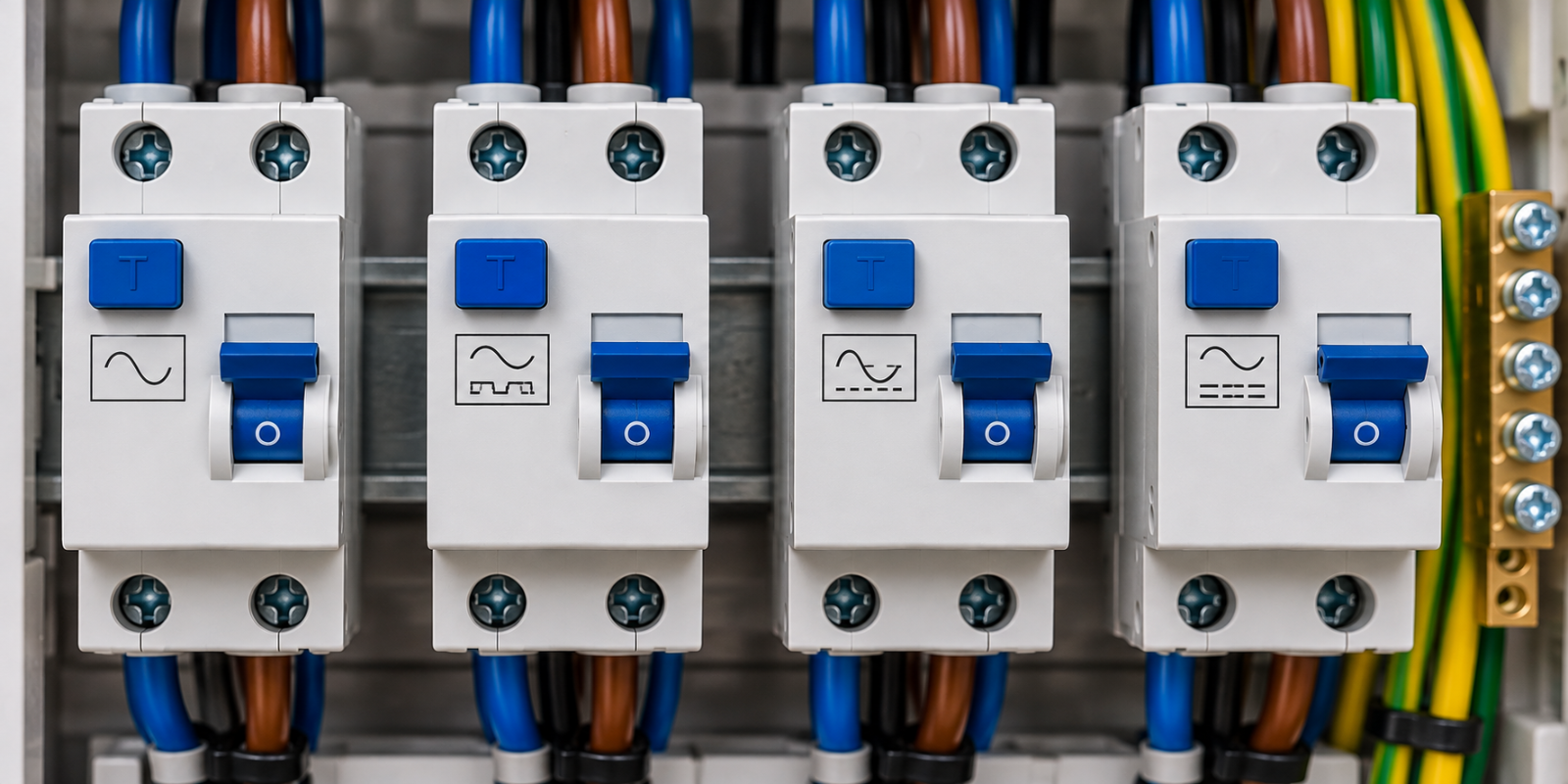
RCD Types AC, A, F and B: Differences and How to Choose
Residual current devices (RCDs) play a critical role in electrical safety. However, not all RCDs provide the same protection against different types of residual current.
Four important classifications are Type AC, Type A, Type F and Type B.
The main difference between these types is their ability to detect particular residual current waveforms. This becomes increasingly important in modern electrical installations containing electronic power supplies, variable-speed drives, heat pumps and electric vehicle charging equipment.
Understanding these differences helps explain why choosing an RCD based only on its current rating or price is not sufficient.
What Is an RCD?
An RCD, or residual current device, monitors the balance of electrical current flowing through the live conductors of a circuit.
Under normal conditions, the current flowing into a circuit should equal the current returning.
When some current flows through an unintended path, a residual current imbalance occurs.
If the imbalance reaches the device’s operating threshold, the RCD disconnects the electrical supply.
In many residential installations, RCDs with a rated residual operating current of 30 mA provide additional protection against certain electric shock hazards.
However, the 30 mA rating does not determine which residual current waveforms the device can detect.
That capability depends on its type.
Type AC RCD: Basic Alternating Current Detection
A Type AC RCD is designed to detect sinusoidal alternating residual currents.
It represents the most basic classification in terms of detectable residual current waveforms.
Type AC devices are not designed to provide the same response to pulsating direct residual currents or smooth direct residual currents.
This limitation is important when electrical installations contain modern electronic equipment.
The suitability of Type AC depends on the characteristics of the connected loads, applicable installation requirements and the manufacturer’s instructions.
It should not be assumed that Type AC is appropriate for every residential circuit.
Type A RCD: Protection for Additional Residual Current Waveforms
A Type A RCD can detect:
Sinusoidal alternating residual currents.
Pulsating direct residual currents under the conditions specified by the relevant standards.
This gives Type A devices broader detection capabilities than Type AC devices.
Many modern electrical appliances contain electronic control circuits, rectifiers and switching power supplies.
Under certain fault conditions, such equipment may produce residual current waveforms that are not purely sinusoidal.
Type A RCDs are therefore widely used in applications involving modern electrical equipment.
However, Type A devices are not designed to detect every form of smooth direct residual current.
Their suitability must be evaluated for the specific installation.
Type F RCD: Designed for Certain Frequency-Converter Applications
Type F RCDs provide the detection capabilities associated with Type A, together with additional capabilities for certain composite residual currents.
These may arise in selected single-phase frequency-converter applications.
Equipment with electronically controlled motors can produce more complex residual current waveforms than conventional loads.
A Type F RCD may be suitable for such applications when required or permitted by the equipment manufacturer and applicable standards.
However, Type F is not equivalent to Type B.
It does not provide the same smooth DC residual current detection capabilities as a Type B device.
Type B RCD: Detection of Smooth DC Residual Currents
Type B RCDs provide broader residual current detection capabilities.
Depending on their specifications, they are designed to detect:
Sinusoidal alternating residual currents.
Pulsating direct residual currents.
Smooth direct residual currents.
Certain additional residual current waveforms and frequency components within their specified operating range.
Type B devices may be required for particular installations containing power electronic converters, certain variable-speed drives or electric vehicle charging systems.
However, the presence of electronic equipment does not automatically mean that a Type B RCD is necessary.
The correct choice depends on the equipment design, possible fault currents, relevant standards and manufacturer’s requirements.
RCD Type Comparison
RCD Type | Main Detection Capability | Typical Considerations |
Type AC | Sinusoidal AC residual current | Applications where this level of detection is permitted and sufficient |
Type A | Sinusoidal AC and pulsating DC residual currents | Many circuits supplying electronic equipment |
Type F | Type A capabilities plus specified composite residual currents | Selected single-phase frequency-converter loads |
Type B | AC, pulsating DC and smooth DC residual currents, plus specified additional waveforms | Certain power converters, industrial equipment and EV charging applications |
This table provides a simplified comparison. Actual performance depends on the relevant product standards and device specifications.
Which RCD Type Is Suitable for a Home?
There is no single RCD type that is automatically suitable for every residential installation.
Selection depends on several factors:
Types of connected electrical equipment.
Possible residual current waveforms.
Manufacturer’s installation instructions.
Electrical installation design.
Applicable national regulations and technical standards.
Coordination with other protective devices.
Type A RCDs are commonly used for many modern residential applications.
However, certain equipment may require Type F, Type B or another specifically designed protective arrangement.
The final selection should be made by a qualified electrician.
RCD Types and Heat Pumps
Modern heat pumps frequently use power electronics and variable-speed inverter technology.
These components can influence the residual current characteristics of the equipment under fault conditions.
As a result, the appropriate RCD type may depend on the heat pump’s electrical design.
It is incorrect to assume that every heat pump requires the same RCD type.
Some manufacturers specify particular residual current protection requirements.
The installation must follow the manufacturer’s instructions and applicable electrical regulations.
RCD Types and Electric Vehicle Chargers
Electric vehicle charging installations require careful consideration of residual current protection.
Depending on the equipment and applicable requirements, an installation may use:
A suitable Type B RCD.
A Type A RCD combined with an appropriate 6 mA DC residual current detection device.
The second arrangement is acceptable only where the relevant standards and equipment specifications permit it.
Some EV charging equipment incorporates DC residual current detection, but this must be verified from the manufacturer’s documentation.
The required protective arrangement should always be determined by a qualified professional.
Why Does Smooth DC Residual Current Matter?
Certain electronic power converters can produce a smooth DC component under fault conditions.
An RCD that is not designed to operate correctly in the presence of such currents may not provide the required protection.
In particular, smooth DC residual current can adversely affect the operation of some RCD types.
This is one reason why selecting the appropriate RCD type is essential.
However, not every electronic appliance creates conditions requiring a Type B device.
The actual equipment characteristics must be assessed.
Is Type B Always Better Than Type A?
Type B provides additional residual current detection capabilities, but this does not make it the universal choice for every circuit.
A protective device must be suitable for the actual electrical installation.
Selection also involves:
Rated current.
Rated residual operating current.
Number of poles.
Device construction and applicable standards.
Coordination and selectivity.
Compatibility with connected equipment.
A correctly selected Type A device may be appropriate for one circuit, while another may require Type F or Type B.
The objective is suitable protection, not simply choosing the device with the broadest classification.
Can You Replace an RCD Yourself?
Replacing an RCD involves work inside an electrical distribution board and requires professional competence.
Incorrect installation or selection can create serious electrical hazards.
A qualified electrician must assess the circuit, select the appropriate protective device and perform the required tests.
Never bypass an RCD or replace it solely to stop repeated tripping without investigating the cause.
Frequently Asked Questions
What is the difference between Type AC and Type A RCDs?
Type AC detects sinusoidal alternating residual currents.
Type A additionally detects pulsating direct residual currents under specified conditions.
This makes Type A suitable for a broader range of residual current waveforms.
Does every house need a Type B RCD?
No.
Type B is required only where the equipment characteristics and applicable electrical requirements call for its additional detection capabilities.
What is the difference between Type F and Type B?
Type F is designed for certain composite residual currents, including those associated with selected single-phase frequency converters.
Type B additionally provides detection of smooth DC residual currents within its specified capabilities.
Is a Type B RCD the same as a B-curve circuit breaker?
No.
Type B in an RCD classification refers to the residual current waveforms it can detect.
A B-curve miniature circuit breaker refers to its instantaneous overcurrent tripping characteristic.
These are completely different classifications.
Is a 30 mA RCD suitable for every appliance?
Not necessarily.
The 30 mA rating describes the rated residual operating current.
The appropriate RCD type, device characteristics and installation requirements must also be considered.
Can the wrong RCD type affect electrical safety?
Yes.
If a device is unsuitable for the residual current waveforms that may occur, it may not provide the required protective function under certain fault conditions.
Conclusion
Type AC, Type A, Type F and Type B RCDs are not interchangeable in every application.
Their key difference is the range of residual current waveforms they are designed to detect.
Type A is commonly used in many modern electrical installations, while Types F and B address additional requirements associated with certain electronic equipment.
The correct RCD must be selected according to the electrical installation, connected equipment, manufacturer’s instructions and applicable standards.
thermosphere.gr — Practical technical knowledge for safer electrical installations.
Disclaimer: This article is intended for general information only. It does not replace professional electrical inspection or constitute instructions for carrying out electrical work.
Technical References
IEC 60755 — General safety requirements for residual current operated protective devices.
IEC 62423 — Type F and Type B residual current operated circuit-breakers.
IEC 61008-1 — Residual current operated circuit-breakers without integral overcurrent protection.
IEC 61009-1 — Residual current operated circuit-breakers with integral overcurrent protection.
IEC 60364-7-722 — Requirements for supplies for electric vehicles.
ELOT 60364 — Requirements for electrical installations in Greece.