
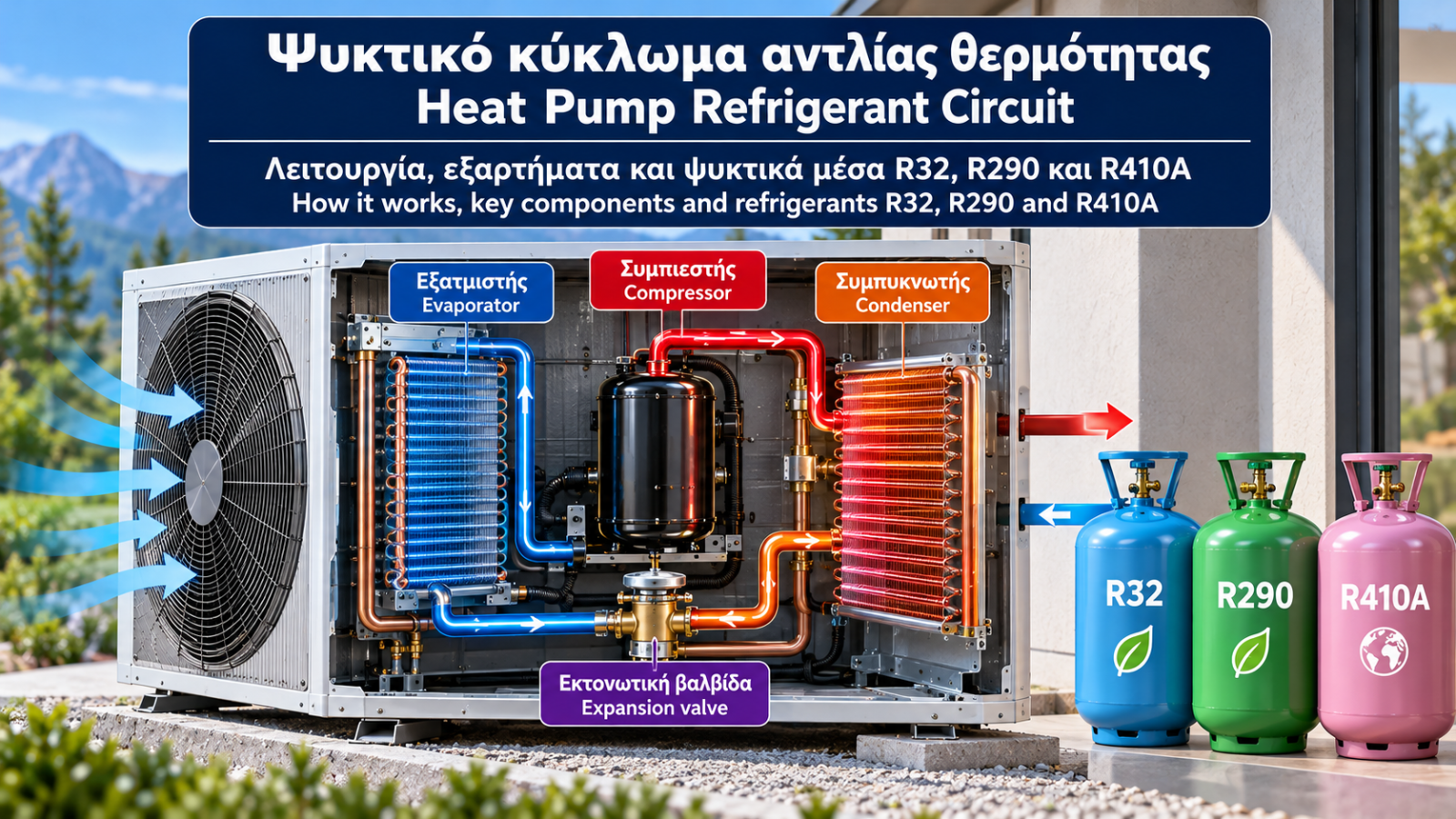
Heat Pump Refrigerant Circuit: How It Works and R32, R290 & R410A Explained
The refrigerant circuit is the core of a heat pump. It enables thermal energy to be transferred from a lower-temperature source to a building’s heating system.
This process relies on changes in pressure, temperature and physical state of a working fluid known as the refrigerant.
Modern heat pumps use different refrigerants, including R32, R290 and R410A. Each has distinct thermodynamic properties, safety requirements and environmental characteristics.
Understanding the refrigerant circuit helps explain heat pump performance, potential faults and the importance of selecting suitable equipment.
1. What Is a Refrigerant Circuit?
A refrigerant circuit is a sealed system through which refrigerant circulates.
Instead of producing all its heat through electrical resistance, a heat pump primarily uses electricity to operate its compressor and auxiliary components, transferring thermal energy from the environment into a building.
In heating mode, an air-to-water heat pump extracts heat from outdoor air and delivers it to the building’s hydronic heating circuit.
This is achieved through four fundamental stages:
Evaporation.
Compression.
Condensation.
Expansion.
These stages repeat continuously during operation.
2. The Four Main Components
Evaporator
The evaporator is the heat exchanger in which the refrigerant absorbs heat from the source.
In a typical air-to-water heat pump operating in heating mode, that source is outdoor air.
The refrigerant enters at low pressure and temperature. As it absorbs heat, it evaporates.
Its evaporation temperature must be below the source temperature for heat transfer to occur.
Compressor
The compressor draws in refrigerant vapour and increases its pressure.
Compression also raises the refrigerant temperature.
This enables the refrigerant to release heat at a higher temperature.
Many modern heat pumps use variable-speed compressors to adjust heating output according to demand.
Condenser
The condenser is the heat exchanger where the hot refrigerant releases thermal energy.
In an air-to-water heat pump, this energy is transferred to the heating water.
As heat is released, the refrigerant condenses from vapour into liquid.
Expansion Valve
The expansion valve reduces refrigerant pressure before it enters the evaporator.
This pressure reduction produces a substantial temperature decrease.
Modern heat pumps frequently use electronic expansion valves to regulate refrigerant flow under changing operating conditions.
3. How Does the Refrigeration Cycle Work?
Consider an air-to-water heat pump operating in heating mode.
Step 1 — Heat absorption
The refrigerant passes through the evaporator and absorbs energy from outdoor air.
Step 2 — Compression
The compressor increases the pressure and temperature of the refrigerant vapour.
Step 3 — Heat delivery
The refrigerant enters the condenser, transfers heat to the heating water and condenses.
Step 4 — Expansion
The expansion valve reduces refrigerant pressure and temperature, preparing it to absorb heat again.
The cycle then repeats.
Real systems may also include reversing valves, pressure sensors, filters and protective devices.
4. What Is a Refrigerant?
A refrigerant is the working fluid that transfers thermal energy within the heat pump’s sealed circuit.
Refrigerants are selected according to thermodynamic performance, equipment compatibility, safety and environmental characteristics.
Different refrigerants are not freely interchangeable.
Compressors, heat exchangers, valves, lubricants and protective systems are designed for specific refrigerants and operating conditions.
A refrigerant must never be replaced with another type without explicit equipment approval and a suitable technical procedure.
5. R32 Refrigerant
R32, or difluoromethane, is a fluorinated refrigerant used in many heat pumps.
Main Characteristics
Chemical name: Difluoromethane.
Safety classification: A2L.
Global Warming Potential (GWP100): 675 under the EU F-gas reference values.
Lower burning velocity within the A2L flammability classification.
Advantages
R32 has thermodynamic properties suitable for many heat pump applications.
Its GWP is also substantially lower than that of R410A.
Limitations
R32 is flammable under certain conditions.
Installation, servicing and refrigerant circuit work must comply with manufacturer instructions and applicable safety requirements.
6. R290 Refrigerant — Propane
R290 is high-purity propane suitable for refrigeration applications.
It is increasingly used in heat pumps, particularly factory-assembled units.
Main Characteristics
Substance: Propane.
Safety classification: A3.
Very low Global Warming Potential.
High flammability.
Under the European Commission’s current refrigerant comparison, R290 has a GWP100 of approximately 0.02.
Advantages
R290 has a very low direct climate impact in the event of a leak compared with many fluorinated refrigerants.
Its thermodynamic properties also support efficient heat pump designs, including systems capable of producing higher water temperatures.
However, this does not mean every R290 heat pump is more efficient than every alternative.
Limitations
Because R290 is classified as A3, installation design must carefully consider:
Equipment location.
Safety distances and designated zones.
Potential ignition sources.
Ventilation.
Servicing procedures.
Requirements depend on the equipment and installation.
7. R410A Refrigerant
R410A is a refrigerant blend widely used in earlier generations of heat pumps.
Main Characteristics
Blend of R32 and R125.
Safety classification: A1.
GWP100: 2088 under EU F-gas reference values.
No flame propagation under the specified A1 classification conditions.
Advantages
R410A has a long operating history and remains present in a substantial installed equipment base.
Limitations
Its high GWP is a major environmental disadvantage.
European restrictions on fluorinated greenhouse gases progressively affect the placing on the market of new equipment using higher-GWP refrigerants.
This does not mean every existing R410A heat pump must be immediately replaced.
8. R32 vs R290 vs R410A
Characteristic | R32 | R290 | R410A |
Refrigerant type | HFC | Hydrocarbon | HFC blend |
Safety classification | A2L | A3 | A1 |
Flammability | Lower burning velocity | High | No flame propagation in classification testing |
GWP100 | 675 | Approximately 0.02 | 2088 |
Main advantage | Suitable properties and lower GWP than R410A | Very low GWP | Established installed base |
Main challenge | A2L safety requirements | A3 flammability requirements | High GWP |
Important: Refrigerant type alone does not determine the efficiency of a heat pump. The entire system design must be considered.
9. What Do A1, A2L and A3 Mean?
Refrigerant safety classifications combine toxicity and flammability characteristics.
The letter A indicates the lower toxicity classification under the relevant standard.
The number and additional letter describe flammability characteristics.
A1
Refrigerants that do not exhibit flame propagation under specified test conditions.
A2L
Refrigerants with lower flammability and low burning velocity.
A3
Highly flammable refrigerants.
These classifications do not imply that any refrigerant is entirely harmless.
Even A1 refrigerants may create hazards associated with pressure, oxygen displacement in confined spaces or other conditions.
10. How Does Refrigerant Choice Affect Efficiency?
Heat pump efficiency depends on several factors:
Refrigerant thermodynamic properties.
Compressor efficiency.
Heat exchanger design.
Evaporation temperature.
Condensation temperature.
Expansion valve control.
Heating system requirements.
When a heat pump must deliver higher water temperatures, the required temperature lift between evaporation and condensation generally increases.
This tends to reduce the Coefficient of Performance (COP).
Refrigerant selection is an important design factor, but it does not independently determine system efficiency.
11. What Happens When Refrigerant Leaks?
A refrigerant leak may reduce the amount of working fluid available in the circuit.
Depending on system design and operating conditions, symptoms may include:
Reduced heating performance.
Failure to reach the required water temperature.
Abnormal operating pressures.
Protective fault codes.
Increased component stress.
System shutdown.
These symptoms do not prove that a leak exists.
They may also result from sensor faults, inadequate water flow, heat exchanger problems or other issues.
What Should the Owner Do?
A suspected refrigerant leak should never be investigated by opening the sealed circuit.
With flammable refrigerants, potential ignition sources must be avoided and manufacturer safety instructions followed.
Inspection should be performed by appropriately qualified personnel.
12. Why Should Refrigerant Not Simply Be Topped Up?
The refrigerant circuit is designed to operate as a sealed system.
Repeated refrigerant additions may indicate a leak or an earlier incorrect service procedure.
Adding refrigerant without diagnosis can result in incorrect charge and operating problems.
A proper professional process may include:
Diagnosing the cause.
Locating and repairing any leak.
Performing appropriate tightness checks.
Preparing and evacuating the circuit as specified.
Charging the correct refrigerant quantity.
Verifying operating conditions.
These procedures are not suitable for untrained owners.
13. European F-Gas Regulations
The European Union regulates fluorinated greenhouse gases through Regulation (EU) 2024/573.
The regulation introduces progressive restrictions on placing certain equipment containing fluorinated refrigerants on the market.
The applicable requirements depend on factors such as:
Equipment category.
Rated capacity.
Refrigerant GWP.
Relevant implementation date.
Specific safety-related exceptions.
For example, restrictions beginning in 2027 affect certain self-contained heat pumps with fluorinated refrigerants above specified GWP thresholds.
However, requirements differ between self-contained and split systems, and between capacity categories.
Existing equipment is not automatically subject to immediate replacement merely because new equipment restrictions enter into force.
R290 is a non-fluorinated refrigerant and is not subject to the same HFC phase-down mechanism, although product and installation safety requirements still apply.
14. Refrigerant Circuit Maintenance
A correctly sealed refrigerant circuit should not require routine refrigerant top-ups.
Appropriate professional maintenance may include:
Checking operating information.
Reviewing fault codes.
Inspecting components and connections.
Assessing heat exchanger condition.
Checking sensors.
Performing leak checks where required.
Verifying operating performance.
Maintenance requirements depend on manufacturer instructions, system design and applicable regulations.
15. Frequently Asked Questions
Which Is Better, R32 or R290?
There is no universal answer. R290 has a much lower GWP but belongs to the highly flammable A3 category. Selection should consider equipment design, safety requirements and actual model performance.
Can R410A Be Replaced With R32?
Not as a simple substitution. The refrigerants have different properties and safety requirements. Equipment must be explicitly approved for the refrigerant used.
Is R290 Dangerous?
R290 is highly flammable. It can be used safely in appropriately designed and installed equipment when the specified protective measures are followed.
Does Refrigerant Need to Be Refilled Every Year?
No. Routine annual refilling is not required in a correctly sealed refrigerant circuit.
Does Refrigerant Type Determine Electricity Consumption?
Refrigerant properties influence system design, but actual electricity consumption depends on the complete heat pump and its operating conditions.
Conclusion
The refrigerant circuit is the central heat-transfer system of a heat pump.
The compressor, evaporator, condenser and expansion valve work together to enable the refrigerant to absorb and release thermal energy.
R32, R290 and R410A have different thermodynamic, environmental and safety characteristics.
Selecting suitable equipment requires more than comparing refrigerant names. Actual heat pump performance, installation compatibility and safety are equally important.
Understanding the refrigerant circuit is essential for evaluating the operation, performance and reliability of modern heat pumps.
Thermosphere.gr — Technical knowledge for heating and building systems.