
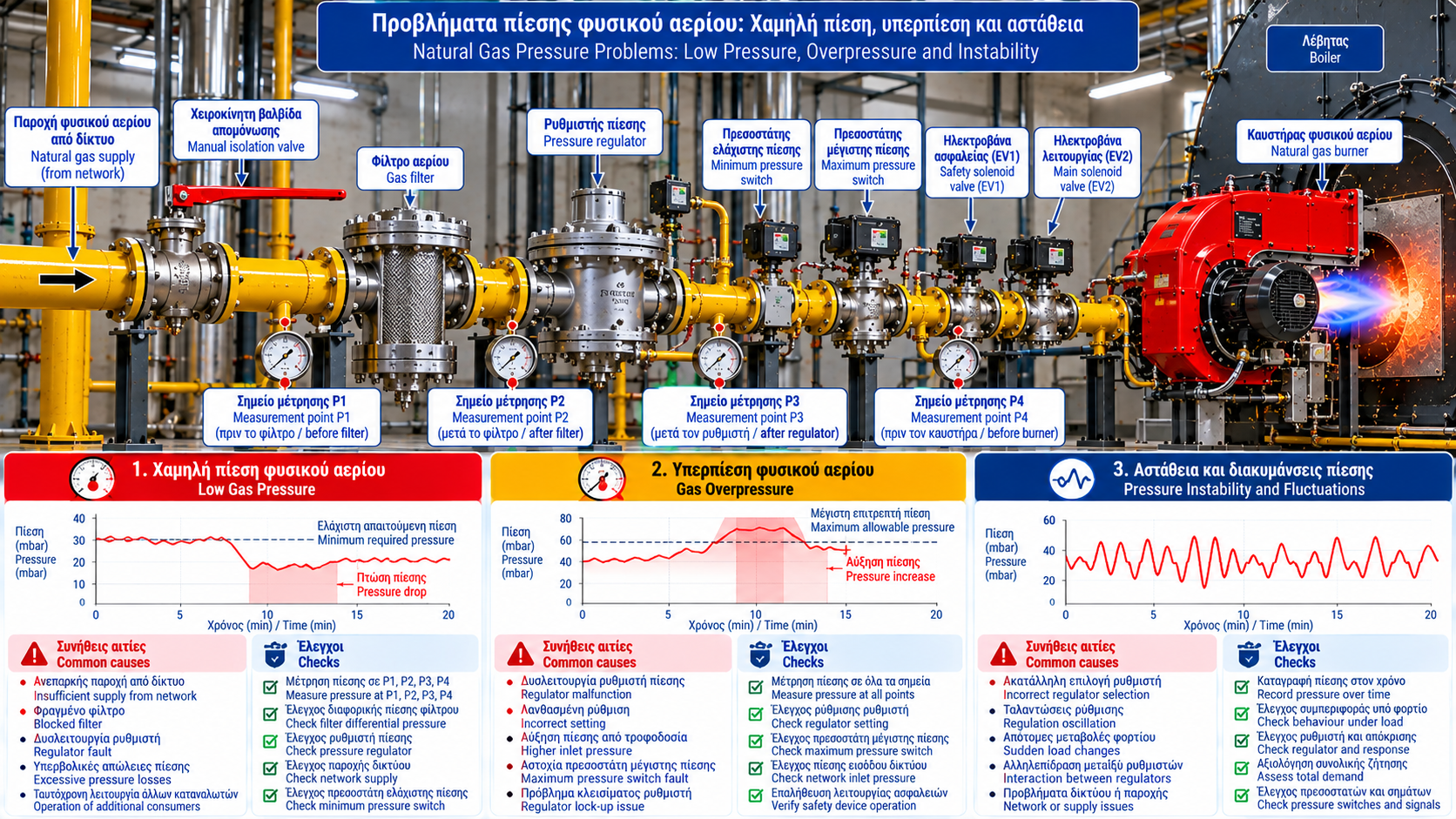
Natural Gas Pressure Problems: Low Pressure, Overpressure and Instability
Natural gas pressure is a critical operating parameter in industrial burners, boilers and thermal energy systems.
Low pressure can prevent startup or cause burner shutdown. Overpressure may activate protective devices and create unsafe conditions. Pressure fluctuations can affect combustion stability, particularly in installations with changing loads.
Effective troubleshooting requires evaluating the entire gas supply path rather than relying on a single pressure gauge.
1. The Role of Gas Pressure
Natural gas flows through piping and appropriate isolation, filtration, regulation and safety equipment before reaching the burner.
Pressure must remain within the specified limits under the relevant flow conditions.
The required pressure depends on burner type, rated capacity, modulation range, gas train arrangement and manufacturer specifications.
There is no universal operating pressure suitable for all industrial burners.
2. No-Flow Pressure Versus Pressure Under Load
Pressure measured without consumption can differ significantly from pressure during operation.
No-flow pressure: Pressure at a location when gas consumption is absent or negligible.
Pressure under load: Pressure at the same location while gas is flowing.
Gas flow produces pressure losses in pipes and components.
A network may have acceptable pressure without consumption but insufficient pressure at high burner demand.
Therefore, a no-flow reading alone cannot confirm adequate supply capacity.
3. Low Natural Gas Pressure
Low gas pressure may occur during startup or normal operation.
Possible symptoms include startup failure, minimum pressure switch activation, shutdown during load increase, combustion instability and reduced available heat output.
These symptoms require confirmation through appropriate measurements.
4. Insufficient Supply Pressure
The problem may originate upstream of the burner installation.
Supply pressure can vary due to network conditions, supply restrictions or other consumers.
In multi-burner facilities, simultaneous operation can significantly increase total demand.
Assessment should consider installation inlet pressure and its response to changing load.
5. Clogged Gas Filter
Gas filters retain particles that could affect regulators and valves.
Accumulated contamination increases pressure loss across the filter.
The effect can become more significant as flow increases.
Useful indicators include increasing differential pressure and insufficient downstream pressure at high load.
Inspection and maintenance must follow manufacturer instructions and approved isolation procedures.
6. Excessive Piping Pressure Loss
Pressure decreases during flow because of friction and local resistance.
Losses depend on pipe length, internal diameter, flow rate, fittings, pipe condition and gas properties.
A network that previously performed adequately may develop problems after additional consumers are connected.
Proper assessment requires gas network pressure-loss calculations using suitable parameters and units.
7. Gas Pressure Regulator Malfunction
A regulator maintains the required downstream pressure within its specified operating range.
Possible problems include low outlet pressure, slow response, oscillation, unwanted pressure rise at low or zero flow and protective device activation.
Causes may involve internal wear, unsuitable sizing, installation conditions or operation outside specifications.
Adjustment and repair must be performed by appropriately authorized personnel.
8. Gas Overpressure
Overpressure occurs when pressure exceeds the allowable limit for a particular section or component.
Potential causes include pressure regulation failure, unexpected inlet pressure increases, incorrect settings or protective system faults.
Overpressure requires investigation and verification of the system’s protective arrangements.
9. Pressure Rise at Zero Flow
Downstream pressure may increase after consumption stops.
This behavior must be assessed against the regulator’s specified lock-up characteristics.
Excessive pressure rise may indicate seat leakage or another malfunction.
Acceptable lock-up pressure depends on the specific regulator.
10. Pressure Instability and Oscillation
Gas pressure may fluctuate periodically or irregularly.
Possible causes include unsuitable regulator selection, interaction between regulators, sudden demand changes, poor installation conditions, control mechanism faults or sensing problems.
Oscillations can disturb burner operation and trigger repeated shutdowns.
11. Pressure Drop When a Second Burner Starts
This is a common diagnostic scenario in multi-consumer installations.
One burner may operate normally, but starting another increases total gas demand.
If supply capacity or pipework sizing is insufficient, pressure may fall below the acceptable range.
Investigation should include simultaneous consumption, dynamic pressure, network losses and regulator capacity.
12. Pressure Switches
Minimum and maximum gas pressure switches monitor critical operating conditions.
A minimum pressure switch may prevent or interrupt burner operation when pressure falls below its specified limit.
A maximum pressure switch may activate when pressure exceeds the permitted threshold.
Their activation may represent correct protective behavior.
Switches must not be bypassed or adjusted arbitrarily.
13. Pressure Measurement Locations
Measurement points depend on the installation design.
A diagnostic assessment may consider:
Installation inlet pressure.
Pressure upstream and downstream of the filter.
Regulator inlet and outlet pressure.
Designated gas train measurement points.
Pressure during burner operation.
Pressure during simultaneous consumer operation.
Connections and test points must not be opened arbitrarily.
Measurements require qualified personnel, suitable instruments and approved procedures.
14. The Value of Pressure Trend Recording
A single measurement may fail to reveal an intermittent problem.
Trend recording allows pressure behavior to be correlated with burner startup, load changes, simultaneous consumer operation, alarms and shutdowns.
For example, recording pressure during a high-load shutdown can be more informative than measuring pressure after the burner has stopped.
15. Diagnostic Table
Symptom | Possible Cause | Diagnostic Focus |
Low pressure at all consumers | Insufficient main supply | Assess inlet pressure |
Low pressure at one burner | Local restriction or component fault | Compare measurement points |
High filter pressure drop | Contamination | Assess differential pressure |
Pressure drops at high load | Insufficient capacity or excessive losses | Record under load |
Pressure rises at zero flow | Regulator lock-up problem | Compare with specifications |
Continuous pressure oscillation | Regulation instability | Assess regulator behavior |
High gas pressure alarm | Actual overpressure or monitoring fault | Verify actual pressure |
Low gas pressure alarm | Actual low pressure or monitoring fault | Verify actual pressure |
Pressure falls when another burner starts | Insufficient combined capacity | Assess simultaneous load |
Possible causes must be confirmed before corrective action.
16. Common Troubleshooting Mistakes
Measuring only when the burner is stopped: May miss load-related problems.
Replacing a pressure switch without verification: May overlook an actual pressure problem.
Changing regulator settings arbitrarily: Can compromise operation and safety.
Ignoring other gas consumers: May conceal a network capacity problem.
Bypassing protective devices: Creates unacceptable risk.
17. When Must Operation Stop?
The installation must remain out of service if there is suspected gas leakage, unacceptable overpressure, protective device failure, inability to isolate fuel safely or unexplained repeated pressure-related shutdowns.
Restoration must be performed by appropriately authorized personnel.
18. Technical Standards
Relevant references include:
EN 88-1: Pressure regulators for gas appliances, within its scope.
EN 334: Gas pressure regulators for applicable gas network installations.
EN 1854: Pressure sensing devices for gas burners and appliances.
EN 15001-1: Design, construction, inspection and testing of gas installations within its scope.
EN 676: Forced draught burners for gaseous fuels.
Applicability depends on pressure category, equipment and installation characteristics.
Conclusion
Natural gas pressure problems cannot be diagnosed effectively through a single reading or arbitrary adjustments.
Low pressure, overpressure and oscillations may originate from the supply network, piping, filters, regulators or changing consumer demand.
Safe troubleshooting requires pressure comparison at suitable locations, trend recording under actual operating load and technical assessment of the complete gas system.