
# Reverse Osmosis (RO) Pretreatment: Filtration, Chemical Treatment and Membrane Protection
## Introduction
Water pretreatment is one of the most important stages of an industrial reverse osmosis (RO) installation.
Even high-performance RO membranes can deteriorate rapidly when feedwater contains suspended solids, colloidal particles, microorganisms, oxidizing chemicals or substances that cause mineral scaling.
Effective pretreatment involves more than installing a filter upstream of the RO unit. It requires feedwater characterization, suitable treatment processes, chemical control and continuous monitoring.
## 1. Why Is RO Pretreatment Necessary?
RO membranes act as selective barriers to many dissolved substances. However, contaminants in feedwater can cause several types of membrane deterioration.
These include:
- Particulate fouling: accumulation of suspended particles.
- Colloidal fouling: deposition of fine colloidal materials.
- Organic fouling: adsorption and accumulation of organic compounds.
- Biofouling: formation of biological deposits and biofilms.
- Scaling: precipitation of sparingly soluble salts.
- Oxidative damage: chemical deterioration caused by oxidizing agents.
These mechanisms can reduce permeate production, increase differential pressure, deteriorate water quality and increase cleaning frequency.
## 2. Feedwater Analysis
A representative feedwater analysis is essential before selecting pretreatment equipment.
Important parameters include:
- pH and temperature.
- Conductivity and total dissolved solids (TDS).
- Turbidity and suspended solids.
- Calcium and magnesium hardness.
- Alkalinity.
- Sulfate, chloride and silica.
- Iron and manganese.
- Free and total residual chlorine.
- Total organic carbon (TOC), where relevant.
- Microbiological and fouling indicators.
For surface water, seawater and sources with seasonal variation, a single water sample may not adequately represent operating conditions.
## 3. Multimedia Filtration
Multimedia filters reduce suspended solids and turbidity.
They may contain graded filtration media such as anthracite and silica sand.
During operation, water passes through the filter bed, where particles are retained within the media.
Filtration performance depends on:
- Media grading and configuration.
- Filtration velocity.
- Particle characteristics.
- Effective backwashing.
- Differential pressure and filter bed condition.
Multimedia filters do not significantly remove most dissolved salts and cannot independently guarantee a sufficiently low silt density index.
## 4. Activated Carbon Filtration
Activated carbon is commonly used to adsorb selected organic compounds and reduce certain residual oxidants under suitable operating conditions.
Free chlorine removal is particularly important when polyamide RO membranes are installed.
Performance depends on contact time, carbon characteristics, water chemistry and bed condition.
Activated carbon filters can also support microbial growth if suitable hygiene and maintenance practices are not followed.
Consequently, outlet water quality must be monitored and the system must be maintained appropriately.
## 5. Chemical Dechlorination
Chemical reduction can be used as an alternative or supplement to activated carbon treatment.
Sodium metabisulfite (SMBS) is commonly used for dechlorination.
When dissolved in water, it produces reducing sulfite-related species that react with oxidizing compounds.
The required dosage depends on oxidant concentration, chemical form, reaction stoichiometry, water chemistry and supplier recommendations.
Excessive dosing is not automatically safer and can introduce additional operating problems.
Oxidation-reduction potential (ORP) monitoring may provide useful supplementary information, but it does not always replace direct verification of residual oxidants.
## 6. Cartridge Filters
Cartridge filters are commonly installed as a final particulate protection stage upstream of the RO membranes, with their exact location determined by hydraulic design.
They help retain residual particles and prevent media carryover from upstream treatment equipment.
Nominal filtration ratings around 5 micrometres are common, although the correct rating must follow the equipment and membrane manufacturer's requirements.
Important monitoring parameters include:
- Filter differential pressure.
- Replacement frequency.
- Material compatibility.
- Element sealing.
- Potential bypass caused by incorrect installation.
Cartridge filters are not a substitute for properly designed primary pretreatment.
## 7. Silt Density Index (SDI)
The silt density index is a widely used practical indicator of particulate plugging potential.
The test is performed using a specified test membrane under defined pressure conditions.
SDI15 refers to a test interval of 15 minutes.
For many RO applications, manufacturers specify an SDI15 below 5, while lower values such as below 3 are often preferred.
Actual limits depend on the membrane type and operating conditions.
SDI is not a comprehensive measure of every fouling mechanism and does not independently predict biological or organic fouling.
## 8. Antiscalant Dosing
Antiscalants are chemical additives used to reduce the precipitation of selected sparingly soluble salts.
Depending on their formulation, they can interfere with crystal nucleation, growth and aggregation.
Common scaling risks include:
- Calcium carbonate.
- Calcium sulfate.
- Barium sulfate.
- Strontium sulfate.
- Silica-related deposits.
Antiscalant selection and dosing require feedwater analysis, saturation calculations and verification of membrane compatibility.
Antiscalant addition does not allow unlimited increases in system recovery.
## 9. Water Softening and pH Adjustment
Ion-exchange softening can reduce calcium and magnesium ions that contribute to certain scaling mechanisms.
Other systems use controlled pH adjustment to manage specific precipitation risks.
The appropriate approach depends on water chemistry, recovery targets, operating cost and process limitations.
Changing pH can affect different scaling compounds in different ways and must be evaluated carefully.
## 10. Ultrafiltration (UF)
Ultrafiltration is an advanced membrane pretreatment process used to retain suspended solids, colloids and many microorganisms.
It can provide more consistent RO feedwater quality, particularly when treating surface water or sources with variable turbidity.
However, ultrafiltration does not significantly remove most dissolved salts.
UF systems also require their own backwashing, monitoring and potentially chemical cleaning procedures.
## 11. Typical Pretreatment Configuration
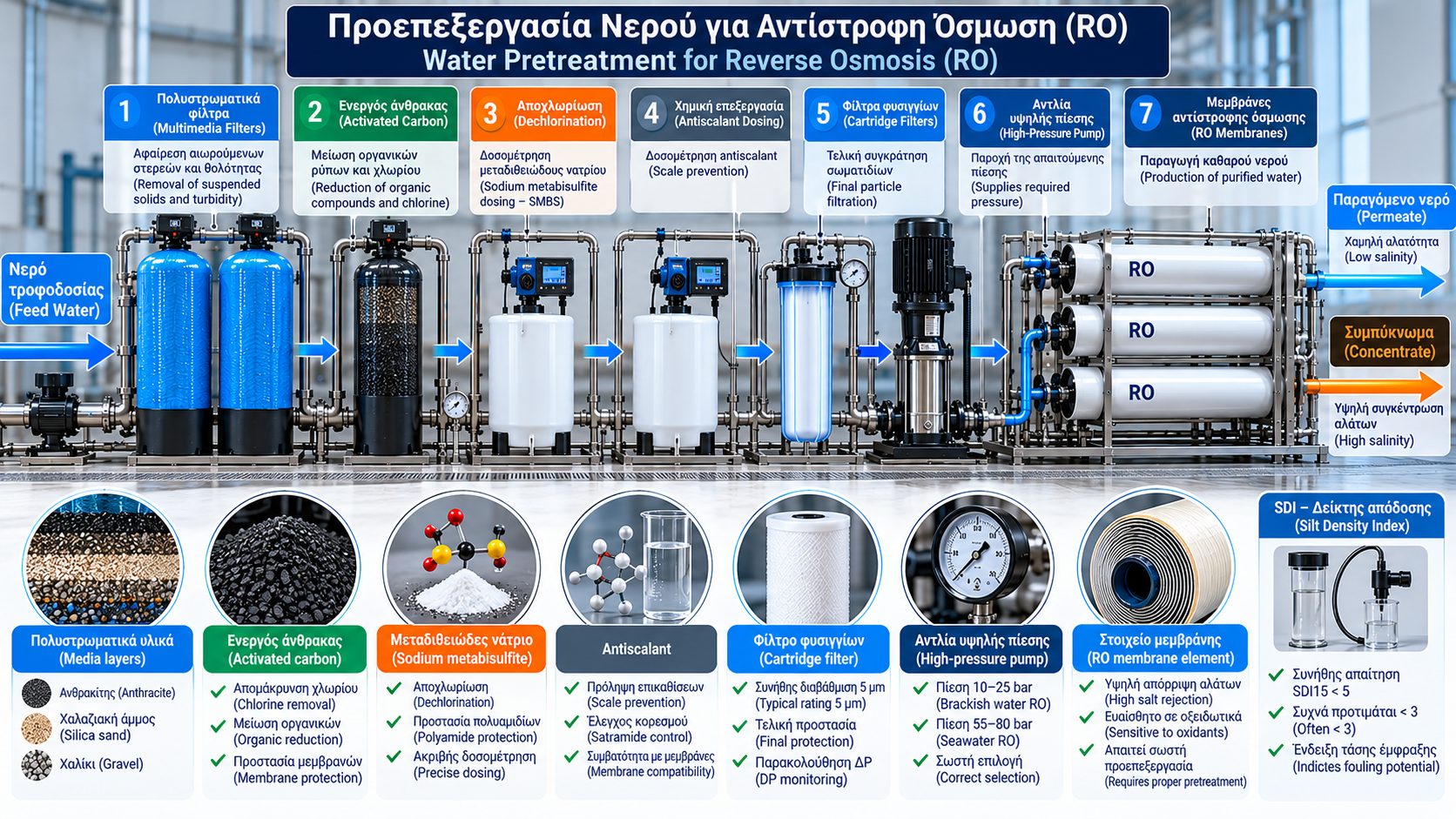
A possible industrial pretreatment sequence is:
Feedwater → Primary Filtration → Dechlorination, where required → Chemical Conditioning and Antiscalant Dosing → Cartridge Filtration → High-Pressure Pump → RO Membranes.
The actual sequence depends on feedwater quality and system design.
Not every RO installation requires activated carbon, softening or ultrafiltration.
## 12. Monitoring and Maintenance
An effective pretreatment operating program includes:
- Turbidity and SDI monitoring where appropriate.
- Filter differential pressure measurements.
- Residual oxidant verification.
- Chemical dosing pump inspection.
- Cartridge filter replacement.
- Scheduled multimedia filter backwashing.
- Microbiological fouling assessment.
- Evaluation of seasonal feedwater changes.
Pretreatment effectiveness should be verified through operating measurements rather than assumed from the presence of specific equipment.
## 13. Common Pretreatment Mistakes
Frequent mistakes include:
1. Selecting filters without feedwater analysis.
2. Inadequate dechlorination.
3. Excessive or insufficient antiscalant dosing.
4. Ignoring SDI monitoring.
5. Poor activated carbon maintenance.
6. Incorrect cartridge filter selection.
7. Inadequate biological fouling control.
8. Increasing recovery without scaling assessment.
## Conclusion
Water pretreatment is essential for the long-term reliability of industrial reverse osmosis systems.
The appropriate combination of filtration, dechlorination, chemical conditioning and monitoring reduces the risk of fouling, scaling and membrane chemical damage.
Effective pretreatment must be based on actual feedwater characteristics and membrane manufacturer specifications.
Thermosphere.gr – Technical Knowledge for Professionals.