Why is chimney diameter critical for safety?
The chimney is not just a pipe that removes smoke. It is the "lung" of the heating system. Correct sizing ensures that combustion products are safely exhausted into the environment without returning to the living space (backdraft phenomenon) and without creating dangerous soot or condensate buildup.
In Greece, many homeowners and amateur technicians make the mistake of believing that "the larger the diameter, the better." This is a dangerous myth. An excessively large chimney causes the flue gases to cool rapidly, reducing thermal buoyancy and causing condensation that damages the walls and reduces boiler efficiency.
The key factors determining cross-section
Before reaching for the caliper and starting calculations, we must understand what affects flue gas flow. The three pillars are:
- Device power (kW): The more fuel we burn per hour, the greater the volume of flue gases.
- Effective height: The vertical distance from the device outlet to the top of the chimney. Greater height means stronger draft, which often allows for a slightly smaller diameter.
- Fuel type: Oil, natural gas, wood, and pellets have different outlet temperatures and different combustion air requirements.
Technical calculation for boilers and fireplaces
1. Oil and Gas Boilers
For standard boilers, the diameter is usually specified by the manufacturer. However, if the chimney has many bends or a long horizontal section, the diameter should be increased by one size (e.g., from Φ150 to Φ180). A rule of thumb for residential boilers up to 40,000 kcal/h (approximately 46 kW) is to use a chimney diameter of 150mm to 180mm, provided the height exceeds 5-6 meters.
2. Energy Fireplaces and Wood Stoves
Things are more demanding here due to solid residues. For a fireplace with an 80-100cm hearth, the minimum diameter is usually Φ200. If the building height is low (e.g., a detached house with a 4-meter chimney height), a Φ250 might be needed to avoid smoking during ignition.
The importance of insulation and roughness
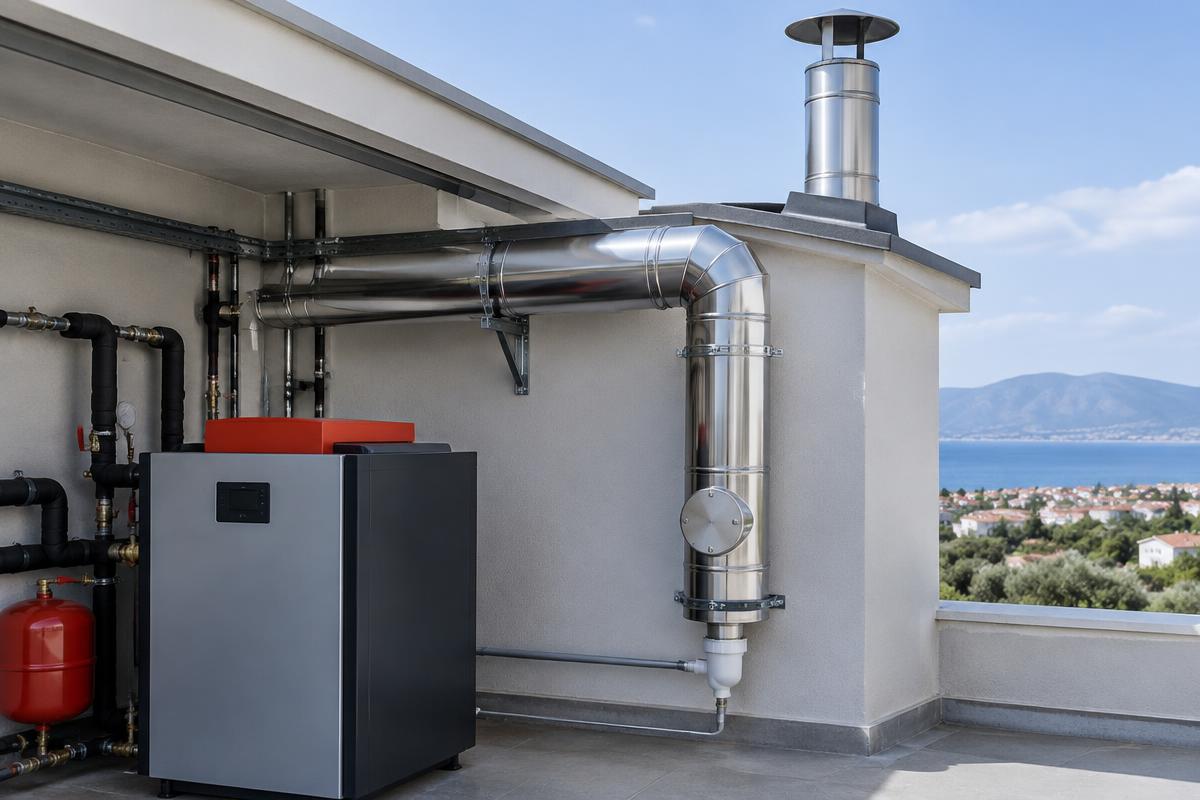
Diameter alone is not enough; the material also plays a role. Stainless steel chimneys (Inox 304 or 316L) offer a smooth inner surface, reducing friction. It is important that the chimney is double-walled with insulation (usually 25-50mm mineral wool). The insulation keeps the flue gases hot, maintaining a constant upward velocity. A cold chimney "brakes" the smoke, creating a layer of cold air at the top that acts like a plug.
Common mistakes and how to avoid them
- Constricting the cross-section: Never install a chimney with a smaller diameter than the device outlet. If the boiler has a Φ150 outlet, the chimney must be at least Φ150.
- Many 90-degree bends: Each 90° bend corresponds to a draft loss equivalent to 1 meter of height. Prefer 45° bends for smoother flow.
- Wrong chimney cap: A narrow or decorative cap can reduce the effective cross-section of the chimney by up to 30%. Choose "storm-proof" or aerodynamic caps.
Frequently Asked Questions (FAQ)
Can I connect two devices to the same chimney?
According to modern regulations and the ELOT EN 13384-2 standard, this is permitted only under strict conditions and calculation of the shared cross-section. In most residential installations, a separate chimney is recommended for each device to prevent flue gas backflow from one device into the other.
What happens if the chimney is too large?
If you install a Φ300 chimney for a small energy fireplace that requires Φ200, the flue gases will lose their heat too quickly. The result will be condensation (black sludge), odors, and the fireplace's inability to "draw" properly when outside temperatures are low.
How does the region's altitude affect the calculation?
In mountainous areas (above 800-1000 meters), the air is thinner. This means that for the same combustion, we need a slightly larger cross-section or greater height to achieve the same mass of combustion air.
Conclusion
Calculating chimney diameter is not a simple "eyeballing" matter. It requires combining the manufacturer's technical specifications, an understanding of draft physics, and proper material selection. A correctly sized, insulated stainless steel chimney guarantees fuel economy, longevity of the heating system, and, above all, the safety of your family.