
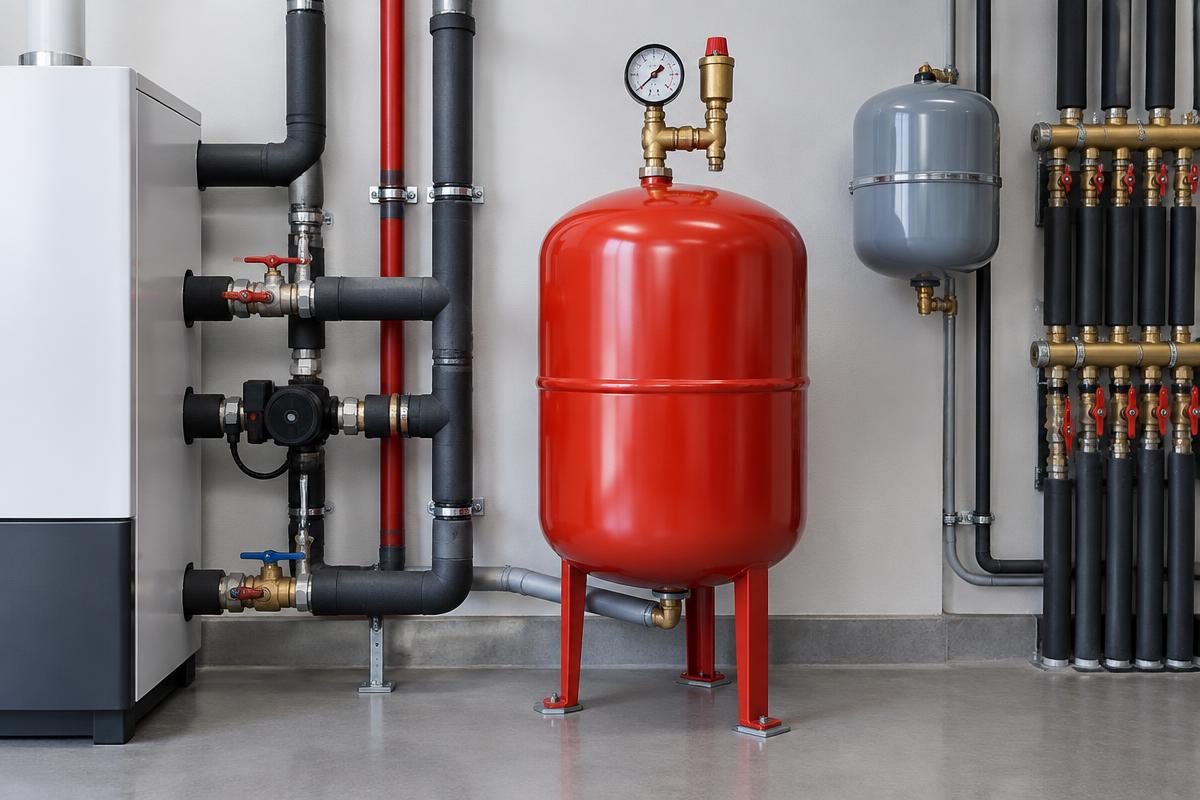
The expansion vessel is one of the most important components in a sealed central heating system. Its purpose is to accommodate the increase in water volume as the system heats up, helping to keep pressure within the designed operating limits.
When an expansion vessel loses its gas pre-charge, develops a damaged diaphragm, or is incorrectly sized, the heating system may experience significant pressure fluctuations between cold and hot operating conditions.
In this guide, we examine 10 key warning signs of a faulty heating expansion vessel, explain the possible causes and outline the checks a qualified heating technician should carry out.
How Does a Heating Expansion Vessel Work?
A diaphragm-type expansion vessel contains two separate chambers. One is connected to the heating water, while the other contains pressurised gas, usually air or nitrogen.
As the heating water temperature rises, the water expands. The additional volume enters the vessel and compresses the gas behind the diaphragm.
When the system cools, the gas expands and pushes water back into the heating circuit. This process helps control pressure variations during normal operation.
1. Boiler Pressure Rises Excessively When Heating Is On
One of the most common warning signs is an unusually large pressure increase as the heating water warms up.
For example, pressure may be within the expected range when the system is cold but rise close to the safety relief valve setting when the boiler reaches its operating temperature.
Possible causes include:
- Loss of expansion vessel pre-charge.
- A damaged or ruptured diaphragm.
- Insufficient vessel capacity.
- A closed isolation valve.
- A blocked or restricted connection between the vessel and the heating circuit.
Important: Some pressure increase during heating is normal. A pressure rise alone does not prove that the expansion vessel has failed. The actual pressures and system design must be assessed.
2. The Pressure Relief Valve Discharges Water
The pressure relief valve protects the heating system against excessive pressure by releasing water when its specified opening pressure is reached.
Many domestic heating systems use a 3-bar safety valve, although the correct setting depends on the equipment and system design.
If the valve repeatedly discharges water while the heating is running, the expansion vessel, its pre-charge and the overall system operation should be checked.
Never block the discharge pipe or attempt to change the relief valve setting without an approved technical procedure.
3. Boiler Pressure Drops When the System Cools Down
A common sequence is:
- The system is cold and filled to its specified pressure.
- The boiler heats the water and pressure rises excessively.
- The safety valve opens and releases water.
- When the system cools, the pressure becomes unusually low.
- Water is added again, and the cycle repeats.
Repeatedly topping up the heating system does not solve the underlying problem. Frequent additions of fresh water can also introduce oxygen and contribute to corrosion or deposits.
4. Water Comes Out of the Expansion Vessel Air Valve
Most diaphragm expansion vessels have a gas charging valve similar to a tyre valve.
During a properly conducted technical inspection, water emerging from this valve is a strong indication that the diaphragm has failed.
Many small domestic vessels have non-replaceable diaphragms and must be replaced as complete units. Some larger vessels have replaceable diaphragms, depending on their construction and manufacturer specifications.
The inspection should be performed safely by a competent technician familiar with pressurised heating systems.
5. How to Check Expansion Vessel Pre-Charge Correctly
Pre-charge pressure is the gas pressure inside the vessel before pressure from the heating water is applied.
The true pre-charge cannot be measured correctly while normal system water pressure is acting on the vessel.
A proper technical inspection generally involves:
- Safely shutting down and allowing the system to cool, where required.
- Isolating the vessel or the relevant part of the heating circuit.
- Depressurising the water side of the vessel.
- Measuring the gas pressure using a suitable pressure gauge.
- Comparing the measurement with the required pre-charge pressure.
Isolation and depressurisation must follow the manufacturer's instructions without compromising the system's safety devices.
6. What Pressure Should an Expansion Vessel Have?
There is no single correct pre-charge pressure for every heating installation.
Values around 0.8–1.0 bar are encountered in some small domestic systems, but these figures are examples rather than universal settings.
The required pre-charge depends on:
- The static height of the heating system.
- The installation position of the expansion vessel.
- The minimum required system pressure.
- The cold filling pressure.
- The equipment manufacturer's instructions.
As a useful approximation, a 10-metre column of water produces about 1 bar of hydrostatic pressure.
A multi-storey building may therefore require different pressure settings from a small single-storey house.
Important: Expansion vessel pre-charge pressure and heating system filling pressure are different values. They should not automatically be set to the same pressure.
7. What Happens When the Expansion Vessel Loses Air?
Loss of pre-charge does not necessarily mean the diaphragm has ruptured.
Possible causes include gradual gas loss or leakage through the charging valve.
If the diaphragm remains intact and the vessel is otherwise suitable for service, restoring the correct pre-charge may be possible.
However, the cause of the pressure loss should be investigated before recharging the vessel.
Simply adding air while the water side remains pressurised is not a reliable method of measuring or setting the pre-charge.
8. What Happens When the Diaphragm Ruptures?
If the diaphragm fails, water may enter the chamber that normally contains the compressed gas.
The vessel then loses some or all of its ability to absorb thermal expansion.
As a result, system pressure may rise rapidly as the heating water temperature increases.
Water appearing at the gas valve is a strong indication of diaphragm failure. However, the absence of water at the valve does not, by itself, prove that the diaphragm is intact.
9. Can an Expansion Vessel Be Working but Too Small?
Yes. An expansion vessel may be mechanically sound but have insufficient capacity for the heating installation.
Correct sizing depends on:
- The total water volume in the system.
- The operating temperature range.
- The thermal expansion of the water.
- The vessel pre-charge pressure.
- The system filling pressure.
- The maximum permitted operating pressure.
- The static height of the installation.
Choosing an expansion vessel based only on boiler output in kilowatts is not an adequate sizing method.
10. Could Something Other Than the Expansion Vessel Be Causing the Problem?
Yes. Unusual pressure changes do not always indicate a faulty expansion vessel.
Other possible causes include:
- Leaks from pipework, radiators or fittings.
- A leaking or defective pressure relief valve.
- A filling valve that does not close properly.
- A faulty automatic filling device, if fitted.
- An inaccurate pressure gauge.
- A closed or restricted vessel connection.
- A blocked pipe leading to the vessel.
- Pressure transfer through a heat exchanger from a higher-pressure circuit, where applicable.
A reliable diagnosis requires assessment of the entire heating system rather than one component in isolation.
How Should a Technician Diagnose Expansion Vessel Problems?
Diagnosis should not rely solely on tapping the vessel and listening to the sound it makes. This is not a reliable way to confirm diaphragm condition or pre-charge pressure.
A systematic inspection includes:
- Recording system pressure when cold.
- Monitoring pressure as the heating water warms up.
- Checking for discharge from the pressure relief valve.
- Safely isolating and depressurising the vessel's water side.
- Measuring the actual gas pre-charge.
- Checking for evidence of diaphragm failure.
- Confirming vessel sizing and its connection to the heating circuit.
The findings determine whether adjustment, repair or replacement is required.
Conclusion
The expansion vessel is essential for the stable and safe operation of a sealed central heating system.
When boiler pressure rises excessively during heating and falls significantly as the system cools, the expansion vessel is one of the first components that should be investigated.
However, accurate diagnosis depends on measurements and technical assessment, not automatically replacing parts.
Frequently Asked Questions (FAQ)
What pressure should a heating expansion vessel have?
The correct pre-charge depends on the system's static height, filling pressure and design requirements. Values such as 0.8–1.0 bar are used in some domestic systems but are not universal settings.
How can I tell if the expansion vessel diaphragm has failed?
Water emerging from the gas charging valve is a strong indication of diaphragm failure. A qualified technician should confirm the diagnosis using appropriate checks.
Why does boiler pressure increase when the heating is on?
Water expands as it heats up. If the expansion vessel cannot accommodate the additional volume, pressure may rise excessively.
Why does boiler pressure drop when the system cools?
If water was previously discharged through the pressure relief valve, system pressure may become low after cooling. Leaks and other causes of pressure loss should also be investigated.
Can I add air to the expansion vessel myself?
It is not recommended without appropriate technical training. Measuring and adjusting pre-charge requires safe isolation and depressurisation of the vessel's water side.
Can a faulty expansion vessel be repaired?
It depends on the design. Some vessels have replaceable diaphragms, while many smaller domestic vessels require complete replacement if the diaphragm fails.
How is the correct expansion vessel size calculated?
Sizing is based on system water volume, thermal expansion, pre-charge, operating pressures and installation characteristics. Boiler output alone is insufficient.
Technical References
- EN 12828: Heating systems in buildings – Design for water-based heating systems.
- The expansion vessel manufacturer's installation, sizing and maintenance instructions.
- Technical specifications for the boiler, pressure relief valve and associated heating system components.
Safety notice: This article is for general technical information. Inspection, depressurisation and adjustment of heating equipment should be carried out by appropriately qualified personnel in accordance with manufacturer instructions and applicable safety requirements.