
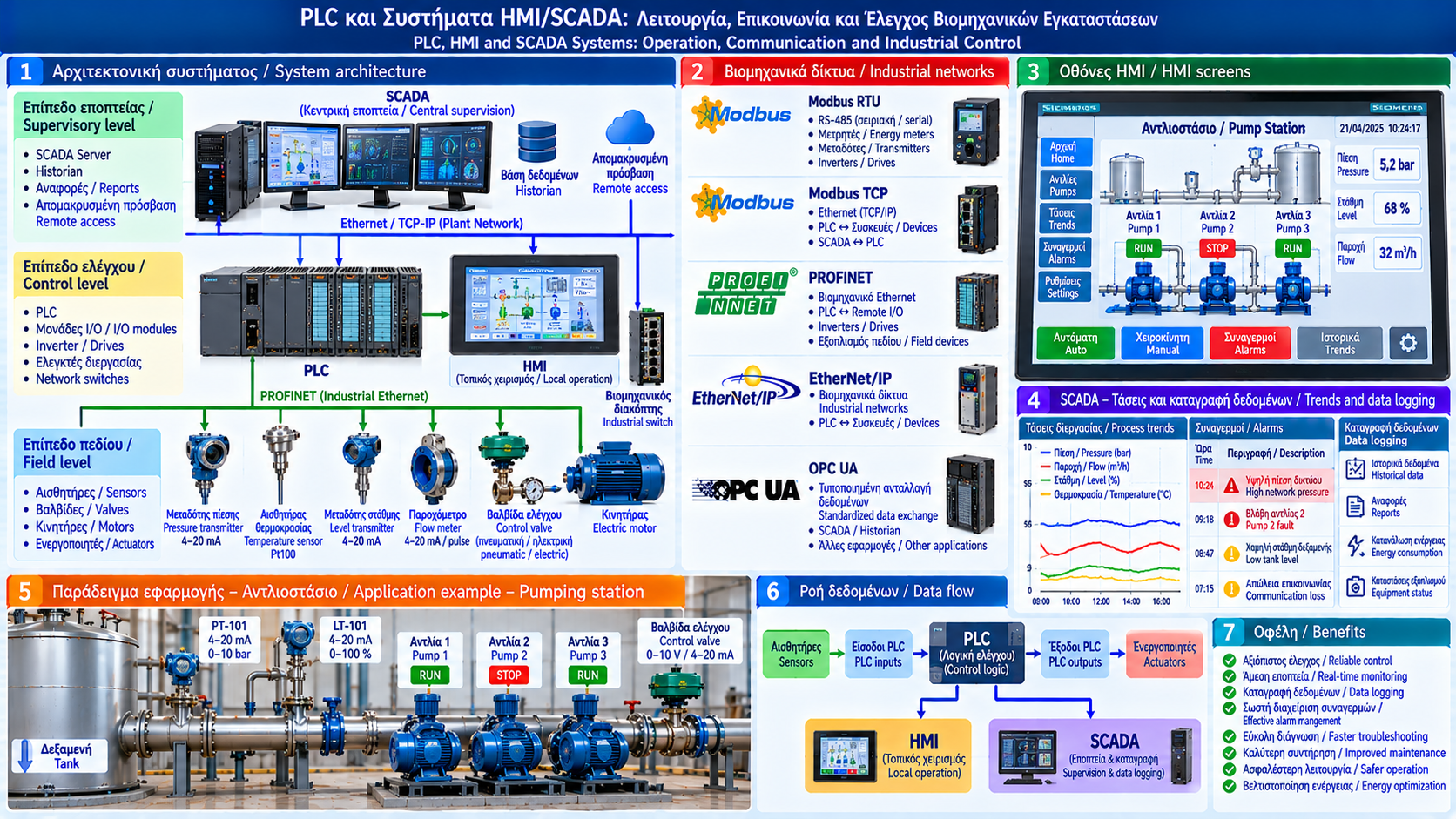
# PLC, HMI and SCADA Systems: Operation, Communication and Industrial Control
## Introduction
Modern industrial facilities use automation systems to monitor, control and manage equipment and processes.
PLCs execute control logic, HMIs provide operator interfaces, and SCADA platforms support supervisory monitoring and data collection across larger systems.
Their integration is especially important in pumping stations, water treatment facilities, steam boiler plants, manufacturing lines and energy installations.
Understanding system architecture improves operation, maintenance and troubleshooting.
## 1. What Is a PLC?
A Programmable Logic Controller is an industrial controller that receives field information, executes programmed functions and controls outputs.
Typical applications include:
- Starting and stopping motors.
- Pump control.
- Valve management.
- Level control.
- Pressure regulation.
- Sequence execution.
- Operational alarm handling.
- Communication with other controllers.
A PLC may continue local control when HMI or SCADA communication is lost, provided the architecture and program are designed to support that behavior.
## 2. What Is an HMI?
A Human Machine Interface allows operators to monitor and interact with machinery or processes.
An HMI may display:
- Operating status.
- Pressure and temperature.
- Level and flow.
- Motor status.
- Valve position.
- Alarms.
- Authorized settings.
An HMI is not necessarily responsible for executing the actual control logic.
In many conventional architectures, the PLC remains responsible for primary equipment control.
## 3. What Is SCADA?
SCADA stands for Supervisory Control and Data Acquisition.
It provides supervisory monitoring and data collection for industrial processes.
Typical capabilities include:
- Centralized equipment monitoring.
- Historical data recording.
- Trend visualization.
- Alarm management.
- Operating reports.
- Event logging.
- Supervisory commands.
- Data collection from multiple PLCs.
A SCADA platform may supervise one facility or multiple geographically distributed sites.
## 4. Differences Between PLC, HMI and SCADA
Each technology has a distinct primary role.
PLC:
Executes control logic and manages inputs and outputs.
HMI:
Provides a local or machine-level operator interface.
SCADA:
Supports wider supervision, data acquisition and operational management.
Capabilities may overlap depending on the product.
For example, some HMIs store historical data, while certain SCADA platforms perform additional supervisory control functions.
## 5. Automation System Architecture
A typical architecture includes several layers.
Field layer:
- Sensors.
- Transmitters.
- Valves.
- Motors.
- Actuators.
Control layer:
- PLCs.
- I/O modules.
- Process controllers.
- Motor drives.
Supervisory layer:
- HMIs.
- SCADA servers.
- Historians.
- Operator workstations.
Communication between layers uses suitable networks and protocols.
## 6. What Are PLC Tags?
Tags are named variables representing system information.
Examples:
PUMP_01_RUN:
Pump running status.
PUMP_01_FAULT:
Pump fault indication.
PT_101_PRESSURE:
Measured pressure.
TANK_01_LEVEL:
Tank level.
VALVE_01_OPEN_FB:
Valve open-position feedback.
Consistent naming supports maintenance and reduces confusion.
Commands must be distinguished from actual equipment feedback.
## 7. Run Commands Versus Running Feedback
A start command does not prove that equipment is operating.
For example, the PLC may activate PUMP_START_CMD.
The pump might fail to start because of:
- Active protection.
- Contactor failure.
- VFD fault.
- Missing power supply.
- Unsatisfied permissives.
Actual operation should be verified through suitable feedback, such as auxiliary contacts or drive RUN status.
Even a RUN signal does not by itself prove that the required flow is present or that the process is performing correctly.
## 8. Industrial Communication Networks
Automation systems use different protocols to exchange data.
Common examples include:
- Modbus RTU.
- Modbus TCP.
- PROFINET.
- PROFIBUS.
- EtherNet/IP.
- OPC UA.
Selection depends on:
- Equipment compatibility.
- Required speed.
- Network topology.
- Distance.
- Diagnostic capabilities.
- Reliability and cybersecurity requirements.
## 9. Modbus RTU
Modbus RTU is commonly used over serial communication networks such as RS-485.
Applications include:
- Energy meters.
- Transmitters.
- Motor drives.
- Controllers.
- Remote I/O modules.
Correct communication requires compatible settings such as:
- Device address.
- Baud rate.
- Parity.
- Stop bits.
- Register mapping.
RS-485 networks also require appropriate wiring and termination according to system design.
## 10. Modbus TCP
Modbus TCP uses TCP/IP networks.
Typical applications include:
- PLC-to-meter communication.
- PLC-to-drive communication.
- SCADA device integration.
- Industrial data acquisition.
Advantages include the use of Ethernet infrastructure and broad device support.
Correct operation requires:
- Appropriate IP addressing.
- Correct network configuration.
- Compatible data mapping.
- Response-time verification.
- Access protection.
Ethernet connectivity does not automatically make a network secure.
## 11. PROFINET and PROFIBUS
PROFINET is widely used for industrial Ethernet communication.
PROFIBUS is a family of fieldbus technologies.
They differ in physical media, architecture and capabilities.
A PROFINET system may connect:
- PLCs.
- Remote I/O.
- Variable-frequency drives.
- Industrial devices.
- Diagnostic systems.
Troubleshooting requires knowledge of topology, configuration and manufacturer-specific tools.
## 12. OPC UA and Data Exchange
OPC UA supports standardized exchange of industrial information.
It may connect:
- PLCs.
- SCADA platforms.
- Historians.
- Manufacturing management systems.
- Other industrial applications.
It supports structured data and secure communication mechanisms when properly configured.
OPC UA support does not automatically mean that a system uses secure settings.
## 13. Alarms and Events
HMI and SCADA platforms generate alarms when predefined conditions are met.
Examples include:
- High pressure.
- Low level.
- Motor fault.
- Communication failure.
- High temperature.
- Start failure.
Two concepts should be distinguished.
Alarm:
A condition requiring operator awareness or action.
Event:
A recorded occurrence that is not necessarily an alarm.
Acknowledging an alarm does not mean its underlying cause has been corrected.
## 14. Alarm Management
A properly designed alarm system should provide:
- Clear messages.
- Equipment identification.
- Appropriate priority.
- Timestamps.
- Active and cleared status.
- Operator response guidance.
Excessive alarm generation can make critical conditions harder to recognize.
IEC 62682 and ISA-18.2 are important references for alarm management in process industries.
## 15. Historical Data and Trends
Data logging enables analysis of process behavior over time.
Common recorded variables include:
- Network pressure.
- Tank level.
- Temperature.
- Flow.
- Motor speed.
- Energy consumption.
- Equipment status.
Historical data helps identify:
- Recurring problems.
- Sudden changes.
- Unstable control.
- Relationships between events.
- Deviations from normal operation.
Recording frequency should match process dynamics.
## 16. Pumping Station Example
Consider a pumping station with three pumps, a pressure transmitter and a level sensor.
The PLC:
- Reads measurements.
- Checks permissives.
- Starts and stops pumps.
- Manages lead-pump rotation.
- Communicates with VFDs.
- Processes operational alarms.
The HMI:
- Displays pump status.
- Provides authorized operator controls.
- Displays pressure and level.
- Shows alarms.
The SCADA system:
- Collects data.
- Records historical trends.
- Supervises multiple pumping stations.
- Generates operating reports.
Safety functions must remain effective during supervisory system problems, according to the safety design.
## 17. What Happens When Communication Is Lost?
Communication loss may result from:
- Cable damage.
- Switch failure.
- Power loss.
- Incorrect IP address.
- Configuration changes.
- Network device faults.
- Protocol configuration errors.
The system response should be defined in advance.
Depending on process requirements and risk assessment, local control may continue or transition to a specified safe state.
SCADA communication loss does not necessarily stop a PLC.
## 18. Common HMI Problems
Potential problems include:
- Frozen screens.
- Values not updating.
- Incorrect status indications.
- Failed operator commands.
- PLC connection loss.
- Incorrect tag mapping.
- User permission problems.
Before assuming a PLC fault, the actual equipment condition should be verified using appropriate independent indications and approved procedures.
## 19. Basic Communication Troubleshooting
A structured investigation includes:
1. Recording symptoms.
2. Confirming equipment and process safety.
3. Checking device power.
4. Inspecting physical connections.
5. Reviewing network status indicators.
6. Verifying communication settings.
7. Checking PLC status.
8. Reviewing tags and data mapping.
9. Confirming operation after correction.
10. Documenting the incident.
Tests must avoid unauthorized interventions that could affect plant operation or safety.
## 20. Backups and Change Management
Maintaining current backups is essential.
Recommended records include:
- PLC programs.
- HMI projects.
- SCADA configurations.
- VFD parameters.
- Network configuration.
- Signal lists.
- Electrical drawings.
- Change history.
Backups should be checked for completeness and recoverability.
All modifications should follow an approved change-management procedure.
## 21. Industrial Network Cybersecurity
PLC, HMI and SCADA systems are part of the Operational Technology environment.
Important practices include:
- IT/OT network segmentation.
- Controlled remote access.
- Account management.
- Appropriate patch management.
- Backups.
- Event logging.
- Disabling unnecessary services.
- Incident response procedures.
The IEC 62443 series provides a framework for industrial automation and control system security.
Cybersecurity measures must consider process availability and operational safety requirements.
## 22. Reliability and Documentation
System reliability depends on both equipment quality and documentation.
Useful documents include:
- I/O lists.
- Cause-and-effect matrices.
- Network architecture diagrams.
- Instrument indexes.
- Alarm lists.
- Functional descriptions.
- Electrical drawings.
- Backup registers.
- Maintenance history.
Accurate documentation speeds troubleshooting and reduces the risk of incorrect intervention.
## Conclusion
PLCs, HMIs and SCADA platforms perform complementary roles in industrial automation.
PLCs execute control, HMIs provide operator interaction, and SCADA systems deliver broader supervision, data collection and analysis.
Reliable communication, clear signal naming, effective alarm management, current backups and cybersecurity practices are essential for dependable industrial operation.
Thermosphere.gr – Technical Knowledge for Professionals.