
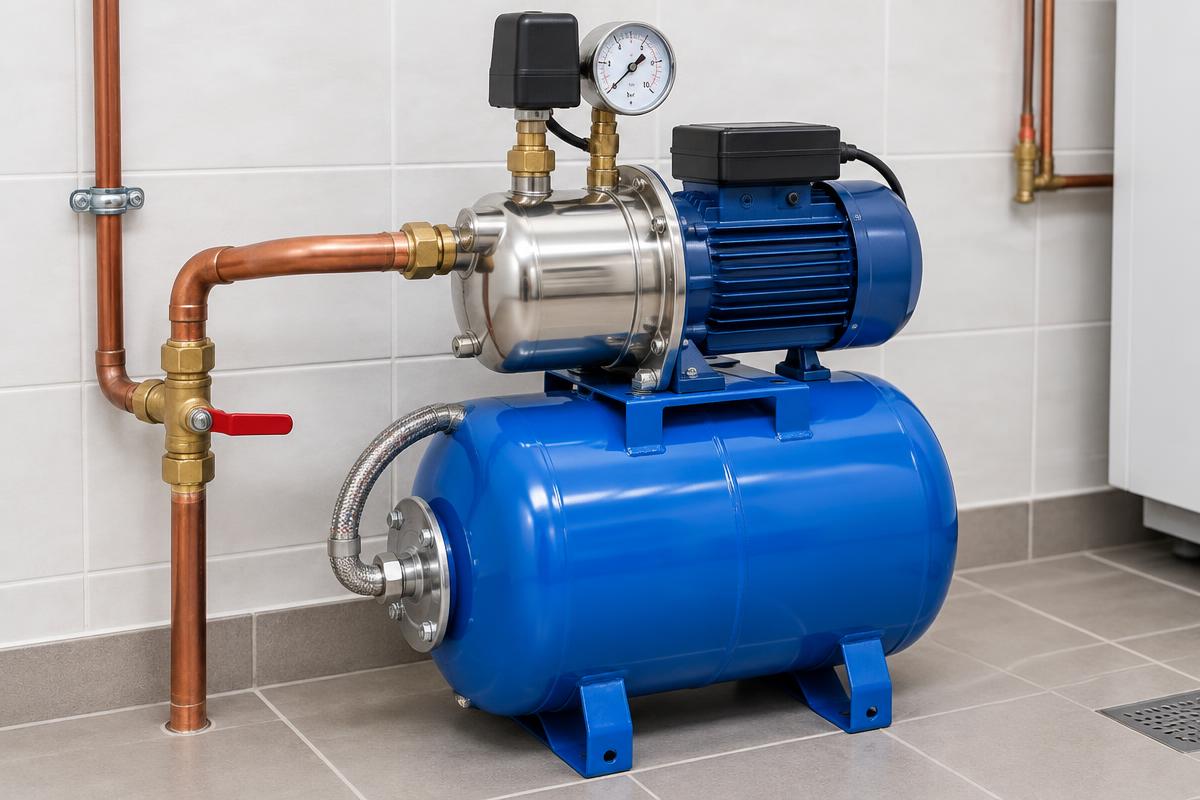
Inadequate water pressure on the upper floors of an apartment building is one of the most common problems a professional plumber has to solve. Whether it is an old building where new bathrooms have been added, or a new construction with modern requirements (hydromassage columns, flush valves), choosing the right booster pump system is critical. It is not enough to simply buy the largest pump on the market; an oversized pump will cause noise, water hammer, and premature wear on the piping.
1. Understanding the Basic Parameters: Flow Rate and Head
To select the appropriate system, we must understand two basic concepts that determine the performance of any pump:
- Flow Rate (Q): This is the quantity of water the pump can move per unit of time. It is usually measured in cubic meters per hour (m³/h) or liters per minute (l/min). In an apartment building, the flow rate depends on the number of apartments and the probability of simultaneous use.
- Manometric Head (H): This is the pressure generated by the pump, expressed in meters water column (m.w.c) or bar (10 meters ≈ 1 bar). It must be sufficient to overcome the height difference and friction losses in the pipes.
2. How to Calculate Flow Rate (Q) for Apartment Buildings
Calculating the flow rate is not done by simply adding up all the taps, as it is statistically unlikely that they will all be opened simultaneously. We use a Simultaneity Factor.
The Loading Units (LU) Rule
In practice, for a typical apartment building, we can follow an empirical but safe rule:
- For 4-6 apartments: A flow rate of approximately 3-4 m³/h is required.
- For 10-12 apartments: A flow rate of approximately 6-8 m³/h is required.
- For large units with 20+ apartments: The flow rate may exceed 12-15 m³/h.
It is important to consider if there are automated irrigation systems in communal areas, which usually operate during peak hours.
3. Calculating Manometric Head (H): Reaching the Top Floor
The booster pump must have the power to send water to the highest point (e.g., the 5th-floor shower) and provide a minimum operating pressure there (usually 1.5 to 2 bar).
The calculation formula is: H = Hstat + Hloss + Hreq
- Hstat (Static Head): The vertical distance from the pump to the highest tap (e.g., 5 floors x 3 meters = 15 meters).
- Hloss (Friction Losses): Losses caused by pipes, elbows, and valves. These are estimated at approximately 10-20% of the static head.
- Hreq (Required outlet pressure): The pressure we want the resident to have on the top floor (e.g., 20 meters or 2 bar).
Example: For a 5-story building with the booster pump in the basement, we need approximately 15m (height) + 3m (losses) + 20m (comfort pressure) = 38 meters of manometric head.
4. Types of Booster Pump Systems: Inverter vs. Conventional
The choice of control technology is just as important as the pump sizes.
Conventional Booster Pumps with Tank and Pressure Switch
This is the traditional solution. The pump starts when the pressure drops below a limit and stops when it reaches the maximum. A large expansion tank (e.g., 100-200 liters) protects the pump from frequent starts. Disadvantage: Pressure fluctuations during use.
Inverter Booster Pumps (Variable Speed)
These are the modern and most suitable solution for apartment buildings. The inverter adjusts the motor speed according to demand. If one tap is opened, the pump turns slowly. If ten are opened, the pump accelerates. Benefits include constant pressure, silent operation, and energy savings of up to 50%.
5. Common Installation Mistakes
Even the best booster pump will fail if the installation is faulty. Pay attention to the following:
- Lack of a break tank: Direct connection to the municipal water supply network is prohibited and creates negative pressure problems in the local network. Always use a water tank (plastic or stainless steel).
- Incorrect air pressure in the tank: The air pressure in the expansion tank should be checked every 6 months and should be 0.2 bar lower than the pump's start pressure.
- Small suction pipe diameter: The pipe feeding the pump from the tank must have at least the same or a larger diameter than the pump inlet.
Frequently Asked Questions (FAQ)
1. What is the ideal pressure for an apartment?
A pressure between 3 and 4 bar at the apartment entrance is considered ideal. Pressures above 5 bar can cause damage to flush mechanisms, faucets, and water heaters.
2. Why does the booster pump make noise and start constantly?
This is usually due to air loss in the expansion tank or a ruptured membrane. If the tank is full of water, there is no air "cushion," and the pump performs short, repetitive cycles (cycling).
3. Do I need a twin booster pump system?
In buildings with more than 10-12 apartments, a twin system (two pumps) is recommended. This provides redundancy (if one breaks, the other works) and better management of peak demand.
Conclusion
Choosing a booster pump system for an apartment building is not a random off-the-shelf purchase. It requires a proper study of height differences and the number of users. Investing in a system with Inverter technology and properly maintaining the expansion tank ensures the longevity of the network and real comfort for the residents. Before purchasing, always consult an experienced plumber or engineer who will perform accurate calculations for your specific building.