
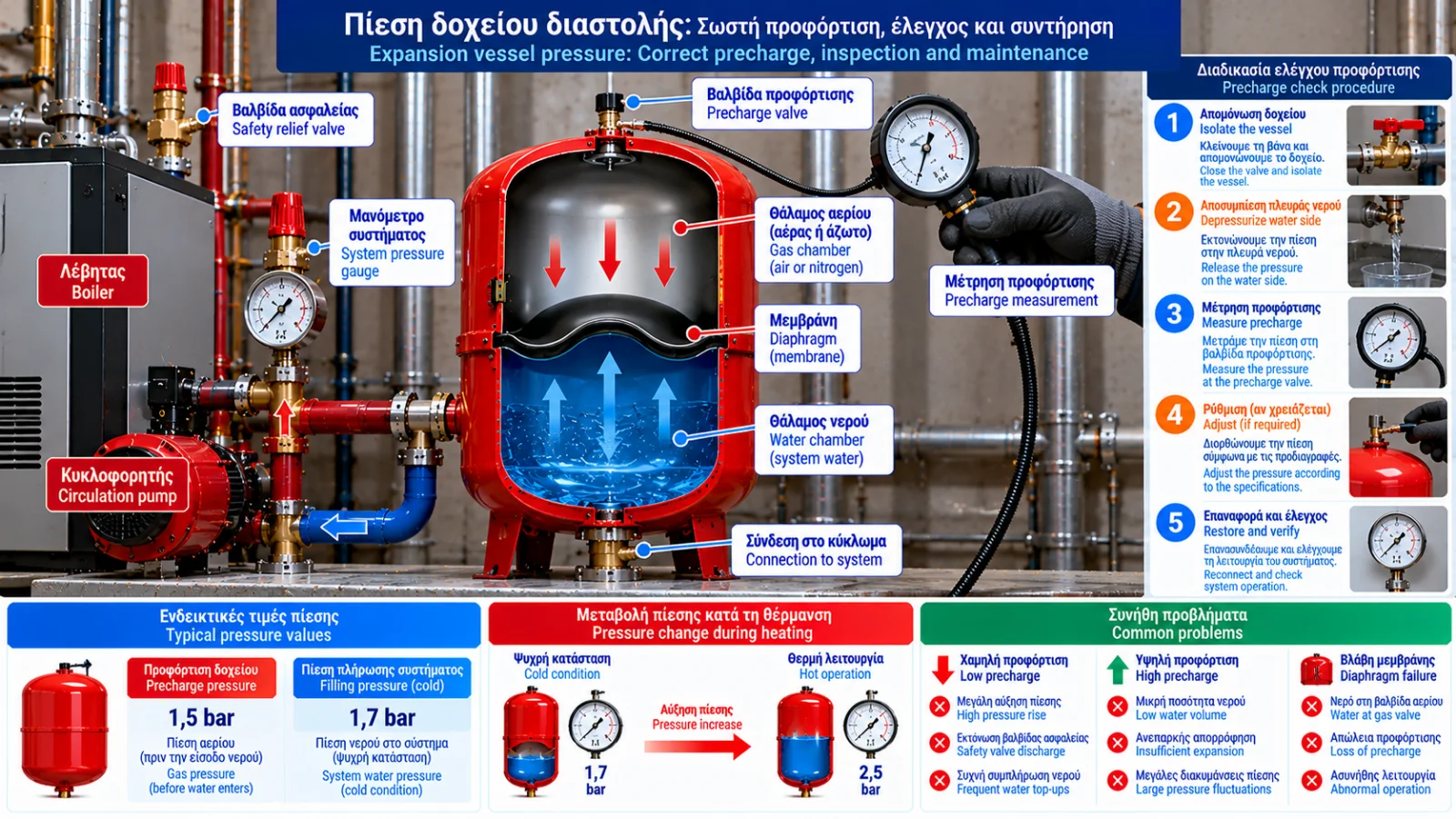
Expansion Vessel Pressure: Correct Precharge, Inspection and Maintenance
Precharge pressure is one of the most important operating parameters of a closed expansion vessel. Even a correctly sized vessel may perform poorly when its precharge does not match the actual system conditions.
In heating and cooling systems, incorrect precharge can cause excessive pressure fluctuations, frequent water top-ups, safety relief valve discharge and unreliable operation.
A proper procedure involves determining the required pressure, safely isolating the vessel, measuring the actual precharge and verifying performance after reconnection.
1. What Is Precharge Pressure?
Precharge pressure is the pressure of the gas inside the expansion vessel when the water side is depressurized.
The gas, usually air or nitrogen depending on vessel construction, acts as a compressible medium.
As water heats up and expands, it enters the vessel and compresses the gas.
Precharge establishes the initial operating condition of this process.
It should not be adjusted arbitrarily or copied from another installation.
2. Precharge Pressure Versus Filling Pressure
These two pressures have different purposes.
Precharge pressure (p₀)
The gas pressure in the vessel with the water side depressurized.
Filling pressure (pfill)
The system water pressure under the specified initial, usually cold, operating condition.
In many installations, filling pressure is selected slightly above precharge so that an initial water reserve is available inside the vessel.
The exact relationship depends on the design method and manufacturer instructions.
3. Why Is Correct Precharge Important?
Precharge affects:
The initial quantity of water inside the vessel.
Available expansion acceptance capacity.
Pressure rise during heating.
System pressure during cooling.
Operating stability.
The likelihood of safety relief valve discharge.
Incorrect adjustment can create symptoms similar to those of an undersized vessel.
4. How Static Height Affects Precharge
Static height is the elevation difference between the vessel connection and the highest point in the circuit.
For water, the hydrostatic pressure difference can be approximated by:
pstatic ≈ H / 10
Where:
pstatic: hydrostatic pressure difference in bar.
H: elevation difference in metres.
For a 12-metre-high installation:
pstatic ≈ 1.2 bar
This is the hydrostatic component, not necessarily the final precharge.
An additional margin is needed to maintain appropriate pressure at the highest point, according to design requirements.
5. Practical Precharge Example
Consider a heating system with:
Parameter | Illustrative Value |
|---|---|
Static height | 12 m |
Hydrostatic pressure difference | 1.2 bar |
Additional design margin | 0.3 bar |
Illustrative precharge | 1.5 bar(g) |
Illustrative filling pressure | 1.7 bar(g) |
Under these assumptions:
p₀ = 1.2 + 0.3 = 1.5 bar(g)
Filling pressure is illustratively selected as 1.7 bar(g).
These values are educational examples, not universal settings.
Before applying actual values, equipment requirements, vessel location, maximum operating pressure and available vessel capacity must be checked.
6. How to Measure Precharge Correctly
Precharge cannot be reliably determined while the vessel's water side remains pressurized.
Under those conditions, gas pressure may follow system pressure.
For a correct measurement, the water side must be at zero gauge pressure according to the manufacturer's procedure.
The work should be carried out by appropriately trained personnel.
7. Precharge Inspection Procedure
A typical inspection involves the following stages.
Step 1 — Safe shutdown
Place the installation in a safe condition and allow it to cool where required.
Step 2 — Vessel isolation
Isolate the vessel using a suitable maintenance arrangement, where provided.
Isolation must not leave the installation operating without the required expansion protection.
Step 3 — Water-side depressurization
Depressurize the water side safely and in a controlled manner.
Step 4 — Gas pressure measurement
Connect a suitable pressure gauge to the precharge valve.
Step 5 — Compare with design value
Compare the measured pressure with the documented required precharge.
Step 6 — Adjust where permitted
Adjust pressure only according to manufacturer instructions using appropriate equipment.
Step 7 — Restore the installation
Reconnect the vessel and restore the specified system filling pressure.
Step 8 — Operational verification
Check pressure behavior during heating and cooling.
8. Required Equipment
A technician may use:
A suitable, verified gas pressure gauge.
Compatible precharge equipment.
Safe isolation and depressurization arrangements.
A thermometer or system temperature readings.
Vessel technical documentation.
Appropriate personal protective equipment.
Unsuitable equipment may produce inaccurate readings or create hazardous conditions.
9. Can Precharge Be Measured with the System Full?
A gas valve reading taken while the vessel is connected to a pressurized system does not necessarily reveal the original precharge.
If water has entered the vessel, the gas has already been compressed.
The measured pressure therefore represents the current operating state rather than the initial precharge.
Reliable precharge measurement requires depressurizing the water side.
10. What Happens When Precharge Is Too Low?
If precharge is too low relative to filling pressure, excessive water may enter the vessel even when the system is cold.
This reduces the remaining capacity for thermal expansion.
Possible symptoms include:
Large pressure rise during heating.
Safety relief valve discharge.
Pressure drop after cooling.
Frequent need for water top-ups.
Other faults can cause similar symptoms, so diagnosis is required.
11. What Happens When Precharge Is Too High?
If precharge exceeds the initial filling pressure, the vessel may contain no water in the cold condition.
This can limit its ability to maintain pressure as the circuit cools or experiences small volume changes.
It may also reduce the available pressure range for accommodating expansion.
Correct adjustment should be based on design calculations, not the assumption that higher precharge is always better.
12. Why Does Precharge Decrease Over Time?
Gas pressure may decrease because of:
Small leaks at the gas valve.
Gas permeation through the diaphragm.
Seal deterioration.
Diaphragm damage.
Other vessel defects.
Temperature changes may also affect measured gas pressure.
Significant or repeated pressure loss requires technical investigation.
13. Signs of Possible Diaphragm Failure
Potential indicators include:
Rapid system pressure changes.
Inability to retain precharge.
Water emerging from the gas valve.
Repeated safety relief valve discharge.
Water at the gas valve is a strong indication of internal failure.
However, not every pressure drop proves that the diaphragm has failed.
14. Precharge and Safety Relief Valve Operation
The safety relief valve protects the system against overpressure.
If the expansion vessel has insufficient acceptance capacity, pressure may approach the relief valve setting.
Arbitrarily increasing the relief valve setting is not an acceptable solution.
The following must be checked:
Precharge.
Filling pressure.
Nominal vessel volume.
Actual system water volume.
Operating temperatures.
Vessel connection to the circuit.
15. How Often Should Precharge Be Checked?
Inspection frequency depends on the manufacturer, installation type and maintenance requirements.
In many applications, inspection is included in periodic, often annual, maintenance.
Additional inspection is appropriate when there are:
Unusual pressure fluctuations.
Frequent water top-ups.
Safety relief valve discharge.
Changes in system volume or operating conditions.
No universal inspection interval replaces manufacturer instructions.
16. Expansion Vessels in Heat Pump Systems
In heat pump installations, precharge must be evaluated against:
Static height.
Total system water volume.
Buffer tank capacity.
Underfloor heating circuits.
Fan coil units.
Minimum and maximum temperatures.
Possible glycol use.
Factory precharge in an integrated expansion vessel may not suit every installation.
17. Maintenance in Cooling Systems
Cooling circuits require attention to operating temperatures and fluid type.
Water–glycol mixtures may have different expansion properties.
Precharge and vessel capacity must be suitable for actual operating conditions.
Periodic inspection should also include corrosion, connections and leaks.
18. Common Maintenance Mistakes
Frequent mistakes include:
Measuring precharge with the water side pressurized.
Adjusting without knowing static height.
Confusing precharge with filling pressure.
Increasing precharge without checking vessel capacity.
Failing to inspect the gas valve.
Returning the system to operation with the vessel isolated.
Ignoring repeated safety relief valve discharge.
Using unsuitable measuring equipment.
Failing to record previous readings.
Working on pressurized equipment without appropriate procedures.
19. Periodic Inspection Record
Parameter | Record |
|---|---|
Manufacturer / model | |
Nominal volume | L |
Maximum allowable pressure | bar |
Static height | m |
Required precharge | bar(g) |
Measured precharge | bar(g) |
Filling pressure | bar(g) |
Pressure during hot operation | bar(g) |
Gas valve condition | |
Leakage indications | |
Diaphragm failure indications | |
Inspection date | |
Technician |
Maintaining a history helps identify gradual precharge loss.
20. Standards and Technical References
Relevant references include:
EN 12828: Design of water-based heating systems.
EN 13831: Closed expansion vessels with built-in diaphragm.
Directive 2014/68/EU (PED): Pressure equipment requirements, where applicable.
Manufacturer instructions: Precharge, maintenance, permissible pressures and inspection procedures.
Applicable editions and requirements must be verified.
Conclusion
Correct precharge is essential for effective expansion vessel operation.
Its selection depends on static height, filling pressure, vessel location and design requirements.
Reliable inspection requires depressurizing the water side and following the manufacturer's procedure.
Periodic maintenance, measurement records and investigation of unusual pressure changes contribute to safe and efficient system operation.