
Why Does My RCD Keep Tripping? 8 Common Causes and What to Do
A residual current device (RCD) is one of the most important electrical safety devices in a home. When it trips and disconnects the electricity supply, it may be responding to an earth leakage current or another electrical fault that requires investigation.
An RCD that repeatedly trips should never be ignored. Although the cause may be relatively straightforward, it can also indicate a potentially dangerous electrical problem.
In this guide, we explain how RCDs work, eight possible reasons for repeated tripping, and when professional electrical inspection is necessary.
What Is an RCD and How Does It Work?
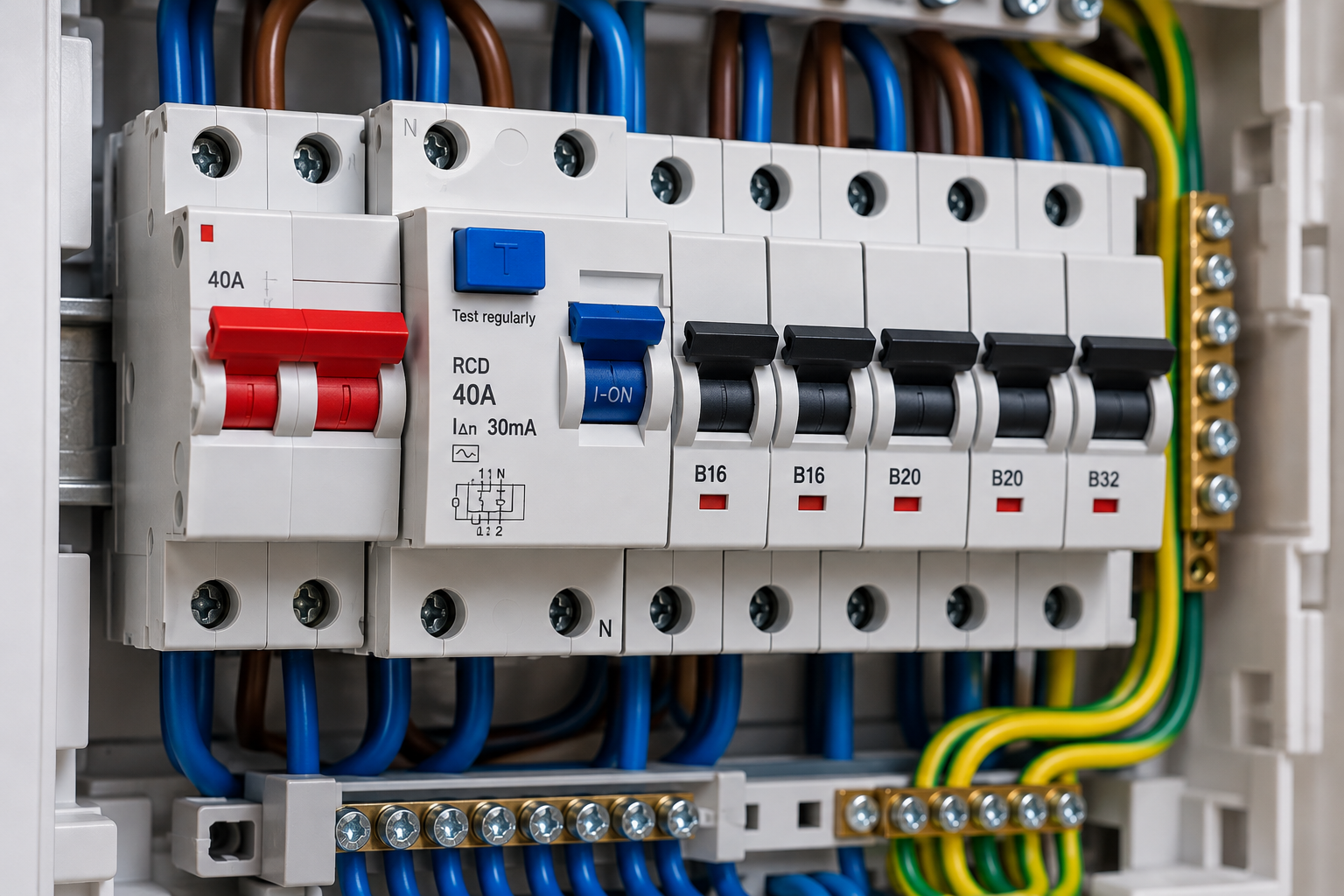
An RCD, or residual current device, monitors the balance of electrical current flowing through the live conductors of a circuit.
Under normal conditions, the current flowing out should equal the current returning. If a difference occurs, some current may be flowing through an unintended path.
When the residual current reaches the device’s operating threshold, the RCD disconnects the circuit.
In many residential applications, 30 mA RCDs are used to provide additional protection against electric shock.
However, an RCD does not replace proper earthing or other essential protective measures. A standard RCD also does not provide overload or short-circuit protection by itself.
1. A Faulty Electrical Appliance
A defective appliance is a common possible cause of RCD tripping.
Damaged internal insulation or electrical components may allow current to leak to earth.
Appliances that may develop these faults include:
Washing machines
Dishwashers
Electric ovens
Water heaters
Other appliances containing heating elements
If the RCD trips whenever a particular appliance operates, stop using that appliance and arrange a professional inspection.
2. Moisture in Electrical Installations
Moisture can reduce electrical insulation resistance and create unwanted leakage paths.
This problem may occur in:
Outdoor sockets
Garden lighting
Basements
Electrical junction boxes
Equipment exposed to rain or condensation
If tripping frequently occurs after rainfall, moisture ingress may be involved.
Electrical equipment affected by water should not be handled or operated until it has been assessed safely.
3. Damaged Cable Insulation
Electrical cables can deteriorate because of age, heat, mechanical damage, or improper installation.
When insulation becomes damaged, leakage current may flow through unintended paths.
The affected cable may be hidden inside a wall, ceiling, floor, or electrical enclosure.
A qualified electrician can perform insulation resistance testing to identify possible defects.
4. A Faulty Electric Water Heater
Electric water heaters contain heating elements that operate in demanding conditions.
Over time, insulation failure within a heating element may lead to leakage current.
A typical warning sign is an RCD that trips when the water heater is switched on or begins heating.
Never disconnect the protective earth conductor or bypass the RCD to keep the water heater operating.
5. Incorrect Neutral and Earth Connections
Incorrect connections between neutral and protective earth conductors downstream of an RCD may cause residual current imbalance.
Problems can also occur when neutral conductors are incorrectly shared between circuits protected by different RCDs.
These faults require inspection of the electrical installation and must be diagnosed by a qualified electrician.
6. Accumulated Leakage Current
Some electronic devices naturally produce small leakage currents during normal operation.
This can occur because of electromagnetic interference filters and other internal electronic components.
When multiple devices are connected to circuits protected by the same RCD, their leakage currents may add together.
The combined leakage current can contribute to unwanted tripping, even when no single appliance has a major fault.
A professional assessment can determine whether circuit distribution or equipment selection needs improvement.
7. An Unsuitable Type of RCD
Not all RCDs have the same detection capabilities.
Different types, including AC, A, F, and B, are designed to respond to different forms of residual current.
Modern electronic equipment may require a specific RCD type depending on its design and the applicable installation requirements.
An unsuitable RCD may fail to provide the required protection or contribute to operating problems.
The correct device must be selected according to the installation, equipment manufacturer’s instructions, and applicable electrical standards.
8. A Defective RCD
Like other electrical components, an RCD may eventually develop a fault.
Possible issues include mechanical deterioration, internal component failure, or incorrect operation.
However, an RCD should not be assumed defective simply because it trips frequently.
An electrician should investigate the connected circuits and test the device before recommending replacement.
What Should You Do When Your RCD Trips?
If your RCD trips, the priority is safety.
Do not repeatedly reset the device without investigating the cause.
Follow these basic precautions:
Do not bypass or disable the RCD.
Do not open the electrical distribution board or touch internal wiring.
Do not touch wet or visibly damaged electrical equipment.
If it is safe, unplug portable appliances that may be involved.
Note when the tripping occurs and which appliances were operating.
Contact a qualified electrician if the problem continues.
If you notice smoke, sparks, burning smells, signs of electric shock, or water near electrical equipment, stay clear of the hazard and seek urgent professional assistance.
How Is an RCD Tested?
Many RCDs include a TEST button.
This button allows a basic functional check in accordance with the manufacturer’s instructions.
However, pressing the TEST button does not replace a complete electrical safety inspection.
A qualified electrician may use specialist instruments to assess:
RCD operating time
Residual operating current
Insulation resistance
Leakage currents
Circuit connections and protective arrangements
Testing requirements depend on the installation and applicable electrical regulations.
Frequently Asked Questions
Why does my RCD trip when nothing is switched on?
Possible causes include permanently connected equipment, damaged wiring, moisture, accumulated leakage current, or a faulty RCD.
Some appliances may remain electrically connected even when they appear switched off.
Can a water heater cause an RCD to trip?
Yes. A heating element with damaged insulation or another internal electrical fault can produce leakage current and cause the RCD to operate.
Why does my RCD trip when it rains?
Rainwater may enter outdoor electrical equipment, sockets, lighting fixtures, or damaged enclosures.
This can reduce insulation resistance and cause leakage current.
Repeated tripping during wet weather requires professional investigation.
Can I install a higher-rated RCD to stop the tripping?
Changing the RCD’s sensitivity or type without identifying the underlying problem is not a safe solution.
The required protective device must be selected by a qualified electrician based on the installation’s design and relevant standards.
Does an RCD protect against every electrical hazard?
No. RCDs provide important protection against certain residual-current faults, but they do not eliminate every electric shock risk.
Correct earthing, circuit protection, suitable equipment, and proper installation remain essential.
Conclusion
An RCD that keeps tripping is a warning sign that should be taken seriously.
Possible causes range from faulty appliances and moisture to damaged cables, incorrect wiring, accumulated leakage currents, or problems with the RCD itself.
The safest approach is to identify the underlying cause through proper electrical inspection rather than repeatedly restoring the electricity supply.
A qualified electrician can perform the necessary tests and recommend appropriate corrective measures.
thermosphere.gr — Practical technical information for safer electrical installations.
Disclaimer: This article is for general information only. It is not a substitute for professional electrical inspection or a guide to performing electrical work.
Technical References
IEC 61008-1 — Residual current operated circuit-breakers without integral overcurrent protection.
IEC 61009-1 — Residual current operated circuit-breakers with integral overcurrent protection.
IEC 60364 — Low-voltage electrical installations.
ELOT 60364 — Requirements for electrical installations in Greece.