
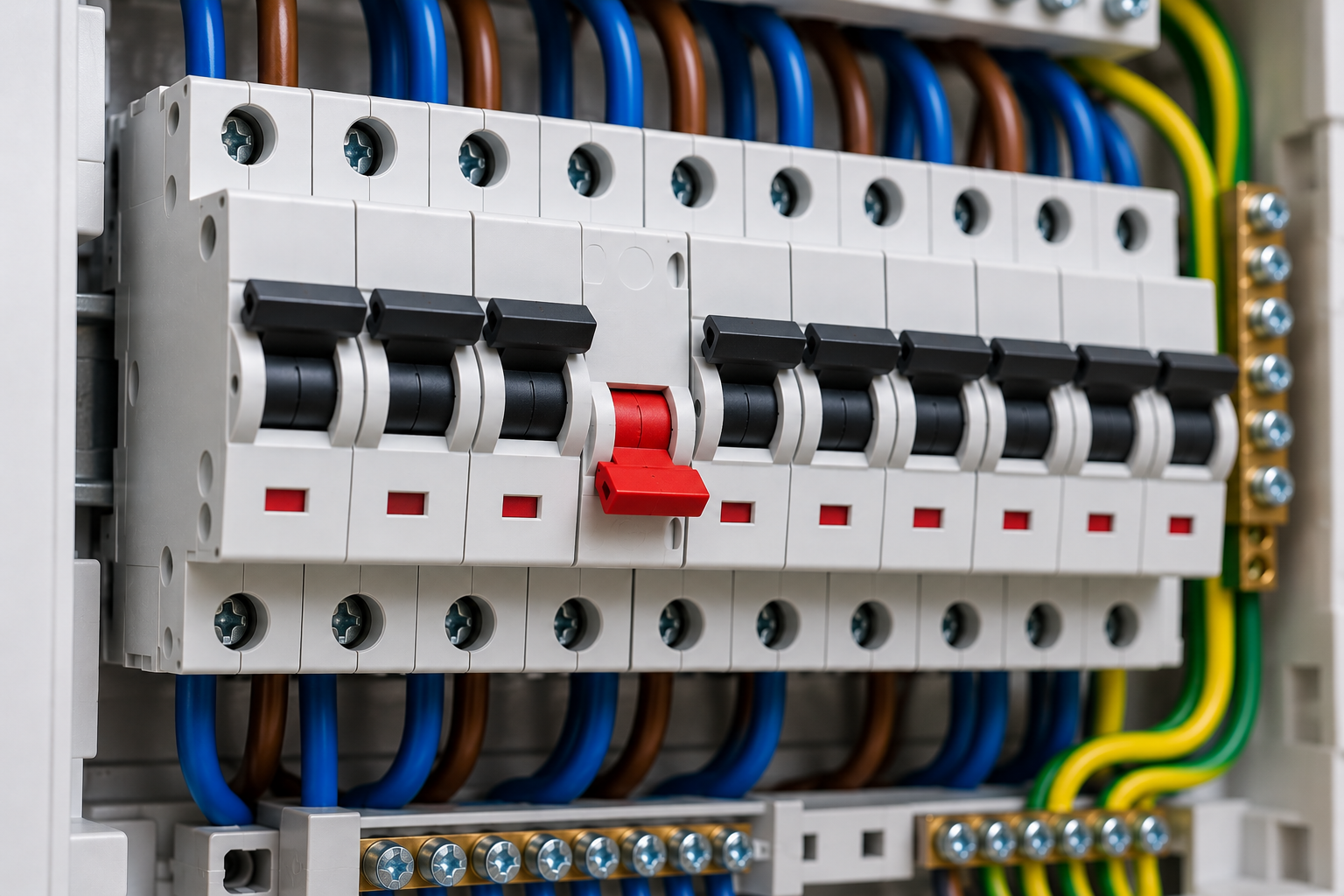
Why Does My Circuit Breaker Keep Tripping? 7 Causes and What to Do
When a circuit breaker trips, electricity is disconnected from one or more circuits in your home.
Sometimes this happens when several appliances operate simultaneously. In other cases, the breaker trips as soon as a particular appliance is switched on, or seemingly without warning.
A miniature circuit breaker (MCB) is designed to protect electrical circuits against excessive current. Repeated tripping may indicate an overloaded circuit, a short circuit, defective equipment, or another problem requiring investigation.
In this guide, we examine seven possible causes of circuit breaker tripping, explain how a breaker differs from an RCD, and outline the precautions homeowners should take.
What Is a Circuit Breaker and How Does It Work?
A miniature circuit breaker (MCB) is a protective device designed to interrupt electrical current under specified overcurrent conditions.
Its main functions are:
Overload protection: Disconnecting a circuit when excessive current persists for a sufficient period.
Short-circuit protection: Interrupting high fault currents resulting from certain electrical faults.
Circuit breakers must be selected according to the electrical installation, conductor characteristics, connected loads, and applicable standards.
Common markings include B10, B16, and C16.
The letter indicates the instantaneous tripping characteristic, while the number indicates the rated current in amperes.
Replacing a breaker with one of a higher current rating without proper assessment can create a serious electrical hazard.
1. An Overloaded Electrical Circuit
Overloading is one of the most common reasons a circuit breaker may trip.
It occurs when the current flowing through a circuit exceeds its intended operating capacity.
For example, operating an electric heater alongside several other high-power appliances on the same circuit may result in excessive current.
Depending on the magnitude and duration of the overload, the breaker may trip after a period of time rather than immediately.
What should you do?
Avoid operating multiple high-power appliances on the same circuit when doing so exceeds its intended capacity.
If the problem continues, have the installation assessed by a qualified electrician.
Do not use extension leads or power strips as a way to increase the circuit’s electrical capacity.
2. A Short Circuit
A short circuit occurs when an unintended low-impedance electrical connection develops between conductors at different potentials.
This can produce a very high current.
Possible causes include:
Damaged cable insulation.
Internal faults in electrical appliances.
Crushed or deteriorated power cables.
Defective electrical components.
Damaged electrical connections.
A circuit breaker may disconnect the supply very quickly when a sufficiently high short-circuit current occurs.
What should you do?
Do not repeatedly reset the breaker.
A suspected short circuit requires professional investigation before the affected circuit is returned to service.
3. A Faulty Electrical Appliance
An electrical appliance may develop a fault that causes excessive current.
Possible examples include:
Electric ovens.
Space heaters.
Washing machines.
Dishwashers.
Appliances containing electric motors.
If the circuit breaker consistently trips when a particular appliance starts operating, that appliance may be involved.
However, the fault could also be associated with the circuit supplying it.
What should you do?
Stop using the suspected appliance and arrange a professional inspection.
Do not attempt internal repairs without the necessary qualifications.
4. Damaged Sockets or Loose Electrical Connections
Loose or deteriorated electrical connections can create localised heating and dangerous conditions.
In some cases, the damage may develop into an overcurrent fault that causes the breaker to trip.
However, a loose connection does not necessarily produce enough current to activate an MCB.
This is particularly important because overheating can occur even when the breaker remains switched on.
Warning signs include:
Burning smells.
Discoloured sockets.
Visible heat damage.
Unusual crackling sounds.
Sparks.
What should you do?
Stop using the affected socket or equipment and contact a qualified electrician.
Do not touch visibly damaged electrical components.
5. High Starting Current
Some electrical equipment draws a temporary surge of current when it starts.
This is known as inrush current.
It may occur in equipment containing:
Electric motors.
Transformers.
Certain power supplies.
Other electrical and electronic components.
If the starting current exceeds the circuit breaker’s instantaneous operating characteristic, unwanted tripping may occur.
What should you do?
A qualified electrician should assess the load characteristics, circuit wiring, and protective device.
Installing a larger breaker without checking the installation is not an appropriate solution.
6. An Incorrectly Selected or Defective Circuit Breaker
A circuit breaker may be unsuitable for the circuit it protects or may have developed a fault.
For example, an inappropriate tripping characteristic may contribute to unwanted operation with certain electrical loads.
A breaker’s age alone does not prove that it is defective.
Its condition and suitability must be assessed alongside the installation’s electrical characteristics.
What should you do?
Do not replace the breaker yourself.
A qualified electrician should determine whether the device requires replacement and select an appropriate protective device.
7. A Fault Within the Electrical Installation
Sometimes the problem is not caused by a portable appliance.
The fault may be located within the building’s electrical installation.
Possible causes include:
Damaged fixed wiring.
Defective electrical accessories.
Incorrectly designed or modified circuits.
Faults in permanently connected equipment.
Inadequate circuit protection arrangements.
These problems may require electrical testing and inspection.
What should you do?
Arrange an inspection by a qualified electrician.
Do not open the electrical distribution board or attempt to inspect internal wiring yourself.
Circuit Breaker vs RCD: What Is the Difference?
Circuit breakers and residual current devices (RCDs) protect against different electrical hazards.
MCB | RCD / RCCB |
Protects against overloads | Detects residual current |
Protects against short circuits | Provides additional protection against certain electric shock hazards |
Does not necessarily detect small leakage currents | A standard RCCB does not provide overload or short-circuit protection |
An RCBO combines residual current protection with overcurrent protection in one device.
For more information, read our related guide on thermosphere.gr: Circuit Breaker vs RCD: What’s the Difference and What Does Each Protect?
What Should You Do When a Circuit Breaker Trips?
Safety should always come first.
1. Look for warning signs.
If you notice smoke, sparks, burning smells, or visible damage, keep away from the affected equipment and seek urgent professional assistance.
2. Stop using potentially affected appliances.
If it is safe to do so, unplug portable appliances that were operating when the breaker tripped.
3. Identify when the problem occurs.
Note whether the breaker trips during the operation of a particular appliance or under specific conditions.
4. Avoid repeated resetting.
Repeatedly restoring the electricity supply without identifying the fault may expose the installation to further hazards.
5. Contact a qualified electrician.
Professional inspection is necessary when the problem continues or its cause is uncertain.
Never bypass a protective device or interfere with internal distribution-board wiring.
Why You Should Never Install a Higher-Rated Breaker Without Assessment
A common misconception is that replacing a frequently tripping breaker with a higher-rated one will solve the problem.
For example, replacing a 16 A breaker with a 20 A or 25 A breaker may appear to prevent unwanted trips.
However, this change can leave the electrical wiring inadequately protected.
The correct rating depends on factors such as:
Cable size and installation method.
Current-carrying capacity.
Connected electrical loads.
Fault-current conditions.
Applicable electrical standards.
Only a qualified electrician should determine whether a protective device or circuit requires modification.
When Should You Call an Electrician?
Professional assistance is recommended when:
The circuit breaker trips repeatedly.
A breaker trips immediately after being reset.
A particular appliance consistently causes tripping.
Electrical sockets or equipment show signs of overheating.
You notice sparks or burning smells.
The installation is old or has been modified.
You intend to connect high-power equipment.
An electrician may investigate circuit loading, insulation condition, electrical connections, and protective-device suitability.
Frequently Asked Questions
Why does my circuit breaker trip when I turn on the oven?
Possible causes include an overloaded circuit, a fault within the oven, or a problem with its electrical supply.
A professional inspection is needed to determine the cause.
Why does my breaker trip immediately after I reset it?
An active fault, such as a short circuit, may still be present.
Avoid repeated resetting and contact a qualified electrician.
Can a breaker trip when no appliances are running?
Yes.
A fault may exist in fixed wiring or permanently connected electrical equipment, even when no portable appliance appears to be operating.
Can I replace a 16 A breaker with a 20 A breaker?
Not without a proper technical assessment.
The breaker must be correctly coordinated with the wiring and the installation’s protection requirements.
Is it normal for an electrical panel to feel warm?
Some electrical components may experience a normal temperature rise during operation.
However, excessive heat, burning smells, discolouration, or other signs of overheating require professional attention.
Conclusion
A circuit breaker that repeatedly trips should never be ignored.
The cause may be an overloaded circuit, a short circuit, a faulty appliance, damaged connections, or an unsuitable protective device.
The correct approach is to identify and resolve the underlying problem rather than repeatedly resetting the breaker or increasing its current rating.
A qualified electrician can carry out the necessary inspection and recommend safe corrective measures.
thermosphere.gr — Practical technical knowledge for safer electrical installations.
Disclaimer: This article is for general information only and does not constitute instructions for carrying out electrical work or replace professional electrical inspection.
Technical References
IEC 60898-1 — Circuit-breakers for overcurrent protection for household and similar installations.
IEC 60364 — Low-voltage electrical installations.
IEC 61008-1 — Residual current operated circuit-breakers without integral overcurrent protection.
IEC 61009-1 — Residual current operated circuit-breakers with integral overcurrent protection.
ELOT 60364 — Requirements for electrical installations in Greece.