
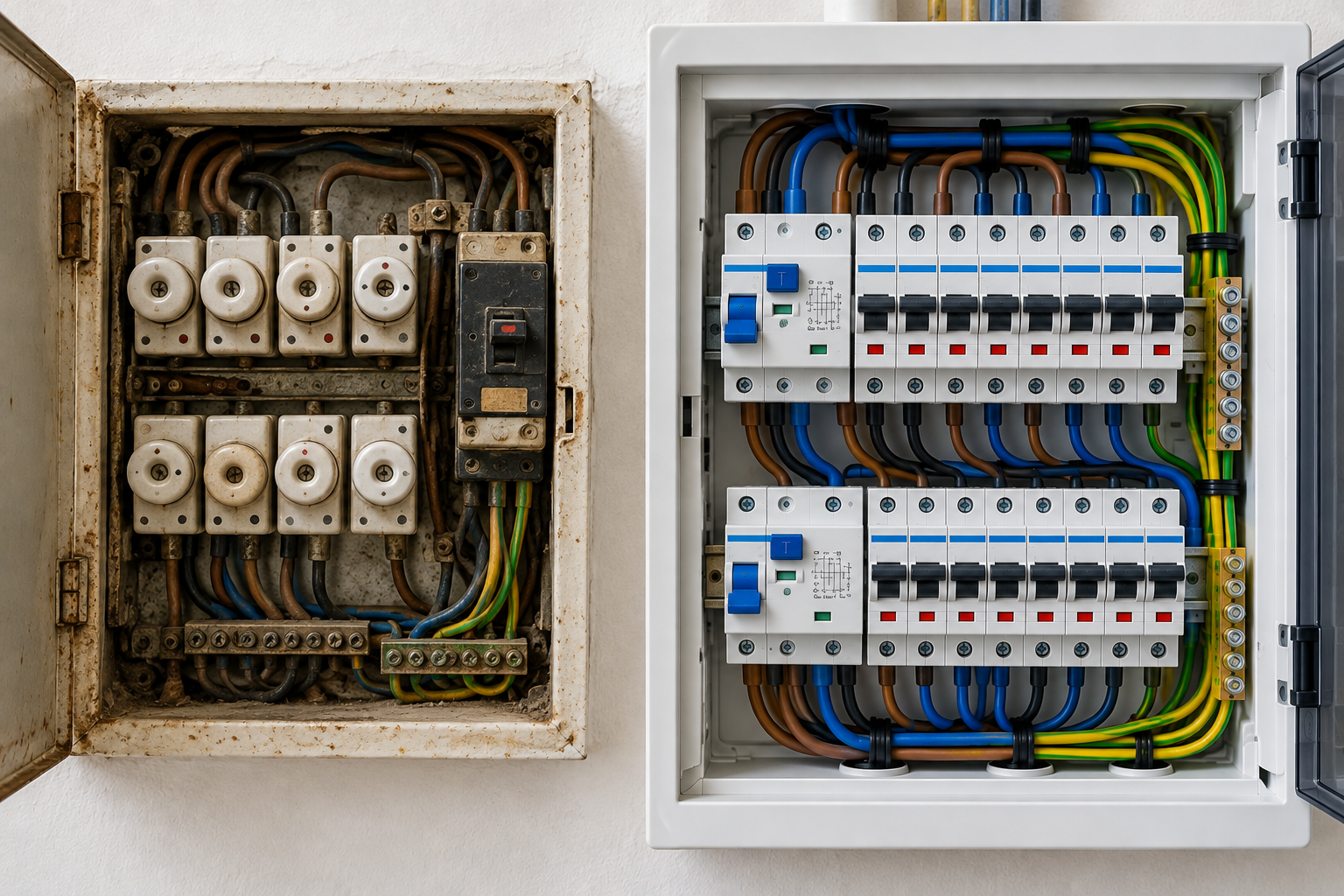
Old Electrical Panels: When to Replace Them, Warning Signs and Costs
The electrical distribution board is one of the most important components of a building’s electrical installation. It distributes electricity to individual circuits and houses protective devices designed to respond to electrical faults.
Many older homes still have electrical panels installed decades ago. Some contain traditional ceramic fuses, outdated switching equipment, a limited number of circuits or components that no longer meet the property’s electrical requirements.
However, the age of an electrical panel alone does not necessarily mean it must be replaced.
Its physical condition, protective devices, electrical design, compliance with applicable requirements and inspection results are more important than its installation date.
This guide explains when an old electrical panel may need replacement, which warning signs should never be ignored, how professional inspections and maintenance work, and what determines the cost of an upgrade.
1. How Can You Identify an Old Electrical Panel?
Older electrical distribution boards may contain:
Traditional rewirable or cartridge-type fuses.
Ceramic screw-in fuse holders.
Older switching and protective equipment.
A limited number of individual circuits.
Missing or unclear circuit labels.
Worn enclosures and damaged covers.
Previous modifications without adequate documentation.
Insufficient space for additional protective devices.
These characteristics do not automatically prove that an installation is unsafe.
For example, an older fuse system is not necessarily dangerous simply because of its age. Its suitability must be assessed within the context of the complete electrical installation.
A qualified electrician should evaluate the condition of the equipment, the wiring and the effectiveness of the protective measures.
2. When Should an Old Electrical Panel Be Replaced?
Replacement may become necessary when existing problems cannot be resolved safely through repairs or a limited upgrade.
Physical Damage and Overheating
Burn marks, heat-damaged insulation, deteriorated contacts and deformed components can indicate serious electrical problems.
Overheating may result from several causes, including unsuitable equipment, excessive current or defective connections.
A professional inspection is required to identify the underlying cause.
Inadequate Protective Devices
Older installations may not have the protective arrangements required for their present configuration or intended use.
If the existing protective devices are unsuitable, the installation may require redesign, upgrading or replacement.
Increased Electrical Demand
Modern homes may contain appliances and equipment that were not anticipated when the original electrical installation was designed.
Examples include:
Heat pumps.
Electric vehicle chargers.
Electric cooking appliances.
Electric water heaters.
Additional high-power equipment.
Installing such equipment does not automatically require a new distribution board.
The electrician must first assess the supply capacity, wiring, circuit protection and electrical load requirements.
Extensive Previous Modifications
A distribution board that has undergone numerous undocumented changes may be difficult to inspect, maintain or expand safely.
In some cases, complete replacement may be more appropriate than attempting further modifications.
Unsuitable Enclosure or Environmental Conditions
Water ingress, corrosion, excessive humidity and damaged enclosures can compromise electrical safety.
Depending on the condition of the installation, the enclosure or the entire distribution board may require replacement.
3. Seven Electrical Panel Warning Signs You Should Never Ignore
Certain symptoms indicate that an electrical panel requires urgent professional attention.
1. A Burning Smell
An unusual burning smell near the electrical panel may indicate overheating or electrical component failure.
It should never be ignored.
2. Smoke or Sparks
Visible smoke or sparking is a serious warning sign.
Do not approach or touch the affected equipment.
3. Discoloured or Deformed Components
Blackened surfaces, melted plastic or visible deformation may indicate thermal damage.
4. Repeated Circuit Breaker or RCD Tripping
Circuit breakers and residual current devices may operate when they detect conditions requiring disconnection.
Repeated tripping should be investigated rather than treated as an inconvenience.
Continuously resetting a protective device without identifying the cause is not a safe solution.
5. Unusual Electrical Noises
Crackling, buzzing or other abnormal sounds may indicate a problem requiring professional investigation.
6. Water or Moisture
Signs of water entering an electrical enclosure require immediate attention.
Water can compromise insulation and protective equipment.
7. Exposed Electrical Parts
Missing covers, damaged enclosures or exposed conductors may create a risk of electric shock.
Important safety warning: If an electrical panel is smoking, sparking, overheating or producing a strong burning smell, do not open or touch it. Keep people away and seek urgent professional assistance. Isolate the electrical supply only if this can be done safely without approaching the hazard.
4. What If an Old Electrical Panel Has No RCD Protection?
A residual current device, commonly called an RCD, is an important electrical protective device.
It monitors the difference between the currents flowing through the active conductors of a circuit.
When the residual current reaches the device’s operating threshold under the specified conditions, the RCD can disconnect the circuit.
Some older installations may lack RCD protection or may not provide appropriate additional protection for all circuits where it is required.
The necessary improvements depend on the applicable electrical regulations and the actual installation design.
However, adding an RCD alone does not guarantee that an installation is safe.
Other factors must also be evaluated, including:
Earthing arrangements.
Protective conductor continuity.
Insulation condition.
Circuit design.
Overcurrent protection.
Correct device selection and coordination.
An RCD does not normally provide overload or short-circuit protection.
A combined device known as an RCBO incorporates residual current protection and overcurrent protection.
The appropriate protective arrangement must be determined by a qualified electrician.
5. Can an Old Electrical Panel Be Upgraded Without Complete Replacement?
In some cases, yes.
If the existing enclosure and electrical arrangement are suitable, a qualified electrician may recommend targeted improvements.
Possible work may include:
Replacing defective protective devices.
Adding suitable protective equipment where technically feasible.
Improving circuit identification.
Correcting defective connections.
Reorganising circuits.
Updating installation documentation.
However, not every existing enclosure can safely accommodate modern equipment.
Component compatibility, available space, electrical ratings and installation requirements must all be considered.
If the existing panel cannot be upgraded safely, complete replacement may be necessary.
6. What Does a Professional Electrical Panel Inspection Include?
A professional inspection generally involves a visual examination and appropriate electrical verification procedures.
The exact scope depends on the installation and the applicable standards.
Enclosure and Component Condition
The electrician examines the distribution board for:
Physical damage.
Signs of overheating.
Corrosion.
Moisture.
Missing covers.
Deteriorated components.
Earthing and Protective Conductors
The inspection assesses the relevant protective measures and includes appropriate verification of the earthing arrangement.
Protective Devices
Circuit breakers, RCDs and other protective devices are assessed for suitability and operation, as applicable.
Insulation Resistance
Appropriate insulation resistance testing can help identify defects in electrical circuits.
Protective Conductor Continuity
Continuity testing verifies the relevant protective conductor paths where required.
Circuit Identification and Documentation
The electrician checks whether circuits are clearly identified and whether the installation documentation is adequate.
These activities require appropriate qualifications, instruments and safe working procedures.
7. How Often Should an Electrical Panel Be Inspected?
There is no single inspection interval that applies to every electrical installation worldwide.
Mandatory periodic inspection requirements depend on factors such as:
National regulations.
Building use.
Installation characteristics.
Environmental conditions.
Specific legal requirements.
In Greece, periodic electrical installation inspections and the relevant electrician’s declaration, known as the ΥΔΕ (YDE), are governed by the applicable national requirements.
Property owners should verify the requirements relevant to their installation.
Additional inspections may also be appropriate after:
Electrical faults.
Flooding or water ingress.
Significant electrical incidents.
Major installation modifications.
Installation of high-power equipment.
Signs of overheating or deterioration.
A homeowner may visually observe the outside of the panel for obvious damage.
However, internal inspection, testing and electrical maintenance should be carried out by appropriately qualified professionals.
8. What Is Involved in Replacing an Electrical Distribution Board?
Replacing an electrical panel is more than installing a new enclosure.
The process generally includes several stages.
Initial Assessment
The electrician evaluates the existing circuits, electrical loads, supply characteristics and protective arrangements.
Design and Equipment Selection
A suitable distribution board and protective devices are selected according to the installation requirements.
Safe Isolation
Electrical work is performed using the required isolation and verification procedures.
Installation
The qualified professional installs and connects the appropriate equipment.
Circuit Labelling
Circuits and protective devices are clearly identified to support safe operation and future maintenance.
Inspection and Testing
The installation is verified through the applicable inspections and tests before normal operation.
Documentation
Required installation records, inspection results and declarations are prepared or updated where applicable.
The exact procedure depends on national requirements and the scope of the electrical work.
9. How Much Does Electrical Panel Replacement Cost?
There is no universal price for replacing an electrical distribution board.
The final cost depends on the size, condition and complexity of the installation.
The main cost factors include:
Cost Factor | Why It Matters |
Panel size | Larger enclosures may require more materials |
Number of circuits | More circuits generally require additional equipment and labour |
Single-phase or three-phase supply | Different electrical arrangements may require different devices |
Protective equipment | RCDs, RCBOs, surge protection devices and other components affect cost |
Existing wiring condition | Defective wiring may require additional work |
Building alterations | Wall repairs or enclosure modifications may be necessary |
Inspection and documentation | Testing and required records form part of the overall work |
A small residential panel with relatively few circuits can have a substantially different replacement cost from a large three-phase distribution board with extensive circuit protection.
What Should an Electrical Panel Replacement Quote Include?
A detailed quotation should identify:
The proposed enclosure.
The number of circuits.
Protective device types and specifications.
Equipment and materials.
Installation labour.
Required electrical tests.
Documentation.
Any additional repairs.
Comparing quotations is most meaningful when they cover the same technical scope.
The cheapest quotation is not necessarily the most suitable if important protective measures, testing or documentation are excluded.
10. Do You Need to Replace All the Wiring When Replacing an Electrical Panel?
Not necessarily.
Electrical panel replacement and complete rewiring are different types of work.
If the existing circuits, conductors and protective measures remain suitable, a full rewiring project may not be necessary.
However, additional work may be required if the inspection identifies:
Deteriorated insulation.
Missing or inadequate protective conductors.
Unsuitable conductor sizes.
Damaged cables.
Inadequate circuit arrangements.
Other serious installation defects.
The decision should be based on professional assessment and testing rather than the age of the building alone.
11. Frequently Asked Questions
How long does an electrical panel last?
There is no universal service life for all electrical distribution boards. Suitability depends on equipment condition, installation quality, operating conditions and maintenance.
Are old fuse boxes dangerous?
Not necessarily because of their age or fuse type alone. The complete electrical installation must be assessed to determine whether the protective arrangements remain suitable.
Can I replace only the RCD?
A targeted replacement may be possible if the existing installation is compatible and suitable. A qualified electrician must assess the requirements.
Do I need a new electrical panel for a heat pump?
Not always. The decision depends on the heat pump’s electrical specifications, the available supply and the existing installation.
Is electrical certification required after replacing a panel?
Requirements vary by country and by the scope of the work. In Greece, the applicable YDE documentation requirements should be assessed by the responsible electrician.
Can I replace an electrical panel myself?
Electrical panel replacement involves hazardous electrical work and requires appropriate professional qualifications, testing and verification. It should not be treated as a DIY project.
Is a modern electrical panel automatically safer than an old one?
Not automatically. A modern panel must still be correctly designed, installed, protected and tested. New equipment does not compensate for defective wiring or inadequate protective measures.
Conclusion
An old electrical panel does not automatically need replacement simply because it has been operating for many years.
The decision should be based on its actual condition, the effectiveness of its protective devices, the applicable safety requirements and the electrical needs of the building.
A professional inspection can determine whether targeted improvements are sufficient or whether complete replacement is necessary.
Thermosphere.gr — Technical knowledge for safer and more efficient electrical installations.
Disclaimer: This article provides general technical information and does not replace professional electrical design, inspection, testing or installation.
Technical References
IEC 60364 — Low-voltage electrical installations.
IEC 60364-6 — Verification of low-voltage electrical installations.
IEC 61439-3 — Distribution boards intended to be operated by ordinary persons.
IEC 61008-1 — Residual current operated circuit-breakers without integral overcurrent protection.
IEC 61009-1 — Residual current operated circuit-breakers with integral overcurrent protection.
ELOT 60364 — Requirements for electrical installations in Greece.
HEDNO (DEDDIE) — Official guidance on electrical installation declarations and applicable procedures in Greece.