
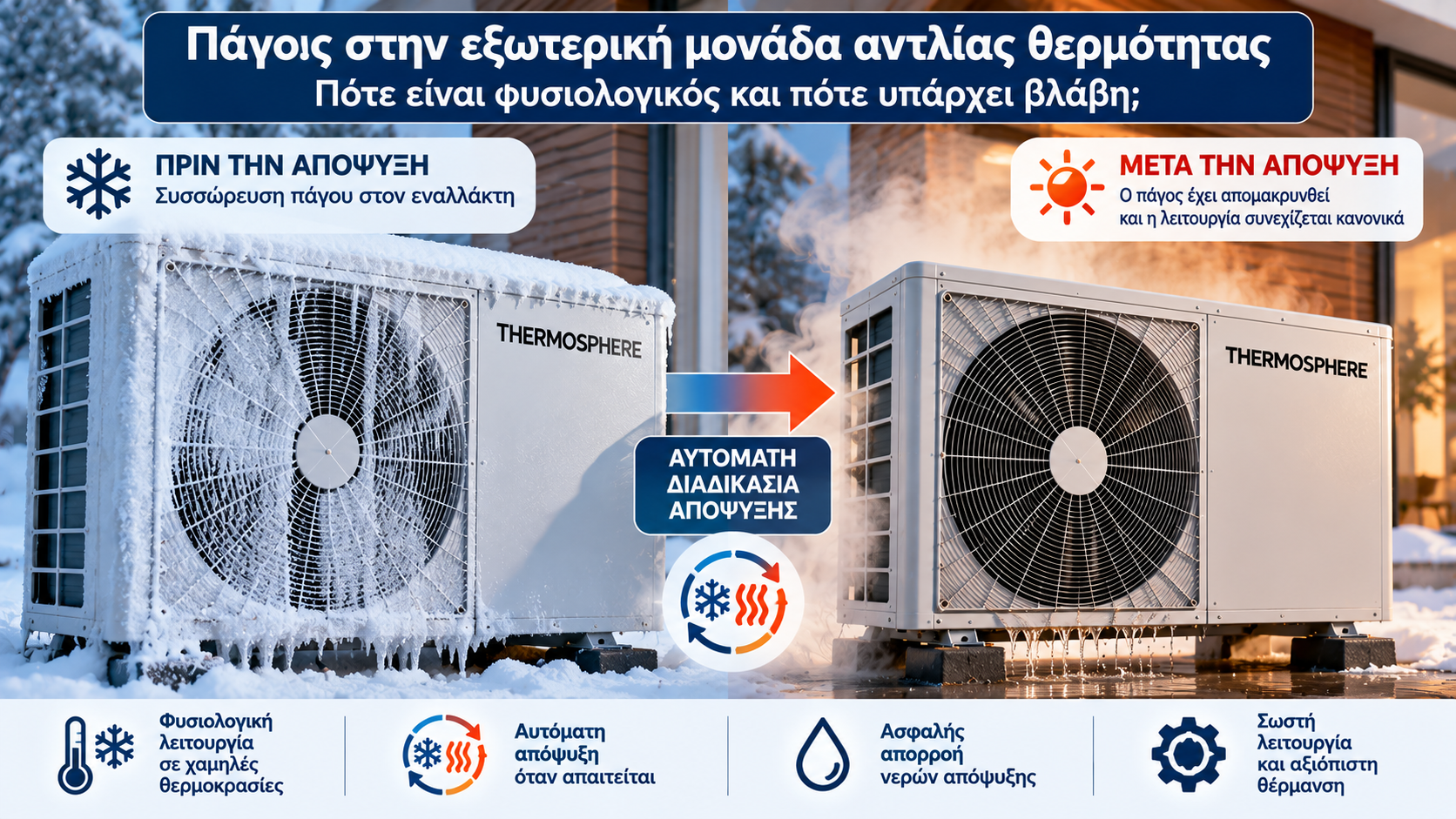
Ice on a Heat Pump Outdoor Unit: When Is It Normal and When Is It a Fault?
Ice formation on the outdoor unit of a heat pump is common during winter.
Many homeowners become concerned when they see frost covering the outdoor heat exchanger or notice that the heat pump temporarily stops supplying heat and releases a cloud of white vapour.
However, ice formation does not necessarily indicate a malfunction.
Modern air-to-water heat pumps include automatic defrost systems designed to remove ice when it begins to restrict heat transfer.
The important distinction is whether the heat pump can remove the ice effectively and return to normal heating operation.
1. Why Does Ice Form on the Outdoor Unit?
During heating operation, a heat pump extracts thermal energy from outdoor air.
To do this, the surface temperature of the outdoor heat exchanger may fall below the surrounding air temperature.
When the heat exchanger surface is below freezing and sufficient moisture is present, frost or ice can form.
This is a natural consequence of the refrigeration cycle.
It does not automatically mean that the refrigerant charge is low or that the compressor is faulty.
2. At What Temperatures Is Frost Most Common?
Frost formation depends on more than outdoor air temperature.
Important factors include:
Relative humidity.
Heat exchanger surface temperature.
Airflow.
Heat pump operating conditions.
Local weather patterns.
Significant frosting can occur when outdoor air temperatures are slightly above 0°C and humidity is high.
This happens because the heat exchanger surface can be colder than the surrounding air.
By contrast, colder but much drier weather may produce less frost.
For example, a humid day at +2°C may require more frequent defrost cycles than a dry day at −5°C.
3. What Is a Defrost Cycle?
Defrost is an automatic process that removes accumulated ice from the outdoor heat exchanger.
Many heat pumps use temporary refrigerant cycle reversal to perform this function.
A typical sequence is:
The controller detects the need for defrost.
Refrigerant circuit operation changes.
Heat is transferred to the outdoor heat exchanger.
Ice melts.
Meltwater drains away.
The heat pump returns to normal heating operation.
The exact sequence varies by manufacturer and equipment design.
4. Why Does Heating Temporarily Stop?
During reverse-cycle defrost, thermal energy is directed toward the outdoor heat exchanger.
As a result, heat delivery to the building may temporarily decrease or stop.
In some air-to-water systems, part of the required energy comes from the heating-water circuit.
Adequate system water volume and correct hydraulic design can therefore be important for reliable defrost operation.
5. Is White Vapour from the Outdoor Unit Normal?
Yes. A visible white cloud during defrost can be normal.
As the ice melts and heat exchanger surfaces warm, water vapour or tiny water droplets may form a visible cloud.
It can resemble smoke.
This usually lasts for a limited period and disappears after defrost is completed.
However, a burning smell, actual smoke or unusual equipment behaviour requires immediate investigation.
6. How Long Does Defrost Take?
There is no universal defrost duration.
It depends on:
Ice accumulation.
Outdoor conditions.
Refrigerant circuit temperatures.
Equipment design.
Manufacturer control strategy.
In many residential systems, a defrost cycle lasts several minutes.
Actual duration should be assessed against the specific manufacturer’s documentation.
A longer-than-usual cycle does not automatically prove a fault, but repeated prolonged cycles combined with insufficient heating should be investigated.
7. When Is Ice Formation Normal?
Frost is generally part of normal operation when:
It appears mainly on the outdoor heat exchanger.
Automatic defrost is activated.
Ice is removed after the cycle.
Normal heating resumes.
Persistent fault codes are absent.
Indoor comfort remains acceptable.
Small amounts of frost that appear and disappear periodically are not necessarily a cause for concern.
8. When Can Ice Indicate a Problem?
Professional inspection is recommended when:
Thick ice remains on the heat exchanger.
Defrost cycles do not appear to complete.
Repeated defrost attempts fail to remove ice.
Heating performance decreases significantly.
Fault codes appear.
Ice obstructs the fan.
Ice accumulates around critical components.
Unusual noise or vibration develops.
A qualified technician should determine the underlying cause.
9. Restricted Outdoor Heat Exchanger
Leaves, dust and debris can restrict airflow through the outdoor heat exchanger.
This affects heat transfer and may worsen frosting conditions.
Owners can keep the area around the unit clear and safely remove external obstructions.
Sharp tools and high-pressure water should not be used to clean heat exchanger fins.
10. Defrost Sensor Problems
Defrost operation relies on sensor data and manufacturer-specific control logic.
Incorrect sensor readings may cause the system to:
Delay defrost.
Start unnecessary defrost cycles.
End defrost prematurely.
Display operating faults.
Diagnosis requires suitable tools and knowledge of the particular model.
11. Blocked Defrost Water Drainage
Defrost produces meltwater that must drain away from the unit.
If drainage is blocked or the installation base is unsuitable, water may accumulate and freeze again.
Possible consequences include:
Ice accumulation at the base.
Restricted drainage.
Ice contacting equipment components.
Slippery surfaces around the installation.
In freezing climates, special drainage arrangements or frost protection may be required according to manufacturer guidance.
12. Can Low Refrigerant Cause Icing?
Incorrect refrigerant charge or other refrigerant circuit problems can affect operating temperatures and pressures.
However, ice on the outdoor unit does not prove that refrigerant is missing.
A proper assessment considers:
Operating conditions.
Defrost behaviour.
Airflow.
Sensor readings.
Refrigerant circuit data.
Refrigerant must never be added without appropriate diagnosis.
13. Why Do Frequent Defrost Cycles Increase Energy Consumption?
During defrost, the heat pump consumes energy without delivering its normal heating output to the building.
Additional energy may also be required to restore normal operating conditions.
Frequent defrost cycles can therefore reduce seasonal efficiency.
The impact depends on:
Cycle frequency.
Cycle duration.
Outdoor weather conditions.
System design.
Heating-water temperature.
Defrost is essential and must not be disabled simply to reduce electricity consumption.
14. How Does Hydraulic Design Affect Defrost?
In many air-to-water heat pumps, reverse-cycle defrost uses heat from the hydraulic heating circuit.
Insufficient water volume or restricted flow can interfere with the process.
Important design factors include:
Minimum required water volume.
Minimum flow rate.
Circulation pump operation.
Filter condition.
Valve operation.
Buffer tank requirements, where applicable.
A buffer tank is not universally necessary. Its suitability depends on manufacturer requirements and system design.
15. Can You Remove Ice with Hot Water?
Pouring hot or boiling water over a frozen outdoor unit is not recommended unless a specific manufacturer procedure explicitly permits an appropriate method.
It may cause thermal stress, affect electrical components or create additional refreezing problems.
Avoid:
Sharp tools.
Metal objects used to break ice.
Open flames.
Improvised heaters.
Unapproved chemical de-icers.
Persistent ice should be investigated rather than forcibly removed.
16. Practical Checks for Homeowners
If ice appears on the outdoor unit, observe:
Outdoor air temperature.
Humidity or fog.
Where the ice is forming.
Whether defrost starts.
Whether ice is removed.
Whether meltwater drains freely.
Whether heating resumes.
Whether a fault code appears.
Photos or short videos may help a technician understand the problem.
Protective covers must not be removed, and owners should not interfere with electrical or refrigerant components.
17. When Should You Call a Technician?
Contact a qualified technician if:
Ice remains after repeated defrost cycles.
Heating output becomes insufficient.
The fan does not operate correctly.
Fault codes recur.
Unusual noises develop.
Drainage is blocked by ice.
The unit repeatedly stops operating.
The technician may inspect sensors, the heat exchanger, drainage, water flow and operating data.
18. Frequently Asked Questions
Is It Normal for a Heat Pump Outdoor Unit to Freeze?
Yes. Temporary frost formation can be normal during heating operation in cold, humid conditions.
Why Does My Heat Pump Release Steam in Winter?
During defrost, warming the outdoor heat exchanger can produce a visible white cloud of water vapour or tiny droplets.
How Often Should a Heat Pump Defrost?
There is no fixed interval. Frequency depends on weather conditions, equipment design and control strategy.
Why Does Ice Build Up Under the Outdoor Unit?
Meltwater may accumulate and refreeze due to low temperatures or inadequate drainage.
Can I Disable Defrost?
No. Defrost is necessary for correct operation when ice forms.
Does Frequent Defrost Mean Something Is Wrong?
Not necessarily. Humid conditions may require more frequent cycles. However, significant loss of heating performance should be investigated.
Conclusion
Ice formation on a heat pump outdoor unit does not necessarily indicate a fault.
In modern heat pumps, defrost is a normal part of winter operation.
The distinction between normal frosting and a technical problem depends mainly on system behaviour: whether ice is removed effectively, whether heating resumes and whether fault codes appear.
Persistent ice, ineffective defrost and significant heating performance loss should be investigated by a qualified technician.
Thermosphere.gr — Technical knowledge for heating and building systems.