
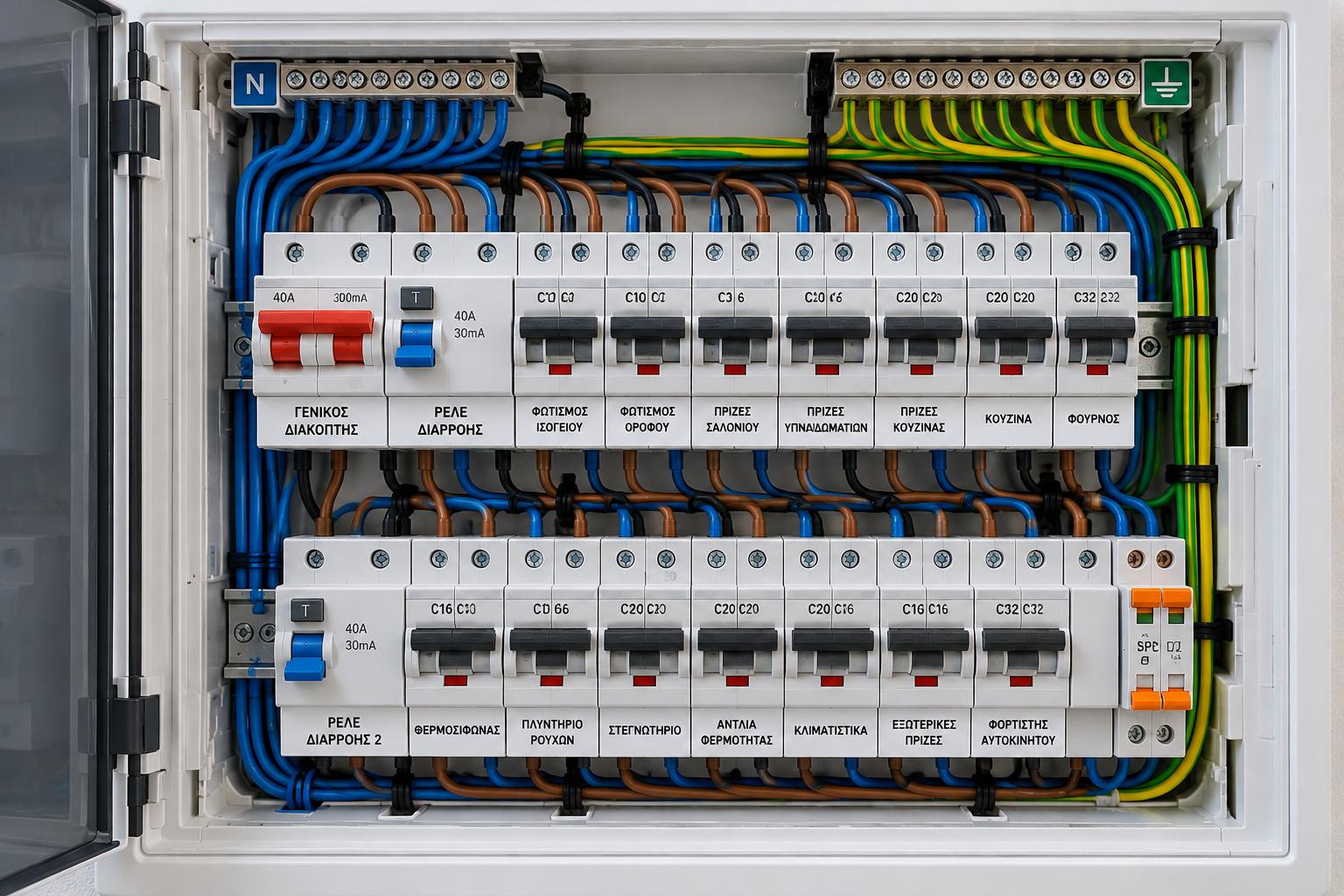
Electrical Panel Organization: Circuits, Load Distribution and Labelling
The electrical distribution board is the central point from which electricity is distributed throughout a residential building. It supplies individual electrical circuits and houses protective devices designed to respond to electrical faults.
However, a properly organized electrical panel is not simply one with neatly arranged cables and perfectly aligned circuit breakers.
Effective electrical panel organization involves several important aspects:
Appropriate separation of electrical circuits.
Correct selection of protective devices.
Suitable distribution of electrical loads.
Clear identification and labelling of circuits.
Safe access for professional inspection and maintenance.
Adequate capacity for current and future electrical requirements.
In this guide, we explain how residential electrical distribution boards are organized, why circuit separation matters, how electrical loads are distributed and what makes a panel safe, functional and easier to maintain.
1. What Does Proper Electrical Panel Organization Mean?
A properly organized distribution board is designed so that each circuit serves a defined purpose and is protected by suitable equipment.
A residential installation may include separate circuits for:
Lighting.
General-purpose socket outlets.
Electric cookers and ovens.
Electric water heaters.
Washing machines.
Heat pumps.
Outdoor electrical installations.
Electric vehicle chargers.
Not every appliance automatically requires its own dedicated circuit.
The need for a separate circuit depends on the electrical load, manufacturer’s instructions, intended use and applicable installation requirements.
Circuit separation should be based on electrical design rather than arbitrary rules.
2. What Is the Difference Between an Electrical Circuit and a Wiring Run?
In everyday language, the terms electrical circuit and electrical line are sometimes used interchangeably.
In electrical installation practice, a wiring run generally refers to a cable route supplying particular equipment or outlets.
An electrical circuit includes the conductors and components associated with a specific electrical supply arrangement.
A simplified example is:
Distribution board → Protective device → Wiring → Lighting fixtures
This represents the basic arrangement of a lighting circuit.
A real installation must also account for protective conductors, earthing arrangements, wiring methods and the required protective measures.
3. Why Are Electrical Circuits Separated?
Circuit separation serves several purposes.
Limiting the Impact of Electrical Faults
If a fault occurs on one circuit, appropriate circuit organization can help limit its effect on other parts of the installation.
Easier Fault Identification
Clearly identified circuits make it easier for a qualified electrician to locate the section requiring investigation.
Suitable Circuit Protection
Different circuits may have different electrical characteristics and protection requirements.
Future Installation Upgrades
A well-designed distribution board may make future modifications easier, provided sufficient electrical and physical capacity is available.
However, dividing an installation into an excessive number of circuits does not automatically make it safer or better.
The design should reflect actual technical requirements.
4. How Should Lighting Circuits Be Organized?
Lighting circuits are designed according to the building layout, connected loads and operational requirements.
In some properties, separating lighting into several circuits may be beneficial.
For example:
Main living area lighting.
Bedroom lighting.
Outdoor lighting.
This arrangement may reduce the likelihood of an entire property losing lighting because of a fault affecting one circuit.
However, there is no universal number of lighting circuits suitable for every home.
The appropriate arrangement depends on the electrical design and applicable requirements.
5. How Should Socket Outlet Circuits Be Organized?
General-purpose socket outlets may supply a wide range of electrical equipment.
Electrical design should consider:
The number and location of outlets.
Expected electrical loads.
Simultaneous appliance operation.
Conductor size and installation method.
Appropriate overcurrent protection.
Applicable RCD protection requirements.
For example, kitchen sockets may supply several relatively high-power appliances, while bedroom sockets may typically serve lighter loads.
These differences should be considered during circuit design.
The circuit breaker rating must be appropriate for the entire circuit, including the installed conductors and associated equipment.
6. Which Appliances May Require Dedicated Circuits?
Some appliances have significant electrical demands or specific connection requirements.
Electric Cookers
Depending on the appliance’s power rating and connection arrangement, a dedicated circuit may be necessary.
Electric Water Heaters
The supply arrangement must be suitable for the equipment’s electrical characteristics and the applicable protection and isolation requirements.
Heat Pumps
Heat pump electrical requirements depend on the specific model, maximum current, auxiliary electric heaters and manufacturer’s instructions.
A heat pump’s thermal heating capacity must not be confused with its electrical input power.
Electric Vehicle Chargers
EV charging installations require appropriate circuit design, protective equipment and assessment of the available electrical supply capacity.
Whether an appliance requires a dedicated circuit should be determined from its technical specifications and the applicable installation requirements.
7. How Are Loads Distributed in a Single-Phase Electrical Panel?
In a single-phase installation, the individual circuits are supplied from the same phase.
The total electrical demand must remain within the limits of the available supply and installation design.
For example, a home may contain:
An electric oven.
An electric water heater.
A washing machine.
A heat pump.
If several high-power appliances operate simultaneously, their combined electrical demand may become significant.
Electrical design must consider expected simultaneous operation, actual power requirements and the characteristics of the electricity supply.
Installing more circuit breakers does not increase the total electrical capacity available to the property.
Each circuit must be suitably protected, while the overall demand must remain compatible with the supply arrangement.
8. How Are Loads Distributed in a Three-Phase Electrical Panel?
A three-phase distribution board receives electricity from three phases.
Single-phase loads can be distributed among these phases according to the installation design.
The objective is to avoid excessive loading of one phase and achieve a suitable distribution of electrical demand.
Illustrative Example
Phase | Example Loads |
L1 | Selected lighting and socket circuits |
L2 | Kitchen circuits and other appliances |
L3 | Additional socket circuits and auxiliary equipment |
This table is illustrative only and is not an actual wiring design.
Proper phase distribution requires an assessment of expected loads and the maximum permitted current on each phase.
It is important to understand that the total theoretical capacity of a three-phase supply cannot necessarily be drawn from a single phase.
Each phase has its own current limitations.
Why Does Phase Imbalance Matter?
If one phase carries significantly more current than the others, it may reach its permitted limit before the total available three-phase capacity is fully utilized.
This can lead to operational problems or protective device operation.
Load distribution must therefore be considered during the design and modification of three-phase installations.
9. How Are Circuit Breakers Selected?
Circuit breaker selection should never be arbitrary.
A qualified electrician considers factors such as:
Circuit design current.
Conductor material and cross-sectional area.
Cable installation method.
Ambient temperature and correction factors.
Protective device breaking capacity.
Characteristics of connected equipment.
Overload and short-circuit protection requirements.
Applicable disconnection conditions.
A circuit breaker with a higher current rating is not automatically a suitable replacement for one that trips frequently.
Increasing the breaker rating without assessing the wiring can create a risk of conductor overheating.
Repeated tripping should be investigated to identify the underlying cause.
10. How Should RCD Protection Be Organized?
Residual current devices, commonly known as RCDs, are an important part of electrical protection.
A distribution board design should consider:
Which circuits require RCD protection.
The appropriate RCD type.
Rated residual operating current.
Compatibility with connected equipment.
Unwanted tripping considerations.
Suitable separation of protected circuits.
Some installations use several RCDs or individual residual current circuit breakers with overcurrent protection, known as RCBOs.
An appropriate arrangement may help limit the impact of certain faults and reduce unnecessary interruption to unaffected circuits.
However, simply installing multiple RCDs does not guarantee full selectivity.
Proper coordination depends on the characteristics of the protective devices and the overall protection design.
RCD vs RCBO
An RCD provides residual current protection but does not normally incorporate overload and short-circuit protection.
An RCBO combines residual current protection with overcurrent protection.
The selection of either device depends on the installation requirements.
11. Why Is Electrical Panel Labelling Important?
Clear circuit identification is one of the most practical aspects of electrical panel organization.
Without proper labels, even a modern distribution board may be difficult to inspect or maintain.
An example labelling schedule might include:
Label | Circuit Description |
LIGHTING 1 | Lighting in a defined area |
LIVING ROOM SOCKETS | Living room socket outlets |
KITCHEN SOCKETS | Selected kitchen circuits |
WATER HEATER | Electric water heater supply |
HEAT PUMP | Heat pump electrical circuit |
OUTDOOR LIGHTING | External lighting circuit |
These labels are examples only.
Actual labels must accurately identify the circuits in the specific installation.
They should never be assigned based on assumptions.
What Makes a Good Circuit Label?
A useful label should be:
Clear.
Accurate.
Readable.
Durable.
Consistent with the installation documentation.
Labels should be updated whenever circuits are modified.
12. Should an Electrical Panel Have a Wiring Diagram?
Technical documentation is an important part of a well-organized electrical installation.
Depending on the installation and applicable requirements, documentation may include:
Single-line diagrams.
Circuit schedules.
Protective device specifications.
Supply characteristics.
Inspection and test results.
Relevant installation certificates or declarations.
A single-line diagram provides a simplified representation of the electrical distribution arrangement.
It is especially useful in larger installations or panels containing many circuits.
Accurate documentation helps qualified professionals understand the installation and assess future modifications.
13. How Much Spare Space Should Be Left in an Electrical Panel?
Providing suitable spare capacity may be useful when planning future electrical upgrades.
However, there is no universal spare-space percentage that applies to every residential distribution board.
Panel size should be selected based on:
Number of circuits.
Dimensions of protective devices.
Manufacturer’s installation instructions.
Thermal considerations.
Wiring and termination requirements.
Expected future expansion.
An overcrowded distribution board may make safe installation, inspection and maintenance more difficult.
Conversely, an unnecessarily large enclosure can increase installation costs.
The correct size should be determined through proper electrical design.
14. Common Electrical Panel Organization Mistakes
Missing Circuit Labels
Protective devices are not clearly associated with the circuits they control.
Excessive Loads on Unsuitable Circuits
Several high-power appliances are connected to circuits that were not designed for the expected demand.
Incorrect Protective Devices
Circuit breakers or RCDs are unsuitable for the electrical characteristics of the installation.
Inadequate Documentation
Previous modifications have not been properly recorded.
Insufficient Space
The enclosure does not provide adequate room for the required devices and wiring.
Unplanned Modifications
Additional circuits are installed without assessing the complete electrical installation.
Poor Three-Phase Load Distribution
Uneven phase loading creates operational limitations or other problems.
These issues should be evaluated and corrected by a qualified electrician.
15. When Should an Electrical Panel Be Reorganized?
A distribution board may need reassessment when:
New electrical loads are added.
A property undergoes renovation.
A heat pump is installed.
An EV charger is added.
Repeated electrical faults occur.
Circuit labels are missing or inaccurate.
Numerous previous modifications have been made.
A professional inspection identifies deficiencies.
Reorganization may involve limited improvements or more extensive electrical work.
Complete panel replacement is not always necessary.
The appropriate solution depends on the condition and design of the existing installation.
16. Frequently Asked Questions
Does every room need its own circuit breaker?
Not necessarily. Circuit separation depends on electrical loads, installation design and applicable requirements.
Can lighting and socket outlets share a circuit?
Suitability depends on the installation design and applicable regulations. Separate circuits may offer operational advantages, but arrangements should not be chosen arbitrarily.
Does a heat pump need its own circuit breaker?
The required electrical circuit and protective devices depend on the specific heat pump’s electrical specifications and manufacturer’s instructions.
Is it better to have several RCDs?
An appropriately designed arrangement with multiple RCDs or RCBOs may reduce the impact of some faults. However, the number and type of devices should be determined through electrical design.
Can homeowners label circuit breakers themselves?
Homeowners can keep existing external labels clean and readable. Unknown circuits should be identified by a qualified electrician rather than through unsafe testing or by opening the panel.
Does adding a new circuit require replacing the entire panel?
Not always. The available space, equipment compatibility, supply capacity and protection requirements must first be assessed.
Is a neat-looking electrical panel necessarily safe?
No. A visually tidy panel can still contain unsuitable protective devices, defective connections or inadequate wiring. Electrical safety requires appropriate design, installation and verification.
Conclusion
Proper electrical panel organization involves much more than arranging cables neatly.
It requires appropriate circuit separation, suitable protective devices, balanced electrical loads where applicable, clear circuit identification and accurate technical documentation.
A well-designed distribution board supports reliable operation and makes professional inspection and future maintenance easier.
Any significant modification should be assessed and performed by a suitably qualified electrician in accordance with applicable electrical installation requirements.
Thermosphere.gr — Technical knowledge for safer and more efficient installations.
Disclaimer: This article provides general technical information. It is not a wiring instruction manual and does not replace professional electrical design, installation, inspection or testing.
Technical References
IEC 60364 — Low-voltage electrical installations.
IEC 60364-4-43 — Protection against overcurrent.
IEC 60364-5-52 — Selection and erection of wiring systems.
IEC 60364-5-53 — Devices for protection, isolation, switching, control and monitoring.
IEC 60364-6 — Verification of electrical installations.
IEC 61439-3 — Distribution boards intended to be operated by ordinary persons.
IEC 61008-1 — Residual current operated circuit-breakers without integral overcurrent protection.
IEC 61009-1 — Residual current operated circuit-breakers with integral overcurrent protection.
ELOT 60364 — Requirements for electrical installations in Greece.