
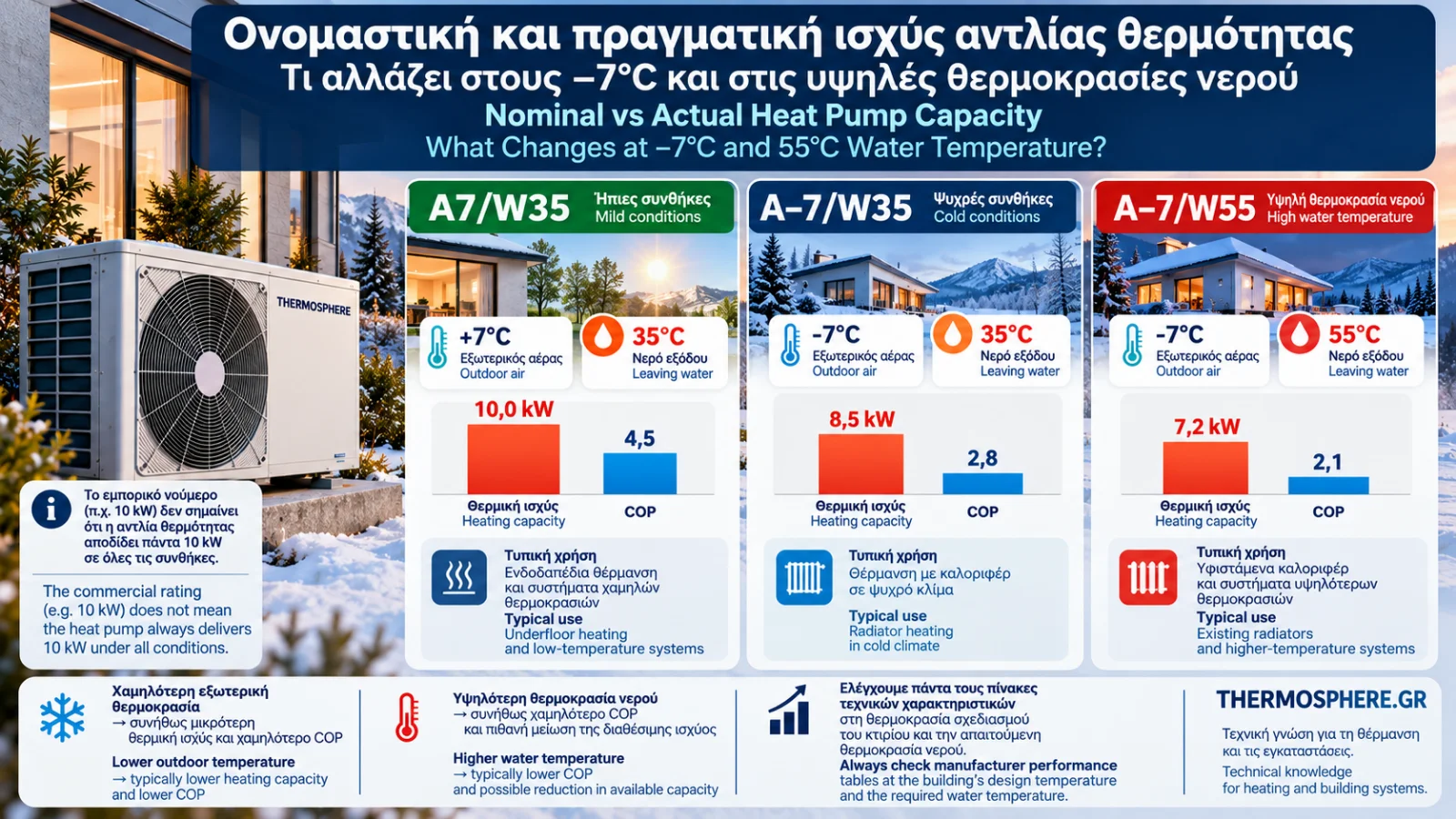
Nominal vs Actual Heat Pump Capacity: What Changes at −7°C and 55°C Water Temperature?
Nominal heating capacity is one of the first specifications considered when selecting a heat pump. Manufacturers offer models marketed as 6, 8, 10, 12 or 16 kW units, which can create the impression that these figures represent a constant heating output under all operating conditions.
In reality, the available heating capacity of an air-to-water heat pump depends on outdoor temperature, heating-water temperature, compressor operation and the specific design of the equipment.
A heat pump operating at an outdoor temperature of +7°C with a leaving-water temperature of 35°C may perform differently when operating at −7°C with a leaving-water temperature of 55°C.
This distinction is particularly important in colder climates, buildings with conventional radiators and systems requiring relatively high water temperatures.
In this Thermosphere.gr guide, we explain the meaning of A7/W35, A−7/W35 and A−7/W55, examine the relationship between heating output and COP, and show how to use manufacturer performance data for correct heat pump sizing.
1. What Is Nominal Heat Pump Capacity?
Nominal heating capacity is a manufacturer-declared output associated with specified testing or operating conditions.
For example, a heat pump marketed as a 10 kW model may deliver approximately 10 kW at a particular reference condition.
However, this does not guarantee that the same unit will deliver exactly 10 kW at every outdoor temperature and every heating-water temperature.
Commercial model names are not always identical to certified capacity values.
For reliable equipment selection, the manufacturer's technical performance tables must be examined.
2. Thermal Capacity vs Electrical Power Input
Heating capacity describes the rate at which thermal energy is delivered to the heating system.
Electrical power input describes the rate at which electrical energy is consumed.
The coefficient of performance, or COP, relates these quantities:
COP = Heating output / Electrical power input
For example, if a heat pump supplies 9 kW of heating while consuming 3 kW of electrical power:
COP = 9 / 3 = 3
This COP applies to the specified operating condition.
It should not be confused with SCOP, which represents seasonal performance under defined assessment conditions.
3. What Does A7/W35 Mean?
A7/W35 describes an operating condition for an air-to-water heat pump.
A7: Outdoor air temperature of +7°C.
W35: Leaving-water temperature of 35°C.
Therefore, A7/W35 refers to operation with outdoor air at +7°C and heating water leaving the unit at 35°C.
This condition is commonly used when evaluating heat pumps intended for low-temperature heating systems, including underfloor heating.
However, the precise test methodology, water-side temperature difference and other parameters depend on the applicable standard and manufacturer documentation.
4. What Does A−7/W35 Mean?
A−7/W35 refers to:
Outdoor air temperature of −7°C.
Leaving-water temperature of 35°C.
This represents a more demanding outdoor condition than A7/W35.
For many air-source heat pumps, lower outdoor temperatures affect heating output and efficiency.
However, the degree of change varies considerably between models.
Some heat pumps use advanced compressor control and refrigeration-cycle technologies to maintain relatively high output at low outdoor temperatures.
Therefore, applying a universal percentage reduction in heating capacity to all heat pumps is technically incorrect.
5. What Does A−7/W55 Mean?
A−7/W55 refers to:
Outdoor air temperature of −7°C.
Leaving-water temperature of 55°C.
This operating condition is particularly relevant when evaluating systems that require higher heating-water temperatures, including certain existing radiator installations.
Producing water at 55°C in cold outdoor conditions generally requires a greater temperature lift than producing water at 35°C.
As a result, COP will typically be lower.
Available heating capacity may also change, although the direction and magnitude depend on the heat pump model and its control strategy.
6. Comparison of the Three Operating Conditions
Operating condition | Outdoor air | Leaving water | Typical evaluation purpose |
|---|---|---|---|
A7/W35 | +7°C | 35°C | Mild outdoor conditions and low-temperature heating |
A−7/W35 | −7°C | 35°C | Cold weather and low-temperature heating |
A−7/W55 | −7°C | 55°C | Cold weather and higher-temperature heating |
These conditions do not describe three different types of heat pump.
They describe different operating points that can be used to assess the same equipment.
7. Why Does Outdoor Temperature Affect Heating Capacity?
An air-to-water heat pump extracts thermal energy from outdoor air and transfers it to the heating-water circuit.
As outdoor temperature decreases, the thermodynamic conditions of the refrigeration cycle change.
Depending on the equipment design, this can lead to:
Reduced available heating capacity.
Increased electrical input for a given heating output.
Lower COP.
Changes in compressor operating frequency.
Periodic defrost operation.
The actual behaviour must be established using documented performance data for the specific model.
8. Why Does Water Temperature Affect Efficiency?
Leaving-water temperature is another critical operating parameter.
When the heat pump must produce hotter water, the compressor generally operates across a greater pressure and temperature difference.
This normally increases the work required by the refrigeration cycle.
Consequently, operation at 35°C water temperature is generally more efficient than operation at 55°C, assuming comparable other conditions.
However, the correct flow temperature must be determined by the building's heating requirements and the capacity of its heat emitters.
Reducing flow temperature is not beneficial if the heating system can no longer maintain comfortable indoor conditions.
9. Illustrative Example: A 10 kW Heat Pump
Consider a hypothetical heat pump marketed as a 10 kW model.
The following values are invented solely to demonstrate how performance tables are interpreted.
They are not verified specifications for any real manufacturer or model.
Operating condition | Heating output | COP | Calculated electrical input |
|---|---|---|---|
A7/W35 | 10.0 kW | 4.5 | 2.22 kW |
A−7/W35 | 8.5 kW | 2.8 | 3.04 kW |
A−7/W55 | 7.2 kW | 2.1 | 3.43 kW |
Electrical input is calculated as:
Electrical input = Heating output / COP
In this hypothetical example, the unit supplies 10 kW at A7/W35 but only 7.2 kW at A−7/W55.
This demonstrates why the number in the commercial model name is not sufficient for equipment selection.
Important: The example does not imply that every 10 kW heat pump delivers 7.2 kW at A−7/W55. Each model has its own performance characteristics.
10. Connecting Actual Capacity to Building Heat Loss
Required heating capacity must be established through a design heat-loss calculation.
Consider a hypothetical home with a design heating load of 8 kW at an outdoor temperature of −7°C.
If the heating system requires a leaving-water temperature of 55°C, the available output should be checked at A−7/W55 or another suitably documented equivalent operating point.
If the selected heat pump delivers 7.2 kW under these conditions, the calculated shortfall is:
8.0 − 7.2 = 0.8 kW
This shortfall does not automatically mean the installation is incorrectly designed.
The system may be designed for full compressor coverage or for bivalent operation with supplementary heating.
The intended heating strategy must therefore be established before evaluating the equipment.
11. What Is Bivalent Temperature?
The bivalent temperature is the outdoor temperature at which the available heat pump capacity meets the building's heating demand under a defined design strategy.
Below this temperature, supplementary heating may be needed, depending on the installation.
Bivalent temperature is not a fixed value for every heat pump.
It depends on:
Building design heat loss.
Available heat pump capacity at different outdoor temperatures.
Required heating-water temperature.
Selected operating strategy.
Availability of a supplementary heating source.
A correct assessment compares the building heating-load curve with the heat pump's available-capacity curve.
12. When Does the Electric Backup Heater Operate?
Some heat pumps include an integrated or external electric backup heater.
Depending on the equipment and its configuration, it may operate:
When compressor heating capacity is insufficient.
Under certain protection conditions.
During specific domestic hot water functions.
In emergency or backup modes.
Electric resistance heating can significantly increase electrical energy consumption.
It is therefore important to determine whether a published heating-capacity figure refers to the refrigeration cycle alone or includes supplementary electrical heating.
13. How Does Defrost Affect Heating Output?
During cold and humid weather, frost may accumulate on the outdoor heat exchanger.
The heat pump periodically performs defrost cycles to restore normal operation.
During defrost, the instantaneous heating supplied to the building may temporarily decrease or reverse, depending on the operating method.
Defrost frequency and duration depend on weather conditions and equipment design.
Manufacturer performance data and the relevant testing methodology should be examined to understand how defrost effects are represented in declared values.
14. What Does Constant Heating Capacity Mean?
Some manufacturers state that certain heat pump models can maintain their heating capacity down to a specified outdoor temperature.
This may be achieved through compressor technology, refrigeration-cycle design and advanced control strategies.
However, the claim should always be evaluated carefully.
Important questions include:
At what leaving-water temperature is the capacity maintained?
What heating output is actually available?
What is the COP under those conditions?
Is supplementary electrical heating involved?
What are the equipment's operating limits?
Maintaining heating capacity does not necessarily mean maintaining the same COP.
15. Why Minimum Modulation Capacity Matters
Maximum heating capacity is not the only important parameter.
The minimum stable heating output of an inverter-driven heat pump also matters.
An oversized heat pump with a relatively high minimum capacity may cycle frequently when the building's heating demand is low.
Frequent starts and stops can affect seasonal efficiency and operating behaviour.
Correct sizing therefore requires consideration of both design heating load and part-load operation.
16. How to Read a Manufacturer Performance Table
Before selecting a heat pump, examine the official technical documentation for:
Heating output at the relevant outdoor temperature.
Leaving-water temperature associated with that output.
COP at the same operating point.
Permitted operating-temperature limits.
Maximum and minimum available heating capacity, where provided.
Applicable testing standards and conditions.
Whether backup electric heating is included.
Manufacturer sizing and installation requirements.
Avoid comparing heating-output or COP figures taken from different operating conditions.
For a meaningful comparison, the relevant test points must be equivalent.
17. Common Heat Pump Sizing Mistakes
Mistake 1: Assuming nominal capacity is constant.
Available heating output depends on operating conditions.
Mistake 2: Comparing COP values measured at different conditions.
Equivalent test conditions are necessary for a valid comparison.
Mistake 3: Selecting equipment using A7/W35 data alone.
The building may need heating at substantially lower outdoor temperatures.
Mistake 4: Ignoring the required heating-water temperature.
Operating at 55°C is not equivalent to operating at 35°C.
Mistake 5: Overlooking electric backup heating.
Supplementary resistance heating can significantly affect electricity consumption.
Mistake 6: Ignoring minimum modulation capacity.
Part-load performance matters during much of the heating season.
18. Frequently Asked Questions
Does a 10 kW Heat Pump Always Deliver 10 kW?
Not necessarily. Actual heating capacity must be checked at the relevant outdoor and water temperatures.
Is A7/W35 Better Than A−7/W55?
These are operating conditions, not competing products. The relevant condition depends on the climate and heating-system requirements.
Does Heating Capacity Always Fall at −7°C?
Not in the same way for every model. Some heat pumps maintain substantial heating output in cold weather. Official performance data must be checked.
Is It Normal for COP to Decrease at Higher Water Temperatures?
Yes. Higher leaving-water temperatures generally reduce COP under otherwise comparable conditions.
Can I Select a Heat Pump Using Only Its Product Brochure?
The brochure provides essential information, but reliable sizing also requires a design heat-loss calculation, an assessment of heat emitters and evaluation of the complete heating system.
Conclusion
Nominal heating capacity is useful, but it is not sufficient on its own for selecting an air-to-water heat pump.
Operating conditions such as A7/W35, A−7/W35 and A−7/W55 demonstrate why heating output and COP must be evaluated at the temperatures relevant to the actual installation.
Correct heat pump sizing is based on the building's design heating load and documented equipment performance curves, not simply the kW figure in the model name.
Technical References and Further Reading
EN 14511 series — Air conditioners, liquid chilling packages and heat pumps: Terms, test conditions, test methods and requirements.
EN 14825 — Seasonal performance testing and rating under part-load conditions.
EN 12831-1 — Method for calculating building design heat load.
Commission Regulation (EU) No 813/2013 — Ecodesign requirements for space heaters and combination heaters.
Official manufacturer technical manuals — Heating capacity tables, COP values, modulation ranges and operating limits.
Thermosphere.gr — Technical knowledge for heating and building systems.