
Chimney Insulation: When Is It Needed, Which Materials Are Used and What Should You Consider?
Chimney insulation is an important factor in the thermal performance, draft characteristics and safe operation of a flue gas evacuation system.
When a heating appliance operates, combustion gases carry heat through the chimney towards the outdoor environment.
If these gases cool excessively, natural chimney draft may be affected. Depending on the appliance and fuel, the likelihood of unwanted condensation may also increase.
Thermal insulation can reduce heat loss and help maintain more favourable operating conditions.
However, not every chimney requires the same type of insulation, and adding an arbitrary insulating material around an existing flue is not necessarily safe.
The correct solution depends on the appliance, fuel, operating temperatures, chimney location and technical classification of the flue system.
What Is Chimney Insulation?
Chimney insulation refers to the materials or construction methods used to reduce heat transfer from the flue gas passage to the surrounding environment.
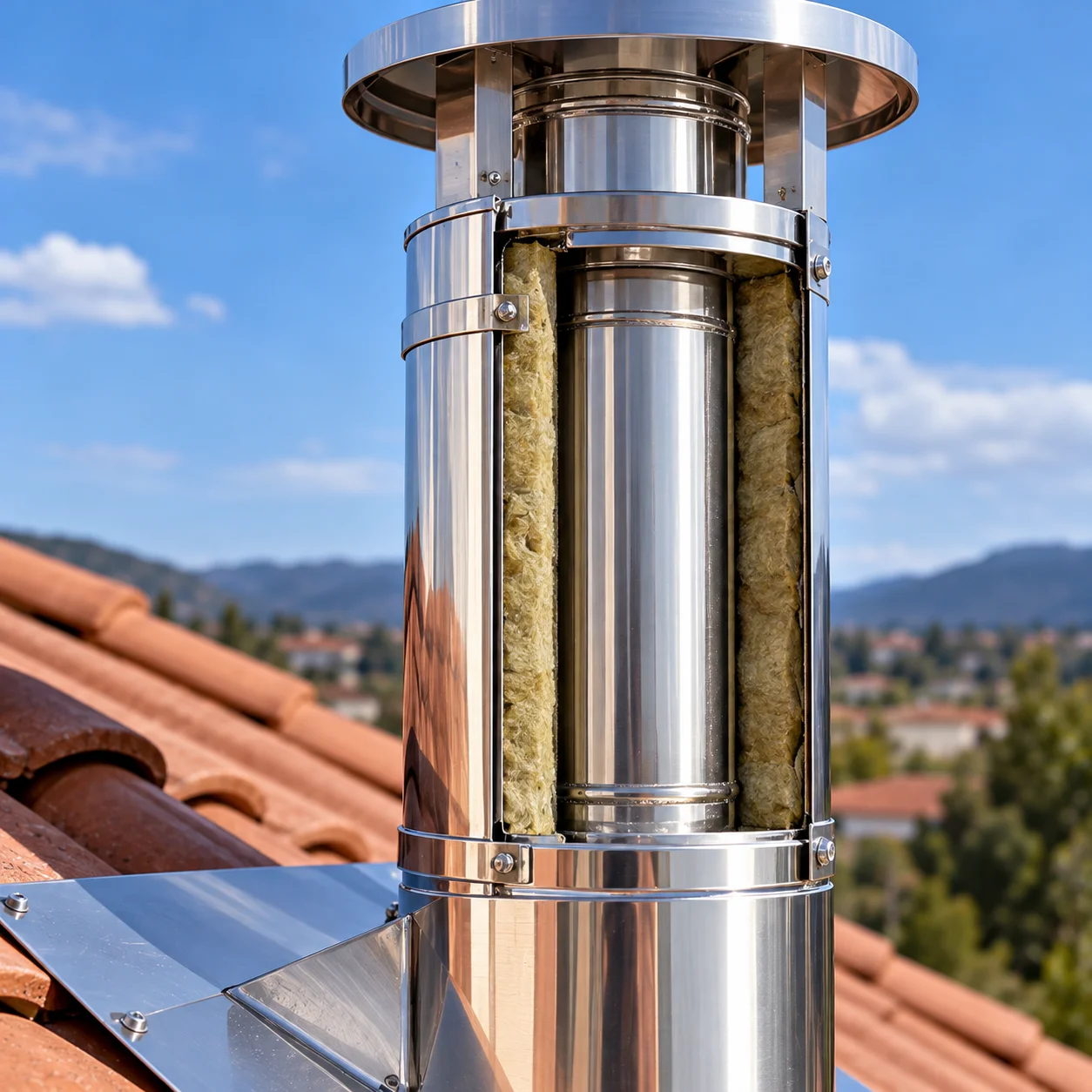
In modern metal chimney systems, insulation is often incorporated into a factory-manufactured twin-wall construction.
A typical insulated twin-wall chimney may consist of:
An inner metal liner carrying the combustion gases.
An intermediate layer of suitable thermal insulation.
An outer metal casing.
Compatible joints, brackets, supports and accessories.
The insulation material and thickness are determined by the system manufacturer.
The presence of insulation alone does not establish whether a chimney is suitable for a particular application.
The complete product classification and technical documentation must be considered.
Why Is Chimney Insulation Important?
Chimney insulation can influence three main operating parameters:
Flue gas temperature.
Natural chimney draft.
Heat transfer to the surrounding environment.
It can also influence the conditions under which condensation occurs.
Maintaining Flue Gas Temperature
As combustion gases rise through the chimney, they lose heat to the surroundings.
Thermal insulation reduces the rate of this heat loss.
This may be particularly useful when the chimney is installed outdoors or passes through unheated parts of a building.
Supporting Natural Chimney Draft
Natural chimney draft is primarily generated by the density difference between warm combustion gases and cooler outdoor air.
Maintaining a higher flue gas temperature can help preserve the available pressure difference.
However, chimney draft also depends on:
Chimney height.
Internal diameter.
Bends and changes of direction.
Flow resistance.
Combustion air supply.
Wind conditions.
Therefore, insulation cannot automatically correct an incorrectly sized or poorly designed chimney.
Reducing Unwanted Condensation
In some installations, cooling of the combustion gases can cause water vapour to condense inside the chimney.
Thermal insulation may reduce this tendency by limiting heat loss.
However, insulation does not eliminate condensation in systems where condensate production is an intended part of normal operation.
When Is an Insulated Chimney Needed?
There is no universal answer for every heating installation.
The need for insulation must be assessed according to the chimney design and operating conditions.
1. When the Chimney Is Installed Outside the Building
External chimneys are exposed to low ambient temperatures and changing weather conditions.
This can increase flue gas heat loss.
In many such applications, certified insulated twin-wall chimney systems are commonly used.
The final selection must be based on the heating appliance requirements and the installation design.
2. When the Flue Passes Through Unheated Spaces
A chimney may pass through an unheated attic, storage area or another cold part of the building.
In these situations, the thermal performance of the flue may be significantly affected by its surroundings.
A suitable insulated system can help reduce heat loss.
3. When the Chimney Serves a Fireplace or Wood-Burning Stove
Solid-fuel appliances can produce combustion gases at relatively high temperatures.
Depending on operating conditions, soot and creosote deposits may also develop.
Chimney selection must therefore consider:
Temperature classification.
Suitability for the expected operating conditions.
Soot-fire resistance, where required.
Clearance to combustible materials.
The appliance manufacturer's instructions.
An insulated chimney may be appropriate, but its suitability must be documented.
4. When Flue Gases Cool Excessively
If an installation experiences excessive flue gas cooling or unwanted condensation, the thermal performance of the chimney should be assessed.
Insulation may be one of the factors considered.
However, it should not automatically be treated as the only possible solution.
The chimney diameter, height, appliance operating conditions and overall configuration may also require evaluation.
Which Materials Are Used for Chimney Insulation?
The insulation material depends on the temperature, construction and performance requirements of the specific system.
Rock Wool and Mineral Wool
Rock wool is an inorganic fibrous thermal insulation material.
Suitable grades are used in a range of high-temperature applications.
In chimney construction, rock wool may form part of a factory-manufactured insulated system.
Potential advantages include:
Good thermal insulation properties.
Availability in different densities and forms.
Suitability for certain high-temperature applications when correctly specified.
Important limitations include:
Not every rock wool product is suitable for chimney use.
Performance depends on the material grade, composition and operating temperature.
Installation must follow the approved system design.
Ordinary building insulation should not automatically be considered suitable for wrapping a chimney.
Ceramic Fibres and Other Refractory Fibrous Materials
Some specialised fibrous materials are designed for high-temperature applications.
These may be used in industrial equipment and other specialised thermal systems.
Their suitability depends on chemical composition, temperature limits and product-specific requirements.
They are not a universal solution for domestic chimneys.
Certain refractory fibre categories also have specific occupational health and safety requirements during handling.
These materials should only be selected for applications in which their use is expressly permitted.
Other Specialised Insulation Materials
Certified chimney systems may use other insulation materials depending on their construction.
The essential consideration is not simply the name of the insulation material, but the documented performance of the complete chimney product.
For example, two insulated chimneys with different constructions may have different temperature classifications and different required clearances to combustible materials.
Single-Wall vs Twin-Wall Chimneys: Which Provides Better Insulation?
Single-wall metal chimneys generally consist of one metal flue passage.
Insulated twin-wall chimneys contain an inner liner, an intermediate insulation layer and an outer casing.
Characteristic | Single-wall chimney | Insulated twin-wall chimney |
|---|---|---|
Construction | Single metal wall | Inner liner, insulation and outer casing |
Heat loss | Generally higher | Generally lower |
Outdoor applications | Depends on the specific installation | Common in suitable external systems |
External surface temperature | May become very high | Depends on design and operating conditions |
Clearance to combustibles | As specified by classification and instructions | As specified by classification and instructions |
A twin-wall chimney is not automatically safe to touch during operation, nor does its insulation mean it can be installed in direct contact with combustible materials.
Can an Existing Metal Chimney Be Insulated?
Adding insulation to an existing chimney requires careful technical consideration.
Wrapping a metal flue with an arbitrary insulation material is not a safe general-purpose solution.
Such a modification may:
Change component operating temperatures.
Affect thermal expansion.
Create unexpected conditions at joints.
Alter heat transfer near combustible structures.
Invalidate the conditions under which the chimney's performance was assessed.
In some cases, the correct solution may involve replacing a section with a compatible insulated system or using another manufacturer-approved arrangement.
The decision must be based on a technical assessment.
Chimney Insulation and Fire Safety
One of the most important considerations is the distance between the chimney and combustible building materials.
Examples include:
Timber beams.
Wooden roof structures.
Timber cladding.
Certain insulation products.
Other combustible construction elements.
Chimney insulation does not automatically permit a reduction in the required safety clearances.
These distances depend on the product classification, installation configuration and manufacturer's instructions.
What Does the G Classification Mean?
In European chimney classifications, the designation G indicates soot-fire resistance.
The designation O applies to systems that are not classified as soot-fire resistant.
These designations are associated with additional requirements and clearance information that must be interpreted within the complete product classification.
For example, a clearance stated in the classification does not necessarily apply unchanged to every possible floor or roof penetration detail.
The installation arrangements specified by the manufacturer must be followed.
Chimney Insulation Through a Timber Roof
A chimney passing through a timber roof requires particular attention.
Using an insulated pipe alone is not sufficient.
The installation must account for:
Suitability of the system for the roof penetration.
Required clearance to combustible elements.
Approved penetration components.
Thermal expansion.
Structural support and mechanical stability.
Weatherproofing against rain.
Access for inspection.
Safety clearances around a chimney must not be filled with insulation unless the manufacturer specifically permits that arrangement.
An air gap may form part of the system's required thermal protection.
Chimney Insulation for Fireplaces
Fireplace chimneys must be selected according to the requirements of the appliance and its expected combustion conditions.
For installations with long external flue sections, a suitable insulated chimney may help reduce heat loss.
However, insulation should not be considered a universal solution to smoke problems.
Smoke entering the room may result from:
Insufficient combustion air.
Incorrect chimney diameter.
Inadequate chimney height.
Excessive flow resistance.
Wind effects.
Negative indoor pressure.
Correct diagnosis must come before selecting a solution.
Chimney Insulation for Wood-Burning Stoves
Wood-burning stoves can operate with different flue gas temperatures depending on their design and combustion conditions.
The chimney must be suitable for the expected temperatures and fuel type.
Insulation can reduce flue gas cooling, particularly in external chimney sections.
However, it does not replace:
Correct chimney sizing.
Appropriate flue configuration.
Adequate combustion air supply.
Regular chimney cleaning.
Safe clearance from combustible materials.
Chimney Insulation for Oil and Gas Boilers
Insulation requirements depend on the boiler type and flue gas evacuation system.
In conventional installations, chimney thermal performance may affect condensation and natural draft.
In modern condensing boilers, condensate production is expected.
Therefore, the primary requirement is not necessarily to prevent condensation, but to use a suitable flue system with the required tightness and condensate drainage.
Approved boiler flue systems must not be modified by arbitrarily changing their components or insulation.
How Does Insulation Affect Chimney Condensation?
Thermal insulation reduces the rate of heat transfer from the chimney to the surrounding environment.
This can help maintain higher flue gas temperatures.
In systems designed for dry operation, this effect may reduce conditions that favour condensation.
However, the amount of condensate depends on several factors:
Fuel type.
Flue gas temperature.
Water vapour content.
Chimney route.
Appliance operating conditions.
An appropriate solution may require a combination of correct sizing, suitable materials and proper condensate management.
How Do You Choose the Right Insulated Chimney?
Before selecting a system, the following factors should be assessed.
1. Heating Appliance Type
Fireplace, wood-burning stove, oil boiler, gas boiler or another combustion appliance.
2. Fuel Type
Flue gas composition and temperature vary according to the fuel.
3. Temperature Classification
The chimney must be suitable for the expected operating temperatures.
4. Pressure Conditions
The flue system must be suitable for its intended negative-pressure or positive-pressure operating conditions.
5. Wet or Dry Operation
The classification must correspond to the expected condensation conditions.
6. Corrosion Resistance
Materials must be compatible with the chemical composition of the flue gases and potential condensate.
7. Soot-Fire Resistance
Where required, the chimney must have an appropriate soot-fire resistance classification.
8. Safety Clearances
Clearance to combustible materials must follow the declared product performance and installation instructions.
9. Accessories and Supports
Only compatible components and fittings specified for the system should be used.
10. Maintenance Access
The chimney must allow the required inspection and cleaning.
Which European Standards Apply to Chimney Insulation?
Insulation is assessed as part of the complete chimney system.
Relevant European standards include:
EN 1443: General chimney requirements and classification.
EN 1856-1: Requirements for metal system chimney products.
EN 1856-2: Requirements for metal flue liners and connecting flue pipes.
EN 13384-1: Thermal and fluid dynamic calculation methods for chimneys serving one combustion appliance.
EN 15287-1: Design, installation and commissioning requirements for chimneys within its scope.
Compliance of an individual insulation material with a material standard does not establish compliance of the complete chimney assembly.
The product's Declaration of Performance, classification, manufacturer's instructions and applicable national requirements must be checked.
Frequently Asked Questions
Does Every Chimney Need Insulation?
No. The need for insulation depends on the appliance, fuel, chimney route and requirements of the specific flue system.
Is a Twin-Wall Chimney Better?
An insulated twin-wall chimney may be more suitable for many outdoor applications, but the correct choice depends on the technical characteristics of the installation.
Can I Wrap My Chimney with Rock Wool?
Not without documented approval for the specific application. Adding insulation without proper assessment may alter the chimney's thermal behaviour and fire safety performance.
Does Chimney Insulation Reduce Condensation?
It may reduce unwanted condensation in certain installations, but it does not eliminate condensate production in systems designed to operate with condensation.
Can an Insulated Chimney Touch Wood?
Not unless the specific approved installation arrangement explicitly permits it. The manufacturer's required clearances and installation instructions must be followed.
Does Insulation Always Improve Chimney Draft?
No. Insulation may help maintain flue gas temperature, but chimney draft depends on several additional factors.
Conclusion
Chimney insulation can reduce heat loss, support natural draft and decrease the likelihood of unwanted condensation in suitable installations.
Choosing an insulated system is particularly important when a chimney is exposed to outdoor conditions or passes through unheated spaces.
However, insulation should not be treated as simply adding a material around a metal pipe.
The safest approach is to select a technically documented chimney system, ensure correct sizing and follow the manufacturer's installation instructions.
Technical References
EN 1443 — Chimneys: General requirements.
EN 1856-1 — Chimneys: Requirements for metal chimneys — Part 1: System chimney products.
EN 1856-2 — Chimneys: Requirements for metal chimneys — Part 2: Metal flue liners and connecting flue pipes.
EN 13384-1 — Chimneys: Thermal and fluid dynamic calculation methods — Part 1.
EN 15287-1 — Chimneys: Design, installation and commissioning — Part 1.
The applicable editions of these standards, manufacturer documentation and national requirements must be verified for each installation.