
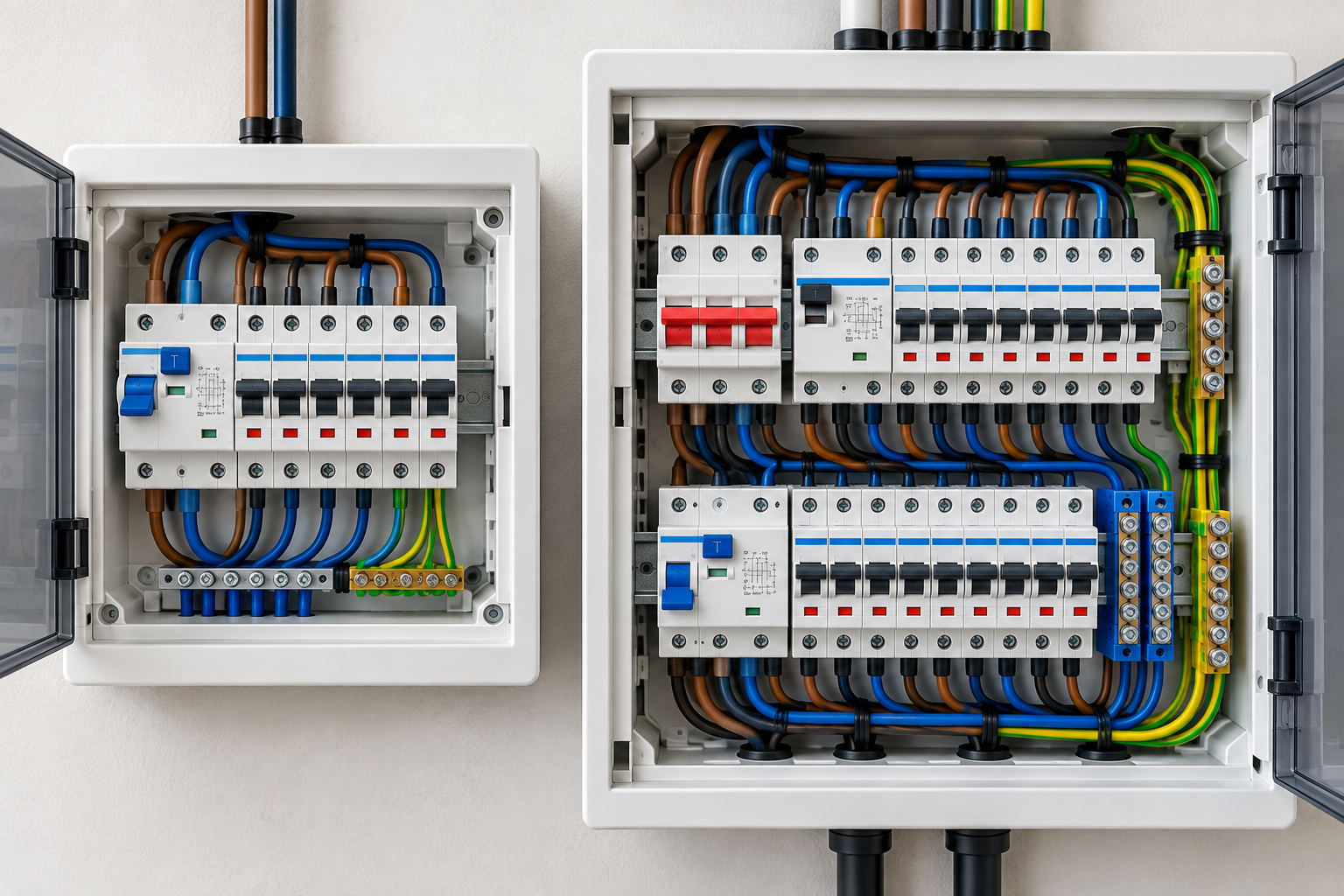
Single-Phase vs Three-Phase Electrical Panels: Differences and How to Choose
Single-phase and three-phase electrical panels are two different arrangements for distributing electrical power within a building. Choosing between them depends on the type of electrical supply, the property’s power requirements and the equipment that needs to be connected.
Many homeowners consider upgrading to a three-phase supply when installing a heat pump, electric cooker, electric vehicle charger or several high-power appliances.
A three-phase supply offers important advantages in certain situations, but it is not necessary for every home.
This guide explains the differences between single-phase and three-phase distribution boards, how electrical power is calculated, their advantages and limitations, and what is involved in upgrading an installation.
What Is a Single-Phase Electrical Panel?
A single-phase electrical panel is used in an installation supplied by one phase and a neutral conductor, according to the supply arrangement.
In Greece and many other European countries, the nominal voltage between phase and neutral is 230V.
A single-phase distribution board may supply circuits for:
Residential lighting.
General-purpose sockets.
Refrigerators and household appliances.
Electric water heaters.
Electric ovens designed for single-phase operation.
Single-phase heat pumps.
The available power depends on the supply capacity, protective devices and electrical installation design.
A single-phase panel is not automatically suitable for every combination of electrical loads.
What Is a Three-Phase Electrical Panel?
A three-phase electrical panel distributes power from a supply with three phases.
In a typical European low-voltage network, the nominal voltages are:
230V between a phase and neutral.
400V between two phases.
A three-phase distribution board can supply appropriately designed single-phase and three-phase equipment.
For example, a home may have conventional 230V lighting and socket circuits while also supplying equipment designed for three-phase operation.
Distributing electrical loads across the three phases is an important part of electrical installation design.
Single-Phase vs Three-Phase: Key Differences
Feature | Single-Phase | Three-Phase |
Number of phases | 1 | 3 |
Typical phase-to-neutral voltage | 230V | 230V |
Typical phase-to-phase voltage | Not applicable | 400V |
Load distribution | One phase | Three phases |
Direct supply to three-phase equipment | No | Yes, when suitable |
Distribution board complexity | Usually lower | Usually higher |
A three-phase installation does not mean every connected appliance operates at 400V.
Most ordinary household appliances still use a 230V phase-to-neutral supply.
How Much Power Can a Single-Phase Electrical Panel Supply?
The electrical power depends on voltage, current and power factor.
For a single-phase AC load:
P = V × I × cosφ
Where:
P = Active power in watts.
V = Voltage in volts.
I = Current in amperes.
cosφ = Power factor.
For a 230V supply with a power factor of 1:
Current | Calculated Power |
16A | 3.68 kW |
25A | 5.75 kW |
32A | 7.36 kW |
40A | 9.20 kW |
These are theoretical calculation results.
They do not confirm that a particular home has the corresponding contracted supply capacity or that its wiring can safely carry those loads.
The actual available power depends on the supply arrangement and installation specifications.
How Much Power Can a Three-Phase Electrical Panel Supply?
For a balanced three-phase AC load, active power is calculated using:
P = √3 × VLL × I × cosφ
Where VLL is the line-to-line voltage.
For a 400V supply with a power factor of 1:
Current Per Phase | Calculated Total Power |
16A | 11.1 kW |
20A | 13.9 kW |
25A | 17.3 kW |
32A | 22.2 kW |
These figures assume balanced loading and are illustrative calculations.
They do not necessarily correspond to the standard supply capacities offered by a particular electricity network operator.
It is also important to understand that the total three-phase power cannot be arbitrarily drawn from a single phase.
Each phase has its own current limits.
Is a Three-Phase Electrical Panel Better?
A three-phase distribution board provides greater flexibility for distributing electrical loads, but it is not always the best technical or financial option.
Potential advantages include:
Supplying equipment designed for three-phase operation.
Distributing single-phase loads across three phases.
Supporting greater total electrical demand when the supply capacity allows it.
Providing flexibility for future electrical upgrades.
However, a three-phase installation may also involve:
A larger distribution board.
Additional protective devices.
More complex electrical design.
Higher modification and connection costs.
The appropriate choice depends on the actual requirements of the property.
Do Heat Pumps Require Three-Phase Electricity?
Not necessarily.
Both single-phase and three-phase heat pumps are available.
The required electrical supply depends on the specifications of the particular model.
Important factors include:
Rated supply voltage.
Maximum electrical current.
Required protective devices.
Auxiliary electric heating elements.
Manufacturer’s installation instructions.
Available electrical capacity.
A crucial distinction is the difference between thermal output and electrical input.
For example, a heat pump with a heating capacity of 12 kW does not necessarily consume 12 kW of electrical power.
Its electricity consumption depends on operating conditions and system efficiency.
The correct supply must be selected according to the equipment’s electrical specifications, not its heating capacity alone.
Do Electric Cookers Need a Three-Phase Supply?
It depends on the appliance.
Some electric cookers and induction hobs support different electrical connection arrangements.
Others have specific supply requirements.
A three-phase supply should not be assumed necessary for every electric cooker.
The appliance’s rating plate, connection diagram and manufacturer’s instructions must be checked by a qualified electrician.
Do Electric Vehicle Chargers Require Three-Phase Power?
Not always.
AC electric vehicle chargers are available in both single-phase and three-phase configurations.
Typical theoretical charging power levels include:
Charging Arrangement | Nominal Calculation |
Single-phase, 230V, 16A | Approximately 3.7 kW |
Single-phase, 230V, 32A | Approximately 7.4 kW |
Three-phase, 400V, 16A | Approximately 11 kW |
Three-phase, 400V, 32A | Approximately 22 kW |
Actual charging performance depends on:
The vehicle’s onboard AC charger.
The charging equipment.
Available electrical supply capacity.
Load management settings.
Applicable installation and network restrictions.
Installing a 22 kW charger does not guarantee that every vehicle will charge at 22 kW.
The vehicle must also support that AC charging capacity.
Why Is Load Balancing Important in a Three-Phase Panel?
In a three-phase distribution board, single-phase loads are distributed among the available phases.
The aim is to avoid excessive loading of one phase and support appropriate installation operation.
For example, if several high-power appliances are connected to the same phase, that phase may exceed its permitted current even when the property’s total power consumption appears lower than the theoretical three-phase supply capacity.
Load distribution should be designed by a qualified electrician.
The assessment should consider actual appliance demand, simultaneous operation and supply limitations.
Are Circuit Breakers Different in Single-Phase and Three-Phase Panels?
The fundamental purpose of protective devices remains the same.
They are selected to provide appropriate protection against electrical faults and, where applicable, safe isolation.
However, the device arrangements may differ.
Three-phase installations may require multipole switching and protective devices, depending on the circuit and earthing arrangement.
Selection factors include:
Number of phases.
Presence of a neutral conductor.
Rated voltage.
Load current.
Fault conditions.
Isolation requirements.
Equipment compatibility.
A single-phase protective device cannot simply be replaced with a three-phase device without considering the complete electrical design.
Can You Upgrade From Single-Phase to Three-Phase Electricity?
In many cases, upgrading is technically possible, provided the electricity network and connection requirements allow it.
The process may involve:
Assessing the property’s electrical loads.
Inspecting the existing installation.
Applying for a supply modification through the relevant electricity network operator.
Confirming the necessary technical work and approvals.
Modifying or replacing the distribution board where required.
Distributing circuits appropriately across the phases.
Performing verification tests and preparing the required documentation.
In Greece, modifications to electricity supply characteristics are associated with the procedures of HEDNO (DEDDIE), the Hellenic Electricity Distribution Network Operator.
Exact requirements depend on the property and the applicable procedures.
In other countries, the relevant distribution network operator and national electrical regulations determine the process.
How Much Does It Cost to Upgrade From Single-Phase to Three-Phase?
There is no universal conversion price.
The total cost may depend on:
Network operator charges.
Supply connection requirements.
Distribution board replacement or modification.
Number of circuits.
Existing cable condition and conductor sizes.
Additional wiring work.
Protective devices.
Inspection, testing and documentation.
A professional technical assessment and detailed quotation are necessary before making a decision.
Does a Three-Phase Home Consume More Electricity?
Not simply because it has a three-phase supply.
Electricity consumption primarily depends on the power used by appliances and how long they operate.
For example, an appliance consuming 2 kW for one hour uses approximately 2 kWh of electrical energy, regardless of whether the property has a single-phase or three-phase supply.
However, capacity-related charges, network tariffs and other connection terms may differ according to the supply arrangement and electricity contract.
Therefore, electricity consumption and electricity billing should not be confused.
How Can You Tell Whether Your Home Has Single-Phase or Three-Phase Power?
The supply type may be identified from:
Official electricity supply documentation.
Electrical installation drawings.
The installation’s technical records.
Information provided by the electricity network operator.
A qualified electrician can also verify the supply arrangement safely.
Do not open an electrical distribution board or touch internal conductors to determine the number of phases.
Frequently Asked Questions
Is three-phase electricity cheaper than single-phase electricity?
Not necessarily. A three-phase supply does not automatically reduce electricity consumption or the price per kWh.
Is three-phase electricity safer?
Not inherently. Electrical safety depends on proper installation design, earthing, protective devices and professional verification.
Can you use normal household sockets with three-phase electricity?
Yes. Standard single-phase socket circuits can be supplied from an appropriate phase-to-neutral connection.
Do all cables need replacing when upgrading to three-phase?
Not necessarily. The required changes depend on the existing installation and the new supply arrangement.
Can you install a three-phase electrical panel without a three-phase supply?
A cabinet designed for three-phase distribution does not create a three-phase electrical supply. The appropriate supply connection and installation design are required.
Does a 12 kW heat pump require three-phase power?
Not necessarily. A 12 kW heating capacity does not directly indicate the required electrical supply. The specific model’s electrical characteristics must be checked.
Can a single-phase house have an EV charger?
Yes, provided the electrical supply, installation and charging equipment are suitable.
Conclusion
Choosing between a single-phase and three-phase electrical panel should not be based on the assumption that three-phase electricity is always better.
A single-phase installation can fully meet the needs of many homes.
A three-phase installation offers additional flexibility for distributing electrical loads and supplying suitable three-phase equipment.
The correct choice requires assessment of the property’s electrical demand, available supply capacity, future requirements and existing installation characteristics.
thermosphere.gr — Practical technical knowledge for safer and more efficient electrical installations.
Disclaimer: This article provides general technical information and does not replace professional electrical design, inspection, testing or installation.
Technical References
IEC 60364 — Low-voltage electrical installations.
IEC 60364-4-43 — Protection against overcurrent.
IEC 60364-5-52 — Selection and erection of wiring systems.
IEC 60364-5-53 — Protection, isolation, switching, control and monitoring.
IEC 61439-3 — Distribution boards intended to be operated by ordinary persons.
ELOT 60364 — Requirements for electrical installations in Greece.
HEDNO (DEDDIE) — Official electricity supply modification procedures and technical requirements.