
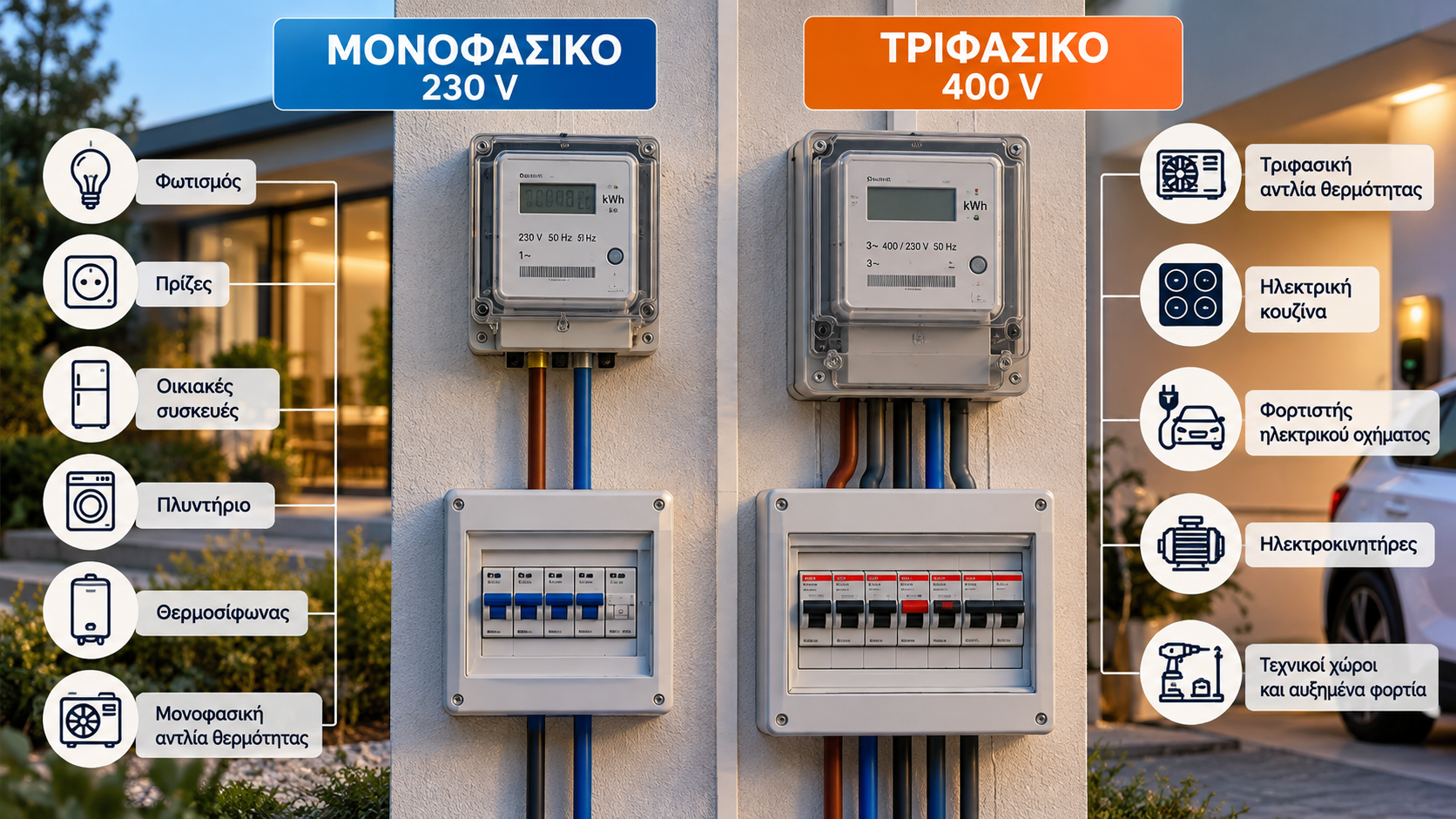
Single-Phase vs Three-Phase Electricity at Home: Differences, Power and When to Upgrade
Choosing between a single-phase and a three-phase electricity supply is an important consideration for modern residential electrical installations.
In the past, many households had relatively modest electricity requirements. Today, electric cooking appliances, heat pumps, instantaneous water heaters and electric vehicle chargers can significantly increase demand.
However, not every home needs three-phase electricity.
A properly designed single-phase supply can meet the requirements of many residential properties, depending on the available electrical capacity and the equipment installed.
Three-phase electricity offers additional capabilities, particularly for larger electrical loads and equipment specifically designed to operate on three phases.
This guide explains how single-phase and three-phase supplies work, their main differences, how electrical power is calculated and when upgrading a residential connection may be appropriate.
It also outlines the general procedure for upgrading an electricity supply in Greece.
1. What Is Single-Phase Electricity?
Single-phase electricity is a common form of electrical supply for residential buildings.
In European low-voltage distribution systems, the nominal voltage between a phase conductor and neutral is generally 230 volts, with a frequency of 50 Hz.
A typical single-phase supply uses one phase and a neutral conductor, together with the appropriate protective arrangements within the electrical installation.
Single-phase electricity can supply:
Lighting circuits.
General socket outlets.
Refrigerators and household appliances.
Washing machines.
Electric water heaters.
Certain electric cookers.
Single-phase heat pumps.
Compatible electric vehicle chargers.
Whether these appliances can operate simultaneously depends on the available supply capacity and the combined electrical demand.
2. What Is Three-Phase Electricity?
A three-phase electrical supply uses three alternating voltage waveforms.
In a typical European low-voltage system, the nominal voltages are:
230 V between phase and neutral.
400 V between two phases.
The three phase voltages are displaced by 120 electrical degrees.
A three-phase supply can power equipment designed for three-phase operation.
It can also supply ordinary single-phase circuits when the installation is appropriately designed.
Typical applications include:
Homes with substantial electrical demand.
Three-phase heat pumps.
Certain electric cooking appliances.
Three-phase EV chargers.
Electric motors.
Workshops and technical facilities.
Having a three-phase supply does not mean every appliance in the property must be three-phase.
3. Single-Phase vs Three-Phase: Main Differences
Feature | Single-Phase | Three-Phase |
Number of phases | One | Three |
Typical phase-to-neutral voltage | 230 V | 230 V |
Typical phase-to-phase voltage | Not applicable | 400 V |
Supports single-phase appliances | Yes | Yes, with appropriate design |
Directly supports three-phase equipment | No | Yes |
Available supply capacity | Depends on the connection | Depends on the connection |
Load distribution | One phase | Three phases |
Installation requirements | Generally simpler | Requires appropriate phase distribution and protection |
Three-phase electricity is not automatically better for every household.
The appropriate supply depends on the actual requirements of the property.
4. How Much Power Can a Single-Phase Supply Deliver?
The available electrical power depends on the characteristics and limitations of the supply connection.
For a single-phase AC circuit under sinusoidal conditions, active power can be expressed as:
P = U × I × cosφ
Where:
P: Active power in watts (W).
U: RMS voltage in volts (V).
I: RMS current in amperes (A).
cosφ: Power factor under sinusoidal conditions.
For a power factor of 1 and a voltage of 230 V:
Current | Calculated Power |
16 A | 3.68 kW |
25 A | 5.75 kW |
32 A | 7.36 kW |
40 A | 9.20 kW |
Important: These figures are mathematical examples, not a list of connection capacities offered by the Greek electricity distribution network operator.
The actual available power depends on the approved characteristics of the individual electricity connection.
The rating of a circuit breaker alone does not establish the contracted capacity of a property.
5. How Much Power Can a Three-Phase Supply Deliver?
For a balanced three-phase load under sinusoidal conditions, active electrical power can be calculated using:
P = √3 × U × I × cosφ
In this equation:
P: Total active power.
U: Line-to-line RMS voltage.
I: Line current.
cosφ: Power factor.
Assuming 400 V and a power factor of 1:
Current per Phase | Calculated Total Power |
16 A | 11.09 kW |
20 A | 13.86 kW |
25 A | 17.32 kW |
32 A | 22.17 kW |
These are illustrative electrical calculations.
They do not confirm that a particular connection capacity is available or approved at every property.
Actual supply capacity depends on the connection agreement, technical infrastructure and network conditions.
6. Is Three-Phase Electricity Cheaper?
Not necessarily.
Three-phase electricity does not automatically reduce the amount of electrical energy consumed by an appliance.
Electricity consumption is generally measured in kilowatt-hours (kWh).
For example, if an appliance requires 2 kWh of electrical energy to perform a particular task, connecting it to a three-phase installation does not inherently reduce that energy requirement.
Certain equipment may have different operating characteristics depending on its design and supply configuration.
However, any efficiency differences must be assessed using the actual equipment specifications.
The overall cost of electricity may also depend on:
The electricity tariff.
Regulated charges.
Contracted connection capacity.
Charges associated with the particular supply arrangement.
Therefore, a meaningful cost comparison requires information about the specific property and electricity contract.
7. When Does a Home Need Three-Phase Electricity?
Three-phase electricity may be beneficial when:
Several high-power appliances are installed.
Equipment specifically requires a three-phase supply.
The existing single-phase connection cannot meet the expected demand.
A three-phase EV charger is planned.
A heat pump requires three-phase electrical input.
Large electrical loads need to be distributed across several phases.
The decision should be supported by a proper electrical load assessment.
Simply adding together the rated power of every appliance without considering how the equipment operates may not accurately represent the expected demand.
8. Do Heat Pumps Require Three-Phase Electricity?
Not all heat pumps require three-phase electricity.
Heat pumps are manufactured with different electrical supply requirements.
Some models operate on single-phase electricity, while others require a three-phase supply.
The appropriate supply depends on:
The specific heat pump model.
Rated electrical input.
Maximum operating current.
Auxiliary electric heating elements.
Manufacturer specifications.
Available electrical capacity at the property.
Heating Capacity Is Not Electrical Consumption
A heat pump rated at 12 kW of heating capacity does not necessarily consume 12 kW of electrical power.
Heating output and electrical input are different quantities.
Electrical installation design must be based on the actual electrical characteristics of the equipment.
This distinction is particularly important when assessing whether an existing household supply is sufficient.
9. Is Three-Phase Electricity Necessary for an EV Charger?
The answer depends on the charging equipment, the vehicle and the available supply.
In European residential installations, common AC charging configurations include single-phase and three-phase chargers.
Under nominal conditions:
Charging Configuration | Approximate Power |
Single-phase, 230 V, 16 A | 3.68 kW |
Single-phase, 230 V, 32 A | 7.36 kW |
Three-phase, 400 V, 16 A per phase | 11.09 kW |
Three-phase, 400 V, 32 A per phase | 22.17 kW |
The actual charging power may be limited by:
The vehicle’s onboard charger.
The charging station.
The available electricity supply.
Load management settings.
Applicable technical restrictions.
Not every electric vehicle supports 11 kW or 22 kW AC charging.
A three-phase supply may enable higher charging power, but the entire charging system must support it.
10. What About Electric Cookers and Induction Hobs?
Electric cookers and induction hobs can have substantial rated electrical power.
However, not every model requires three-phase electricity.
The correct supply depends on:
Appliance design.
Permitted connection configurations.
Rated electrical power.
Operating limitations.
Manufacturer installation instructions.
Some appliances support more than one approved electrical connection arrangement.
This does not mean that any wiring configuration is acceptable.
The installation must follow the manufacturer’s specifications and be performed by an appropriately qualified professional.
11. What Is Phase Load Balancing?
In a three-phase electrical installation, individual single-phase circuits can be distributed among the three phases.
The objective is to manage electrical loads appropriately.
If one phase carries significantly more current than the others, operating limitations may arise.
Proper load distribution requires consideration of:
Expected electrical loads.
Simultaneous equipment operation.
Appliance characteristics.
Protective device requirements.
Overall installation design.
Load distribution is part of professional electrical design.
Circuits should never be moved between phases without the necessary technical assessment.
12. How Can I Tell Whether My Home Has Single-Phase or Three-Phase Electricity?
The type of electrical supply may be identified through:
Electricity connection documentation.
Technical records for the property.
Information displayed on the electricity meter.
Confirmation from the distribution network operator.
Inspection by a qualified electrician.
Some electricity meters display markings indicating single-phase or three-phase operation.
However, homeowners should not open sealed meter compartments or electrical distribution boards to identify the supply.
If there is any uncertainty, the safest option is to consult the relevant documentation or a qualified professional.
13. How Do You Upgrade from Single-Phase to Three-Phase Electricity in Greece?
In Greece, changes to electricity connection characteristics are handled through the relevant procedures of the Hellenic Electricity Distribution Network Operator, commonly known as HEDNO (ΔΕΔΔΗΕ).
The exact requirements depend on the existing connection and the proposed modification.
A typical process may involve:
Assessing the property’s electrical requirements with a qualified electrician.
Inspecting the existing electrical installation.
Determining the required supply capacity and configuration.
Submitting the appropriate application to the distribution network operator.
Reviewing technical conditions and applicable charges.
Completing any required electrical installation modifications.
Carrying out the necessary inspections and preparing the required documentation.
Completing the supply modification according to the network operator’s procedures.
The precise sequence and documentation may vary.
Approval should not be assumed before the network operator has assessed the request.
Some properties may require additional electrical or infrastructure work.
14. Does Upgrading to Three-Phase Require a New Electrical Panel?
A change from single-phase to three-phase supply requires a technical assessment of the existing electrical distribution board.
Depending on its condition and configuration, modifications may be necessary.
The assessment should consider:
Suitability of the existing enclosure.
Available space.
Protective devices.
Circuit distribution.
Incoming supply conductors.
Earthing and protective arrangements.
Applicable electrical installation requirements.
The extent of the work varies between properties.
An electricity supply upgrade should not be viewed as merely replacing the electricity meter.
15. How Much Does a Single-Phase to Three-Phase Upgrade Cost?
There is no universal fixed price for upgrading a residential electricity connection.
Potential costs may include:
Electrical inspection and assessment.
Distribution board modifications.
Changes to supply conductors.
Electrical materials.
Professional installation work.
Testing and documentation.
Network operator charges.
Additional infrastructure work where necessary.
The total cost depends on the existing installation, the requested capacity and the technical requirements of the property.
A reliable estimate requires an assessment by a qualified electrician and confirmation of the applicable network operator charges.
For properties in Greece, current procedures and charges should be checked directly with HEDNO.
16. When Is a Three-Phase Upgrade Unnecessary?
A three-phase upgrade may not be necessary when:
The existing single-phase supply meets the property’s electrical demand.
No installed equipment requires three-phase power.
The electrical installation can operate safely within the available capacity.
Future electricity requirements do not justify an upgrade.
Suitable load management arrangements can address specific demand limitations.
The most appropriate electricity supply is not necessarily the largest available.
It is the one that safely and reliably meets the property’s requirements.
17. Common Mistakes When Choosing an Electrical Supply
Assuming Three-Phase Is Always Better
Three-phase electricity has advantages, but many homes operate effectively with single-phase power.
Confusing Heating Output with Electrical Input
This is particularly common when evaluating heat pumps.
Ignoring Simultaneous Electrical Demand
The way appliances operate together affects the required supply capacity.
Overlooking Manufacturer Requirements
Electrical supply arrangements must match the specifications of the equipment.
Underestimating Upgrade Work
Changing the supply may require modifications to the internal electrical installation.
Making Decisions Without a Technical Assessment
Supply upgrades should be based on documented electrical requirements rather than assumptions.
18. Frequently Asked Questions
Is Three-Phase Electricity Better Than Single-Phase?
Not in every situation. The appropriate supply depends on the electrical loads and requirements of the property.
Does Three-Phase Electricity Have a Higher Voltage?
In typical European low-voltage systems, the voltage between phase and neutral is approximately 230 V. A three-phase system also provides approximately 400 V between phases.
Does Three-Phase Electricity Consume More Energy?
Not inherently. Energy consumption depends on the connected appliances and their operation.
Do I Need Three-Phase Electricity for a Heat Pump?
Only if the equipment requires it or the overall electrical demand makes a three-phase supply appropriate.
Do I Need Three-Phase Electricity for an Electric Cooker?
That depends on the appliance specifications and the available electrical installation.
Can I Charge an Electric Car Using Single-Phase Electricity?
Yes. Single-phase EV charging is possible with compatible equipment and an appropriately designed installation.
Who Approves an Electrical Supply Upgrade in Greece?
The relevant distribution network operator handles the connection modification process, subject to the applicable requirements.
Is New Electrical Installation Certification Required?
Inspection and documentation requirements depend on the modifications and applicable regulations. In Greece, the need for an updated electrician’s declaration (ΥΔΕ) should be confirmed for the specific work.
Can Three-Phase Electricity Improve Heat Pump Efficiency?
Not automatically. Heat pump efficiency depends primarily on equipment design, operating conditions and system configuration.
Can a Three-Phase Home Still Use Ordinary 230 V Appliances?
Yes. Appropriately designed single-phase circuits can supply standard 230 V appliances from a three-phase installation.
Conclusion
Choosing between single-phase and three-phase electricity should be based on the actual electrical requirements of the property.
Single-phase electricity can support many residential applications, while three-phase electricity provides additional options for higher electrical loads and equipment specifically designed for three-phase operation.
Installing a heat pump, an EV charger or another high-power appliance does not automatically mean that a supply upgrade is required.
A professional electrical assessment, appropriate demand calculations and confirmation of the available connection options are essential before making a decision.
Thermosphere.gr — Technical knowledge for safer and more efficient installations.
Disclaimer: This article provides general technical information and does not replace an electrical design, professional inspection or advice from the relevant distribution network operator. Electrical installation modifications must be carried out by appropriately qualified professionals in accordance with applicable regulations.
Technical References
IEC 60038 — Standard Voltages.
IEC 60364 — Low-Voltage Electrical Installations.
IEC 60364-4-41 — Protection Against Electric Shock.
IEC 60364-5-52 — Selection and Erection of Wiring Systems.
IEC 60364-6 — Verification.
IEC 60364-7-722 — Supplies for Electric Vehicles.
ELOT 60364 — Electrical Installation Requirements in Greece.
HEDNO (ΔΕΔΔΗΕ) — Official information on electricity connections, supply modifications and technical requirements: https://www.deddie.gr/