
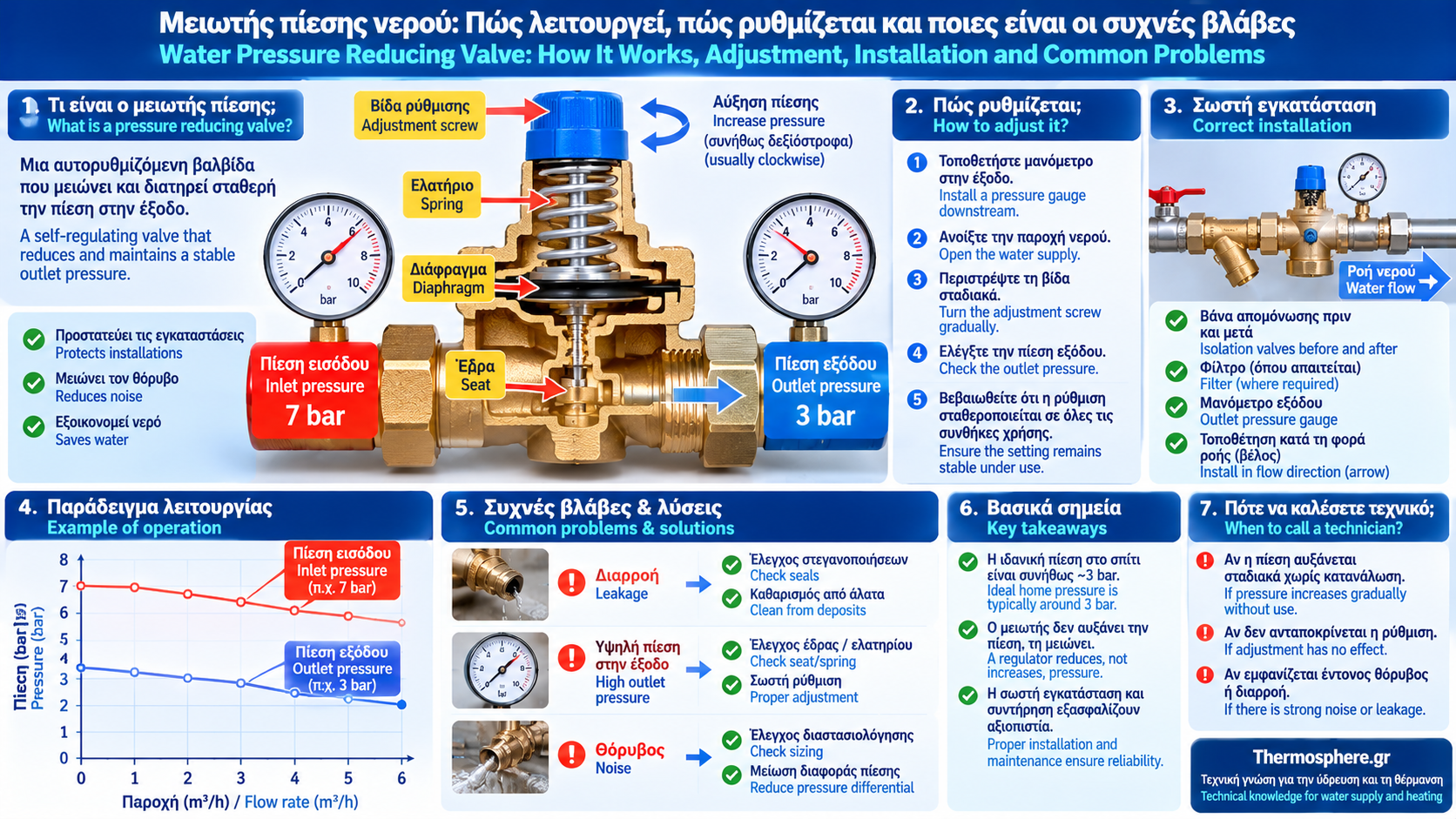
Water Pressure Reducing Valve: How It Works, Adjustment, Installation and Common Problems
Water pressure is one of the most important factors affecting the safe and reliable operation of plumbing systems.
Excessive pressure increases mechanical stress on pipes, fittings, flexible connections and appliances.
Insufficient pressure can cause poor water delivery, particularly when several outlets operate simultaneously.
A water pressure reducing valve is designed to reduce downstream pressure and maintain it close to a selected setting within its operating limits.
This Thermosphere.gr technical guide explains how pressure reducing valves work, how they are selected and adjusted, and how common problems can be diagnosed.
1. What Is a Water Pressure Reducing Valve?
A pressure reducing valve, commonly abbreviated PRV, is a self-regulating valve installed in a pipeline to control downstream pressure.
Its purpose is to provide a lower, relatively stable outlet pressure despite variations in inlet pressure and water consumption, within the limits of its design.
It is not a pump and cannot increase water pressure.
It must also not be confused with a pressure relief or safety valve, which performs a different function.
2. How Does a Pressure Reducing Valve Work?
Common mechanical pressure reducing valves use a combination of:
Valve body.
Internal seat and movable closure element.
Adjustment spring.
Diaphragm or piston.
Spring-preload adjustment mechanism.
Outlet pressure acts on the diaphragm or piston.
This force is balanced against the force of the spring.
When outlet pressure tends to decrease due to increased demand, the mechanism allows the valve to open further.
When outlet pressure increases, the valve opening is reduced.
The valve therefore attempts to maintain outlet pressure close to its setpoint.
Actual performance depends on valve design and operating conditions.
3. Inlet Pressure Versus Outlet Pressure
Inlet pressure is the pressure upstream of the regulator.
Outlet pressure is the pressure downstream, in the protected installation.
For example:
Inlet pressure: 7 bar.
Desired outlet pressure: 3 bar.
A suitable regulator may be adjusted to provide approximately 3 bar downstream under the specified conditions.
This does not mean outlet pressure will remain exactly 3 bar at every flow rate.
Flow-dependent deviations occur and depend on valve size, demand and performance characteristics.
4. Why Install a Pressure Reducing Valve in a Home?
In some locations, public water supply pressure may be high or fluctuate considerably.
A properly selected regulator can help:
Limit excessive pressure.
Reduce mechanical stress.
Protect sensitive components.
Reduce certain flow-related noises.
Provide more controlled operating conditions.
Reducing pressure may also reduce flow through certain open outlets and therefore lower water consumption.
Actual water savings depend on fixtures and usage habits.
5. Where Should a Pressure Reducing Valve Be Installed?
In domestic installations, a regulator is commonly installed on the main supply line to protect the required downstream section.
An illustrative arrangement is:
Main supply → Isolation valve → Filter, where required → Pressure reducing valve → Outlet pressure gauge → Internal distribution
The actual arrangement depends on system design, utility requirements, backflow protection devices and manufacturer instructions.
A downstream gauge simplifies adjustment and inspection.
Adequate maintenance access should be provided.
6. How Do You Adjust a Water Pressure Regulator?
Most adjustable mechanical regulators have an adjustment screw or similar mechanism.
The exact procedure depends on the model.
General steps include:
Confirm that a suitable downstream pressure gauge is installed.
Read the manufacturer’s instructions.
Open the supply and check for leakage.
Adjust the regulator gradually.
Observe downstream pressure.
Check pressure both at no flow and during water consumption.
Confirm adequate performance at the outlets.
On many models, clockwise rotation increases the pressure setting, but this must not be assumed for every regulator.
Always follow the manufacturer’s specified adjustment direction.
Lowering the setting may require controlled release of downstream pressure through an appropriate outlet, according to the manufacturer’s procedure.
7. What Water Pressure Should a Home Have?
There is no single ideal pressure for every home.
The appropriate value depends on:
Building height.
Pipe pressure losses.
Appliance requirements.
Simultaneous water demand.
Installation specifications.
Local regulatory requirements.
Settings around 3 bar are common reference values in many domestic installations, but they are not universally required or suitable.
The correct setting should be determined from hydraulic design and system requirements.
In multistorey buildings, pressure at the most demanding outlets must also be considered.
8. Static and Dynamic Pressure
Static Pressure
Static pressure is measured when there is no water flow through the relevant section.
Dynamic Pressure
Dynamic pressure is measured while water is flowing.
During consumption, pressure losses occur in pipes, fittings and valves.
For example:
Static outlet pressure: 3 bar.
Outlet pressure during flow: 2.5 bar.
This difference does not automatically indicate a fault.
It must be assessed against the flow rate and regulator performance data.
9. What Happens When Inlet Pressure Is Too Low?
A pressure reducing valve cannot increase pressure.
If inlet pressure falls below the desired outlet pressure, the setpoint cannot be maintained.
For example:
Regulator setting: 3 bar.
Available inlet pressure: 2 bar.
The regulator cannot maintain 3 bar downstream.
During flow, additional pressure loss occurs through the valve.
Adequate inlet pressure is therefore essential.
10. How Do You Size a Pressure Reducing Valve?
Selection should not be based only on pipe diameter.
Important parameters include:
Minimum and maximum inlet pressure.
Required outlet pressure.
Design flow rate.
Allowable pressure drop.
Water temperature.
Potable-water suitability.
Manufacturer performance curves.
Flow velocity and noise limits.
An undersized regulator may cause excessive pressure drop at high demand.
An oversized regulator may have less favourable control behaviour at very low flows, depending on its design.
Manufacturer sizing charts should be used.
11. What Is Pressure Drop During Flow?
Water flowing through a regulator encounters hydraulic resistance.
The difference between inlet and outlet pressure is not simply an unwanted loss; it is also the intended result of pressure reduction.
However, as flow increases, actual downstream pressure may deviate from the nominal setpoint.
This behaviour is described by manufacturer performance curves.
Correct selection requires checking outlet pressure at the expected operating flow, not only at no flow.
12. Why Does Downstream Pressure Rise Above the Setting?
If downstream pressure gradually increases when there is no demand, several causes are possible.
Internal Seat Leakage
A worn or contaminated seat may allow pressure to pass from inlet to outlet.
Foreign Particles
Sand, mineral deposits or other debris may prevent proper sealing.
Thermal Expansion
Heating water in a hydraulically closed section can increase pressure even if the regulator operates correctly.
Another Pressure Source
A booster pump or other equipment may affect downstream pressure.
Diagnosis requires pressure monitoring and systematic isolation of possible causes by a qualified technician.
13. Pressure Reducing Valves and Thermal Expansion
Water expands when heated.
If the piping section is hydraulically closed, thermal expansion can cause a substantial pressure rise.
Pressure reducing valves and backflow devices may limit reverse movement of water, depending on system configuration.
In such cases, a suitable expansion-control and overpressure-protection arrangement may be necessary.
A pressure reducing valve does not replace an expansion vessel or safety relief valve.
The correct arrangement must follow system design requirements.
14. Pressure Regulators and Booster Pumps
A booster system increases water pressure using a pump.
A pressure reducing valve performs the opposite function by limiting downstream pressure.
Both may be used within the same installation.
For example, a booster may serve an entire building while regulators protect individual pressure zones.
Installing a regulator without hydraulic assessment can affect booster performance, particularly if it introduces unwanted resistance or interacts with control sensors.
15. Why Does a Pressure Reducing Valve Make Noise?
Possible causes include:
Excessive flow velocity.
Large pressure differential.
Incorrect sizing.
Unstable regulator operation.
Foreign particles.
Cavitation under unfavourable conditions.
Water hammer elsewhere in the system.
Whistling during high demand may be associated with flow through the valve.
Loud impacts during rapid valve closure may indicate water hammer.
A pressure regulator is not, by itself, a complete water-hammer protection device.
16. Signs of a Faulty Pressure Reducing Valve
Symptoms requiring investigation include:
Downstream pressure gradually rising without demand.
Excessive pressure reduction during consumption.
No response to adjustment.
External leakage.
Significant operating noise.
Unexplained pressure fluctuations.
None of these symptoms alone proves that the regulator is defective.
Inlet pressure, outlet pressure and actual flow should be checked.
17. Troubleshooting Table
Symptom | Possible cause | Recommended check |
High outlet pressure | Worn or contaminated seat | Check static pressure and seat tightness |
Low pressure during use | Insufficient flow capacity or high resistance | Measure pressure during flow |
Pressure fluctuations | Inlet variation or unstable control | Monitor inlet and outlet simultaneously |
Whistling | High velocity or pressure differential | Review valve sizing |
External leakage | Seal deterioration | Safely isolate and inspect |
Pressure rise after heating | Thermal expansion | Check closed-system protection |
18. Maintenance and Service Life
Service life depends on:
Water quality.
Frequency of pressure changes.
Temperature.
Materials.
Correct sizing.
Installation quality.
Some models include a cleanable strainer, replaceable cartridge or repair kit.
Others require replacement of the complete unit.
Periodic pressure monitoring can reveal problems before major failure occurs.
Maintenance must be performed with the system safely isolated and depressurised.
19. Common Installation Mistakes
Incorrect Flow Direction
The regulator must be installed according to its flow-direction arrow.
No Pressure Measurement
Adjustment without reliable measurement cannot verify downstream pressure.
Incorrect Size
Choosing only by connection size may result in insufficient flow capacity.
Ignoring Water Quality
Particles can interfere with the valve seat and mechanism.
Overlooking Thermal Expansion
Overpressure protection requires assessment of the entire system.
Poor Maintenance Access
The regulator must remain accessible for inspection and service.
20. Frequently Asked Questions
How Do I Know If I Need a Pressure Reducing Valve?
Measure the supply pressure and assess the installation requirements. High or strongly fluctuating pressure may make pressure reduction beneficial or necessary.
Is 3 Bar the Correct Setting?
It is a common reference value for many domestic applications, but it is not suitable for every installation.
Can I Adjust a Regulator Without a Pressure Gauge?
It is not recommended. Without a gauge, the actual outlet pressure cannot be verified.
Why Does Pressure Drop When Two Taps Are Open?
Possible causes include insufficient supply capacity, pipe losses, filters, incorrect sizing or the regulator’s normal flow-dependent behaviour.
Does a Pressure Regulator Prevent Water Hammer?
It can influence operating pressure, but it does not replace dedicated water-hammer protection where required.
Is a Pressure Reducing Valve the Same as a Safety Valve?
No. A pressure reducing valve controls downstream pressure during normal operation. A safety or relief valve protects against overpressure by releasing fluid.
Is a Regulator Required Before a Water Heater?
This depends on supply pressure, equipment specifications and installation design. It does not replace required safety devices.
Conclusion
A water pressure reducing valve is an important component for controlling pressure in plumbing installations.
Its operation relies on balancing spring force against downstream pressure, automatically changing the valve opening.
Reliable performance requires correct sizing, suitable pressure limits, proper installation and pressure-gauge verification.
It is especially important to distinguish regulator failure from pressure increases caused by thermal expansion or other system conditions.
A properly selected and adjusted pressure regulator does more than lower pressure: it contributes to the overall protection and stability of the water distribution system.
Technical References and Further Reading
EN 1567: Water pressure reducing valves and combination water pressure reducing valves — Requirements and tests.
EN 806: Specifications for installations inside buildings conveying water for human consumption.
EN 1717: Protection against pollution of potable water in water installations.
CEN-CENELEC: https://www.cencenelec.eu/
Caleffi: https://www.caleffi.com/ — technical documentation and plumbing component guides.
Watts: https://www.watts.com/ — pressure regulator documentation and control equipment.
The applicability of standards depends on the specific product, installation and current edition.
Safety note: Before working on a regulator, safely isolate and depressurise the system. Adjustment, repair and replacement should be performed by appropriately qualified personnel in accordance with manufacturer instructions.
Thermosphere.gr — Technical knowledge for water supply and heating systems.