
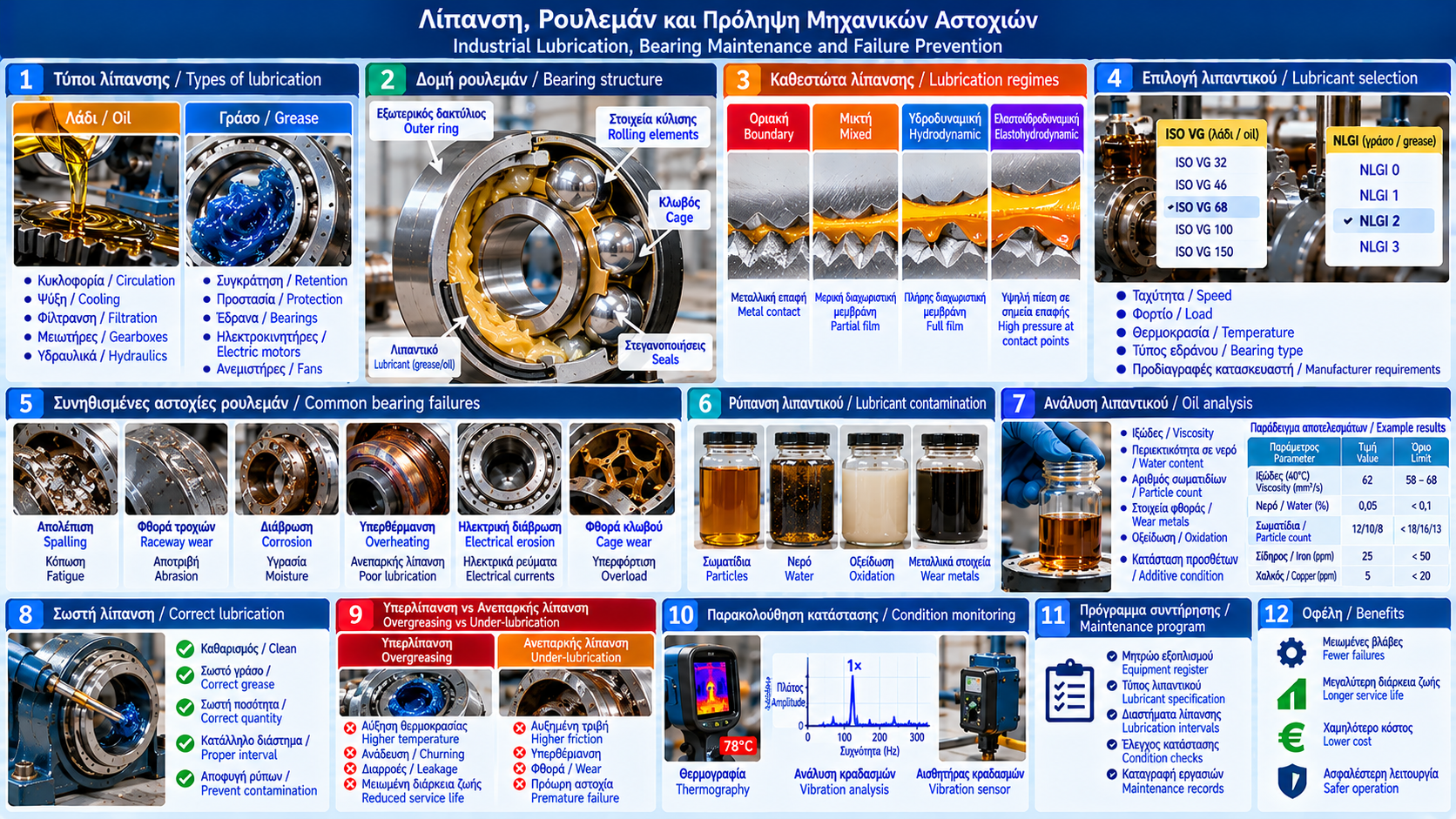
# Industrial Lubrication, Bearing Maintenance and Mechanical Failure Prevention
## Introduction
Proper lubrication is essential for reliable industrial machinery operation. Pumps, electric motors, gearboxes, fans and power transmission systems contain bearings and moving components that require appropriate lubrication.
Insufficient lubrication, unsuitable lubricant selection and contamination can increase friction, temperature, wear and the risk of premature failure.
However, excessive greasing and incorrect lubrication procedures can also cause problems.
Effective maintenance depends on correct lubricant selection, operating condition assessment and bearing condition monitoring.
## 1. Why Is Lubrication Necessary?
A lubricant creates a film that partially or completely separates moving surfaces, depending on operating conditions.
Main lubrication functions include:
- Reducing friction.
- Limiting mechanical wear.
- Protecting against corrosion.
- Removing heat in suitable circulating systems.
- Carrying contaminants to filters where applicable.
- Helping prevent contaminant ingress in certain arrangements.
Performance depends on lubricant properties, load, speed, temperature and surface condition.
## 2. Main Lubrication Regimes
### Boundary Lubrication
Significant microscopic contact occurs between surfaces. Protection depends strongly on lubricant additives and surface properties.
### Mixed Lubrication
Load is supported partly by the lubricant film and partly by contact between surface asperities.
### Hydrodynamic Lubrication
Relative motion and geometry generate pressure in the lubricant film, potentially separating surfaces completely.
### Elastohydrodynamic Lubrication
Common in rolling contacts, including bearings and gears. High contact pressure produces elastic deformation and changes in lubricant viscosity.
The lubrication regime may change during startup, shutdown or load variation.
## 3. Oil or Grease?
Two widely used lubricant categories are oils and greases.
### Lubricating Oil
Oil is suitable for applications requiring defined flow characteristics, circulation, heat removal or filtration.
Typical applications include:
- Gearboxes.
- Circulating lubrication systems.
- Certain bearings.
- Hydraulic systems.
- Turbomachinery.
### Grease
Grease typically consists of base oil, thickener and additives.
Applications include:
- Electric motor bearings.
- Fan bearings.
- Selected pump bearings.
- Mechanisms where lubricant retention is important.
Selection should follow equipment requirements rather than convenience alone.
## 4. What Is Viscosity?
Viscosity describes a fluid's resistance to flow.
In lubrication, it influences lubricant film formation and thickness.
Insufficient viscosity may lead to inadequate surface separation.
Excessive viscosity may increase internal friction losses, temperature or circulation difficulties.
Viscosity changes with temperature.
Selection should consider:
- Rotational speed.
- Load.
- Operating temperature.
- Bearing type.
- Lubrication system.
- Manufacturer recommendations.
## 5. What Does ISO VG Mean?
ISO VG classifies industrial liquid lubricants by kinematic viscosity grade, referenced at 40°C.
For example, ISO VG 68 has a nominal kinematic viscosity of 68 mm²/s at 40°C.
ISO VG alone does not establish lubricant suitability.
Other factors include:
- Base oil type.
- Additive package.
- Oxidation resistance.
- Material compatibility.
- Manufacturer requirements.
- Behavior at actual operating temperatures.
Lubricants should not be substituted solely because they share the same ISO VG grade.
## 6. What Does NLGI Mean?
The NLGI scale classifies grease consistency using worked penetration.
NLGI 2 is widely used in industrial applications but is not universally suitable.
An NLGI grade does not specify:
- Base oil viscosity.
- Thickener type.
- Temperature performance.
- Compatibility with other greases.
- Suitability for a particular bearing.
Selection must consider the full lubricant specification.
## 7. What Are Rolling-Element Bearings?
Rolling-element bearings use balls or rollers to support rotating components.
Main parts may include:
- Inner ring.
- Outer ring.
- Rolling elements.
- Cage.
- Seals or shields.
Common types include ball bearings, cylindrical roller bearings, tapered roller bearings and self-aligning bearings.
Each design is intended for specific combinations of load, speed and operating requirements.
## 8. Common Bearing Failure Mechanisms
### Surface Spalling
May be associated with rolling contact fatigue.
### Abrasive Wear
May result from hard contaminant particles.
### Corrosion
Associated with moisture or aggressive substances.
### Surface Distress
May develop when lubricant film conditions are inadequate.
### Electrical Erosion
In certain motor applications, electrical currents passing through bearings can cause characteristic damage.
### Plastic Deformation
May result from overloading, impact or incorrect mounting.
Accurate diagnosis requires examination of damage patterns and operating conditions.
## 9. Insufficient Lubrication
Insufficient lubrication may cause:
- Increased friction.
- Higher temperature.
- Surface wear.
- Changes in vibration.
- Reduced service life.
- Premature failure.
Potential causes include:
- Insufficient lubricant quantity.
- Incorrect relubrication interval.
- Unsuitable viscosity.
- Leakage.
- Lubricant degradation.
- Improper supply.
Corrective action should address the actual cause rather than simply adding lubricant.
## 10. Excessive Greasing
Overgreasing is a common maintenance error.
Excess grease can cause:
- Increased churning.
- Higher operating temperature.
- Additional power losses.
- Pressure on seals.
- Grease leakage.
The problem can be particularly significant when old grease has no suitable escape path.
Relubrication quantity should be determined from manufacturer guidance and bearing geometry.
## 11. Grease Compatibility
Mixing different greases may create compatibility problems.
Potential consequences include:
- Changes in consistency.
- Oil separation.
- Reduced mechanical stability.
- Poor lubrication performance.
Compatibility depends on thickeners, base oils and additives.
Greases with similar appearance or the same NLGI grade are not necessarily compatible.
Before changing products, follow manufacturer guidance and use an appropriate changeover procedure when required.
## 12. Lubricant Contamination
Contamination sources include:
- Dust.
- Metallic particles.
- Water.
- Chemicals.
- Cleaning residues.
- Wear debris.
Particles can cause abrasion and surface damage.
Water may affect lubricant film formation, promote corrosion and accelerate certain failure mechanisms.
Prevention includes clean storage, proper handling, effective sealing and filtration where applicable.
## 13. Oil Analysis
Oil analysis is a condition-monitoring tool for machinery and lubricants.
Common parameters include:
- Kinematic viscosity.
- Water content.
- Particle count.
- Wear metals.
- Oxidation.
- Acidity where relevant.
- Additive condition.
Repeated measurements from representative samples provide more useful trends than isolated results.
Evaluation limits should reflect lubricant type, equipment design and manufacturer guidance.
## 14. Bearing Temperature Monitoring
Temperature is an important condition-monitoring parameter.
An increase may be associated with:
- Insufficient lubrication.
- Overgreasing.
- Overloading.
- Misalignment.
- Inadequate cooling.
- Bearing damage.
However, temperature also depends on ambient conditions, load and speed.
No universal permissible bearing temperature applies to all applications.
Limits should be based on specifications and operating history.
## 15. Bearing Vibration Analysis
Rolling-element bearing defects may generate characteristic vibration frequencies.
Common techniques include:
- Acceleration measurements.
- Frequency analysis.
- Envelope analysis.
- Trend monitoring.
- Historical comparisons.
Defect frequencies depend on bearing geometry and rotational speed.
Diagnosis should not rely on a single vibration value.
## 16. Building a Lubrication Program
An effective program includes:
1. Equipment register.
2. Lubricant specification records.
3. Defined lubricant quantities.
4. Relubrication schedules.
5. Clean storage.
6. Proper labeling of containers and tools.
7. Personnel training.
8. Maintenance records.
9. Condition monitoring.
10. Periodic program review.
A CMMS can support scheduling and traceability.
## 17. Electric Motor Maintenance Example
An electric motor drives an industrial fan through a coupling.
During operation, one bearing shows a gradual temperature increase.
Investigation includes:
- Recording temperature and load.
- Checking vibration.
- Verifying grease type.
- Reviewing relubrication history.
- Checking alignment.
- Inspecting seals.
- Assessing potential bearing wear.
Adding grease without diagnosis may worsen the problem if the bearing is already overgreased.
Corrective action should follow evaluation of the available evidence.
## 18. When Should a Bearing Be Replaced?
Replacement may be necessary when inspection reveals:
- Severe surface damage.
- Cracks.
- Spalling.
- Deformation.
- Cage failure.
- Unacceptable clearances.
- Other damage preventing safe operation.
Decisions should consider manufacturer specifications and application criticality.
Critical bearings should not be repaired using unapproved methods.
## 19. Lubrication Safety
Lubrication activities require safe procedures.
Key requirements include:
- Isolation of hazardous energy where required.
- Avoiding contact with rotating parts.
- Suitable personal protective equipment.
- Protection from hot oil.
- Prevention of slips caused by leaks.
- Compliance with chemical handling instructions.
- Proper collection and disposal of used lubricants.
Relubrication while machinery is operating is permissible only when supported by manufacturer instructions and an approved safe procedure.
## 20. Practices for Improved Reliability
Bearing and machinery service life can be improved through:
- Correct lubricant selection.
- Appropriate lubricant quantity.
- Scheduled relubrication.
- Cleanliness control.
- Moisture protection.
- Correct bearing installation.
- Alignment verification.
- Vibration monitoring.
- Temperature monitoring.
- Investigation of recurring failures.
Maintenance should be based on documented procedures and actual operating data.
## Conclusion
Proper lubrication and bearing maintenance are essential for reliable industrial equipment.
Insufficient lubrication, overgreasing, contamination and incorrect lubricant selection can cause serious mechanical failures.
Systematic oil analysis, temperature and vibration monitoring, and organized maintenance programs help reduce failures and control overall operating costs.
Thermosphere.gr – Technical Knowledge for Professionals.