
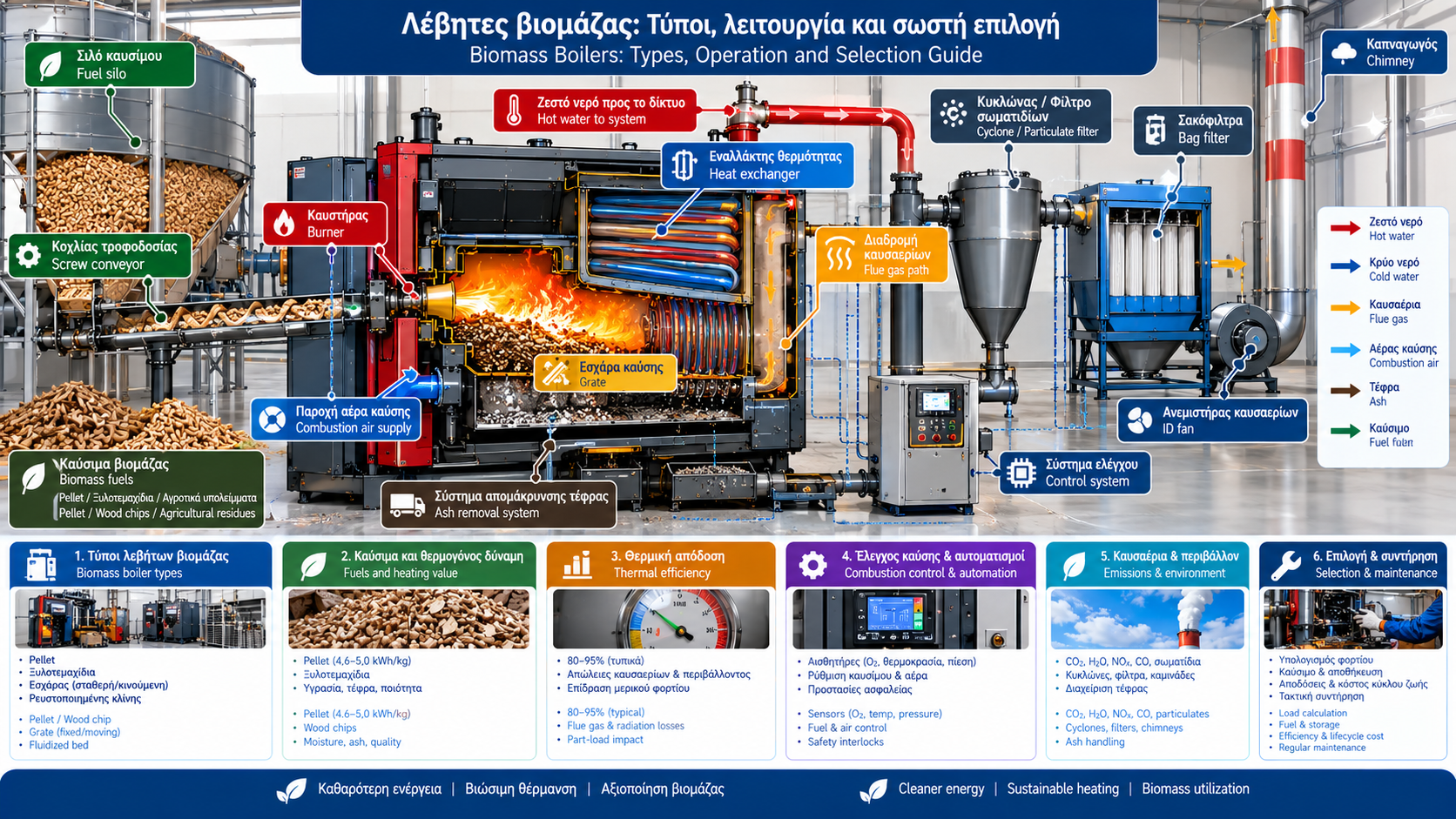
Biomass Combustion and Fuel Feeding Systems: Operation, Automation and Safety
The performance of an industrial biomass boiler depends significantly on how fuel is stored, transported, introduced into the combustion chamber and burned.
A complete installation integrates fuel handling equipment, combustion technology, air supply, instrumentation, automation and safety systems.
Poor design or incorrect adjustment may lead to unstable combustion, excessive emissions, mechanical blockages and fire hazards.
Biomass Fuel Storage
Fuel storage is the first stage of the feeding system.
Wood pellets are commonly stored in suitable silos or dedicated storage rooms. Wood chips may require bunkers with floor extraction mechanisms.
Storage capacity depends on thermal demand, fuel consumption, required operating autonomy and delivery frequency.
Moisture protection is important because degraded fuel may cause conveying difficulties and combustion instability.
Storage design must also address fire, combustible dust, carbon monoxide and confined-space hazards.
Screw Conveyors and Fuel Feeding Equipment
Screw conveyors transport solid fuel using a rotating helical screw inside a suitable casing.
Their conveying capacity depends on screw diameter, rotational speed, pitch, inclination, bulk density and fuel characteristics.
Irregular wood chips can cause bridging in storage bunkers or blockages in feeding equipment.
Larger installations may use chain conveyors, walking floors or hydraulic pushers.
The selected equipment must be compatible with the actual fuel size distribution and moisture content.
Backfire Protection Systems
One of the most important hazards is the propagation of heat or combustion from the furnace towards the feeding equipment and fuel storage.
Depending on system design, protective measures may include rotary valves, isolation devices, separated feeding stages and engineered fire-extinguishing arrangements.
Protective measures must follow a documented risk assessment and manufacturer requirements.
Stopping a screw conveyor alone is not sufficient protection against combustion propagation.
Combustion Chambers and Grates
The combustion chamber supports fuel drying, thermal decomposition and oxidation.
The grate holds the fuel bed and allows primary combustion air to pass through suitable openings.
Fixed grates are used in specific boiler configurations, while moving grates can support fuel movement, burnout and ash discharge.
Selection depends on fuel properties, thermal capacity, ash content and combustion technology.
Primary and Secondary Combustion Air
Primary air is generally introduced into the fuel-bed region to support drying and solid-fuel combustion.
Secondary air is introduced above the fuel bed to promote mixing and combustion of volatile gases.
The required distribution depends on boiler design, fuel characteristics and operating load.
Insufficient air can increase carbon monoxide emissions, while excessive air can increase heat losses through the exhaust gases.
Oxygen-Based Combustion Control
Modern biomass installations may use flue gas oxygen sensors, often referred to as lambda sensors.
Measurements can be used to adjust combustion air delivery and fuel feeding.
There is no universal oxygen setpoint suitable for every biomass boiler.
The appropriate control range depends on fuel, equipment design, operating load and manufacturer specifications.
Oxygen control must operate alongside other process measurements and safety protections.
Combustion Fans and Flue Gas Draught
Combustion fans supply the air required for fuel oxidation.
Many industrial installations also use induced-draught fans to transport flue gases through treatment equipment and towards the chimney.
Furnace pressure control is important for stable and safe operation.
Variable-frequency drives can regulate fan speed when the equipment and control architecture are designed for this purpose.
PLC Automation and Control
A programmable logic controller can coordinate fuel feeding, combustion air, ignition, ash removal and heat production.
The control system manages startup, normal operation, load changes and controlled shutdown.
Inputs may include temperature, pressure, oxygen concentration and motor operating status.
Safety-critical functions require an appropriate safety architecture and independence where necessary.
A standard process controller should not be assumed to provide all required protective functions.
Common Operating Problems
Unstable fuel feeding may cause fluctuations in combustion temperature and thermal output.
Screw conveyor blockages can result from oversized fuel particles, foreign objects or mechanical wear.
Excessive unburned material may indicate poor air distribution, unsuitable fuel or grate problems.
Overtemperature and draught failure require the prescribed protective sequences.
Recurring alarms must be investigated rather than bypassed.
Preventive Maintenance and Safety
Maintenance includes inspection of screw conveyors, gearboxes, motors, grates, fans and instrumentation.
Backfire protection, fire safety systems and ash removal mechanisms also require scheduled inspection.
Before maintenance, equipment must be safely isolated and residual heat hazards assessed.
Entry into fuel silos and enclosed storage spaces requires specific precautions against oxygen deficiency and hazardous gases.
Conclusion
Reliable biomass combustion requires integrated engineering of fuel storage, feeding, combustion air and automation.
Correct coordination between conveyors, grates, fans and sensors supports stable heat generation and reduced emissions.
Effective safety systems and preventive maintenance are essential for dependable industrial biomass operation.