
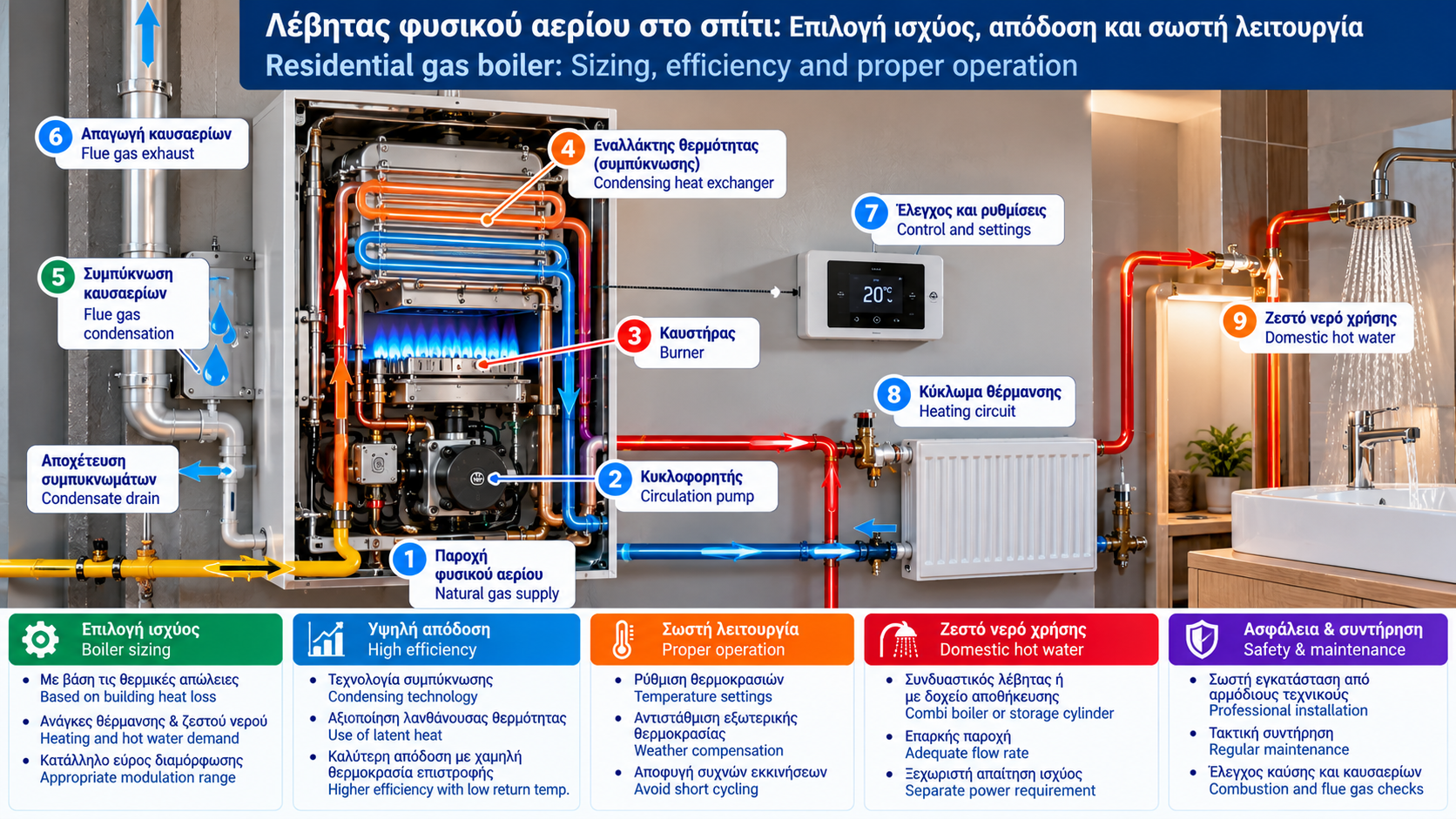
Residential Gas Boiler: Sizing, Efficiency and Proper Operation
A natural gas boiler is a common solution for residential space heating and domestic hot water production.
However, choosing the right boiler involves more than comparing rated output or purchase price.
Building heat losses, condensing technology, modulation range, operating temperatures and hot water demand all influence actual system performance.
A properly selected and commissioned boiler can operate efficiently and reliably while reducing unnecessary burner cycling and fuel consumption.
1. How Does a Natural Gas Boiler Work?
A gas boiler transfers heat released during natural gas combustion to the heating water.
A typical operating sequence includes:
A heating demand from the thermostat or controller.
The required safety sequence.
Burner preparation and ignition.
Heat transfer through the heat exchanger.
Water circulation to radiators or underfloor heating.
Burner output modulation according to demand.
Reduced output or shutdown once the required conditions are reached.
The exact sequence depends on the boiler model and control system.
2. What Is a Condensing Boiler?
A condensing boiler recovers some of the heat contained in water vapour within the combustion products.
In a conventional boiler, much of this energy leaves through the flue.
A condensing boiler cools the flue gases sufficiently to condense some of the water vapour and transfer additional heat to the heating water.
This process is strongly influenced by return-water temperature.
Why Does Return Temperature Matter?
Lower return temperatures generally support more effective condensation.
For natural gas, the flue gas dew point is often approximately 50–60°C, although the exact value depends on fuel composition and combustion conditions.
Operating below the relevant dew point supports condensation, but no single temperature guarantees identical performance in every installation.
3. Can Boiler Efficiency Exceed 100%?
Some boiler specifications show efficiencies above 100%.
This does not mean the boiler produces more energy than the fuel contains.
The difference comes from the heating value used to calculate efficiency.
Lower heating value (LHV) excludes the latent heat of water vapour.
A condensing boiler recovers some of that heat, allowing LHV-based efficiency figures to exceed 100%.
When efficiency is calculated using higher heating value (HHV), the result remains below 100%.
Boilers should only be compared using consistent test conditions and calculation bases.
4. How Many kW Does a Home Need?
Required heating capacity is determined by the building’s design heat loss.
Important factors include:
Building area and geometry.
Thermal insulation.
Windows and doors.
Local design outdoor temperature.
Ventilation and infiltration.
Indoor design temperatures.
Thermal bridges.
An appropriate heat-loss calculation, such as one based on EN 12831-1 where applicable, provides the technical basis for selection.
Example
A 100 m² home could have a design heat load of 6 kW, 10 kW or more, depending on its construction and location.
A fixed W/m² assumption cannot replace a proper design calculation.
5. Why Are 24 kW Boilers So Common?
Many wall-mounted residential boilers have a rated output around 24 kW.
This does not mean that every home needs 24 kW for space heating.
In combination boilers, higher rated capacity is often associated with instantaneous domestic hot water production.
Hot water demand can require substantially more power than the building’s space-heating load.
Therefore, selection should consider heating output, hot water output, minimum output and modulation range separately.
6. What Is Boiler Modulation?
Modern boilers can adjust burner output to match heating demand.
For example, a boiler with a 3–24 kW output range may reduce its output to approximately 3 kW under the specified conditions.
This is valuable during mild weather when heating demand is low.
If actual demand falls below the boiler’s minimum output, frequent burner starts and stops may occur.
This is known as short cycling.
7. Why Is Short Cycling Undesirable?
Frequent cycling can lead to:
Additional operating losses.
Less stable temperatures.
More operating cycles for components.
Reduced efficiency under certain conditions.
Solutions depend on boiler sizing, minimum output, hydraulic design and control strategy.
Replacing the thermostat alone does not necessarily solve the problem.
8. Radiators or Underfloor Heating?
Condensing boilers can work with different heat distribution systems.
Radiators
Radiators may require higher supply-water temperatures depending on their size and design.
Adequately sized radiators can often operate at lower temperatures, particularly when the building heat load is reduced.
Underfloor Heating
Underfloor systems generally operate at lower water temperatures, which can favor condensing operation.
However, actual efficiency depends on the complete heating system.
9. What Is Weather Compensation?
Weather compensation adjusts heating-water supply temperature according to outdoor temperature and a selected heating curve.
In mild weather, lower water temperatures may be sufficient.
As outdoor temperature falls, the controller increases supply temperature according to building demand.
Correct adjustment can improve operating conditions and reduce unnecessarily high water temperatures.
The heating curve must be matched to the building and distribution system.
10. Domestic Hot Water Production
Residential boilers can produce domestic hot water in different ways.
Combination Boiler
A combi boiler heats water on demand without necessarily requiring a separate storage tank.
Available flow depends on boiler output, incoming cold-water temperature and required outlet temperature.
Boiler with Storage Cylinder
A boiler connected to a storage cylinder can provide stored hot water.
This arrangement may be suitable for larger simultaneous demand when properly sized.
11. How Is Hot Water Heating Power Calculated?
The thermal power required to heat water can be estimated using:
P = ṁ × cp × ΔT
Where:
P = thermal power (kW).
ṁ = water mass flow rate (kg/s).
cp = water specific heat capacity, approximately 4.18 kJ/kg·K.
ΔT = temperature rise (K).
Example
For approximately 10 litres per minute and a 35°C temperature rise:
P ≈ 24.4 kW
This represents useful thermal power delivered to the water, excluding additional losses.
It explains why domestic hot water production may require much greater capacity than space heating.
12. How Much Natural Gas Does a Boiler Consume?
Gas consumption depends on useful output, efficiency and the heating value of the supplied gas.
A simplified relationship is:
Gas flow = Useful heat output / (Efficiency × Heating value per m³)
Units and efficiency basis must be consistent.
Example
Assume a boiler delivers 10 kW with 95% LHV-based efficiency and a hypothetical natural gas LHV of 10 kWh/Nm³.
Estimated gas flow is:
10 / (0.95 × 10) ≈ 1.05 Nm³/h
This is an illustrative calculation, not a prediction of a household energy bill.
Actual consumption depends on heating demand, operating hours, installation conditions and gas properties.
13. Which Settings Affect Efficiency?
Important factors include:
Supply-water temperature.
Return-water temperature.
Weather compensation curve.
Room control strategy.
Burner modulation.
Hydraulic balancing.
Heat emitter performance.
Domestic hot water requirements.
There is no single ideal supply temperature for every home.
The objective is to use the lowest practical temperature that reliably meets demand while respecting system and manufacturer requirements.
14. Important Installation Considerations
Before selecting and installing a boiler, assess:
Actual building heat losses.
Required domestic hot water flow.
Available natural gas pressure and flow.
Compatibility with the existing heating system.
Combustion air and flue arrangements.
Condensate drainage.
Water quality and hydraulic system protection.
Maintenance access and service requirements.
Installation and commissioning must be performed by legally qualified professionals.
15. Maintenance and Safe Operation
Boilers must be maintained according to manufacturer instructions and applicable requirements.
Professional maintenance may include:
Burner and heat exchanger inspection.
Flue system assessment.
Combustion analysis using suitable instruments.
Gas tightness checks where required.
Water circulation and system pressure checks.
Condensate drainage inspection.
Safety device testing.
Combustion adjustments and gas-component modifications are not user maintenance tasks.
16. Relevant Technical Standards
Depending on the installation, relevant standards include:
EN 12831-1: Method for calculating design heat load.
EN 15502: Gas-fired central heating boilers.
EN 1775: Gas pipework for buildings.
EN 12828: Design of water-based heating systems.
EN 15316: Methods for calculating energy requirements and system efficiencies.
Applicability depends on equipment type and the relevant regulatory framework.
Conclusion
Choosing the correct residential gas boiler requires more than selecting a rated kW value.
Building heat demand, minimum burner output, domestic hot water requirements and heating-water temperatures determine the suitability of the equipment.
A properly sized condensing boiler, combined with appropriate controls, sound hydraulic design and professional maintenance, can provide reliable heating and effective use of natural gas.