
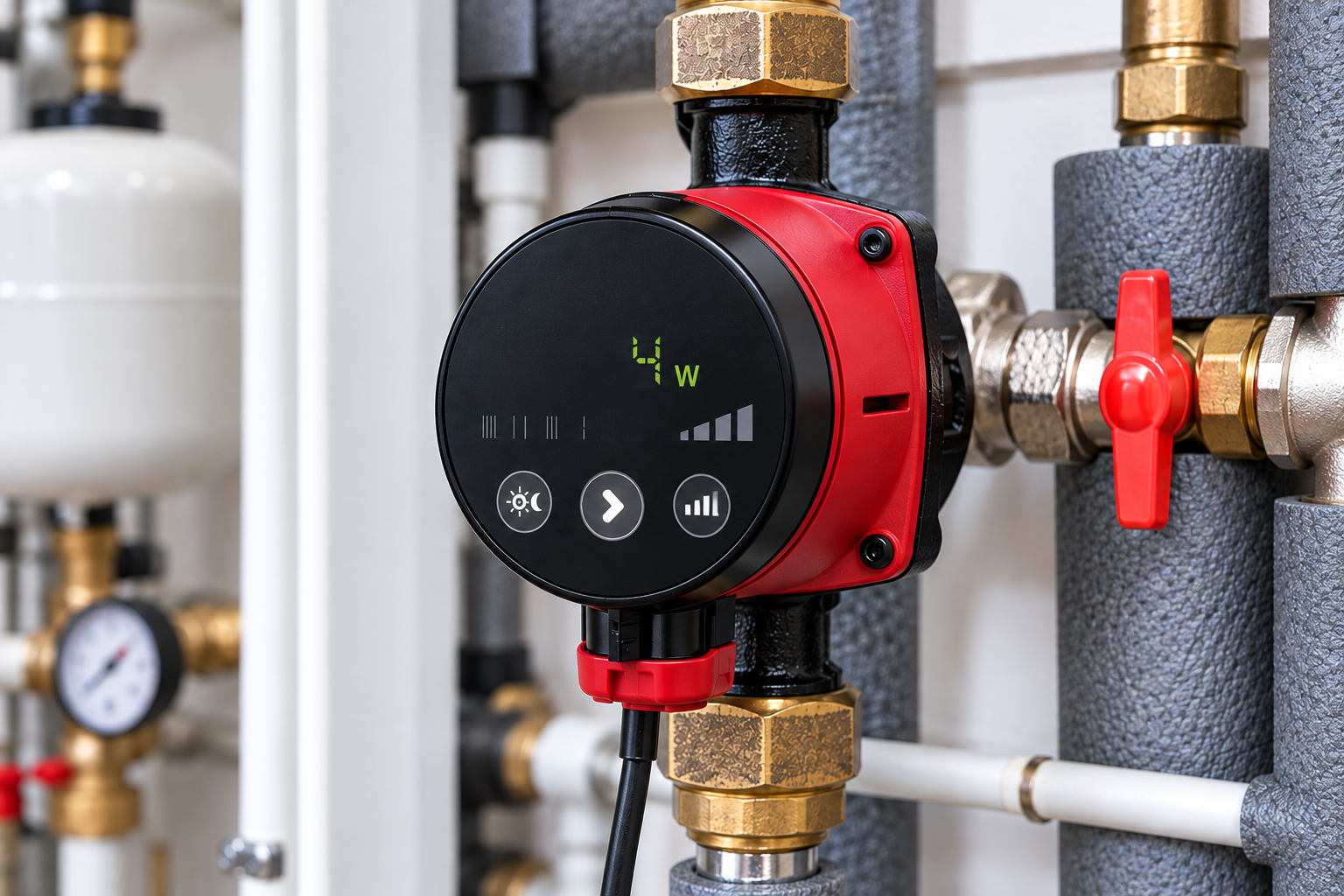
Heating Circulation Pump: How It Works and Key Technical Characteristics
A heating circulation pump is one of the most important components of a hydronic heating system. It ensures that water circulates between the heat source and the radiators, underfloor heating circuits, or other heat exchangers.
Without adequate water circulation, even an efficient boiler or modern heat pump cannot distribute thermal energy effectively throughout a building.
This guide explains how circulation pumps operate, their main components, the differences between conventional and electronically controlled models, and the technical parameters that determine their performance.
1. What Is a Heating Circulation Pump?
A heating circulation pump is an electrically driven pump, typically centrifugal, designed to circulate water through a hydronic heating system.
Many modern residential installations use wet-rotor circulators, where the pumped liquid contributes to the lubrication and cooling of appropriately designed internal components.
The pump does not generate heat. Its purpose is to circulate heated water through the distribution system and return it to the heat source.
Proper circulation affects:
Heat transfer throughout the installation.
Uniform heating of occupied spaces.
Supply and return temperature differences.
Electrical energy consumption.
Hydraulic noise and operating stability.
2. How Does a Circulation Pump Work?
Inside the pump, an impeller rotates using an electric motor.
The rotating impeller transfers energy to the water, creating a pressure difference between the pump inlet and outlet.
This differential pressure overcomes hydraulic resistance in pipes, valves, heat exchangers, radiators, and other system components.
In a typical closed-loop heating installation:
The boiler or heat pump heats the water.
The circulation pump establishes the required flow.
Water transfers thermal energy to radiators or underfloor heating circuits.
The water returns to the heat source.
The process continues while heating is required.
Important: In a properly filled and vented closed heating circuit, the pump does not continuously lift water to the highest floor. Its main function is to overcome frictional and other hydraulic pressure losses.
3. Main Components of a Circulation Pump
A typical heating circulator consists of:
Pump housing: Contains the hydraulic passages and inlet and outlet connections.
Impeller: Transfers mechanical energy to the circulating water.
Electric motor: Drives the impeller.
Rotor and bearings: Support the rotating assembly.
Electronic controller: In modern models, regulates motor speed and operating modes.
Electrical connections and control interface: Provide power, operating settings, and, depending on the model, diagnostic information.
The exact construction varies by manufacturer and product series.
4. Conventional vs Electronically Controlled Circulation Pumps
Conventional Fixed-Speed Pumps
Older circulation pumps commonly operate at one of several manually selected speed settings.
Once selected, the pump generally maintains that speed during operation.
When thermostatic radiator valves close and system demand decreases, a conventional pump does not necessarily reduce its speed automatically.
This can result in excessive differential pressure, hydraulic noise, and unnecessary electricity consumption.
Modern Variable-Speed Electronic Pumps
Modern high-efficiency circulators use electronically controlled motors.
They can adjust rotational speed according to the selected control mode and changing hydraulic conditions.
Depending on the model, available operating modes may include:
Proportional differential pressure.
Constant differential pressure.
Constant curve or fixed-speed operation.
Automatic adaptive control.
Not all operating modes are available on every pump.
5. Understanding Flow Rate (m³/h)
Flow rate describes the volume of water passing through the pump per unit of time.
It is commonly expressed in cubic metres per hour (m³/h).
The required flow rate depends primarily on the thermal power being transferred and the temperature difference between supply and return water.
For water under typical heating conditions, the following approximate equation can be used:
Q = P / (1.163 × ΔT)
Where:
Q = Water flow rate (m³/h).
P = Thermal power (kW).
ΔT = Supply-to-return temperature difference (°C).
1.163 = Approximate conversion factor for water.
Calculation Example
Consider a heating installation with:
Thermal power: 20 kW.
Supply temperature: 70°C.
Return temperature: 50°C.
The temperature difference is:
ΔT = 70 − 50 = 20°C
Therefore:
Q = 20 / (1.163 × 20)
Q ≈ 0.86 m³/h
The installation requires approximately 0.86 m³/h to transfer 20 kW at a temperature difference of 20°C.
This calculation alone is not sufficient to select a circulation pump.
6. Understanding Pump Head (m)
Pump head represents the energy transferred by the pump per unit weight of liquid and is commonly expressed in metres of water column.
In a closed heating circuit, the required pump head is primarily determined by hydraulic pressure losses.
These losses result from:
Pipe lengths and diameters.
Elbows and fittings.
Control valves.
Filters and strainers.
Heat exchangers.
Radiators and manifolds.
Balancing devices.
For water, approximately:
1 metre of water column ≈ 9.81 kPa
Calculation Example
If the pressure loss along the hydraulically most demanding circuit is 30 kPa:
H = 30 / 9.81 ≈ 3.06 m
The selected pump must therefore deliver the required flow rate at approximately 3.06 metres of pump head.
A maximum advertised head of 3.06 metres alone does not demonstrate that the pump is suitable.
7. Understanding Pump Performance Curves
Every circulation pump has characteristic performance curves describing the relationship between flow rate and pump head.
On a typical pump performance diagram:
The horizontal axis represents flow rate.
The vertical axis represents pump head.
The actual operating point is determined by the intersection of the pump characteristic curve and the system resistance curve.
This is known as the operating point.
Correct pump selection requires checking that the required flow rate and pump head can be achieved simultaneously.
Choosing a pump based only on its maximum flow rate or maximum head can lead to incorrect sizing.
8. Common Electronic Pump Control Modes
Proportional Differential Pressure
The differential pressure setpoint decreases as flow demand decreases.
This mode is frequently suitable for radiator networks with thermostatic radiator valves, depending on system requirements.
Constant Differential Pressure
The pump maintains approximately constant differential pressure within its designed operating range.
This may be appropriate for certain underfloor heating installations and other systems with suitable hydraulic characteristics.
Constant Curve or Fixed Speed
The pump follows a selected performance curve or speed setting.
This mode may be required by particular hydraulic configurations or equipment manufacturers.
Automatic Adaptive Control
Some pumps include algorithms that automatically adapt their operation to changing system conditions.
Automatic control does not replace correct pump sizing or hydraulic balancing.
9. How Much Electricity Does a Circulation Pump Consume?
Electricity consumption depends on:
Electrical input power.
Operating hours.
Pump settings.
Hydraulic operating conditions.
Motor and pump efficiency.
Energy consumption is calculated using:
Energy (kWh) = Power (kW) × Operating Hours
Example
An older circulation pump consuming a constant 80 W operates for 3,000 hours annually.
Annual consumption:
0.080 × 3,000 = 240 kWh
A modern electronic pump averaging 20 W over the same operating period consumes:
0.020 × 3,000 = 60 kWh
The illustrative annual difference is:
180 kWh
These values are hypothetical. Actual savings depend on pump characteristics, system design, operating conditions, and control strategy.
10. Common Circulation Pump Problems
The Pump Does Not Start
Possible causes include electrical supply problems, control faults, mechanical blockage, or internal component failure.
The Pump Makes Noise
Noise may be associated with trapped air, unsuitable settings, cavitation, or worn components.
Radiators Do Not Heat Properly
Possible causes include insufficient circulation, trapped air, blocked filters, or poor hydraulic balancing.
Excessive Supply and Return Temperature Difference
The system may require an assessment of flow rate, thermal load, and control settings.
These symptoms do not automatically mean that the circulation pump is defective.
11. Does a Circulation Pump Require Maintenance?
Modern wet-rotor circulation pumps often do not require periodic user lubrication.
However, the heating installation should undergo regular technical inspection.
Typical checks include:
System pressure and general condition.
Air accumulation.
Filters and dirt separators.
Connection tightness.
Fault indications.
Pump settings.
Water quality according to equipment specifications.
Electrical work, pump disassembly, and internal repairs should only be carried out by appropriately qualified personnel.
12. Frequently Asked Questions
What Is the Difference Between a Circulation Pump and a Water Pump?
A circulation pump is a pump designed for circulating liquid through a system. In a closed heating circuit, it primarily overcomes hydraulic resistance rather than continuously lifting water.
Is a Larger Circulation Pump Always Better?
No. An oversized pump can increase electricity consumption, hydraulic noise, and undesirable pressure conditions.
What Does 25-60 Mean on a Circulation Pump?
In many product ranges, 25 refers to a nominal connection size and 60 indicates a maximum pump head of approximately 6 metres. The exact meaning depends on the manufacturer’s naming convention.
Should a Heating Circulation Pump Run Continuously?
Not necessarily. Operating schedules depend on system controls, heat source requirements, and hydraulic design.
Can I Replace an Old Pump With a Modern Electronic Model?
Often, yes, provided the replacement is compatible in terms of flow rate, pump head, connection dimensions, installation length, electrical characteristics, and control requirements.
How Can I Tell Whether My Circulation Pump Is Working Correctly?
A reliable assessment requires checking operating conditions, pressures, temperatures, pump indications, and actual water circulation.
Noise or vibration alone is not sufficient evidence of correct operation.
Conclusion
The heating circulation pump plays a critical role in distributing thermal energy throughout a hydronic heating system.
Flow rate, pump head, performance curves, and control strategy are essential considerations when selecting and operating a circulation pump.
Modern electronically controlled pumps offer significant opportunities to improve energy efficiency and adapt to changing heating demand.
However, proper sizing, installation, adjustment, and hydraulic balancing remain essential for reliable performance.
Technical References
Grundfos – Circulation pump technical documentation and installation manuals: https://www.grundfos.com
Wilo – Circulator performance curves, technical data, and installation instructions: https://wilo.com
European Commission – Ecodesign requirements for circulators, Regulation (EC) No 641/2009 and subsequent amendments: https://eur-lex.europa.eu/eli/reg/2009/641/oj
For selecting a specific pump model, always consult the manufacturer’s official performance curves and current installation instructions.