
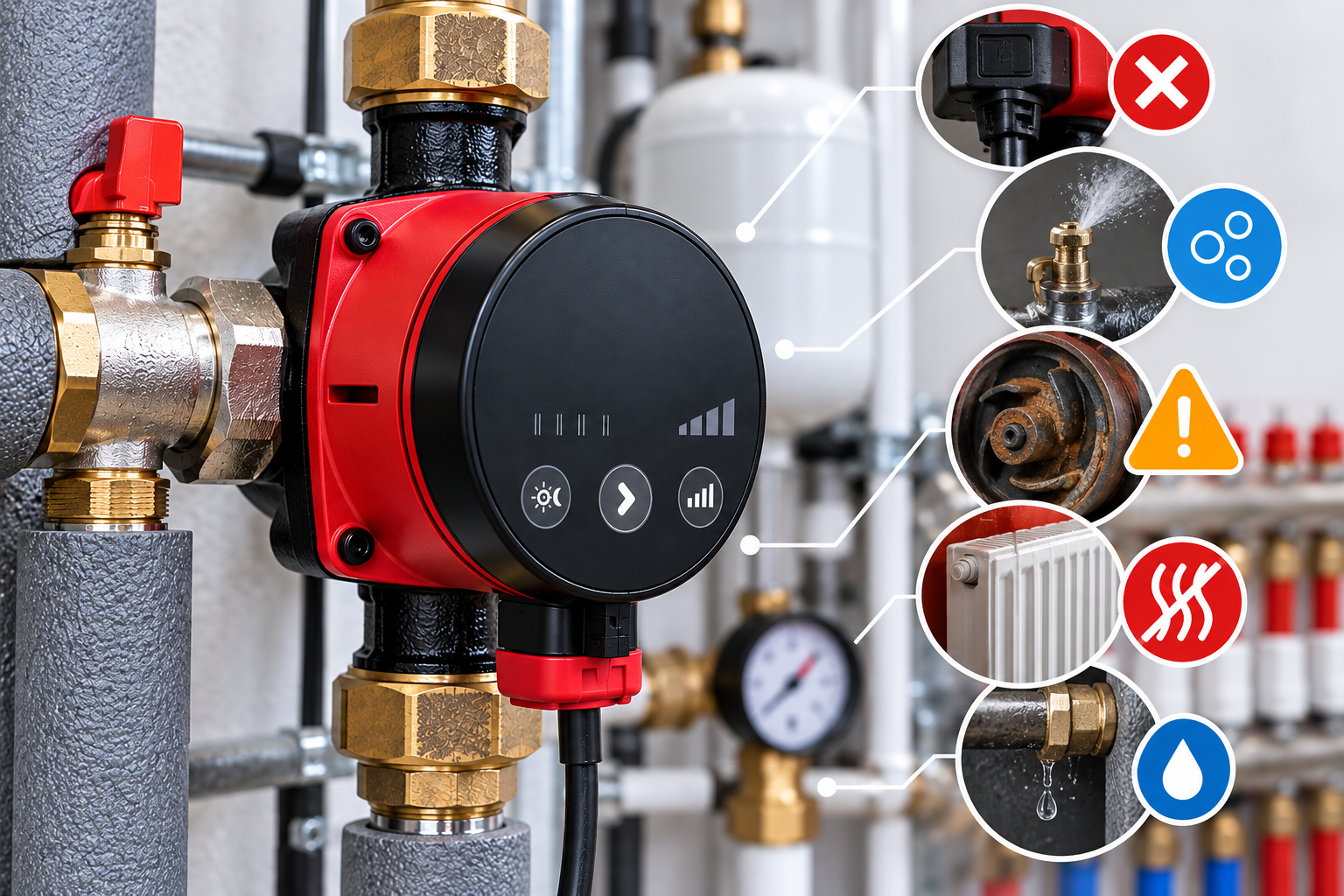
Heating Circulation Pump Not Working: Causes, Symptoms and Troubleshooting
A heating circulation pump moves water through a hydronic heating system, allowing thermal energy to reach radiators, underfloor heating circuits and other heat emitters.
When circulation is disrupted, heating performance can deteriorate significantly.
However, cold radiators, unusual noises and insufficient heating do not necessarily indicate a defective pump. Similar symptoms can result from trapped air, closed valves, blocked filters or control system problems.
This guide explains common symptoms, possible causes, safe preliminary checks and when professional assistance is required.
1. How Can You Tell if a Heating Circulation Pump Is Not Working?
Possible warning signs include:
Radiators remain cold despite a heating demand.
The pump shows no operating indication.
Unusual humming, vibration or other noises occur.
Some radiators heat normally while others remain cold.
The boiler displays a flow-related or temperature-related fault.
An electronic circulator displays an error code.
The heating system repeatedly stops operating.
None of these symptoms proves that the circulation pump itself has failed.
A reliable diagnosis requires assessing the entire heating installation.
2. The Circulation Pump Does Not Start
If a pump fails to start, possible causes include:
No electrical power: There may be a power supply interruption, protective device issue or wiring fault.
No operating command: The thermostat, heating controller or boiler may not be requesting pump operation.
Mechanical blockage: Deposits or prolonged inactivity may prevent the rotating assembly from moving in certain pump designs.
Electronic fault: A modern pump controller may prevent operation after detecting an abnormal condition.
Motor or component failure: Internal electrical or mechanical damage may require repair or replacement.
What Can a Homeowner Check?
Without opening electrical covers or dismantling equipment, a homeowner can:
Confirm that electrical power is available.
Check whether the thermostat is requesting heat.
Look for boiler error messages.
Read any accessible pump display or indicator.
Consult the operating instructions to determine whether the system is in standby.
A dark display alone does not conclusively establish pump failure, because operating indications differ between models.
3. The Pump Hums but Water Does Not Circulate Properly
Continuous humming may indicate that the pump is energised but is not achieving the expected circulation.
Possible explanations include:
A blocked impeller or rotor.
Trapped air.
A closed isolation valve.
Significant hydraulic obstruction.
Internal motor or component problems.
Some older circulators have manufacturer-specific procedures for checking or releasing a blocked rotor.
These procedures are not universal.
Do not loosen pump screws, vent plugs or pressurised connections without the specific manufacturer’s instructions and appropriate technical competence.
Hot pressurised water and electrical components can create serious hazards.
4. The Pump Runs but the Radiators Stay Cold
A running circulator does not guarantee that every radiator receives adequate water flow.
Possible causes include:
Trapped air: Air pockets can restrict or interrupt circulation.
Closed valves: Thermostatic or isolation valves may prevent sufficient flow.
Blocked strainers: Accumulated debris can increase hydraulic resistance.
Insufficient differential pressure: The pump may not provide adequate head at the required flow rate.
Poor hydraulic balancing: Water may be distributed unevenly among heating circuits.
Insufficient heat production: The boiler or heat pump may not be supplying the required water temperature or thermal output.
Troubleshooting must therefore consider both heat generation and heat distribution.
5. Why Is the Circulation Pump Making Noise?
Heating circulators normally operate with relatively low noise levels. New or unusual sounds may indicate abnormal operating conditions.
Gurgling Sounds
These can be associated with trapped air or unstable water circulation.
Whistling in Pipes or Valves
Whistling may indicate excessive differential pressure or high flow velocity through restricted passages.
Metallic Noise or Strong Vibration
Possible causes include mechanical wear, inadequate support or other mechanical and hydraulic issues.
A Gravel-Like Sound
Under certain conditions, this may be associated with cavitation, which occurs when local pressure conditions allow vapour bubbles to form and subsequently collapse.
A sound description alone is not sufficient for a definitive diagnosis.
6. The Circulation Pump Feels Very Hot
Heating circulators often handle hot water, so their external housings may reach high temperatures during normal operation.
A warm or hot housing does not automatically indicate overheating.
Possible causes of actual overheating include:
Operation outside permitted limits.
Mechanical blockage.
Inadequate cooling of internal components.
Electrical or electronic faults.
Unsuitable installation conditions.
If there is a burning smell, smoke, leakage or repeated electrical protection trips, the equipment should be safely taken out of service and inspected by a qualified technician.
Do not touch the pump housing to assess its temperature. It may cause burns.
7. Air Trapped in the Heating Circuit
Air accumulation may cause:
Gurgling noises.
Reduced or interrupted circulation.
Uneven heating.
Unstable pump operation.
Air removal must follow the heating system manufacturer’s instructions.
Some electronic circulators include an automatic or assisted venting function. However, this does not necessarily remove air from the entire heating network.
System filling pressure may need to be checked after venting.
8. Blocked Filters and Accumulated Debris
Hydronic heating systems can accumulate corrosion products, magnetite and other particles.
When these materials collect in strainers, dirt separators or narrow passages, hydraulic resistance increases.
Possible symptoms include:
Reduced heating performance.
Insufficient circulation.
Unusual noise.
Flow-related equipment faults.
Cleaning a strainer or magnetic dirt separator must follow the manufacturer’s instructions and the appropriate precautions for hot pressurised water.
9. What Do Electronic Circulator Error Codes Mean?
Modern circulators may feature digital displays, status indicators or diagnostic codes.
Depending on the model, these may indicate:
Blocked rotor.
Electrical supply problems.
Internal electronic faults.
Thermal protection.
Abnormal operating conditions.
There is no universal error code system shared by all circulation pump manufacturers.
Correct interpretation requires the exact model identification and its official operating manual.
10. Is the Problem in the Pump or the Heating System?
The following table summarises possible relationships between symptoms and causes.
Symptom | Possible causes |
No operating indication | Power supply, control signal, electronic failure |
Humming with insufficient flow | Mechanical blockage, trapped air, hydraulic obstruction |
Some radiators remain cold | Air, valves, hydraulic balancing |
Unusual noise | Air, excessive pressure, cavitation, mechanical problems |
Boiler flow error | Low flow, sensor fault, blocked filter, pump problem |
Repeated shutdown | Electrical protection, control fault, internal failure |
These are possible explanations, not definitive diagnoses.
11. Safe Checks for Homeowners
Homeowners should limit their checks to external observations and normal user controls.
A safe preliminary checklist includes:
Confirm that the thermostat is requesting heating.
Read the boiler or heat pump display.
Record any error codes.
Observe whether all or only some radiators are cold.
Read an accessible system pressure gauge, comparing it with the normal range specified in the equipment instructions.
Consult the manufacturer’s manual for the installed model.
Avoid electrical measurements, dismantling components, opening hot pressurised connections or modifying safety settings.
12. When Should You Call a Technician?
Professional assistance is required when:
The pump does not start despite a valid operating command.
An electrical or mechanical fault is suspected.
Error codes persist.
Water leakage is present.
Strong noise or repeated shutdown occurs.
Filters or components require isolation and dismantling.
Detailed hydraulic diagnosis or balancing is necessary.
A technician may need to assess electrical supply, differential pressure, flow rate, temperatures and pump operating characteristics.
13. Repair or Replace the Circulation Pump?
Replacement may be preferable if the pump has significant internal damage, spare parts are unavailable or repair costs are uneconomical.
Replacing an older fixed-speed pump with a modern electronically controlled model may improve operating efficiency and reduce electricity consumption.
However, replacement should not be based solely on the old pump’s model designation.
Verify:
Required flow rate and pump head.
Installation length and hydraulic connections.
Operating temperature and pressure.
Fluid compatibility.
Electrical supply and control requirements.
14. Frequently Asked Questions
Why Is My Heating Circulation Pump Not Spinning?
Possible causes include missing power, lack of a control command, mechanical blockage or internal electrical failure.
Why Does My Circulation Pump Hum?
Humming may result from mechanical blockage, hydraulic conditions or internal faults. Proper diagnosis is required.
Why Are My Radiators Cold Even Though the Pump Is Running?
Possible causes include trapped air, closed valves, blocked filters, poor hydraulic balancing or insufficient heat generation.
Is It Normal for a Circulation Pump to Get Hot?
Yes. The housing may become hot because of circulating water temperature and motor operation. Actual overheating requires technical assessment.
Can I Unblock a Circulation Pump Myself?
Do not attempt internal work without model-specific manufacturer instructions and the necessary competence. Electrical shock, burns and hot water leakage are potential hazards.
How Long Does a Heating Circulation Pump Last?
There is no single guaranteed service life. Longevity depends on water quality, operating conditions, installation, maintenance and construction.
Conclusion
When a heating circulation pump appears to malfunction, the cause is not necessarily within the pump itself.
Poor heating performance, noise and insufficient water flow can result from electrical, mechanical or hydraulic problems.
Safe troubleshooting begins with recognising symptoms, checking accessible operating indicators and consulting official manufacturer instructions.
Internal inspection, dismantling and repairs should be carried out by appropriately qualified personnel.
Technical References
Grundfos — Installation, operation and troubleshooting manuals: https://www.grundfos.com
Wilo — Circulator technical documentation and maintenance information: https://wilo.com
Caleffi — Technical publications on hydronic circuits, air separation and dirt separation: https://www.caleffi.com
ASHRAE — Hydronic heating engineering references: https://www.ashrae.org
Diagnostic procedures and fault codes must always be checked against the documentation for the specific equipment model.