
Rotary Screw vs Piston Air Compressors: Technical Comparison
Selecting between a rotary screw compressor and a reciprocating piston compressor is an important engineering decision for any facility using compressed air.
Although both technologies operate on the positive displacement principle, they differ in compression mechanisms, airflow characteristics, maintenance requirements and lifecycle costs.
Neither technology is universally more efficient or economical. Selection should be based on required airflow, discharge pressure, operating hours, demand variability and total cost of ownership.
How Reciprocating Piston Compressors Work
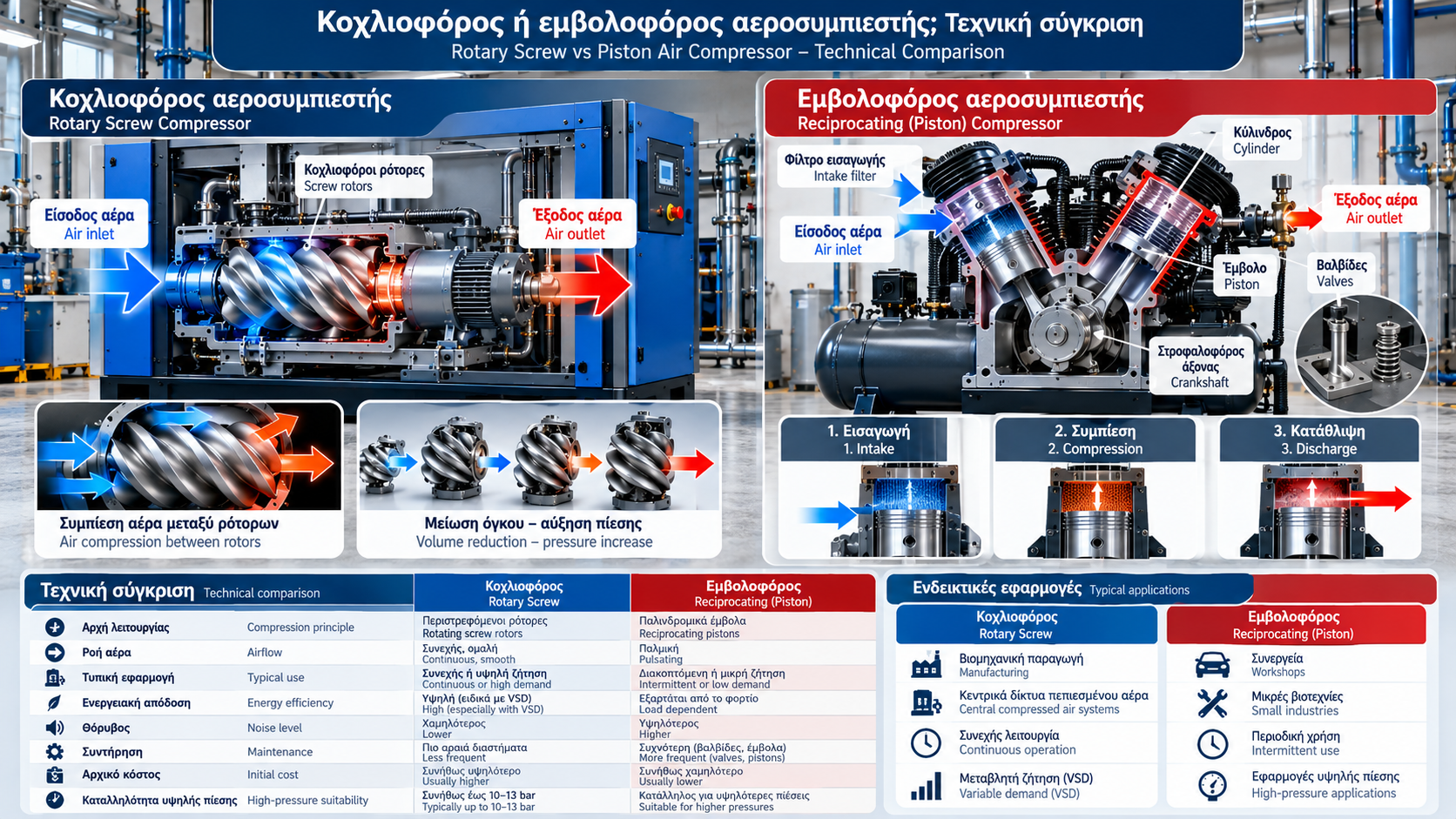
Reciprocating compressors use one or more pistons moving within cylinders. During the intake stroke, air enters the cylinder. During compression, the piston reduces the available volume, increasing air pressure before discharge.
Compression may occur in one or several stages. Multistage configurations can achieve higher pressures and may incorporate intercooling.
Piston compressors are commonly used in workshops, laboratories and intermittent-demand applications. However, industrial reciprocating compressors are also available for sustained or continuous operation.
How Rotary Screw Compressors Work
Rotary screw compressors use two intermeshing rotors. Air is trapped between the rotors and the housing, and its volume decreases as it travels through the compression element.
The process produces relatively smooth airflow compared with many reciprocating designs.
Rotary screw compressors are available in oil-injected and specially engineered oil-free configurations. They may operate at fixed speed or use variable speed drive (VSD) control.
Technical Comparison
Duty Cycle
Rotary screw compressors are widely used in installations with sustained or continuous air demand. Many small piston compressors are designed for intermittent operation, although industrial reciprocating models can also support continuous duty.
Energy Efficiency
Efficiency depends on operating pressure, delivered airflow, compressor design, control strategy and load conditions.
A meaningful comparison requires evaluating actual electrical input power against delivered free air capacity at equivalent operating conditions.
Noise and Vibration
Reciprocating compressors generate oscillating mechanical forces and pressure pulsations. Rotary screw compressors generally offer smoother rotational operation.
Actual noise levels depend on machine construction, acoustic enclosure, operating speed and installation conditions.
Maintenance
Piston compressor maintenance may involve valves, piston rings, lubrication systems and cooling components.
Oil-injected rotary screw compressor maintenance typically includes filters, lubricant, oil separators and cooling systems.
Maintenance schedules must follow manufacturer requirements.
Initial Cost and Lifecycle Economics
For many smaller applications, piston compressors have a lower initial purchase price.
In facilities operating for thousands of hours annually, however, electricity consumption, reliability and maintenance costs can outweigh initial purchase-price differences.
Total lifecycle cost should include purchase, installation, electricity, maintenance, spare parts and production downtime.
When Should You Choose a Piston Compressor?
A piston compressor is often suitable when air demand is intermittent, average consumption is relatively low or specialized high-pressure performance is required.
Selection must account for the permitted duty cycle and the manufacturer's operating limitations.
When Should You Choose a Rotary Screw Compressor?
A rotary screw compressor is often suitable for continuous industrial demand, central compressed air systems and applications requiring sustained airflow.
Variable speed models may be beneficial when demand fluctuates. However, energy savings depend on the actual load profile and should not be assumed without supporting performance data.
Example: Comparing Annual Electricity Costs
Consider two hypothetical installations delivering equivalent airflow and pressure.
Installation A has an average electrical input of 15 kW and operates for 4,000 hours annually.
Installation B has an average electrical input of 12 kW and operates for the same duration.
Annual electricity consumption is therefore 60,000 kWh for Installation A and 48,000 kWh for Installation B.
At an illustrative electricity price of €0.18/kWh, annual costs are €10,800 and €8,640 respectively.
The annual difference is €2,160.
These figures do not represent measured performance differences between piston and rotary screw compressors. They demonstrate why equipment must be compared using verified energy and airflow data under equivalent conditions.
Common Selection Mistakes
A common mistake is selecting a compressor based only on nominal motor power.
Other mistakes include oversizing, ignoring distribution pressure losses, overlooking peak demand and comparing airflow ratings based on different reference conditions.
Compressed air quality must also be considered. Selecting a compressor does not eliminate the need for correctly specified filtration and drying equipment.
Conclusion
Rotary screw and reciprocating piston compressors serve different operational requirements.
A correctly sized piston compressor can be economical for smaller intermittent applications, while a rotary screw compressor may offer operational advantages in sustained industrial service.
The final decision should be supported by verified free air delivery, required operating pressure, electrical consumption, operating hours and lifecycle cost analysis.