
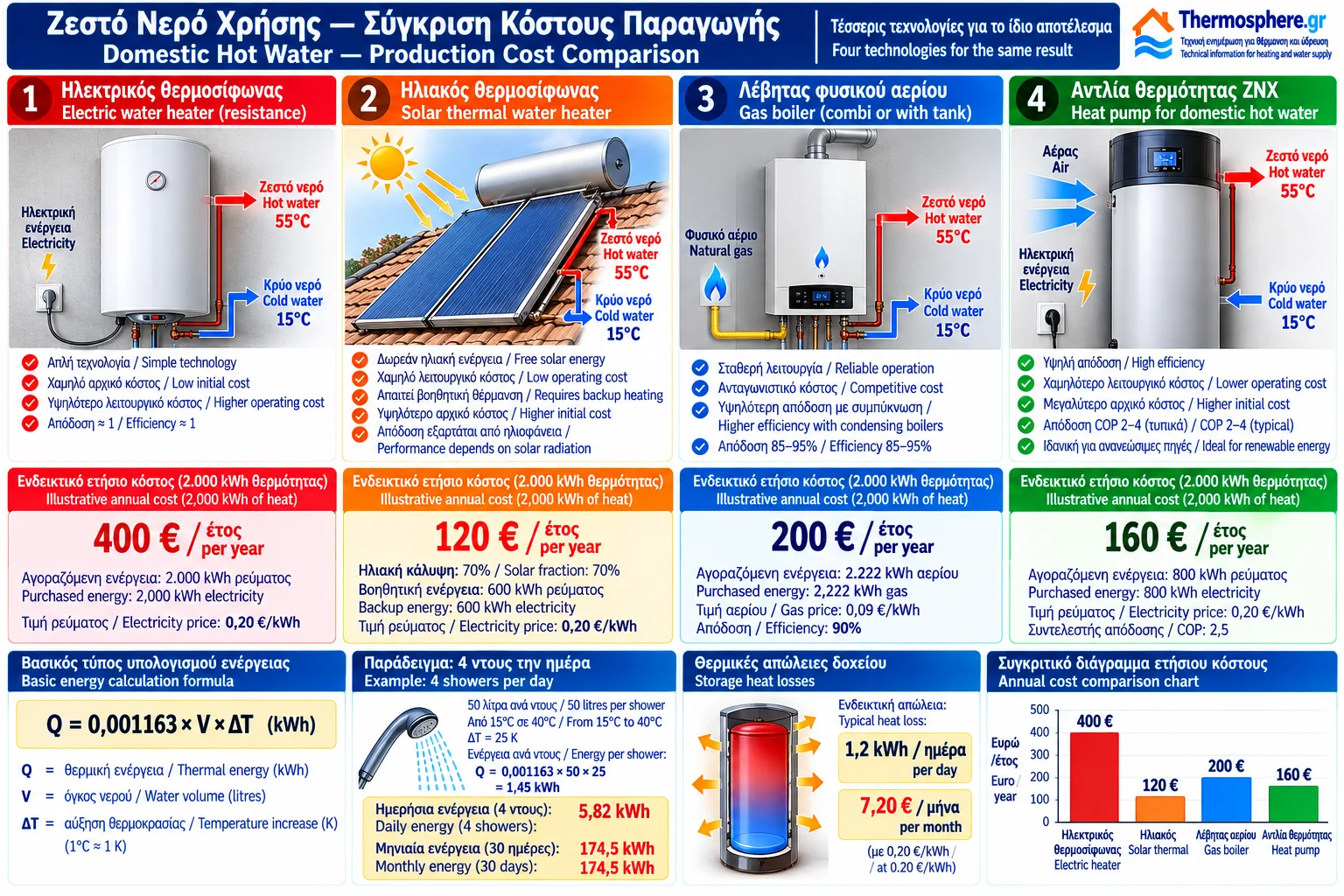
Domestic Hot Water Cost: Electric Heater vs Solar Thermal, Gas Boiler and Heat Pump
Domestic hot water (DHW) is an everyday requirement in residential buildings. It is used for showers, baths, handwashing and other household activities.
Producing hot water requires energy, but the cost varies considerably depending on the technology used.
Common solutions include electric resistance water heaters, solar thermal water heaters, gas boilers and heat pumps.
Which system costs the least to operate?
The answer depends on water consumption, energy tariffs, equipment efficiency, thermal losses and installation costs.
A meaningful comparison begins by calculating how much heat the water actually requires.
1. What Is Domestic Hot Water?
Domestic hot water is water supplied for household use rather than space heating.
In a hydronic heating system, water circulating through radiators is separate from the domestic water supplied to taps and showers.
DHW may be produced using:
Electric resistance heating.
Solar thermal collectors.
A boiler and heat exchanger.
A heat pump.
A combination of energy sources.
Systems may heat water instantaneously or store it in an insulated cylinder.
2. How Much Energy Is Required to Heat Water?
The basic equation is:
Q = m × cp × ΔT
Where:
Q = thermal energy.
m = water mass.
cp = specific heat capacity.
ΔT = temperature increase.
For typical domestic calculations, the following approximation is useful:
Q (kWh) ≈ 0.001163 × V (litres) × ΔT (K)
Example:
Heat 100 litres of water from 15°C to 55°C.
ΔT = 40 K
Q = 0.001163 × 100 × 40
Q ≈ 4.65 kWh of heat
This is the thermal energy absorbed by the water, excluding system losses.
It does not mean every water heating technology consumes 4.65 kWh of purchased energy.
3. Useful Heat vs Purchased Energy
Useful heat and purchased energy must be distinguished.
An electric resistance element converts nearly all the electricity it consumes into heat at the element.
A heat pump transfers additional environmental heat and can deliver more heat than the electricity it consumes.
A gas boiler converts fuel energy into useful heat, with efficiency depending on its design and operation.
A solar thermal system uses solar radiation but may require backup heating.
All systems should therefore be compared on the same basis: the cost of delivering an equivalent quantity of useful hot water.
4. How Much Hot Water Does One Person Use?
Consumption varies with shower duration, showerhead flow, personal habits and delivery temperature.
Illustrative usage ranges include:
Activity | Approximate Mixed Water Volume |
|---|---|
Short shower | 30–50 litres |
Longer shower | 60–90 litres |
Handwashing and small uses | Variable |
Bath | 100–160 litres |
These are illustrative quantities, not universal averages.
It is also important to distinguish mixed water delivered at the tap from hotter water stored in the cylinder.
For example, 50 litres delivered at 40°C are not equivalent to 50 litres stored at 55°C.
5. How Much Energy Does a Shower Require?
Consider a shower using:
50 litres of mixed water.
Cold water at 15°C.
Delivery temperature of 40°C.
ΔT = 25 K
Q = 0.001163 × 50 × 25
Q ≈ 1.45 kWh
For four equivalent showers per day:
Qday ≈ 4 × 1.45
Qday ≈ 5.82 kWh
Over 30 days:
Qmonth ≈ 174.5 kWh
These values represent useful heat delivered to the water, not total equipment electricity or fuel consumption.
6. Electric Water Heater Operating Cost
Electric resistance water heaters heat water using an electrical element.
For a simplified comparison, approximately 1 kWh of electricity is required per 1 kWh of heat supplied by the element.
Storage and distribution losses must be added separately.
For a daily useful demand of 5.82 kWh, assume an illustrative variable electricity price of €0.20/kWh.
Daily cost:
5.82 × 0.20 = €1.16
Monthly cost for 30 days:
174.5 × 0.20 = €34.90
Annual cost for 365 days:
5.815 × 365 × 0.20 ≈ €424.50
These figures use an assumed tariff and exclude thermal losses, standing charges and other fixed costs.
7. The Effect of Storage Heat Loss
A storage water heater loses heat to its surroundings even when no hot water is being drawn.
These are called standby or storage losses.
They depend on:
Cylinder size.
Insulation quality.
Storage temperature.
Ambient temperature.
Standby duration.
Assume an illustrative storage heat loss of 1.2 kWh/day.
Over 30 days:
1.2 × 30 = 36 kWh
At €0.20/kWh:
36 × 0.20 = €7.20 per month
This demonstrates why cylinder insulation can materially affect operating costs.
Actual standby losses should be obtained from manufacturer specifications or appropriate measurements.
8. Solar Thermal Water Heating Cost
Solar water heaters use collectors to transfer solar energy into domestic hot water.
Sunlight itself is not purchased per kWh, but solar systems have installation costs and may require auxiliary energy.
Their performance depends on:
Solar irradiation.
Collector orientation.
Tilt.
Shading.
Collector area.
Storage volume.
Hot water consumption.
System thermal losses.
Solar thermal systems typically need a backup heater when solar energy is insufficient.
9. What Is Solar Fraction?
Solar fraction is the proportion of annual hot water heating demand covered by solar energy.
For example, suppose annual useful heat demand is 2,000 kWh and solar energy provides 1,400 kWh.
Solar fraction:
1,400 / 2,000 × 100
Solar fraction = 70%
The remaining 600 kWh must be provided by a backup heat source if the demand is unchanged.
The 70% value is a hypothetical assumption, not a guaranteed result for every solar water heater.
Solar contribution varies substantially throughout the year.
10. Solar Water Heater Annual Cost Example
Assume:
Annual useful heat demand: 2,000 kWh.
Solar fraction: 70%.
Backup heating: electric resistance.
Electricity price: €0.20/kWh.
Backup electricity requirement:
2,000 × 0.30 = 600 kWh
Annual cost:
600 × 0.20 = €120
For comparison, electric resistance heating of the full 2,000 kWh useful demand would cost:
2,000 × 0.20 = €400
Illustrative annual difference:
€280
This simplified comparison excludes additional storage and distribution losses, maintenance, auxiliary electricity and installation costs.
11. Gas Boiler Hot Water Cost
A gas boiler may produce hot water instantaneously or through a storage cylinder.
Fuel demand depends on actual DHW production efficiency.
The simplified equation is:
Egas = Quseful / η
Where:
Egas = fuel energy input.
Quseful = useful heat output.
η = efficiency expressed as a decimal.
Assume:
Quseful = 2,000 kWh
η = 0.90
Egas = 2,000 / 0.90
Egas ≈ 2,222 kWh
At an assumed variable gas price of €0.09/kWh:
2,222 × 0.09 ≈ €200 per year
The 90% efficiency is an illustrative assumption.
Fuel calorific value and tariff bases must be consistent.
Fixed charges, maintenance, auxiliary electricity and storage losses are excluded.
12. Why Does Boiler DHW Efficiency Vary?
Actual efficiency depends on:
Operating temperature.
Duration of hot water demand.
Frequency of burner starts.
Heat exchanger design.
Standby losses.
Condensing operation.
Modulation capability.
A boiler that performs efficiently during space heating does not necessarily achieve the same seasonal efficiency when producing domestic hot water.
Short, intermittent draw-offs may make start-up and standby losses more significant.
13. Heat Pump Water Heating Cost
A heat pump uses electricity to transfer heat from the surrounding environment into water.
Its coefficient of performance is:
COP = Qheat / Eelectric
A COP of 3 means the heat pump delivers 3 kWh of heat for every 1 kWh of electricity consumed under the specified operating condition.
Actual DHW efficiency depends on ambient temperature, water temperature, operating cycles and auxiliary consumption.
14. Heat Pump Annual Cost Example
Assume:
Annual useful heat demand: 2,000 kWh.
Illustrative average DHW performance factor: 2.5.
Electricity price: €0.20/kWh.
Electricity requirement:
2,000 / 2.5 = 800 kWh
Annual electricity cost:
800 × 0.20 = €160
This calculation assumes the performance factor represents the complete DHW production process being compared.
If it excludes backup resistance heating, auxiliaries or storage losses, these must be added separately.
15. Why Does Higher Water Temperature Reduce Heat Pump Efficiency?
A heat pump generally requires more compressor work as the required hot water temperature rises.
This can reduce COP.
For example, producing water at 45°C may be more efficient than producing it at 60°C under otherwise comparable conditions.
However, storage temperature selection is not solely an energy-efficiency decision.
Legionella control, scald protection, manufacturer requirements and applicable water hygiene regulations must also be considered.
Some heat pump systems use electric resistance heaters during scheduled thermal disinfection cycles.
16. Annual Operating Cost Comparison
The following comparison uses the same annual useful heat demand for all technologies:
2,000 kWh of useful heat
Assumptions:
Electricity: €0.20/kWh.
Natural gas: €0.09/kWh.
Boiler efficiency: 90%.
Heat pump average performance factor: 2.5.
Solar fraction: 70%.
Solar backup: electric resistance.
System | Purchased Energy | Illustrative Annual Cost |
|---|---|---|
Electric resistance heater | 2,000 kWh electricity | €400 |
Solar thermal + electric backup | 600 kWh electricity | €120 |
Natural gas boiler | 2,222 kWh gas | €200 |
Heat pump water heater | 800 kWh electricity | €160 |
Important: This table compares variable energy costs under specific assumptions.
It is not a complete annual bill or a guaranteed ranking of technologies.
Additional storage and distribution losses, standing charges, maintenance, purchase costs and installation costs are excluded.
17. How Energy Prices Change the Comparison
The lowest-cost technology can change as energy prices change.
For a heat pump:
Cost per kWh of heat = Electricity price / COP
At €0.20/kWh electricity and COP 2.5:
0.20 / 2.5 = €0.08/kWh of heat
For a gas boiler:
Cost per kWh of heat = Gas price / Efficiency
At €0.09/kWh gas and 90% efficiency:
0.09 / 0.90 = €0.10/kWh of heat
In this specific example, the heat pump has a lower variable energy cost per useful kWh.
The result cannot be generalised to every tariff or installation.
18. When Is Solar Thermal Water Heating Economical?
Solar thermal water heating may be particularly attractive when:
Solar exposure is favourable.
Shading is limited.
Hot water consumption is reasonably consistent.
Collector and storage sizes are appropriate.
Cylinder and pipework insulation are effective.
Backup heating operates only when required.
Seasonal solar availability has a major influence on actual performance.
Greece has favourable solar resources, but the economic outcome must still be assessed for the specific building and system.
19. When Does a Heat Pump Make Economic Sense for DHW?
Heat pump water heating can be attractive when:
Hot water demand is substantial and regular.
Actual seasonal efficiency is high.
The storage cylinder and heat exchanger are suitable.
Electricity prices are competitive.
A compatible space-heating heat pump is already installed.
A dedicated DHW heat pump is not automatically economical for a household with very low hot water demand.
Its initial cost and standby losses may reduce the financial benefit.
20. Capital Cost vs Operating Cost
An economic comparison must distinguish two cost categories.
Capital costs:
Equipment purchase.
Installation.
Plumbing and electrical work.
Additional components.
Required building modifications.
Annual operating costs:
Purchased energy.
Maintenance.
Auxiliary consumption.
Storage losses.
Potential repairs.
A system with lower running costs is not necessarily the least expensive over its entire service life.
21. Simple Payback Calculation
Consider two hypothetical alternatives.
Assume:
Additional investment in the more efficient system: €1,200.
Annual energy savings: €240.
Simple payback:
Payback = Additional investment / Annual savings
1,200 / 240 = 5 years
This is a simplified calculation.
It excludes financing costs, future energy prices, maintenance differences, replacement costs and residual value.
A complete investment appraisal should consider life-cycle cost.
22. Factors That Increase Actual DHW Costs
Important factors include:
High cylinder standby losses.
Long uninsulated hot water pipe runs.
Continuous recirculation without appropriate controls.
Oversized storage cylinders.
Poor maintenance.
Incorrect control settings.
Excessive backup electric heating.
Low boiler or heat pump efficiency.
High water consumption.
The energy source alone does not determine the total cost.
23. Why Should DHW Storage Temperature Not Be Reduced Arbitrarily?
Lower storage temperatures may reduce heat loss, but they can create water hygiene risks in storage systems.
Legionella growth is an important consideration in domestic hot water design and operation.
Appropriate storage temperatures, thermal disinfection and scald protection must be assessed together.
A universal low-temperature setting should not be recommended without evaluating the installation and relevant requirements.
24. How to Compare DHW Costs in Your Own Home
A practical comparison follows seven steps.
Step 1: Estimate daily mixed hot water use at the delivery temperature.
Step 2: Determine cold water temperature and required delivery temperature.
Step 3: Calculate useful heat using Q = 0.001163 × V × ΔT.
Step 4: Include appropriate storage and distribution losses.
Step 5: Apply actual boiler efficiency, heat pump performance or solar fraction.
Step 6: Use actual variable energy prices from utility bills.
Step 7: Include capital costs and maintenance for a life-cycle comparison.
This avoids misleading comparisons between different technologies.
25. Frequently Asked Questions
How many kWh are needed to heat 100 litres of water?
Heating 100 litres from 15°C to 55°C requires approximately 4.65 kWh of heat, excluding losses.
Does solar water heating work in winter?
Yes. Solar thermal collectors can produce useful heat during winter, but output depends on available solar radiation and operating conditions. Backup heating is often necessary.
Does a heat pump use less electricity than an electric resistance heater?
Generally yes, when its effective COP is above 1. Actual savings depend on seasonal performance and auxiliary consumption.
Is gas or a heat pump cheaper for hot water?
The result depends on energy prices, real operating efficiency and installation costs.
Is solar thermal always the cheapest solution?
Not necessarily. It can have very low purchased-energy costs, but installation, maintenance and actual solar contribution must be included.
26. Technical References
Relevant sources include:
EU Regulation 812/2013: Energy labelling and performance information for water heaters.
EU Regulation 814/2013: Ecodesign requirements for water heaters and hot water storage tanks.
Energy Saving Trust — Solar Water Heating: Solar contribution, operation and backup heating.
Energy Saving Trust — Heat Pump Guidance: DHW operation, immersion heaters and hygiene considerations.
ECDC — European Technical Guidelines for Legionella: Risk management in hot water systems.
Actual financial assessments also require product-specific technical data and current energy tariffs.
Conclusion
Domestic hot water cost depends on more than electricity or gas prices.
It is determined by water consumption, temperature rise, production efficiency, storage losses and installation costs.
Electric resistance water heating is technically straightforward, but its electricity consumption is directly linked to the heat required by the water.
Solar thermal systems use freely available solar energy and can substantially reduce purchased-energy demand.
Gas boilers may offer competitive operating costs depending on fuel prices and actual efficiency.
Heat pumps can achieve low electricity consumption when their real operating efficiency is high.
The best solution is not determined by a universal ranking. It is determined by calculating costs for the household's actual hot water requirements.
All energy prices, efficiencies and financial examples are hypothetical educational assumptions rather than current commercial offers or guaranteed savings.
Thermosphere.gr — Technical information for heating and water supply.