
Heat Pump Cost and Payback Period: How to Calculate Savings with Practical Examples
Installing a heat pump is a significant investment in the heating system of a home or commercial building. However, the purchase price alone does not determine whether the investment is financially worthwhile.
A proper assessment must consider total installation costs, annual electricity consumption, seasonal efficiency, maintenance expenses and the time required to recover the investment through operating savings.
This guide explains the essential calculations, with numerical examples comparing heat pumps with oil-fired and natural gas heating systems.
All prices used below are illustrative assumptions, not verified current market quotations or energy tariffs.
1. What Makes Up the Total Cost of a Heat Pump?
The overall installation cost includes much more than the outdoor unit.
A complete system may require:
The heat pump itself.
Hydraulic connections to the heating distribution system.
Circulation pumps, valves and safety components.
Expansion vessels and, where necessary, buffer tanks.
Electrical wiring and protective devices.
Controls and sensors.
Installation labour.
Commissioning and system adjustment.
Possible modifications to existing radiators or pipework.
The final cost depends on required heating capacity, heat pump type, installation complexity and the condition of the existing heating system.
For financial calculations, the total installed price should be used rather than the equipment purchase price alone.
2. Understanding COP and SCOP
Energy efficiency directly affects operating costs.
COP — Coefficient of Performance
COP is the ratio between useful heating output and electrical input under specified operating conditions.
COP = Heating output / Electrical input
If a heat pump produces 12 kW of heat while consuming 3 kW of electrical power:
COP = 12 / 3 = 4.
Under those conditions, the system delivers 4 kWh of heat for each 1 kWh of electricity consumed.
COP changes with operating conditions and is not constant throughout winter.
SCOP — Seasonal Coefficient of Performance
SCOP represents seasonal efficiency under defined test and calculation conditions.
It is more useful than a single COP value when estimating annual electricity consumption.
However, actual installed seasonal performance may differ because of local climate, heating-water temperature, control settings, auxiliary electricity use and operating behaviour.
3. Calculating Annual Electricity Consumption
A simplified estimate is:
Annual electricity consumption = Annual heating demand / Seasonal efficiency
Consider a home requiring 15,000 kWh of useful heating energy annually.
Assume its estimated actual seasonal efficiency is 3.5.
Annual electricity consumption:
15,000 / 3.5 = approximately 4,286 kWh.
At an illustrative variable electricity price of €0.20/kWh:
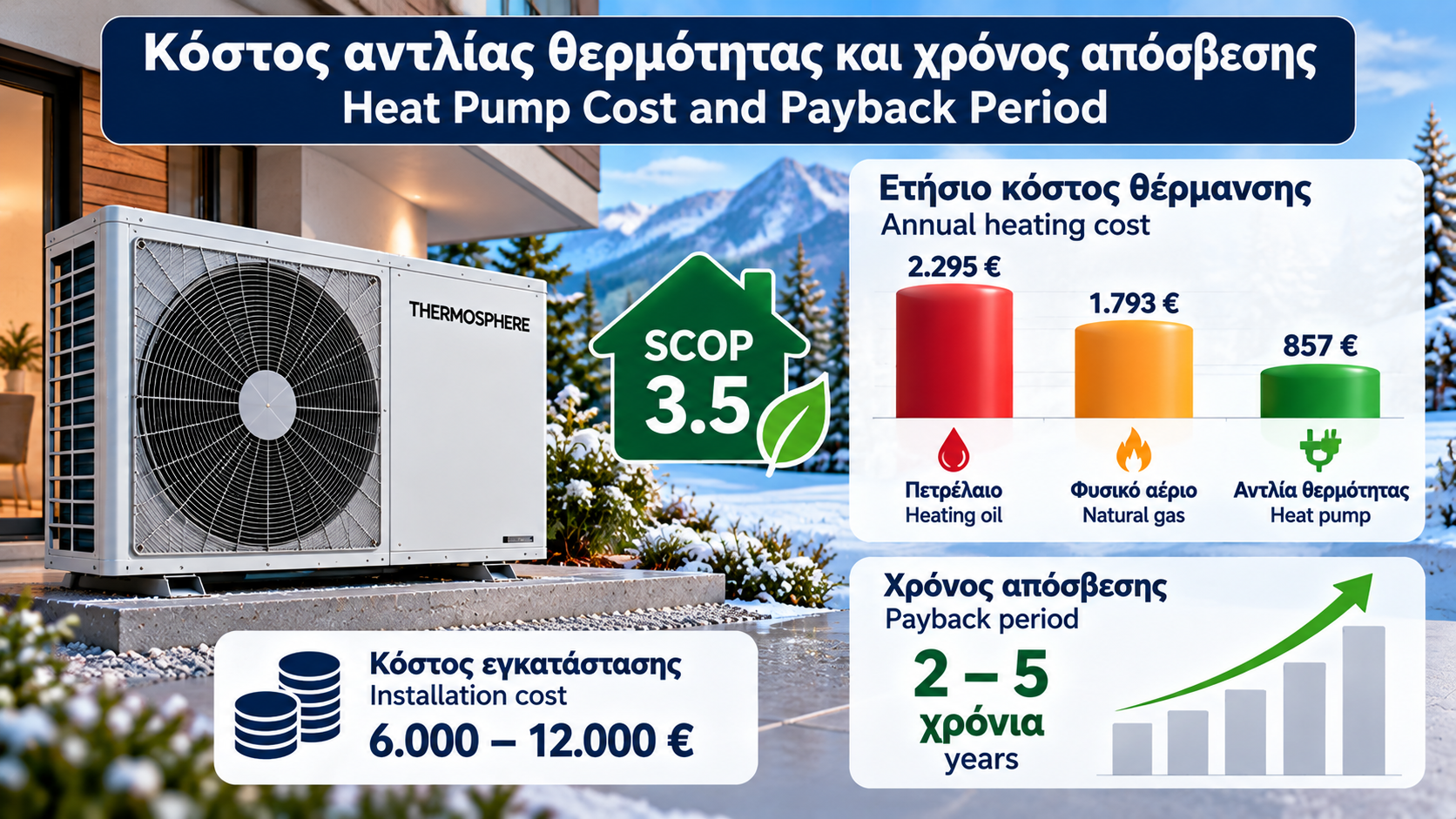
4,286 × €0.20 = approximately €857 per year.
Additional electrical consumption not included in the seasonal efficiency assumption must be accounted for separately.
4. How SCOP Affects Running Costs
Assume annual heating demand of 15,000 kWh and electricity at €0.20/kWh.
Seasonal efficiency | Electricity consumption | Annual cost |
2.5 | 6,000 kWh | €1,200 |
3.0 | 5,000 kWh | €1,000 |
3.5 | 4,286 kWh | €857 |
4.0 | 3,750 kWh | €750 |
4.5 | 3,333 kWh | €667 |
In this example, improving seasonal efficiency from 2.5 to 4.0 reduces annual electricity costs by €450.
This demonstrates the importance of correct sizing, appropriate water temperatures and well-adjusted controls.
5. Heat Pump vs Oil Heating
To compare heating systems fairly, costs should be calculated per unit of useful heat delivered.
Assume the same annual useful heating demand of 15,000 kWh.
For oil heating, use the following illustrative assumptions:
Fuel energy content: 10 kWh per litre.
Seasonal boiler efficiency: 85%.
Oil price: €1.30 per litre.
Required oil consumption:
15,000 / (10 × 0.85) = approximately 1,765 litres.
Annual cost:
1,765 × €1.30 = approximately €2,295.
The heat pump’s estimated annual electricity cost is €857.
Illustrative annual energy saving: approximately €1,437.
Fixed charges, maintenance differences and other non-consumption-related costs are excluded from this initial comparison.
6. Heat Pump vs Natural Gas
Assume the same annual heating demand of 15,000 kWh.
For a natural gas boiler, use:
Seasonal efficiency: 92%.
Illustrative variable gas price: €0.11/kWh of fuel energy.
Required gas energy:
15,000 / 0.92 = approximately 16,304 kWh.
Annual cost:
16,304 × €0.11 = approximately €1,793.
Compared with the heat pump’s €857:
Illustrative annual energy saving: approximately €936.
Actual results depend on tariffs, network charges and real system performance.
7. What Is the Payback Period?
The simple payback period estimates how many years of savings are needed to recover the initial additional investment.
Payback period = Net incremental investment / Annual net savings
Annual net savings should include relevant differences in both energy costs and maintenance expenses.
The important figure is the incremental investment compared with the alternative.
If an existing boiler needs replacement anyway, the correct comparison is between the installed heat pump cost and the cost of installing a new conventional heating system.
8. Worked Payback Example
Assume:
Total heat pump installation cost: €9,000.
Alternative boiler replacement cost: €3,000.
Incremental investment: €6,000.
Annual energy saving versus oil: €1,437.
Additional annual maintenance cost: €100.
Annual net saving:
€1,437 − €100 = €1,337.
Simple payback period:
€6,000 / €1,337 = approximately 4.5 years.
This is an illustrative result, not a universal payback estimate.
If the alternative were keeping an existing functioning boiler, the investment comparison would be different.
9. How Subsidies Affect Payback
Financial incentives can reduce the owner’s initial investment.
Suppose the same €9,000 installation receives a hypothetical €3,000 subsidy.
The owner’s net payment becomes €6,000.
Compared with a €3,000 boiler replacement, the incremental investment is:
€6,000 − €3,000 = €3,000.
With annual net savings of €1,337:
€3,000 / €1,337 = approximately 2.2 years.
This is a hypothetical calculation, not a claim about an active subsidy programme.
Actual eligibility and funding conditions must be checked separately.
10. When Can Payback Take Longer?
A heat pump may have a longer payback period when:
Annual heating demand is relatively low.
The system requires high heating-water temperatures.
The heat pump is incorrectly sized.
Electric backup heaters operate frequently.
Installation costs are unusually high.
The existing heating system has relatively low running costs.
Electricity prices rise relative to the alternative fuel.
Conversely, substantial heating demand, low supply temperatures and good seasonal performance can improve the economics.
11. The Most Common Calculation Mistake
A frequent mistake is comparing the price of one kWh of electricity with one kWh of fuel without accounting for conversion efficiency.
The correct comparison is the cost per kWh of useful heat.
For the heat pump:
€0.20 / 3.5 = €0.057 per kWh of useful heat.
For oil heating:
€1.30 / (10 × 0.85) = €0.153 per kWh of useful heat.
This creates a comparable basis for evaluating operating costs.
12. Why a Proper Heating Assessment Matters
Heat pump selection should not be based on floor area alone.
A technical assessment should consider building heat losses, annual energy demand and required heating-water temperatures.
Important factors include:
Climate and outdoor design temperature.
Building insulation.
Windows and doors.
Existing radiators or underfloor heating.
Required supply-water temperature.
Operating schedule.
Domestic hot water requirements, if included.
A higher-capacity heat pump is not automatically a better choice.
13. Simple Payback vs Full Financial Analysis
Simple payback is useful, but it does not capture the entire investment picture.
A more detailed assessment can use Total Cost of Ownership or Net Present Value (NPV).
These approaches consider:
Initial investment.
Annual operating savings.
Future energy price changes.
Maintenance costs.
Potential repairs.
Equipment lifetime.
Financing costs.
Residual value, where relevant.
Such analysis is particularly important for commercial buildings and larger installations.
14. Frequently Asked Questions
How Many Years Does a Heat Pump Take to Pay Back?
There is no universal figure. Payback depends on installed cost, heating demand, seasonal efficiency, energy prices and the alternative system.
Is a Heat Pump Always Cheaper Than Natural Gas?
Not necessarily. The comparison depends on actual seasonal efficiency and the applicable energy tariffs.
Is a Heat Pump Worth Installing in an Older Home?
It may be, but the building’s heat losses and existing radiator temperature requirements must be assessed.
Does a Bigger Heat Pump Save More Money?
No. Oversizing increases initial costs and can cause operating problems, depending on system design.
Should Maintenance Be Included in the Calculation?
Yes. A meaningful financial comparison should include relevant maintenance expenses and expected repair costs.
Conclusion
Evaluating a heat pump investment requires more than comparing purchase prices.
Actual seasonal performance, building heating demand, electricity tariffs and the cost of alternative heating determine annual savings.
Payback should be calculated using realistic building-specific data rather than generic savings claims.
A properly designed heat pump installation can be financially attractive, but its economic performance must be evaluated individually for each building.
Thermosphere.gr — Technical knowledge for heating and building systems.