
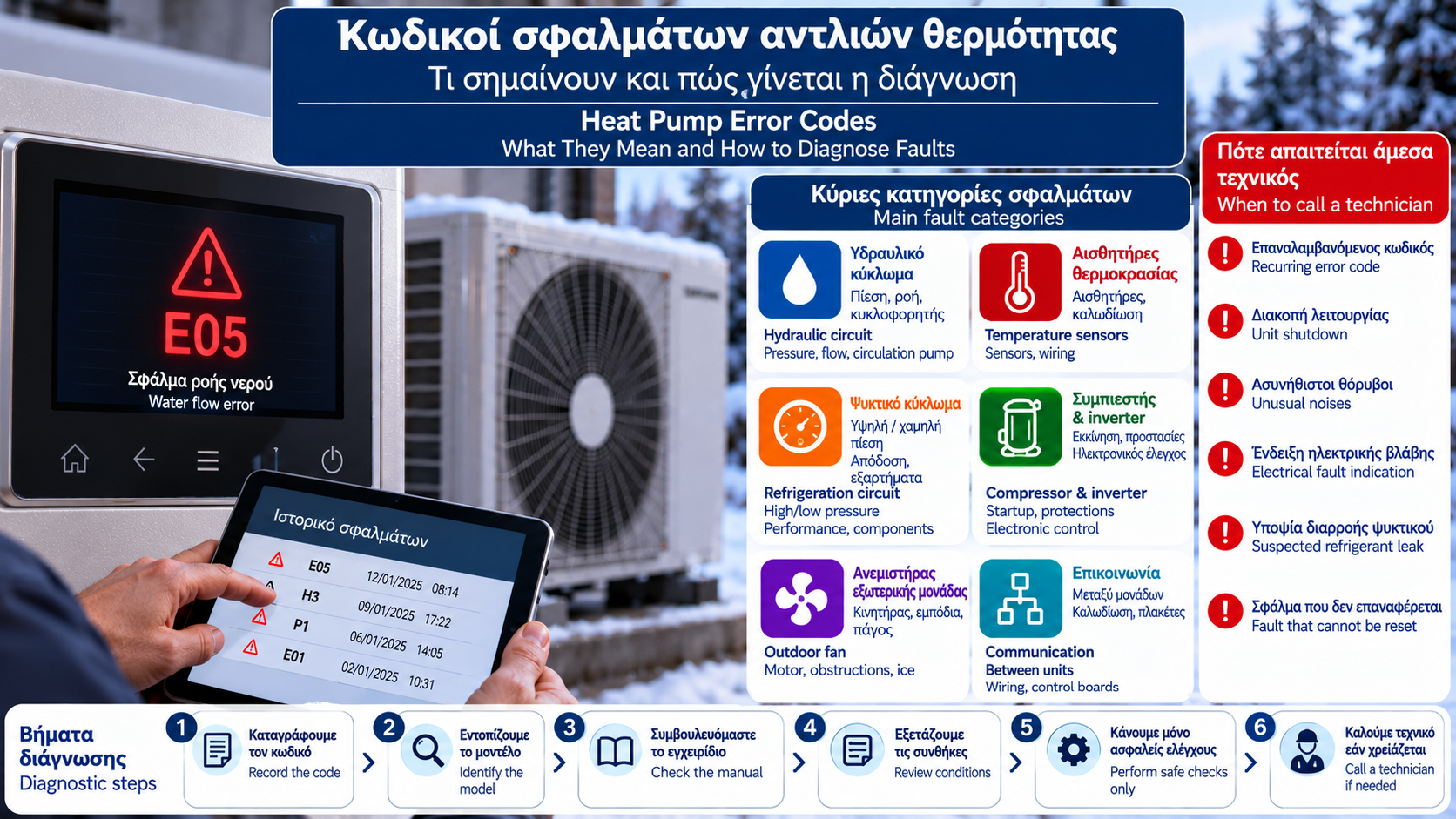
Heat Pump Error Codes: What They Mean and How to Diagnose Faults
When a heat pump displays an error code, the owner usually wants to know two things: what has happened and whether normal operation can be restored without calling a technician.
Error codes form part of the heat pump’s self-diagnostic system. They help identify abnormal operating conditions, activate protective functions and support technical troubleshooting.
However, the same error code does not necessarily have the same meaning across different manufacturers or models.
Furthermore, an error code does not always identify the component that has failed. It often describes an abnormal condition that may have several possible causes.
This guide explains how to interpret error codes correctly, understand the main fault categories and recognize when professional diagnosis is required.
1. What Are Heat Pump Error Codes?
Error codes, also known as fault codes, are messages displayed by a heat pump controller when a particular operating condition is detected.
Depending on the model, they may appear as:
Combinations of letters and numbers.
Numerical codes.
Warning symbols.
Descriptive messages.
Notifications in a remote-control application.
Codes may relate to operating faults, safety protections or maintenance requirements.
Not every code indicates a serious failure.
2. Do All Manufacturers Use the Same Codes?
No.
There is no universal error-code system that every heat pump manufacturer must use.
A code such as E1, E5, H3 or P1 may have different meanings depending on:
Manufacturer.
Model.
Product series.
Software version.
Controller type.
It is therefore technically incorrect to publish a universal table assigning specific faults to all error codes.
Reliable interpretation requires the official documentation for the exact model.
3. What Is the Difference Between a Warning and a Fault?
A heat pump may display different levels of notifications.
Information message: Describes a normal condition, such as defrost or standby.
Warning: Indicates that a parameter requires attention, although immediate shutdown may not always be necessary.
Operating fault: Indicates that a condition outside the permitted operating range has been detected.
Protection or lockout fault: May stop the compressor or the entire unit until the cause is corrected or an authorized reset is performed.
The exact classification depends on the manufacturer.
4. Water Pressure and Flow Errors
An important group of faults concerns the hydraulic circuit.
Possible messages include:
Low water pressure.
Insufficient water flow.
Failure to confirm circulation.
Abnormal flow and return temperatures.
Potential causes include closed valves, blocked strainers, trapped air, circulation pump problems or faulty sensors.
Important: A water-flow error does not necessarily mean that the system needs additional water.
Pressure and flow rate are different parameters.
5. Temperature Sensor Errors
Heat pumps use sensors to monitor temperatures throughout the system.
Examples include:
Outdoor air temperature.
Water flow temperature.
Water return temperature.
Refrigeration circuit temperatures.
Domestic hot water cylinder temperature.
A sensor fault code may indicate an open circuit, short circuit, implausible reading or wiring problem.
However, it does not automatically mean that the sensor must be replaced.
A technician must identify the actual cause.
6. High- and Low-Refrigerant-Pressure Errors
The refrigeration circuit operates within defined pressure and temperature limits.
When conditions exceed permitted limits, protective functions may activate.
Possible causes include:
Inadequate heat transfer.
Restricted airflow or water circulation.
Fan malfunction.
Refrigeration component problems.
Incorrect refrigerant charge.
Pressure sensor or control problems.
The exact cause cannot be determined from the general fault category alone.
Refrigeration circuit work must be performed only by appropriately trained and, where required, certified personnel.
Particular care is necessary with flammable refrigerants such as R290.
7. Compressor and Inverter Faults
The compressor is a central component of the heat pump.
In inverter models, power electronics regulate compressor operation and speed.
Faults in this category may involve:
Overcurrent.
Temperature protection.
Abnormal electrical supply.
Electronic board problems.
Startup failure.
Communication problems between components.
An inverter fault does not necessarily mean that the compressor has failed.
Appropriate measurements and manufacturer-defined diagnostic procedures are required.
8. Communication Errors
Modern heat pumps may contain several electronic modules.
These can include:
Main controller.
Indoor unit.
Outdoor unit.
Inverter board.
Remote controller.
Additional automation modules.
If communication between components is interrupted, an error code may appear.
Possible causes include wiring, power supply, connector or electronic equipment problems.
Professional diagnosis is required.
9. Outdoor Fan Errors
The outdoor fan is essential for proper heat exchange with ambient air.
Problems may result from:
Mechanical obstruction.
Ice accumulation.
Motor failure.
Electronic control malfunction.
Wiring problems.
If the fan cannot rotate normally, the heat pump may reduce output or shut down.
Users should not attempt to rotate the fan manually or access its blades.
10. Defrost Errors
In cold and humid weather, ice may form on the outdoor heat exchanger.
Automatic defrost is a normal operating function.
However, an error may appear if:
The defrost process fails to complete.
Measurements do not match expected operating conditions.
Another protective function activates.
Refrigeration or hydraulic operation is abnormal.
Diagnosis should assess the actual defrost sequence rather than simply the presence of ice.
11. Why Does an Error Code Appear and Then Disappear?
Some faults occur only under specific operating conditions.
Examples include:
Very low outdoor temperatures.
Domestic hot water production.
Several heating zones closing.
Compressor startup.
A particular stage of defrost.
A disappearing code does not necessarily mean that the underlying cause has been corrected.
Recurring faults require investigation of the fault history.
12. What Is the Fault History?
Many controllers store previous fault events.
Depending on the model, recorded information may include:
Fault code.
Time of occurrence.
Number of repetitions.
Operating conditions.
Additional diagnostic data.
Fault history helps technicians distinguish isolated incidents from recurring problems.
Useful information should be preserved before fault records are cleared.
13. How Should You Read an Error Code Correctly?
A reliable approach follows several steps.
Step 1: Record the exact code.
Do not rely on memory. Take a photograph of the display if possible.
Step 2: Identify the exact heat pump model.
Record the model designation and controller version where relevant.
Step 3: Consult the official manual.
Find the code in the manufacturer’s documentation for the specific equipment.
Step 4: Record the operating conditions.
Note whether the error occurred during space heating, domestic hot water production, defrost or startup.
Step 5: Perform only permitted checks.
Homeowners should follow the actions explicitly described in the user manual.
Step 6: Contact a technician if the problem persists.
Accurate troubleshooting requires identifying the cause rather than merely reading the code.
14. When Is a Reset Permitted?
Some heat pumps provide a reset function that can restore operation after particular faults.
However, resetting should not be treated as a universal solution.
A reset may be appropriate when:
The manual permits it.
The underlying cause has been corrected.
No hazardous condition is present.
The manufacturer allows the user to perform the procedure.
If the fault returns, repeated resets should be avoided.
This is particularly important for electrical protection, compressor, high-pressure or overheating faults.
Repeated startup attempts may place additional stress on the equipment.
15. Why Should Repeated Resets Be Avoided?
An error may indicate that a genuine protective function has activated.
If the underlying cause remains, the unit may simply shut down again.
Repeated resets can also complicate troubleshooting by obscuring the original sequence of events.
Only the manufacturer’s specified procedure should be followed.
16. What Information Should You Record Before Calling a Technician?
The following details help make troubleshooting more efficient:
Information | What to record |
Manufacturer | Heat pump brand |
Model | Exact model designation |
Fault code | Exactly as displayed |
Time | When the fault occurred |
Operating mode | Heating, hot water, defrost or startup |
Outdoor temperature | If known |
Symptoms | Noise, shutdown or reduced heating |
Frequency | Isolated or recurring |
Recent work | Maintenance, repairs or setting changes |
A photograph of the controller display can be especially helpful.
17. Practical Example: A Water-Flow Error Appears
Suppose the heat pump displays a code that the official manual identifies as insufficient water circulation.
The owner notices that heating has stopped.
This does not necessarily mean that the circulation pump is defective.
A technician may need to check:
Actual water flow.
Filter condition.
Valve positions.
Trapped air.
Circulation pump operation.
Flow sensor readings.
The correct repair depends on the confirmed cause.
18. Practical Example: Compressor Fault After a Power Outage
A heat pump displays a fault during startup after an electrical outage.
The problem may relate to power supply conditions, the startup sequence or another protective function.
It would be incorrect to assume immediately that the compressor has failed.
A technician should review the fault history and perform the appropriate electrical and operating checks.
The homeowner must not open electrical panels or access power circuits.
19. Practical Example: An Error Occurs Only During Hot Water Production
If a heat pump operates normally during space heating but displays a fault during domestic hot water production, this is important diagnostic information.
Troubleshooting may focus on:
Operating temperatures.
Three-way diverter valve operation, where fitted.
Relevant sensors.
Hydraulic circulation.
Requirements of the specific operating cycle.
The conditions in which an error appears can be as important as the code itself.
20. When Does a Fault Require Immediate Shutdown and Professional Help?
Users must follow the manufacturer’s safety instructions.
Particular attention is required when there is:
Smoke or a burning smell.
Evidence of electrical failure.
Severe unusual mechanical noise.
Significant water leakage near electrical components.
Repeated activation of protective devices.
Suspected refrigerant leakage.
A fault classified by the manual as a serious safety condition.
Where a hazard is suspected, the unit should not be restarted. Safe isolation must follow the specified procedure without exposing anyone to danger.
21. Why Can Replacing a Component Based Only on a Code Be a Mistake?
A fault code often describes the result of a problem rather than its original cause.
For example:
A flow error may result from a blocked filter rather than a faulty sensor.
A temperature sensor error may be caused by wiring.
A high-pressure error may result from inadequate heat transfer.
A communication fault may be caused by a power supply problem rather than a defective board.
Professional diagnosis should identify the actual cause before components are replaced.
22. How Does Preventive Maintenance Help?
Regular maintenance can reduce the likelihood of certain faults.
Depending on the equipment and installation, maintenance may include:
Water filter checks.
Circulation checks.
Electrical connection inspection by qualified personnel.
Sensor checks.
Fan operation checks.
Drainage inspection.
Outdoor heat exchanger inspection.
Fault history review.
Verification of operating settings.
Maintenance cannot guarantee that failures will never occur, but it supports early detection of developing problems.
23. Frequently Asked Questions
What Does Error Code E1 Mean on a Heat Pump?
There is no single meaning across all brands. The exact model and official manual are required.
Are All Error Codes Serious Faults?
No. Some messages are informational or warnings, while others activate protective shutdowns.
Can I Reset My Heat Pump Myself?
Only when the manual permits it and no hazardous condition exists.
Why Does the Same Error Keep Returning?
The underlying cause may remain unresolved or occur only under particular operating conditions.
Can a Sensor Error Appear Even if the Sensor Is Not Faulty?
Yes. Wiring, connections or other conditions may be responsible.
Does a High-Pressure Error Mean Refrigerant Needs to Be Added?
No. Many different causes are possible, and professional diagnosis is required.
Why Does an Error Appear After a Power Outage?
It may be related to the electrical supply, startup conditions or a protective function.
Can a Heat Pump Continue Running With a Warning?
It depends on the warning and the manufacturer’s control logic.
Where Can I Find the Meaning of an Error Code?
In the official user or service documentation for the specific model.
When Should I Call a Technician?
When a fault recurs, the unit does not operate normally, technical measurements are needed or a hazardous condition is suspected.
Conclusion
Error codes are important diagnostic tools in modern heat pumps.
However, they do not provide a complete diagnosis on their own.
Correct interpretation requires knowledge of the specific model, official manufacturer documentation and the conditions under which the fault occurred.
An error code tells us where troubleshooting should begin, not necessarily which component needs replacing.
Recording fault information, avoiding repeated resets and obtaining timely professional assistance help maintain safe and reliable operation.
Thermosphere.gr — Technical knowledge for heating and building systems.