
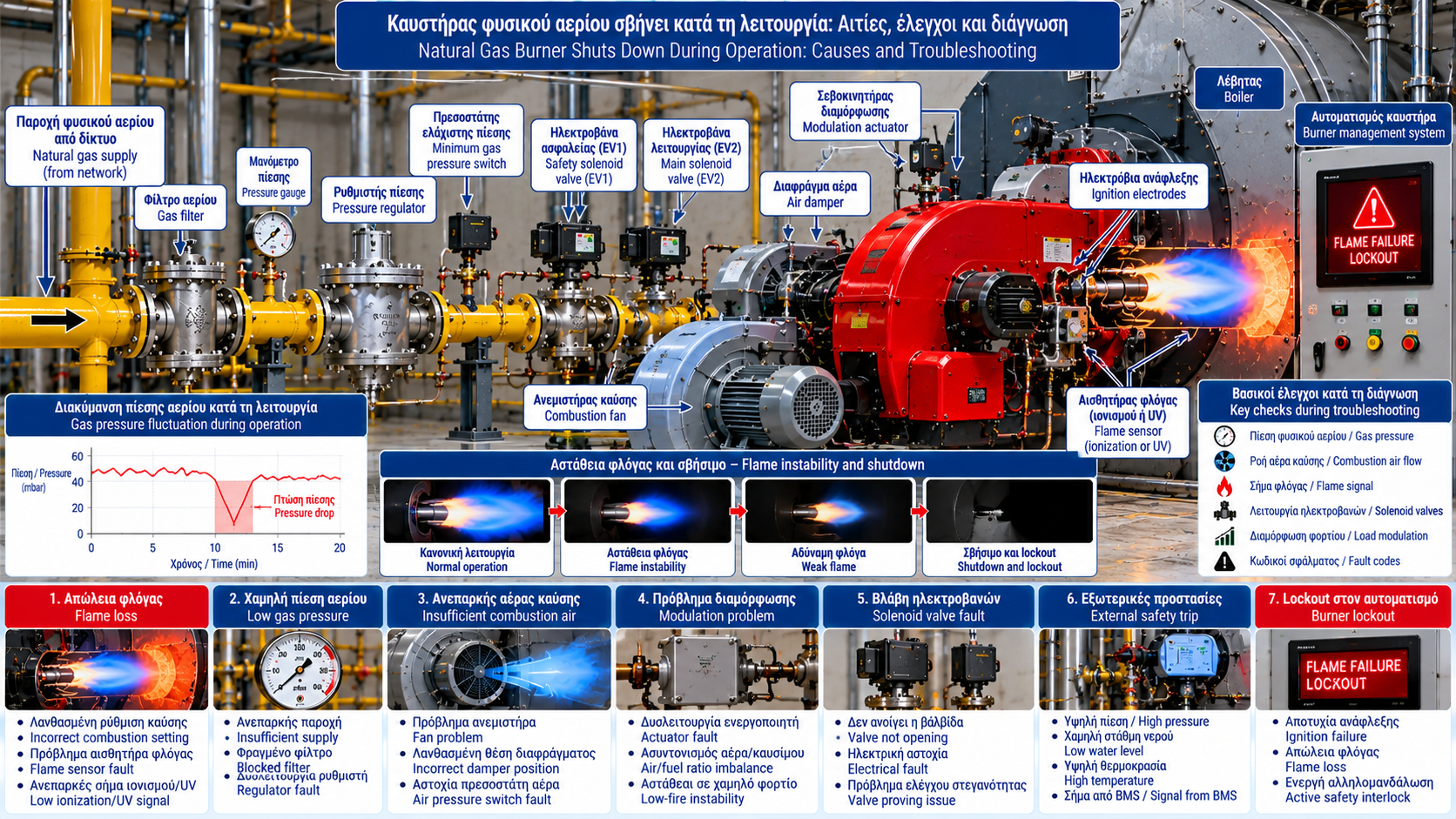
Natural Gas Burner Shuts Down During Operation: Causes and Troubleshooting
An industrial natural gas burner may start normally, establish a flame and then shut down unexpectedly during operation.
This behavior can be associated with actual flame loss, unstable gas supply, inadequate combustion air, sensor faults or activation of protective devices.
However, not every shutdown indicates a fault. A burner may stop normally when heat demand is satisfied or when a scheduled stop command is issued.
Effective troubleshooting begins by distinguishing normal shutdown, safety shutdown and burner lockout.
1. Normal Shutdown or Actual Fault?
Normal shutdown: The temperature or pressure controller ends the heat demand because the required setpoint has been reached.
Safety shutdown: The burner control system interrupts fuel supply because a required operating condition is no longer satisfied.
Lockout: The controller enters a protective state that prevents restart until the manufacturer’s reset conditions have been fulfilled.
These conditions require different diagnostic approaches.
2. When Does the Burner Shut Down?
The timing of the event provides valuable diagnostic information.
Shutdown Timing | Possible Area of Investigation |
Immediately after ignition | Flame supervision or flame stabilization |
During load increase | Gas supply, combustion air or modulation |
During load decrease | Low-fire flame stability |
After several minutes | Thermal limits, pressure variations or sensors |
At irregular intervals | Intermittent electrical faults or unstable supply |
When other consumers operate | Gas network capacity and pressure drop |
Timing provides clues but does not establish a confirmed cause.
3. Flame Loss During Operation
Flame failure is an important cause of burner shutdown.
The flame supervision system must continuously confirm the presence of the required flame.
If the valid flame signal is lost, the burner management system initiates its specified protective response.
Signal loss may result from actual flame extinction or a detection system fault.
Troubleshooting must distinguish between these possibilities.
4. Ionization Electrode Problems
Some gas burners use flame ionization for flame supervision.
Potential causes of inadequate signal include electrode contamination, wear, unsuitable positioning, wiring faults, inadequate grounding and unstable combustion.
Flame signal evaluation must follow the requirements of the specific controller.
There is no universal acceptable ionization current for all burner systems.
5. UV Flame Detector Problems
Some industrial burners use ultraviolet flame detectors.
Performance may be affected by dirty sight glasses, misalignment, sensor deterioration, wiring problems, electronic faults or changes in flame geometry.
Testing must follow manufacturer procedures.
6. Gas Pressure Fluctuations
Variations in gas supply pressure can affect combustion stability.
In facilities with multiple gas consumers, pressure may change as total demand increases.
Possible causes include insufficient supply capacity, excessive pipework pressure losses, regulator faults, clogged filters and unstable inlet pressure.
Diagnosis should evaluate gas pressure during the fault event rather than relying only on readings taken while the burner is stopped.
7. Gas Pressure Switch Activation
A minimum gas pressure switch may detect pressure falling below its specified threshold.
A maximum pressure switch may respond when pressure exceeds the allowable range.
Activation may reflect a genuine pressure problem or an instrument or wiring fault.
Changing pressure switch settings arbitrarily is not an acceptable corrective action.
8. Inadequate Combustion Air
Stable combustion requires an appropriate air-fuel ratio.
Insufficient airflow can affect flame stability and combustion quality.
Potential causes include restricted air intake, fan problems, damper faults, actuator failures and incorrect combustion settings.
Diagnosis must rely on appropriate measurements rather than flame appearance alone.
9. Problems During Load Modulation
Modulating burners adjust fuel and combustion air according to heat demand.
Flame instability may occur during transitions if the two flows do not change in the required coordinated manner.
Possible problem areas include air actuators, gas control valves, mechanical linkages, electronic ratio control and position feedback.
Combustion curve adjustments require suitable instruments and authorized technicians.
10. Low-Fire Instability
Some burners become unstable near their minimum permitted firing rate.
Possible causes include inadequate flame stabilization, incorrect air-fuel ratio or operation outside the manufacturer’s limits.
Minimum firing rates must not be reduced arbitrarily.
11. Combustion Chamber and Flue Conditions
Burner performance is affected by combustion chamber pressure and flue gas discharge conditions.
Potential issues include unexpected furnace pressure, restricted flue paths, draught control faults and changes in system resistance.
Assessment must reflect the boiler and burner specifications.
12. Boiler Protective Devices
Burner shutdown is not always caused by the burner itself.
A steam boiler may stop its burner due to high-pressure limits, low-water protection, high-temperature limits or external safety interlocks.
Troubleshooting must include the boiler and the connected safety systems.
13. Intermittent Electrical Faults
Intermittent shutdowns may be associated with loose connections, unstable power supply, thermal stress, relay faults, sensor failures or communication problems.
Correlating fault timing with load, temperature and recorded events can help identify the cause.
14. Troubleshooting Table
Symptom | Possible Cause | Diagnostic Focus |
Stops immediately after ignition | Weak flame signal | Assess flame supervision |
Stops at high fire | Gas pressure drop | Record pressure under load |
Stops at low fire | Combustion instability | Assess low-fire operation |
Stops during modulation | Air-fuel control problem | Review modulation behavior |
Stops when another burner starts | Insufficient gas supply | Assess combined demand |
Air pressure fault | Airflow not proven | Review air proving |
Flame failure | Flame or signal loss | Distinguish actual and indicated loss |
High limit | Boiler protection activated | Verify actual operating condition |
Stops without alarm | Normal command or intermittent fault | Review event and control history |
These relationships are indicative and require confirmation using actual operating data.
15. Useful Diagnostic Measurements
Depending on the fault, useful information may include:
Operating gas pressure.
Pressure upstream and downstream of regulation.
Pressure switch status.
Flame supervision signal.
Actuator position.
Burner firing rate.
Boiler pressure or temperature.
Flue gas analysis.
Fault codes and event history.
Measurements must be carried out by appropriately qualified personnel using suitable instruments and approved procedures.
16. Why Resetting Is Not a Solution
Restarting may temporarily restore operation without eliminating the underlying problem.
If shutdown results from unstable gas pressure, defective flame supervision or incorrect air-fuel control, the fault may recur.
Repeated lockout resets without investigation are unsafe.
17. When Must the Burner Remain Out of Service?
The installation must remain out of service when there is suspected gas leakage, unsafe combustion, failure of flame supervision, inability to isolate fuel safely, unacceptable pressure or unexplained critical safety faults.
Gas pressure switches, flame detectors and other protective devices must never be bypassed.
18. Technical Standards
Relevant references include:
EN 676: Forced draught burners for gaseous fuels.
EN 298: Automatic burner control systems.
EN 1854: Pressure sensing devices for gas burners.
EN 161: Automatic gas shut-off valves.
Applicability depends on the specific equipment and the scope of each standard.
Final troubleshooting must follow the manufacturer’s service documentation and the installation’s actual operating data.
Conclusion
When a natural gas burner shuts down during operation, effective troubleshooting requires identifying the type of shutdown and the operating conditions under which it occurs.
Flame failure, gas pressure fluctuations, combustion air problems, sensor faults and external protective devices are key areas of investigation.
Recording measurements during the actual fault and systematically evaluating burner management signals is often more valuable than replacing components without evidence.