
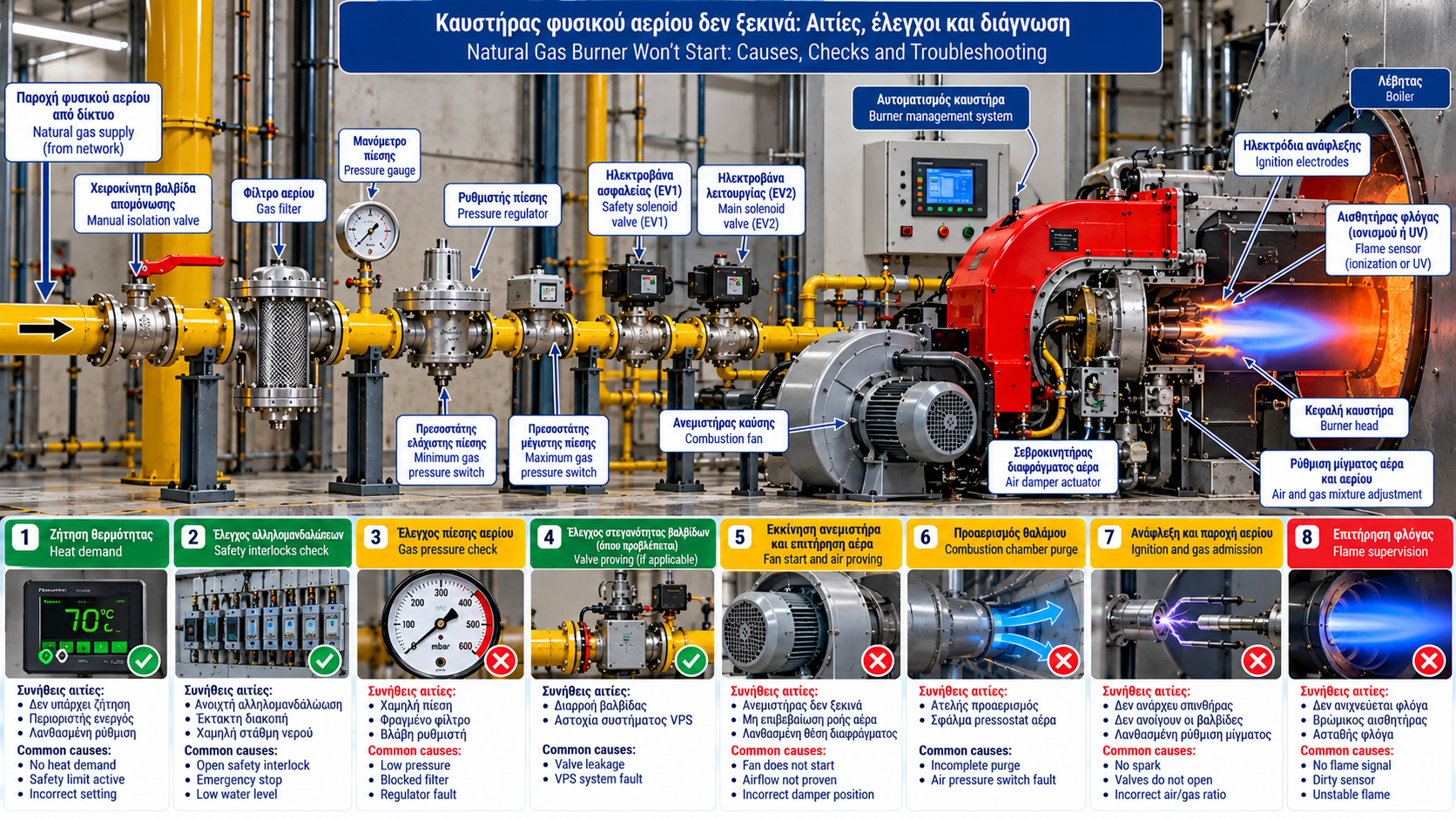
Natural Gas Burner Won’t Start: Causes, Checks and Troubleshooting
Failure to start is a common operational problem in industrial natural gas burners used in boilers, steam generators and thermal processing installations.
A burner that does not start is not necessarily mechanically defective. In many cases, the burner management system intentionally prevents startup because a required safety condition has not been satisfied.
Effective troubleshooting begins by identifying the exact stage at which the startup sequence stops.
Instead of replacing components without evidence, technicians should evaluate alarm records, control signals and actual operating conditions.
1. Understanding the Burner Startup Sequence
The exact startup sequence depends on the burner manufacturer, combustion equipment and burner management system.
A typical arrangement may include:
Heat demand.
Confirmation that the controller is available for startup.
Verification of safety permissives.
Gas pressure checks.
Valve proving where required.
Combustion fan startup and airflow proving.
Combustion chamber pre-purge.
Movement to the ignition position.
Controlled ignition and fuel admission.
Flame establishment and verification within the specified safety time.
Transition to normal operation.
The actual sequence must follow the specific manufacturer’s approved design.
2. Identify Where Startup Stops
Symptom | Possible Problem Area |
No startup sequence | Heat demand, electrical supply, safety interlocks |
Low gas pressure alarm | Supply pressure, filter, regulator, pressure switch |
Fan does not start | Motor, power supply, protection, control command |
Fan runs but sequence stops | Air proving, damper position, pre-purge |
Purge completes but no ignition | Ignition sequence, valves, safety conditions |
Flame appears but immediate lockout occurs | Flame detection, ignition quality, supervision signal |
This table supports initial investigation but does not establish a confirmed fault.
3. No Heat Demand
A burner may remain in standby because no heat demand is present.
Possible causes include satisfied temperature or pressure setpoints, operating schedules, external interlocks or unsuitable operating mode selection.
Confirming actual demand should precede troubleshooting of the combustion equipment.
4. Open Safety Interlock
Industrial burners use protective devices to prevent operation under unsafe conditions.
Depending on the installation, these may include high-temperature limits, boiler pressure limits, low-water protection, gas pressure switches, combustion air proving and emergency shutdown signals.
Safety interlocks must never be bypassed to force startup.
The diagnostic objective is to identify which required condition is not satisfied and why.
5. Low Gas Pressure
Insufficient gas pressure may prevent startup before the fuel valves are energized.
Potential causes include inadequate supply pressure, closed isolation valves, clogged filters, regulator faults, excessive pressure losses and pressure switch problems.
Diagnosis requires appropriate pressure measurements and comparison with the burner specifications.
Arbitrarily reducing a pressure switch threshold is not an acceptable solution.
6. High Gas Pressure
Some installations also monitor maximum gas pressure.
A high-pressure alarm may indicate regulator malfunction, unexpected supply conditions, incorrect settings or a monitoring device fault.
The underlying cause and protective equipment must be evaluated before restart.
7. Combustion Fan Does Not Start
Many forced-draught burners require combustion fan operation before ignition.
Potential causes include missing control commands, motor protection trips, electrical faults, contactor or variable-speed drive problems and mechanical obstruction.
Troubleshooting should distinguish between the absence of a command and failure to execute a valid command.
8. Combustion Air Proving Failure
A fan may run without the required airflow condition being confirmed.
Possible causes include restricted airflow, air pressure switch problems, incorrect damper position, actuator faults and blocked sensing connections.
Motor operation alone does not prove adequate combustion airflow.
9. Pre-Purge Failure
Pre-purge is an important safety function where specified.
The sequence may stop because required damper positions, airflow conditions or controller permissives have not been confirmed.
Pre-purge timing and conditions must not be modified arbitrarily.
10. Ignition Sequence Failure
When the earlier startup stages complete but ignition fails, possible problem areas include the ignition transformer, electrodes, high-voltage cables, pilot gas supply where applicable and the required ignition air-fuel conditions.
Ignition system work involves electrical and fuel hazards and must be performed by qualified personnel.
11. Gas Valves Do Not Open
A closed safety shut-off valve may represent correct controller behavior when safety conditions have not been satisfied.
Other possible causes include missing electrical commands, actuator faults, mechanical failures or unsuccessful valve proving.
Directly energizing valves outside the approved safety sequence is not an acceptable troubleshooting method.
12. Valve Proving Failure
Burners equipped with a valve proving system may require successful completion of the test before startup.
Failure can be associated with internal valve leakage, pressure sensing faults, intermediate pipework issues or unsuitable test conditions.
The system must be assessed using the manufacturer’s approved procedure.
Valve proving must never be bypassed.
13. Burner Ignites but Immediately Shuts Down
If a flame appears but the burner shuts down almost immediately, flame supervision may be involved.
Depending on the equipment, flame detection may use an ionization electrode, ultraviolet detector or another approved sensing technology.
Potential causes include inadequate flame signal, sensor positioning, wiring faults or actual flame instability.
A visible flame does not prove that the controller has received a valid flame supervision signal.
14. What Is Burner Lockout?
Lockout is a protective state that prevents further burner operation after certain faults or unsafe conditions.
Reset requirements depend on the specific burner management system.
Repeated resets without investigation are unsafe.
Fault codes must be interpreted using the documentation for the actual controller because codes are not universal across manufacturers.
15. Diagnostic Reference Table
Symptom | Possible Cause | Diagnostic Focus |
No startup response | No heat demand | Confirm demand status |
Safety alarm | Open interlock | Identify unsatisfied permissive |
Low gas pressure | Inadequate supply | Verify pressure |
High gas pressure | Regulator or supply fault | Review pressure control |
Fan fault | Motor or control problem | Review motor and command status |
Air pressure fault | Airflow not proven | Assess air proving |
Purge fault | Incomplete purge sequence | Review sequence and signals |
Ignition failure | Ignition system problem | Assess ignition sequence |
Flame failure | No valid flame signal | Evaluate flame supervision |
Valve proving fault | Unacceptable proving result | Approved VPS investigation |
Any checks involving gas equipment or safety-related electrical circuits must be performed by appropriately qualified and authorized personnel.
16. Structured Troubleshooting Method
A reliable troubleshooting process includes:
Step 1 — Record the symptom. Document the alarm, time and operating conditions.
Step 2 — Identify the startup stage. Determine the last successfully completed operation.
Step 3 — Review safety permissives. Identify which required condition is missing.
Step 4 — Verify actual conditions. Qualified personnel confirm relevant measurements using suitable instruments.
Step 5 — Establish the cause. Correlate measurements, alarm history and manufacturer documentation.
Step 6 — Correct and verify. Following appropriate repair, complete the specified functional checks before returning the burner to service.
17. When Should Troubleshooting Stop?
The installation must remain out of service if there is suspected gas leakage, failure of safe fuel isolation, unacceptable pressure or an unexplained critical safety failure.
Emergency procedures must be followed if gas leakage is suspected.
Bypassing safety devices, arbitrarily changing limits and repeatedly attempting ignition without establishing the cause are unacceptable.
18. Technical Standards
Relevant references include:
EN 676: Forced draught burners for gaseous fuels, within its scope.
EN 298: Automatic burner control systems for gas or oil burners and appliances, within its scope.
EN 1854: Pressure sensing devices for gas burners and appliances.
EN 161: Automatic gas shut-off valves.
EN 1643: Valve proving systems.
Troubleshooting must ultimately follow the wiring diagrams, operating sequence and service documentation for the specific burner.
Conclusion
When a natural gas burner fails to start, the most valuable diagnostic information is the precise stage at which startup stops.
The underlying problem may involve fuel pressure, combustion air, ignition, flame supervision or a safety interlock.
Systematic troubleshooting based on evidence, suitable measurements and approved procedures provides a safer and more effective path to identifying and correcting the fault.