
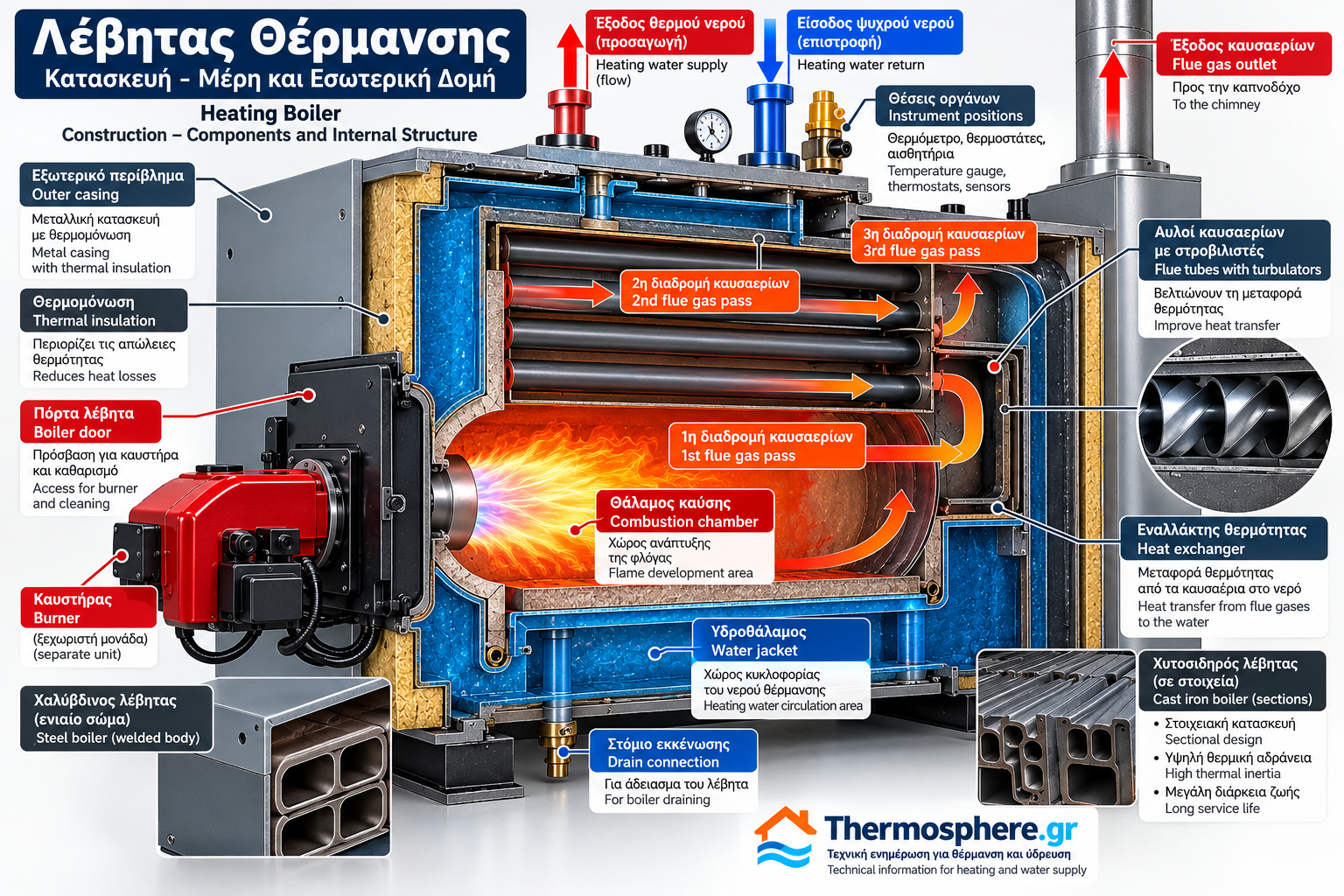
Heating Boiler Construction: Components, Materials and Internal Design
A heating boiler is a key component of many central heating systems. It transfers thermal energy from fuel combustion to water, which circulates through radiators or other hydronic heating circuits.
Although a boiler may appear externally to be a simple metal enclosure, its internal structure is carefully engineered. It includes a combustion chamber, water-containing passages, heat-transfer surfaces and flue gas paths.
Many oil-fired and gas-fired boilers share fundamental heat-transfer principles. However, their actual construction varies according to the combustion system, rated output and whether they are conventional or condensing appliances.
This guide examines the construction of heating boilers, their principal components, materials and operating characteristics.
1. What Is a Heating Boiler?
A combustion-based heating boiler is a device that transfers heat generated by burning fuel to a water circuit.
The process involves three main stages:
Heat is generated through combustion.
Thermal energy passes from the flame and flue gases to the heat exchanger surfaces.
Heat passes through the metal surfaces into the heating water.
The heated water then circulates through the building’s heating installation.
Some boilers operate with a separately mounted burner, while others incorporate an integrated combustion system.
2. Main Boiler Components
A conventional heating boiler may include:
Main boiler body.
Combustion chamber.
Water jacket or water passages.
Heat-transfer surfaces.
Flue gas tubes or passages.
Flue collector and outlet.
Inspection and cleaning access.
Thermal insulation.
External casing.
Water supply and return connections.
Sensor and instrument pockets.
Not every boiler uses the same internal arrangement.
A floor-standing steel boiler with a separate burner differs substantially from a compact wall-mounted gas condensing boiler.
3. Main Boiler Body
The boiler body forms the central heat-transfer structure.
It contains the surfaces separating the heating water from the hot combustion gases.
The body must withstand the specified operating pressure, temperatures and mechanical stresses.
Its design affects water volume, heat-transfer area, temperature distribution, flue gas resistance and maintenance accessibility.
Manufacturing requires suitable materials, controlled production methods and testing under applicable technical requirements.
4. Steel Boilers
Steel boilers are commonly manufactured using steel plates, formed sections and welded connections.
Many models have a single welded body.
Main Characteristics
Flexible heat exchanger geometry.
Different combustion chamber arrangements.
Tubular flue gas passages in many designs.
A range of heating capacities.
Specific requirements for corrosion protection and water quality.
Weld quality and thermal stress management are important factors in durability.
Steel construction alone does not guarantee a particular efficiency or service life.
5. Cast-Iron Boilers
Cast-iron boilers are often assembled from individual cast sections.
The sections are joined using suitable connectors and sealing systems.
This arrangement forms the internal water and flue gas passages.
Main Characteristics
Sectional construction in many models.
Relatively high thermal mass.
Significant thermal inertia.
Specific sealing requirements.
Section-by-section assembly in certain designs.
Cast iron can be vulnerable to severe thermal shock.
The manufacturer’s operating and return-water temperature requirements must therefore be observed.
6. Combustion Chamber
The combustion chamber is the space in which the flame develops.
Its dimensions and geometry must match the intended combustion system and heating capacity.
The design aims to provide:
Appropriate flame development.
Effective heat transfer.
Controlled flue gas movement.
Protection against local overheating.
Compatibility with the burner or integrated combustion assembly.
Some boilers incorporate refractory materials or specialised linings.
Modern compact gas boilers may use combustion chambers that differ significantly from conventional floor-standing boiler designs.
7. Water Jacket
The water jacket contains heating water adjacent to the hot combustion surfaces.
The water is separated from the combustion gases by metal walls.
Thermal energy passes through these walls into the water.
Water jacket design affects temperature distribution, internal circulation, hydraulic resistance, thermal inertia and the risk of local overheating.
The total water content is an important technical specification.
8. Heat Exchanger
The heat exchanger transfers combustion energy to the heating water.
Four heat-transfer mechanisms are involved:
Radiation: The flame and hot surfaces emit thermal energy.
Flue gas convection: Hot gases transfer heat to the exchanger surfaces.
Conduction: Heat passes through the metal.
Water-side convection: Heat passes from the metal surfaces to the heating water.
Heat exchanger performance depends on geometry, surface area, materials and operating conditions.
Soot on combustion-side surfaces and deposits on water-side surfaces increase thermal resistance and can reduce efficiency.
9. Flue Gas Passages
Following combustion, flue gases move through designed passages inside the boiler.
These passages provide additional opportunities for heat transfer before the gases leave through the flue outlet.
The design must balance heat-transfer performance against resistance to gas flow.
Three-Pass Boilers
In a typical three-pass boiler, the combustion gases follow three successive paths.
The first pass usually includes the combustion chamber, while subsequent passes use tubes or other heat-transfer passages.
The exact arrangement depends on the boiler manufacturer.
The number of passes alone does not establish the overall efficiency of the boiler.
10. Flue Tubes and Turbulators
Many conventional steel boilers contain flue tubes.
Some incorporate metal inserts called turbulators.
Turbulators alter flue gas flow and may improve convective heat transfer.
However, they also increase flow resistance.
Their dimensions and placement are part of the engineered design.
They must not be removed or modified without manufacturer authorisation.
11. Inspection and Cleaning Access
Many floor-standing boilers feature a front door that provides access to the combustion chamber or cleaning surfaces.
The door incorporates suitable sealing and, where necessary, thermal insulation.
Proper sealing helps prevent flue gas leakage and uncontrolled air entry.
Other boiler designs, particularly compact wall-mounted units, may use different maintenance access arrangements.
12. Thermal Insulation and Outer Casing
Thermal insulation reduces heat loss from the boiler body to the surrounding plant room.
Suitable insulation materials are selected according to the temperatures and construction requirements.
The outer casing protects the insulation and internal components.
Effective insulation contributes to lower standby heat losses.
13. Heating Water Supply and Return
The boiler connects to the hydronic heating circuit through designated connections.
Supply
The supply carries heated water from the boiler to the heating installation.
Return
The return brings water back after it has released part of its thermal energy.
Correct hydraulic connections and flow requirements must follow the system design and manufacturer instructions.
14. Return Temperature and Condensation Protection
Conventional boilers not designed for condensing operation may be damaged by prolonged condensation on vulnerable internal surfaces.
When return-water temperature is sufficiently low, water vapour in the flue gases can condense.
The condensate may contain corrosive substances.
Repeated condensation can damage the boiler or flue system.
Minimum return-water temperature requirements vary by model and manufacturer.
Where required, mixing valves or recirculation arrangements can provide suitable return-temperature protection.
15. Condensing Boilers
Condensing boilers are designed to recover additional thermal energy by cooling flue gases and condensing part of their water vapour.
They use suitable corrosion-resistant materials and specially designed heat-transfer surfaces.
Depending on the manufacturer, heat exchangers may be constructed from stainless steel or aluminium-silicon alloys.
Condensing boilers require:
Suitable condensate drainage.
Compatible flue systems.
Appropriate operating temperatures.
Maintenance according to manufacturer instructions.
Their internal construction can differ substantially from that of conventional three-pass boilers.
16. Sensor and Instrument Locations
The boiler body may incorporate positions for:
Operating thermostat.
High-limit safety thermostat.
Water temperature sensor.
Temperature gauge.
Additional control devices.
Many boilers use immersion pockets or thermowells.
Correct sensor placement and thermal contact are important for accurate measurement and reliable control.
These components will be covered in subsequent articles.
17. Important Technical Specifications
Key boiler specifications include:
Nominal heat input.
Rated useful heat output.
Declared thermal efficiency.
Maximum permissible operating pressure.
Maximum water temperature.
Boiler water content.
Hydraulic resistance.
Flue gas-side resistance.
Dimensions and weight.
Installation requirements.
Combustion system compatibility.
Maintenance accessibility.
Heating capacity should be selected according to calculated building heat losses and system requirements rather than floor area alone.
18. Boiler Body Maintenance
Maintenance requirements depend on the boiler design.
Typical tasks include:
Inspecting the combustion chamber.
Cleaning heat-transfer surfaces.
Checking flue tubes and turbulators where fitted.
Inspecting seals.
Checking thermal insulation.
Looking for water leaks.
Inspecting corrosion and deposits.
Checking flue gas discharge.
Inspecting condensate management in condensing appliances.
Maintenance must be performed by competent personnel with the equipment safely isolated and in accordance with manufacturer instructions.
Conclusion
A heating boiler is an engineered thermal assembly in which the combustion chamber, water passages, heat exchanger and flue gas routes work together to transfer energy into the heating water.
Understanding the internal construction supports better equipment selection, installation assessment and technical diagnosis.
Conventional steel and cast-iron boilers have different construction characteristics from modern condensing boilers, but they share the fundamental objective of transferring combustion heat into a hydronic heating circuit.
Construction quality, correct installation and regular maintenance are essential to safe, reliable and efficient boiler operation.
This article is intended for technical information and is not a guide to manufacturing or modifying pressure-containing heating equipment. Boiler construction, installation and maintenance must comply with applicable technical and safety requirements.
Thermosphere.gr — Technical information for heating and water supply.