
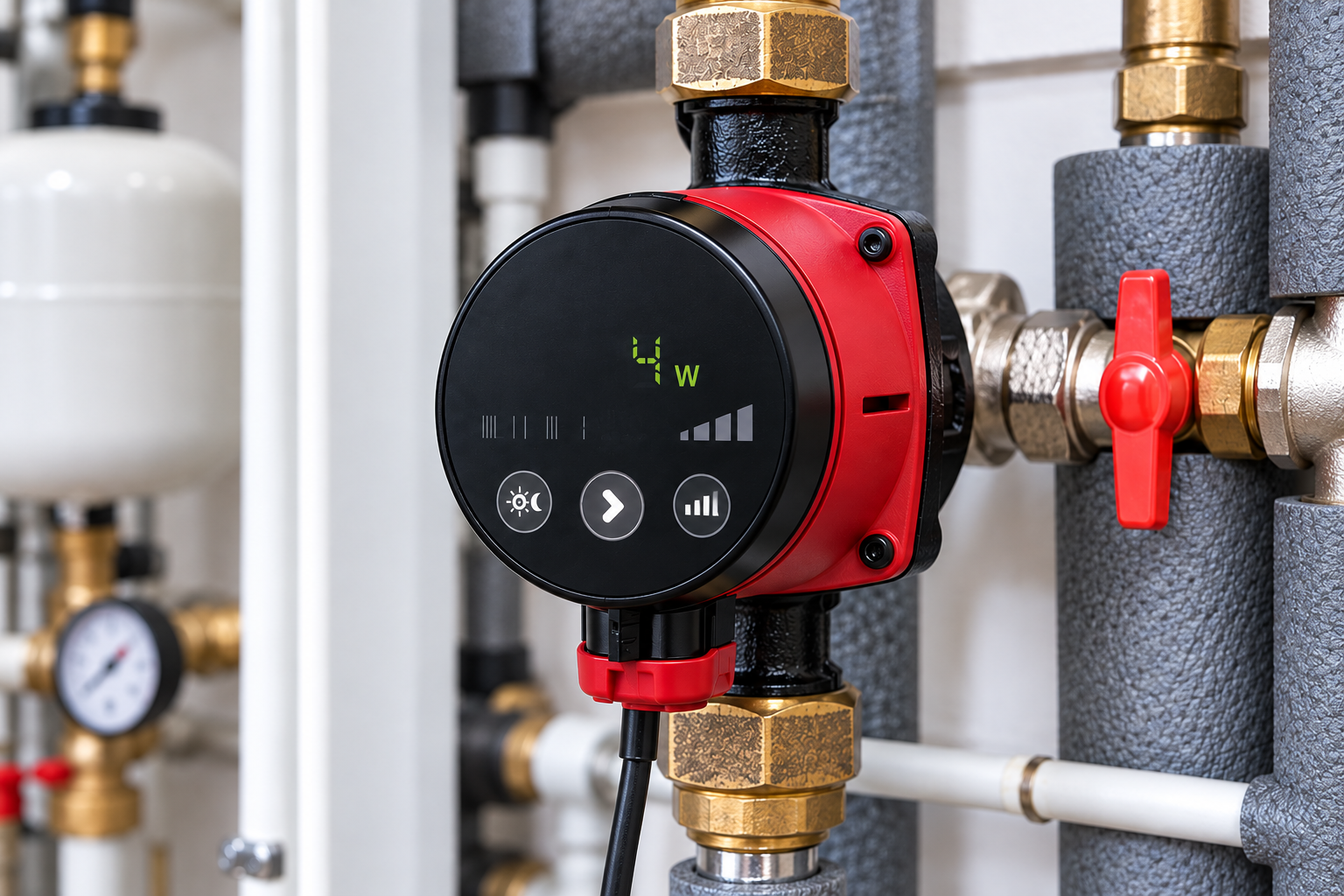
How Much Electricity Does a Heating Circulation Pump Use? Consumption, Cost and Savings
A heating circulation pump is an electrical component that may operate for many hours throughout the heating season. Although its power consumption is generally lower than that of many household appliances, extended operating hours can result in noticeable annual electricity use.
Consumption mainly depends on the pump’s electrical input power, operating hours and control strategy.
Modern high-efficiency electronic circulators can often use less electricity than older models, particularly in heating systems with variable flow demand.
How much does a circulator actually cost to operate, and when is replacement financially worthwhile?
1. How Many Watts Does a Circulation Pump Use?
The electrical input power of a circulator is measured in watts (W).
Actual power depends on the model, pump size, motor and operating conditions.
For small residential applications, illustrative values include:
Older circulator: May operate at approximately 40–100 W or more.
Modern electronic circulator: May operate at approximately 5–40 W under many conditions.
These are illustrative ranges, not universal specifications. Some pumps operate outside these ranges.
Accurate calculations should use the actual electrical input power of the specific circulator.
2. How Do You Calculate Electricity Consumption in kWh?
Electricity consumption is calculated using power and operating time.
Energy (kWh) = Power (W) × Operating hours / 1,000
For example, a circulator operating continuously at 60 W for 10 hours uses:
60 × 10 / 1,000 = 0.60 kWh
If it operates for 30 days on the same schedule:
0.60 × 30 = 18 kWh
This calculation is straightforward when power remains constant.
For variable-speed electronic circulators, electrical input power may change throughout operation. In that case, average power or measured energy consumption should be used.
3. How Much Electricity Does a Circulator Use per Month?
Consider three hypothetical pumps operating for 10 hours per day over 30 days.
30 W circulator: 30 × 300 / 1,000 = 9 kWh/month.
60 W circulator: 60 × 300 / 1,000 = 18 kWh/month.
90 W circulator: 90 × 300 / 1,000 = 27 kWh/month.
These calculations assume constant electrical input power during operation.
Actual electricity consumption may vary depending on the heating schedule and pump control strategy.
4. How Much Does It Cost to Run a Circulation Pump?
Running cost is calculated by multiplying electricity consumption by the electricity price per kWh.
Cost = Energy consumption (kWh) × Electricity price per kWh
Using an illustrative electricity price of €0.20/kWh:
30 W: 9 kWh × €0.20 = €1.80/month.
60 W: 18 kWh × €0.20 = €3.60/month.
90 W: 27 kWh × €0.20 = €5.40/month.
The price of €0.20/kWh is used only for calculation purposes. It does not represent a verified current electricity tariff.
Actual costs depend on the applicable electricity contract and charges.
5. What Is the Annual Running Cost?
Assume a circulation pump operates for 3,000 hours per year.
Older circulator operating at 80 W:
80 × 3,000 / 1,000 = 240 kWh/year.
At an illustrative price of €0.20/kWh:
240 × €0.20 = €48/year.
Electronic circulator averaging 20 W:
20 × 3,000 / 1,000 = 60 kWh/year.
At the same electricity price:
60 × €0.20 = €12/year.
The hypothetical annual difference is:
240 − 60 = 180 kWh.
€48 − €12 = €36.
This is a comparison of two assumed average power levels, not a guaranteed saving from replacing a particular pump.
6. Why Do Electronic Circulators Often Use Less Electricity?
Many modern electronic circulators use high-efficiency motors and electronic speed control.
Depending on the model and operating mode, they can adjust performance when system demand changes.
For example, when thermostatic radiator valves close, the required flow rate may decrease.
An appropriately configured electronic circulator may respond by reducing its electrical input power.
Potential benefits include:
Lower average electricity consumption.
Better adaptation to variable demand.
Reduced excessive differential pressure.
Lower noise in suitable applications.
Actual savings depend on operating conditions.
7. Does Pump Speed Affect Electricity Consumption?
Yes. Rotational speed affects the electrical power required by a circulation pump.
For centrifugal pumps under specified conditions, the pump affinity laws indicate that required shaft power changes approximately with the cube of rotational speed.
However, this does not mean that the actual electrical consumption of every installed circulator follows exactly the same relationship.
Motor efficiency, pump curves, system resistance and control strategy affect the result.
Arbitrarily reducing speed can cause insufficient circulation and heating problems.
8. Does the Pump Use Electricity When the Boiler Is Off?
This depends on the heating system’s control strategy.
Some systems keep the circulator running for a period after the burner stops to remove residual heat.
Other systems may periodically activate the pump for anti-seizing or frost protection.
Certain electronic circulators also consume a small amount of standby power while electrically connected.
To determine whether a circulator uses electricity without an active heating demand, actual operating indications and equipment instructions should be checked.
Power should not be disconnected arbitrarily because protective functions may be affected.
9. Is Replacing an Old Circulation Pump Worth It?
Replacement may be financially worthwhile, particularly when an older pump operates for many hours at relatively high electrical input power.
Important factors include:
Actual electricity consumption of the existing pump.
Expected consumption of the replacement.
Annual operating hours.
Total purchase and installation cost.
Hydraulic compatibility.
Condition and reliability of the existing equipment.
For example, if total replacement cost is €180 and actual annual electricity savings are €36:
€180 / €36 = 5 years simple payback.
This calculation excludes changes in electricity prices, financing costs, future repairs and other economic factors.
The replacement must also meet the system’s required flow rate and pump head.
10. How Can You Reduce Circulator Electricity Consumption?
Correct settings: Appropriate operating curve → Avoid unnecessary power consumption.
Electronic control: Adaptation to variable demand → Potential energy savings.
Hydraulic balancing: Proper flow distribution → Avoid excessive pump settings.
System maintenance: Air and contaminant control → Support reliable circulation.
Control optimisation: Appropriate operating schedules → Avoid unnecessary hours where permitted.
Replacement: Suitable high-efficiency circulator → Potentially lower electricity consumption.
Energy savings must never compromise required water flow or safe system operation.
11. How Can You Measure Actual Electricity Consumption?
The most reliable approach is to measure electrical energy consumption.
Depending on the equipment, suitable methods may include:
Built-in electrical power indications.
An appropriate electricity energy meter.
Measurements performed by a qualified technician.
Operating data from a building control system.
Rated or maximum electrical input power must be distinguished from actual operating power.
The wattage shown on a pump’s nameplate is not necessarily its average power consumption.
12. Frequently Asked Questions
How Much Electricity Does a 60 W Circulator Use?
At a constant input power of 60 W, it consumes 0.60 kWh over 10 hours. Over 30 days with the same daily schedule, consumption is 18 kWh.
How Much Does It Cost to Run a Circulator All Day?
A pump operating continuously at 50 W uses 1.2 kWh over 24 hours. At an illustrative electricity price of €0.20/kWh, this costs €0.24 per day.
Does an Electronic Circulator Use Less Electricity?
Often yes, especially in systems with variable demand. Actual savings should be calculated using measured or representative input power and operating hours.
Is Lowering Pump Speed a Good Way to Save Electricity?
Only when required water flow is maintained and the adjustment is compatible with equipment instructions.
How Long Does It Take for a New Pump to Pay for Itself?
Payback depends on total replacement cost and actual annual electricity savings.
Is It Normal for the Pump to Run After the Boiler Stops?
Yes. Some heating systems use pump overrun to remove residual heat.
Conclusion
The electricity consumption of a heating circulation pump depends on actual input power, operating hours and hydraulic operating conditions.
High-efficiency electronic circulators can often reduce electricity consumption, particularly when replacing older pumps operating for extended periods.
Reliable financial evaluation requires realistic consumption data and an accurate calculation of total replacement costs.
Correct sizing and settings remain essential for efficient and dependable operation.
Technical References
European Commission — Regulation (EC) No 641/2009 on ecodesign requirements for circulators and its amendments: https://eur-lex.europa.eu/eli/reg/2009/641/oj
Grundfos — Circulator specifications and technical manuals: https://www.grundfos.com
Wilo — Electronic circulator technical documentation: https://wilo.com
Europump — Pump technology and energy-efficiency information: https://www.europump.net
All power and cost examples are illustrative. Accurate calculations require the installed pump’s specifications and the applicable electricity tariff.