
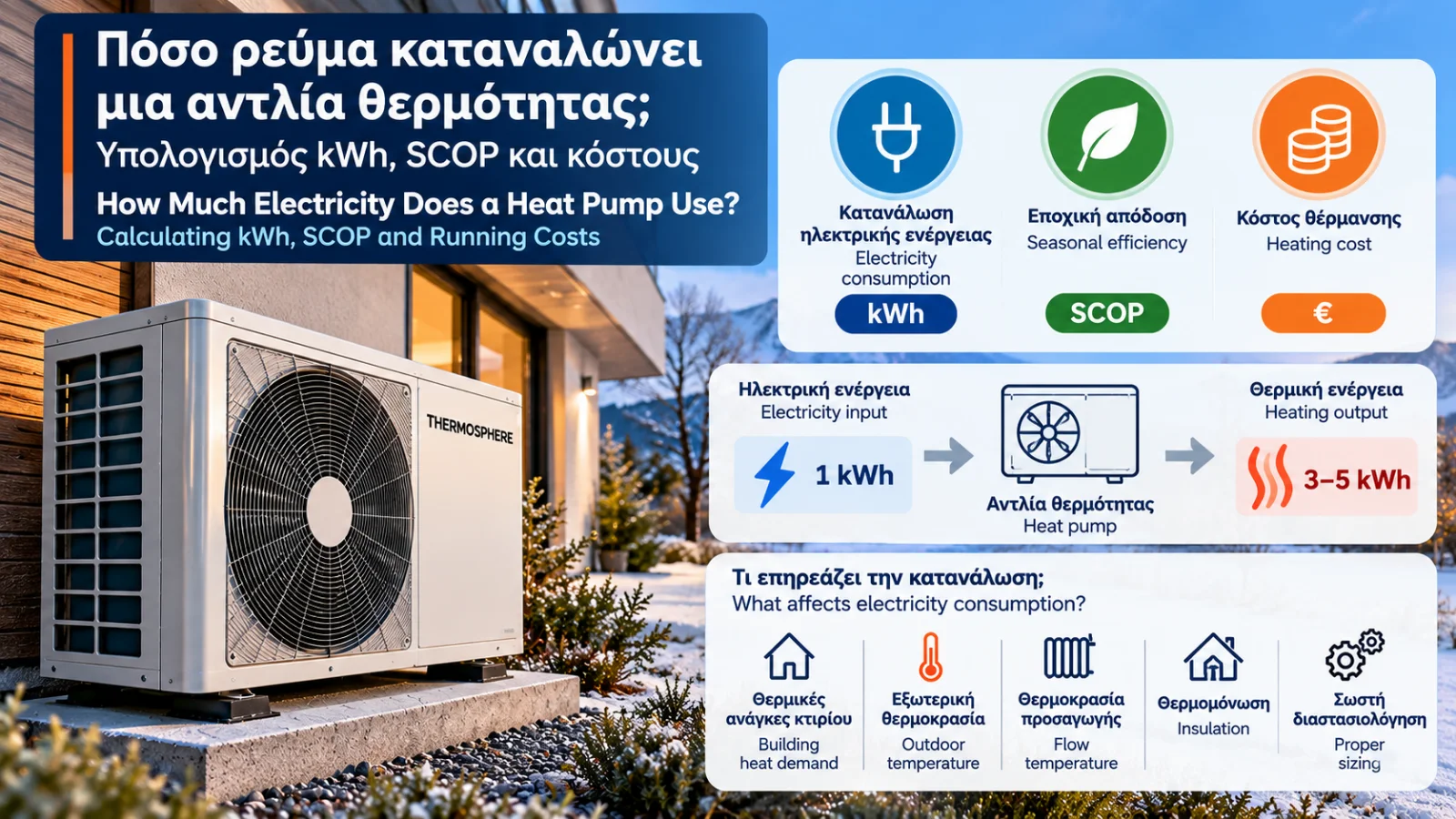
How Much Electricity Does a Heat Pump Use? kWh, SCOP and Running Costs
Electricity consumption is one of the most important considerations when choosing a heat pump.
How many kilowatt-hours will it use during winter? How much will it add to the electricity bill? And why can two similarly sized homes have very different heating costs?
The answer depends on more than the heat pump's rated capacity. Building heat demand, seasonal system efficiency, outdoor temperatures and operating conditions all play important roles.
In this Thermosphere.gr guide, we explain how to estimate electricity consumption using practical calculations and clearly stated assumptions.
1. How Does a Heat Pump Use Electricity?
A heat pump does not generate all its heating output through electrical resistance. Instead, it uses electricity to transfer heat from the environment into the building's heating system.
In an air-to-water heat pump, the compressor is a major electricity consumer. The fan, circulation pumps, controls and any activated auxiliary electric heaters also use electricity.
For example, a heat pump operating at a coefficient of performance (COP) of 4 delivers 4 kWh of heat for every 1 kWh of electricity consumed under the specified conditions.
This does not mean that the heat pump will maintain a COP of 4 throughout winter.
2. What Is the Difference Between COP and SCOP?
COP — Coefficient of Performance
COP expresses the ratio of useful heating output to electrical input under specific operating conditions.
COP = Heating output / Electrical input
Example:
Heating output: 8 kW.
Electrical input: 2 kW.
COP: 8 / 2 = 4.
COP changes with outdoor temperature, water temperature and operating conditions.
SCOP — Seasonal Coefficient of Performance
SCOP represents seasonal performance calculated using standardised conditions and methodologies.
It is generally more useful than a single COP value when making an initial estimate of seasonal electricity consumption.
However, the actual seasonal performance of an installed system may differ from the manufacturer's declared SCOP.
It is also important to check the climate conditions and temperature application associated with the published rating.
3. The Basic Electricity Consumption Formula
For a simplified seasonal estimate:
Electricity consumption (kWh) = Annual heat demand (kWh) / Seasonal performance factor
For example:
Annual space-heating demand: 12,000 kWh of heat.
Assumed seasonal performance factor: 3.5.
Then:
12,000 / 3.5 = approximately 3,429 kWh of electricity.
This is an estimate, not a guaranteed consumption figure.
For greater accuracy, actual installed-system performance, auxiliary electricity consumption and any electric backup heating must be considered, taking care not to double-count items already included in the chosen efficiency metric.
4. How Much Electricity Does a Heat Pump Use in a 100 m² Home?
There is no single electricity consumption figure that applies to every 100 m² home.
Consider three hypothetical scenarios using the same assumed seasonal performance factor of 3.5.
Annual space-heating demand | Estimated electricity consumption |
|---|---|
5,000 kWh of heat | 1,429 kWh |
10,000 kWh of heat | 2,857 kWh |
15,000 kWh of heat | 4,286 kWh |
These examples do not necessarily correspond to specific building energy classes.
Actual heating demand depends on insulation, location, windows, ventilation, indoor temperature settings and heating duration.
5. How Do You Calculate Electricity Costs?
The basic formula is:
Cost = Electricity consumption (kWh) × Electricity price (€/kWh)
Assume:
Annual heating electricity consumption: 3,429 kWh.
Hypothetical variable electricity price: €0.20/kWh.
Then:
3,429 × €0.20 = €685.80 per year.
This represents only the assumed variable charge for the specified electricity consumption. It is not a complete electricity bill estimate.
A more accurate calculation should consider applicable energy supply charges, variable network charges, taxes and other relevant costs, as well as any time-of-use tariffs.
Fixed charges that would be paid regardless of heating should be considered separately when comparing incremental heating costs.
6. How Much Electricity Does a Heat Pump Use Per Month?
Electricity consumption is not distributed equally throughout the heating season.
For example, a hypothetical seasonal total of 3,429 kWh could be distributed as follows:
Month | Electricity consumption |
|---|---|
November | 350 kWh |
December | 650 kWh |
January | 950 kWh |
February | 850 kWh |
March | 629 kWh |
Total | 3,429 kWh |
Actual monthly consumption depends on weather conditions and building use. These are illustrative values, not measured data.
7. How Much Electricity Does a Heat Pump Use Per Hour?
Electrical input power is not constant.
If a heat pump delivers 9 kW of heat at a COP of 3:
9 / 3 = 3 kW electrical input.
Operating for one hour at these conditions would consume approximately 3 kWh of electricity.
However, an inverter heat pump can adjust its output to match changing heating demand.
A rated heating capacity of 12 kW does not mean that the unit continuously consumes 12 kW of electrical power.
8. How Does Outdoor Temperature Affect Consumption?
For air-to-water heat pumps, outdoor temperature has a significant effect on performance.
As outdoor temperatures fall, the heat pump often has to operate across a larger temperature difference between the heat source and the heating system.
This can reduce COP.
Cold and humid conditions may also require defrost cycles.
The actual effect depends on the equipment's design and control strategy.
9. Why Is Flow Temperature Important?
The heating-water temperature required by the building affects energy efficiency.
A system capable of meeting heating demand with 35°C water may, under comparable conditions, operate more efficiently than one requiring 55°C water.
This is one reason underfloor heating systems often work efficiently with heat pumps.
However, properly sized radiators can also deliver effective heat pump operation.
The required flow temperature should be determined from building heat-loss calculations and the characteristics of the heat emitters.
10. How Does Building Insulation Affect Electricity Use?
Insulation directly affects heating demand.
A building with lower heat losses requires less heat to maintain the desired indoor temperature.
This can significantly reduce electricity consumption, even when the same heat pump model is used.
The building's energy performance should therefore be assessed before equipment selection.
11. Why Does Correct Heat Pump Sizing Matter?
Choosing a larger heat pump does not automatically reduce electricity consumption.
An oversized unit may experience more frequent cycling at low loads, depending on its modulation range and the hydraulic system.
An undersized unit may struggle during severe conditions or require additional backup heating.
Heat pump sizing should be based on a heat-loss calculation rather than floor area alone.
12. Do Electric Backup Heaters Increase Consumption?
Yes, when activated.
An electric resistance heater converts approximately 1 kWh of electricity into 1 kWh of heat.
For example, a 3 kW heater operating for two hours consumes approximately 6 kWh.
Backup heating may be required for specific functions or operating conditions, depending on the system design.
Frequent, unexplained activation should be investigated.
13. Is Domestic Hot Water Included?
Not necessarily.
The examples in this article concern space heating.
If the heat pump also produces domestic hot water, its electricity consumption must be added unless it is already included in the total measurement.
Consumption depends on hot water usage, storage temperature and system operation.
14. How Can You Measure Actual Consumption?
The most reliable approach is to record real operating data.
Useful tools include:
A suitable electricity meter for the heat pump installation.
A heat meter, where available.
Energy and performance readings from the heat pump controller.
Outdoor temperature and operating-hour records.
An installed system's seasonal performance can be estimated as:
Seasonal system performance = Total useful heat delivered / Total electricity consumed within the same measurement boundaries.
It is important to identify which auxiliary loads are included.
Built-in controller readings are useful, but they may differ from independently measured values.
15. How Can Electricity Consumption Be Reduced?
Important measures include:
Correct weather-compensation settings.
Using the lowest flow temperature that meets the building's heating demand.
Maintaining adequate water flow.
Keeping filters clean and performing appropriate maintenance.
Avoiding unnecessary auxiliary heater operation.
Improving building insulation where practical.
Reviewing operating schedules and indoor temperature settings.
Monitoring actual electricity use and system performance.
Technical settings should be adjusted in accordance with manufacturer instructions and, where required, by a qualified technician.
16. Frequently Asked Questions
How Many kWh Does a 12 kW Heat Pump Use?
A 12 kW rating normally describes heating capacity under specified conditions, not constant electrical consumption. Electricity use depends on actual input power and operating duration.
Is Higher Electricity Use in January Normal?
Yes. Greater heating demand and more challenging operating conditions can increase electricity consumption.
Is SCOP 5 Better Than SCOP 3.5?
Under comparable rating conditions, a higher SCOP indicates better seasonal efficiency. However, the climate zone and temperature application must match when comparing figures.
Can Electricity Consumption Be Calculated from Floor Area Alone?
Not reliably. Floor area is only one of several required inputs.
Does Running a Heat Pump 24 Hours a Day Always Use More Electricity?
Not necessarily. Total consumption depends on heating demand and the efficiency with which heat is supplied. Continuous low-output operation can be efficient in some installations, but it is not a universal rule.
Conclusion
Heat pump electricity consumption cannot be determined from rated capacity or building floor area alone.
A useful estimate requires the building's heat demand, expected seasonal efficiency, operating temperatures and actual electricity tariff.
The basic calculation is straightforward: divide required heating energy by seasonal performance. The accuracy of the result depends on the quality of the inputs.
Technical References and Further Reading
EN 14825 — Air conditioners, liquid chilling packages and heat pumps with electrically driven compressors for space heating and cooling: Testing and rating at part load conditions and calculation of seasonal performance.
EN 14511 — Air conditioners, liquid chilling packages and heat pumps for space heating and cooling and process chillers with electrically driven compressors.
European Commission — Commission Delegated Regulation (EU) No 811/2013 on the energy labelling of space heaters and combination heaters.
European Heat Pump Association (EHPA) — Educational and technical resources on heat pump performance.
Official manufacturer technical data and installation manuals covering COP, SCOP and operating conditions.
Thermosphere.gr — Technical knowledge for heating and building systems.