
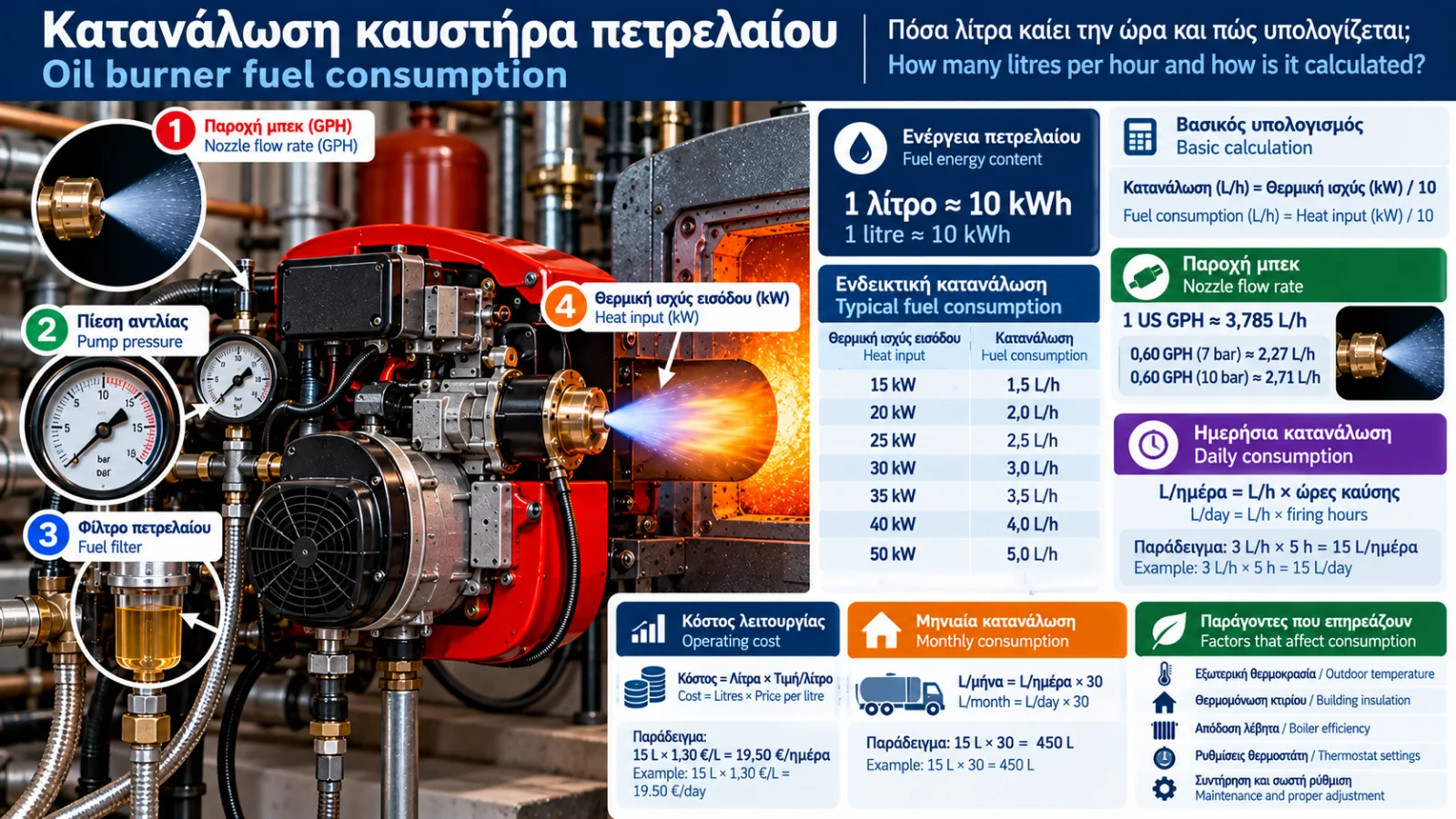
Oil Burner Fuel Consumption: How Many Litres per Hour and How to Calculate It
Heating oil consumption is one of the main concerns for owners of oil-fired central heating systems.
A common question is: How many litres of heating oil does my burner consume per hour?
The answer depends on the actual fuel flow rate, burner heat input, operating mode and the heating requirements of the building.
An oil burner may consume a relatively consistent amount of fuel while firing, but total daily consumption depends on how long it actually operates.
Boiler efficiency, insulation, outdoor temperature and heating controls also affect the amount of fuel needed over a day or heating season.
In this Thermosphere.gr guide, we explain the main calculations, provide illustrative examples and examine practical ways to assess fuel consumption.
1. What Determines Oil Burner Fuel Consumption?
Two quantities determine total consumption:
Fuel flow rate while the burner is firing.
Total time spent burning fuel.
A single-stage oil burner generally has an approximately constant firing rate during normal operation, assuming stable fuel supply conditions.
A two-stage or modulating burner may operate at different fuel flow rates.
Therefore, total consumption cannot be calculated accurately from the boiler's nominal output alone.
2. How Much Energy Does One Litre of Heating Oil Contain?
Heating oil contains chemical energy released during combustion.
For approximate calculations, a lower heating value of 10 kWh per litre is a useful illustrative assumption.
The actual value varies with fuel composition, density and temperature.
This figure represents the energy contained in the fuel, not the useful heat delivered to the building.
For example:
1 litre contains approximately 10 kWh.
10 litres contain approximately 100 kWh.
100 litres contain approximately 1,000 kWh.
These are approximate values intended for educational calculations.
3. Calculating Litres per Hour from Burner Heat Input
The basic equation is:
Fuel consumption (L/h) = Fuel heat input (kW) / Fuel energy content (kWh/L)
Using the illustrative value of 10 kWh/L:
Fuel consumption (L/h) ≈ Heat input (kW) / 10
For example, a burner with an actual fuel heat input of 30 kW would consume approximately:
30 / 10 = 3 L/h
This calculation uses burner fuel heat input, not the boiler's nominal useful output.
The distinction is essential.
4. How Much Oil Does a 20, 25, 30 or 40 kW Burner Use?
The following table assumes a fuel energy content of 10 kWh/L.
Fuel heat input | Estimated consumption |
|---|---|
15 kW | 1.5 L/h |
20 kW | 2.0 L/h |
25 kW | 2.5 L/h |
30 kW | 3.0 L/h |
35 kW | 3.5 L/h |
40 kW | 4.0 L/h |
50 kW | 5.0 L/h |
These are calculated examples, not measured values from specific burners.
If the stated boiler rating refers to useful output, boiler efficiency must be considered before estimating fuel consumption.
5. Burner Heat Input Versus Boiler Useful Output
Fuel heat input is the rate at which chemical energy enters the burner.
Useful boiler output is the rate at which heat is transferred to the heating water.
For a conventional boiler, using a consistent energy basis:
Useful output = Fuel heat input × Efficiency
Consider a hypothetical boiler with:
Useful output: 25 kW.
Efficiency: 85%.
Heating oil energy content: 10 kWh/L.
The required fuel heat input is:
25 / 0.85 = 29.4 kW
Estimated consumption is:
29.4 / 10 = 2.94 L/h
This demonstrates why a boiler rated at 25 kW useful output does not necessarily consume only 2.5 litres per hour.
Actual efficiency must be established under the relevant operating conditions.
6. How Does Nozzle Size Affect Consumption?
Pressure-atomising oil burners use a nozzle to establish the fuel spray.
Nozzles are commonly rated in US gallons per hour (GPH) at specified reference conditions.
One US gallon is approximately 3.785 litres.
Therefore:
1 US GPH ≈ 3.785 L/h
However, the nozzle marking refers to a specified test pressure.
Actual flow depends on differential pressure and fuel properties.
Multiplying the GPH marking by 3.785 without accounting for operating conditions may produce an inaccurate estimate.
7. Example: Calculating Consumption from a Nozzle
Consider a hypothetical nozzle rated:
0.60 US GPH at a reference pressure of 7 bar
Its nominal flow in litres per hour is:
0.60 × 3.785 = 2.271 L/h
If differential pressure were hypothetically 10 bar, the approximate flow relationship would be:
Q₂ = Q₁ × √(Δp₂ / Δp₁)
Therefore:
Q₂ = 2.271 × √(10 / 7)
Q₂ ≈ 2.71 L/h
This is a theoretical estimate for the example, not a recommended operating setting.
Actual flow may differ due to nozzle and fuel characteristics.
Pump pressure should not be changed simply to reduce fuel consumption without professional evaluation. Pressure changes affect atomisation and burner heat input.
8. Calculating Daily Fuel Consumption
For a single-stage burner, estimated daily consumption is:
Daily fuel consumption (L) = Fuel flow (L/h) × Actual firing hours
Example:
Fuel flow: 3 L/h.
Actual firing time: 5 hours per day.
Consumption:
3 × 5 = 15 litres per day
The burner does not need to run continuously for five hours.
Several shorter firing cycles may add up to five hours of actual combustion.
9. Calculating Monthly Consumption
Monthly consumption can be estimated from average daily fuel use.
For example:
Average daily consumption: 15 L.
Period: 30 days.
15 × 30 = 450 litres
However, actual consumption is rarely identical every day.
It varies with:
Outdoor temperature.
Heating operating hours.
Indoor temperature settings.
Building insulation.
Ventilation heat losses.
Domestic hot water production, where supplied by the boiler.
Calculations based on constant daily consumption are only approximations.
10. Calculating Heating Oil Costs
The basic equation is:
Fuel cost = Consumption in litres × Price per litre
Assume a hypothetical heating oil price of €1.30/L.
For 15 litres per day:
15 × 1.30 = €19.50 per day
For 450 litres:
450 × 1.30 = €585
The price of €1.30/L is illustrative and is not a current market quotation.
Actual budgeting should use the price paid for the fuel.
11. Using a Fuel Consumption Calculator
A simple consumption estimate requires three inputs:
Fuel flow rate in L/h.
Actual daily firing hours.
Fuel price per litre.
Multiplying flow rate by firing hours provides daily consumption.
Multiplying the result by the fuel price gives the corresponding daily fuel cost.
For two-stage or modulating burners, the time spent at each firing rate must be considered separately.
12. Why Can Similar Homes Consume Different Amounts?
Oil consumption is not determined by the burner alone.
Two houses with similar boilers may have significantly different heating requirements.
Important factors include:
Building size and geometry.
Wall and roof insulation.
Window performance.
Airtightness.
Building orientation.
Outdoor temperatures.
Indoor temperature settings.
Heating schedules.
Heating-system efficiency.
Comparing fuel consumption without accounting for these factors can be misleading.
13. How Does Insulation Affect Fuel Consumption?
Insulation reduces heat transfer from the heated interior to the outdoor environment.
Under comparable conditions, a better-insulated building generally needs less energy to maintain the same indoor temperature.
This can reduce the total firing time of the oil burner.
However, actual savings depend on building characteristics and the improvements made.
A universal savings percentage cannot be applied reliably to every property.
14. How Does the Thermostat Affect Consumption?
The thermostat determines when the heating system receives a request for heat.
Its temperature setting, schedule and location affect heating demand.
Excessively high indoor temperature settings generally increase building heat losses.
An appropriate heating schedule may reduce unnecessary heating during periods when full comfort temperatures are not required.
Settings should account for occupant comfort, building thermal inertia and individual needs.
15. Can Maintenance Reduce Heating Oil Consumption?
Maintenance may help restore performance when problems include:
Fouled boiler heat-exchange surfaces.
Poor fuel atomisation.
Incorrect combustion conditions.
Fuel delivery problems.
Deteriorated components.
Improved combustion and heat transfer may reduce unnecessary losses.
However, maintenance does not guarantee a fixed reduction in fuel consumption.
A properly maintained and adjusted boiler may show only a small change after routine servicing.
16. What Is an Oversized Oil Burner?
A burner or boiler is oversized when its available heat output is substantially greater than the installation requires under actual conditions.
In some systems, oversizing can cause frequent starts and stops.
Frequent cycling may affect efficiency and component wear, depending on equipment design and operating conditions.
However, fuel flow should not be reduced arbitrarily by changing nozzle size or pump pressure.
Correct sizing requires professional assessment of the boiler, burner and building heat demand.
17. How Can Actual Fuel Consumption Be Measured?
Calculations based on heat input or nozzle ratings are useful estimates.
More reliable assessment may involve:
A suitable fuel consumption meter.
Recording actual burner firing hours.
Fuel delivery records.
Tank level measurements using known tank geometry.
Historical consumption data from comparable periods.
Tank level measurements may be affected by tank shape, calibration and temperature.
Weather conditions should also be considered when comparing different periods.
18. Comparing Fuel Consumption Between Heating Seasons
Comparing total litres from two winters can be misleading.
A colder winter will generally require more heating.
A more meaningful comparison may use Heating Degree Days (HDD).
Heating degree days indicate how cold a period has been relative to a defined base temperature.
Comparing fuel consumption per heating degree day can help assess changes in a building's heating performance.
However, changes in occupancy, indoor temperature settings and domestic hot water demand must also be considered.
19. Frequently Asked Questions
How Many Litres of Oil Does a Burner Use per Hour?
It depends on actual fuel heat input. Assuming 10 kWh/L, a burner with a heat input of 30 kW consumes approximately 3 L/h.
How Much Oil Does a 30 kW Boiler Use?
First determine whether 30 kW refers to fuel heat input or useful boiler output. The resulting fuel consumption differs.
How Many Litres per Hour Does a 0.60 GPH Nozzle Use?
At its nominal reference pressure, approximately 2.27 L/h. Actual flow depends on differential pressure and fuel properties.
Does a Burner Consume Oil Throughout the Entire Heating Period?
Not necessarily. The time that heating is enabled is different from the actual time the burner is firing.
Can Changing the Nozzle Reduce Fuel Consumption?
Nozzle changes should not be made arbitrarily. They affect burner heat input, atomisation and combustion safety.
Why Has My Oil Consumption Increased?
Possible causes include colder weather, longer heating hours, changes in building use or heating-system performance problems.
How Can I Reduce Heating Oil Consumption?
Appropriate maintenance, sensible temperature control, reduced building heat losses and professional assessment of heating-system performance may help.
Conclusion
Oil burner fuel consumption depends on actual fuel flow rate and firing time.
Burner heat input, nozzle flow rating and pump pressure can help estimate litres consumed per hour.
However, total building consumption is also affected by heat losses, weather, heating controls and system efficiency.
For a reliable assessment, distinguish hourly burner consumption from daily or seasonal fuel use and rely on actual measurements wherever possible.
Technical References and Further Reading
EN 267: Automatic forced draught burners for liquid fuels.
Danfoss: Oil nozzle and pump technical documentation — https://www.danfoss.com/
Riello: Burner manuals and heat input specifications — https://www.riello.com/
Baltur: Burner technical manuals and performance data — https://www.baltur.com/
Eurostat: Energy statistics and datasets — https://ec.europa.eu/eurostat/
European Commission Joint Research Centre: Building energy efficiency research — https://joint-research-centre.ec.europa.eu/
Fuel energy content, boiler efficiency and fuel prices used in the examples are illustrative. Real calculations require data for the actual equipment and fuel.
Safety note: Changing nozzle specifications, pump pressure or combustion settings is not a DIY fuel-saving measure. Such work requires a qualified technician and appropriate combustion measurements.
Thermosphere.gr — Technical knowledge for heating and building systems.