
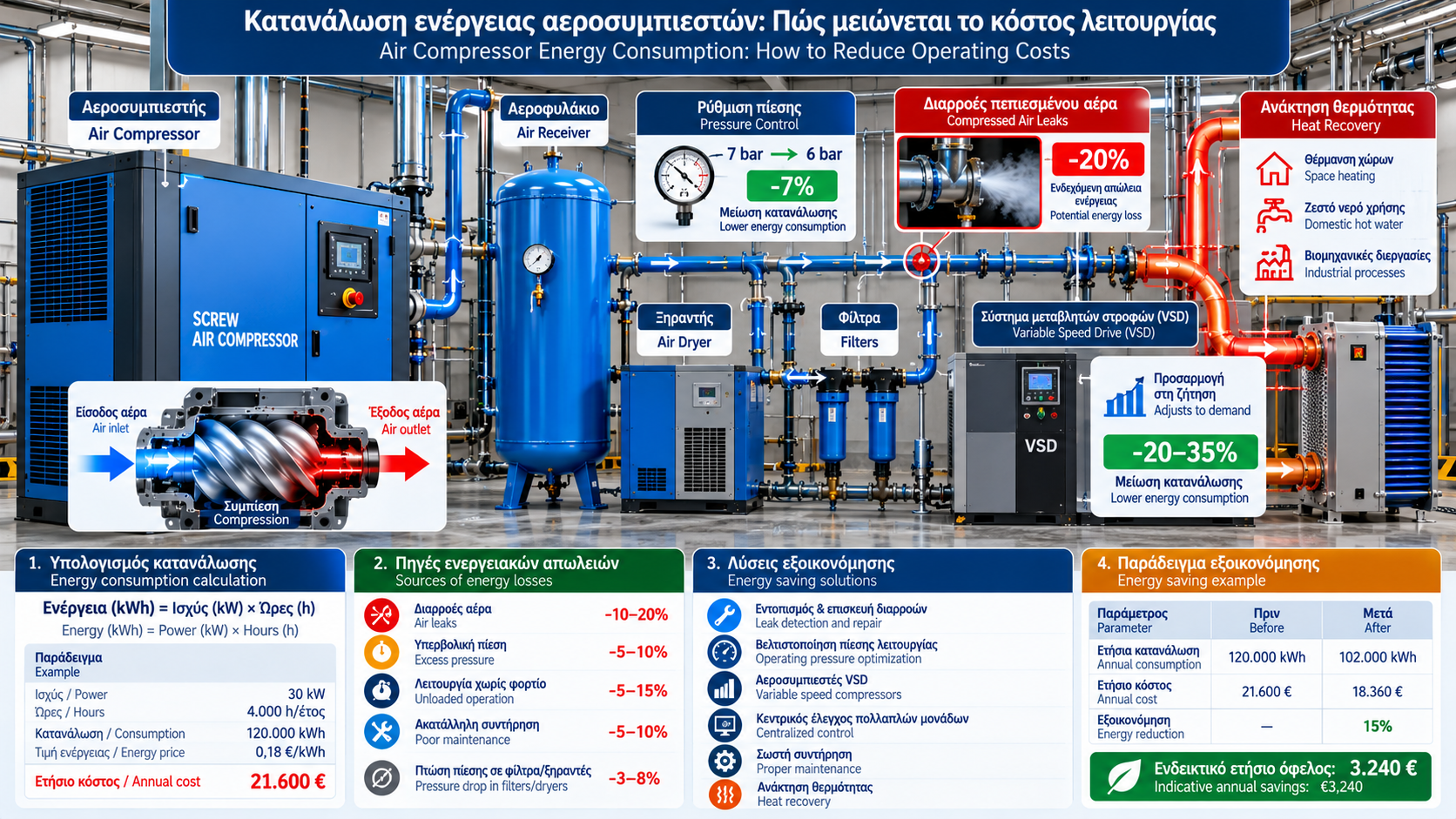
Air Compressor Energy Consumption: How to Reduce Operating Costs
Compressed air is widely used in industrial automation, pneumatic tools, conveying systems and manufacturing processes. Although highly versatile, compressed air is an energy-intensive utility.
Compressor electricity consumption, air leaks, excessive operating pressure, unloaded running and poor maintenance can significantly increase operating costs.
Improving efficiency requires evaluating the complete compressed air system, from generation to final points of use.
Calculating Compressor Electricity Consumption
Electricity consumption is determined by actual electrical input power and operating time.
Energy (kWh) = Average electrical input power (kW) × Operating hours (h)
For example, a compressor drawing an average of 30 kW for 4,000 hours annually consumes 120,000 kWh.
At an illustrative electricity rate of €0.18/kWh, annual energy costs amount to €21,600.
This calculation excludes fixed charges, demand charges, taxes and other electricity billing components.
Actual energy use should be measured using electrical power meters or energy monitoring equipment. Nominal motor power should not automatically be treated as actual electrical input.
Specific Power and Compressor Efficiency
Specific power is an important indicator of compressor performance.
Specific power = Electrical input power / Free Air Delivery (FAD)
When FAD is expressed in m³/min, specific power is measured in kW/(m³/min).
Comparisons should use equivalent discharge pressures, reference conditions and operating points.
Compressed Air Leakage
Leaks are a major source of avoidable compressed air consumption.
Typical leakage points include pipe joints, quick couplings, flexible hoses, valves, regulators and worn pneumatic components.
Detection methods include ultrasonic leak detectors, airflow measurements and controlled pressure-decay tests.
An effective leakage management program should include detection, repair, documentation and periodic verification.
Operating Pressure Optimization
Generating compressed air at a higher pressure than necessary generally increases compression energy requirements.
Higher pressure may also increase consumption at unregulated points of use and increase leakage flow.
The operating pressure should be established according to actual equipment requirements and distribution pressure losses.
Before reducing compressor discharge pressure, engineers should inspect filters, dryers, piping and other components that may create excessive pressure drops.
Variable Speed Drive Compressors
Variable Speed Drive (VSD) compressors adjust motor speed according to compressed air demand within their permitted operating range.
They can improve efficiency in installations with fluctuating demand by reducing unnecessary unloaded operation.
However, VSD compressors do not guarantee lower energy consumption in every application.
Where demand remains relatively constant near rated capacity, a properly selected fixed-speed compressor may offer competitive lifecycle performance.
Selection should be supported by measured load profiles and manufacturer performance data.
Unloaded Operation and Centralized Control
A compressor operating in unloaded mode may continue consuming substantial electrical power despite delivering little or no useful compressed air.
In multi-compressor installations, centralized control can reduce unnecessary operating hours and prevent inefficient interactions between machines.
The most suitable control strategy depends on receiver capacity, demand fluctuations, start-stop limitations and compressor control characteristics.
Filters, Dryers and Pressure Losses
Filtration and air drying are essential for meeting compressed air quality requirements.
However, excessive pressure drops through filters, dryers or piping may require higher compressor discharge pressure.
Monitoring differential pressure, selecting correctly sized equipment and following appropriate maintenance schedules can reduce unnecessary energy losses.
Waste Heat Recovery
Air compression generates considerable heat, which is usually removed through compressor cooling systems.
Depending on equipment design, some of this heat can be recovered for space heating, water preheating or industrial processes.
The potential benefit depends on available thermal power, operating temperature, annual operating hours and the facility's heating demand.
Heat recovery does not necessarily reduce the compressor's own electricity consumption. Instead, it can reduce total facility energy consumption by replacing another source of heat.
Practical Energy Savings Example
Consider a hypothetical compressed air installation consuming 120,000 kWh annually.
Following leak repairs, pressure optimization and improved compressor control, annual consumption falls to 102,000 kWh under equivalent production conditions.
Annual electricity savings equal 18,000 kWh, representing a 15% reduction.
At an illustrative electricity price of €0.18/kWh, the annual cost reduction is €3,240.
These figures are illustrative rather than guaranteed savings. Actual results require an established energy baseline and verification under comparable operating conditions.
Implementing an Energy Optimization Program
The first step is to establish the actual energy consumption and operating profile of the compressed air system.
Engineers should then inspect leaks, record pressure variations, measure pressure drops and assess loaded and unloaded compressor operation.
Potential improvements should be prioritized according to technical feasibility, implementation cost, expected energy savings and payback period.
After implementation, further measurements are required to verify the results.
Conclusion
Reducing air compressor energy consumption requires a system-wide engineering approach rather than simply purchasing a more efficient compressor.
Leak repairs, optimized pressure settings, suitable compressor controls, effective maintenance and waste heat recovery can all contribute to lower operating costs.
Reliable improvements depend on accurate measurements, sound engineering analysis and continuous performance monitoring.