
Chimney Caps: Types, Functions and How to Choose the Right One
A chimney cap is a component installed at the top of a chimney or flue system. Depending on its design, it can serve several purposes.
Some chimney caps help prevent rain from entering the flue, others are designed to reduce certain adverse wind effects, while specialised terminals form part of approved flue gas evacuation systems.
Choosing the correct chimney cap is important because the terminal affects flue gas flow and the pressure conditions within the chimney.
An unsuitable cap may increase flow resistance, accumulate soot or worsen existing chimney draft problems.
There is no single chimney cap suitable for every heating appliance.
The correct choice depends on the appliance, fuel type, chimney characteristics, operating conditions and manufacturer's instructions.
What Is a Chimney Cap?
A chimney cap, sometimes called a chimney cowl, is a component fitted to the upper end of a chimney.
Depending on its construction, it may help:
Reduce direct rain entry.
Prevent birds and larger foreign objects from entering.
Limit certain adverse effects of wind.
Protect the chimney outlet from specific environmental conditions.
However, every additional component changes the geometry of the flue outlet and may introduce additional resistance to flue gas flow.
For this reason, a chimney cap should not be treated as a purely decorative accessory.
What Are the Main Types of Chimney Caps?
1. Fixed Rain Cap
A fixed rain cap is one of the simplest chimney terminal designs.
It usually consists of a metal cover positioned above the chimney outlet, with openings that allow combustion gases to escape.
Advantages:
Simple construction.
No moving parts.
Limited mechanical maintenance requirements.
Can reduce direct rain entry.
Limitations:
Performance may be affected by wind.
Poorly designed openings can increase pressure losses.
Soot and other deposits may accumulate and require cleaning.
Not every fixed cap is suitable for every operating temperature or fuel type.
2. Anti-Downdraught Chimney Cap
Anti-downdraught chimney caps are designed to reduce certain unwanted effects of wind at the chimney outlet.
Wind flowing around a building can create local areas of positive and negative pressure.
Depending on the roof geometry and terminal position, these pressure variations can affect chimney draft.
A properly designed anti-downdraught terminal may improve outlet performance under particular wind conditions.
However, an anti-downdraught cap is not a guaranteed solution to every smoke backdraft problem.
If the chimney has an unsuitable diameter, insufficient effective height or excessive flow resistance, the underlying problem may remain.
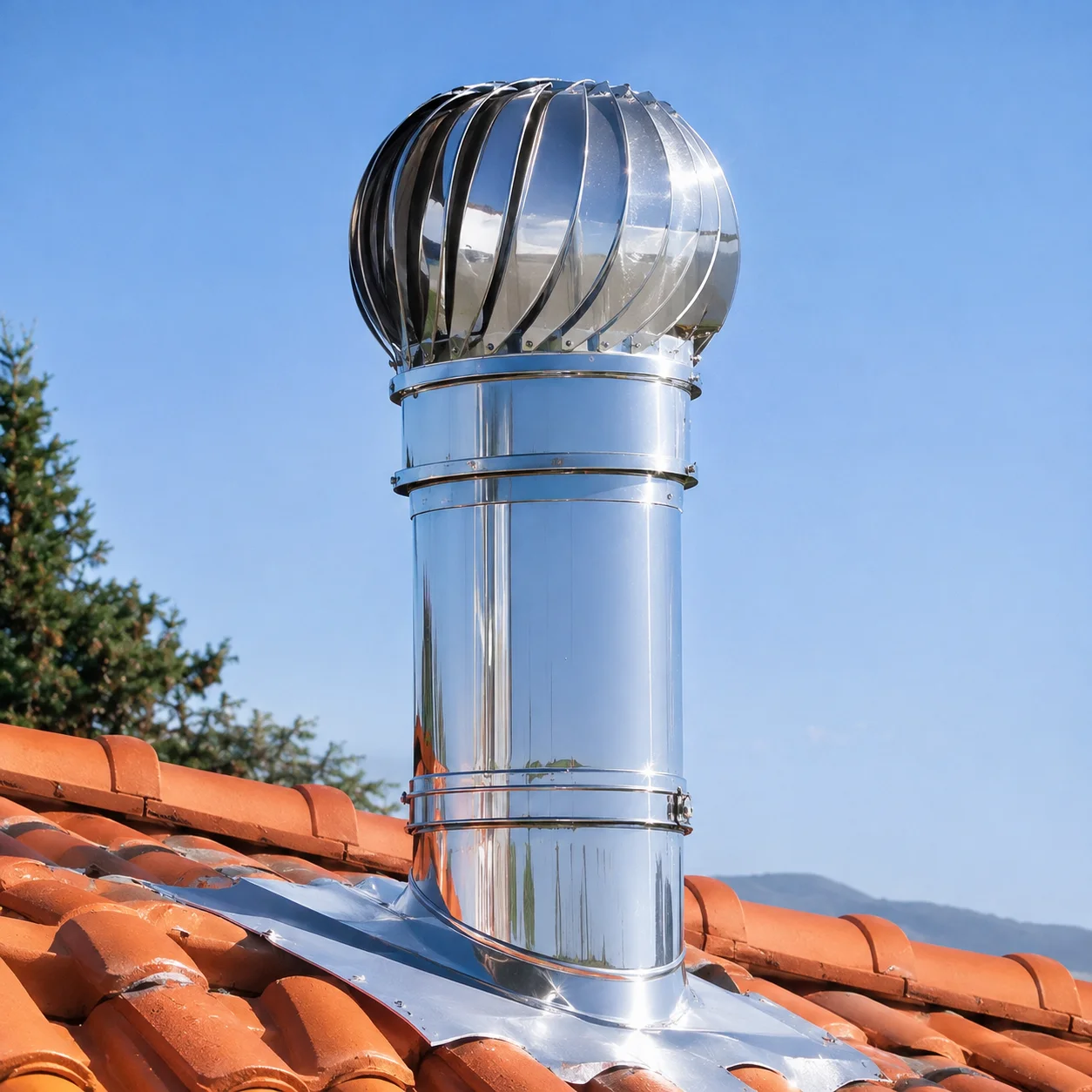
3. Rotating Chimney Cowl
A rotating chimney cowl incorporates a moving section that rotates under the influence of wind.
Some designs aim to create favourable pressure conditions at the flue outlet.
Actual performance depends on the cowl design and operating conditions.
Potential advantages:
Wind-responsive operation.
Possible improvement in terminal performance under certain conditions.
Potential limitations:
Moving mechanical components.
Bearing wear.
Possible seizure due to soot or other deposits.
Dependence on wind conditions.
Rotating cowls used with solid-fuel appliances require particular attention to temperature resistance, soot accumulation, maintenance and manufacturer approval.
4. Chimney Cap with Protective Mesh
Some chimney caps include mesh or screening intended to prevent birds and larger objects from entering the chimney.
The mesh must be suitable for the intended application.
In installations that produce soot, small openings may gradually become blocked.
Such blockages reduce the available outlet area and may seriously affect the safe discharge of combustion gases.
Protective mesh should therefore be used only where it is compatible with the appliance and chimney system requirements.
5. Specialised Flue Terminals
For certain heating appliances, particularly fan-assisted boilers and concentric air/flue systems, the terminal is not a generic chimney cap.
Instead, it is a specific component of an approved flue system.
Replacing that terminal with a conventional chimney cap may alter the system's operating characteristics.
Only terminals permitted by the appliance and flue system manufacturers should be used.
Comparison of Chimney Cap Types
Type | Main function | Main limitation |
|---|---|---|
Fixed rain cap | Reduces direct rain entry | May introduce additional flow resistance |
Anti-downdraught cap | Reduces certain adverse wind effects | Does not solve every draft problem |
Rotating cowl | Influences outlet pressure under wind | Moving parts and maintenance requirements |
Mesh-protected cap | Helps prevent bird entry | Risk of blockage |
Specialised terminal | Approved operation with a specific flue system | Cannot be replaced arbitrarily |
This table provides a general comparison and does not replace technical verification of product suitability.
How Does a Chimney Cap Affect Chimney Draft?
Natural chimney draft is primarily generated by the density difference between hot combustion gases inside the chimney and cooler outside air.
The resulting pressure difference must be sufficient to overcome the flow resistance of the entire flue system.
Pressure losses depend on factors including:
Chimney length.
Internal diameter.
Changes in direction.
Internal surface roughness.
Connecting components.
Terminal geometry.
A chimney cap can influence the local pressure loss at the outlet.
Therefore, a cap that appears dimensionally compatible is not necessarily suitable from an aerodynamic perspective.
In demanding installations, the terminal's pressure-loss characteristics should be considered during chimney sizing and performance calculations.
Can a Chimney Cap Prevent Smoke Backdraft?
Smoke backdraft can have several causes.
These include:
Insufficient natural draft.
Inadequate chimney height.
Incorrect chimney sizing.
Blockages or soot deposits.
Adverse wind effects.
Insufficient combustion air supply.
Negative indoor pressure caused by ventilation or extraction systems.
If wind pressure at the chimney outlet is the main cause, a suitable terminal may form part of the solution.
However, if the problem results from incorrect sizing or inadequate combustion air, changing the chimney cap may not solve it.
The correct approach is to identify the underlying cause before selecting a technical solution.
If smoke or combustion gases enter occupied rooms, the appliance should not continue operating until the cause has been investigated and corrected by a qualified professional.
Chimney Caps for Fireplaces and Wood-Burning Stoves
Solid-fuel appliances have particular operating requirements.
Their combustion gases may contain particulate matter, soot and products of incomplete combustion.
Under certain conditions, creosote deposits can form inside the chimney.
A cap with narrow openings or unsuitable mesh may accumulate these deposits and restrict flue gas flow.
When selecting a chimney cap for a fireplace or wood-burning stove, check:
Suitability for the intended fuel.
Temperature resistance.
Compatibility with the chimney's performance requirements.
Accessibility for cleaning.
Flow resistance.
Resistance to outdoor environmental conditions.
A chimney cap does not replace regular chimney cleaning.
Chimney Caps for Oil-Fired Boilers
For oil-fired boilers, the chimney terminal must be compatible with the operating temperature, pressure conditions and flue system requirements.
Potential condensate formation must also be considered.
An unsuitable cap may introduce excessive resistance or create locations where moisture accumulates.
The selection should therefore be based on the boiler's technical specifications and the chimney system documentation.
Chimney Caps for Gas Boilers
In many modern gas boilers, the flue terminal is part of an approved system.
This is particularly important for condensing boilers and fan-assisted appliances.
Installing a conventional anti-downdraught or rotating chimney cap without manufacturer approval may affect pressure conditions, flue gas discharge or combustion air supply.
Unauthorised modifications to these terminals must be avoided.
What Is the Best Material for a Chimney Cap?
Chimney caps are manufactured from different materials depending on the intended application.
Common options include metal components made from suitable steel grades.
Material selection depends on:
Operating temperature.
Chemical composition of the combustion gases.
Potential condensate exposure.
Environmental conditions.
Required durability.
Compatibility with the chimney system.
Using stainless steel does not automatically guarantee suitability for every application.
The specific material grade and documented performance of the finished product must be considered.
How Does Wind Affect the Chimney Outlet?
Wind effects depend on the building and its surroundings.
A chimney located near a higher roof, parapet or neighbouring building may be exposed to complex airflow patterns.
Under these conditions, local pressure around the chimney outlet can vary significantly.
Selecting a special chimney cap should not replace an assessment of the chimney's height and terminal position.
Some problems may require repositioning the outlet, changing the chimney configuration or applying another appropriate engineering solution.
When Does a Chimney Cap Need Cleaning?
The chimney cap should be included in the chimney's scheduled inspection and maintenance programme.
Inspection frequency depends on the fuel, appliance usage and operating conditions.
Signs that require investigation include:
Visible soot deposits.
Blocked outlet openings.
Restricted movement of rotating components.
Deformation or corrosion.
Loose connections.
Unexplained deterioration in chimney draft.
Inspection and cleaning should be carried out with safe access arrangements by suitably qualified personnel.
Common Mistakes When Choosing a Chimney Cap
Choosing a Cap Based Only on Appearance
Appearance is not a sufficient technical selection criterion.
Installing a Rotating Cowl in Every Situation
Rotating cowls are not universal solutions and require verification of suitability.
Using Mesh with Very Small Openings
Soot accumulation may dangerously reduce the available outlet area.
Ignoring Flow Resistance
The terminal can affect the pressure required for correct operation of the chimney system.
Replacing an Approved Boiler Terminal
Approved flue terminals should not be replaced without confirmation of compatibility from the relevant manufacturer.
Neglecting Maintenance
Even a correctly selected cap can become hazardous if it develops a blockage or mechanical defect.
How to Choose the Right Chimney Cap
Before purchasing and installing a chimney cap, verify the following:
Appliance type: Fireplace, wood-burning stove, oil boiler, gas boiler or another appliance.
Fuel type: Wood, pellets, oil, natural gas or another fuel.
Flue gas temperature: The cap must withstand the expected operating temperatures.
Pressure conditions: Natural-draft or fan-assisted operation.
Dimensions: The terminal must be compatible with the chimney.
Aerodynamic performance: It must not introduce unacceptable flow resistance.
Wind exposure: The outlet position and surrounding roof geometry must be assessed.
Corrosion resistance: Flue gas composition and condensate exposure must be considered.
Maintenance access: Inspection and cleaning must be possible.
Manufacturer approval: The terminal must be suitable and permitted for the specific application.
Which Standards Are Relevant to Chimney Terminals?
Chimney terminals should be assessed as part of the complete flue system.
Relevant European standards include:
EN 1443: General chimney requirements and classification.
EN 1856-1: Requirements for metal system chimney products.
EN 1856-2: Requirements for metal flue liners and connecting flue pipes.
EN 13384-1: Thermal and fluid dynamic calculation methods for chimneys serving one combustion appliance.
EN 15287-1: Design, installation and commissioning requirements for chimneys within its scope.
Additional product-specific requirements may apply depending on the terminal and appliance type.
The applicable editions of the standards, national regulations and manufacturer's instructions must be verified for the particular installation.
Frequently Asked Questions
Does every chimney need a cap?
Not necessarily. The requirement depends on the chimney design, appliance and approved installation arrangement. Some systems use dedicated terminals rather than conventional caps.
Does an anti-downdraught cap always improve chimney draft?
No. Its effectiveness depends on the cause of the draft problem, wind conditions and terminal design.
Is a rotating chimney cowl suitable for a wood-burning stove?
Only if the particular product is suitable for the appliance, fuel, temperatures and chimney operating conditions, and its use is permitted by the relevant manufacturer.
Can a chimney cap cause smoke problems?
Yes. An unsuitable or blocked cap can increase flow resistance and contribute to poor draft or smoke spillage.
Can I install a universal cap on a condensing gas boiler?
A generic cap should not be installed unless it is expressly permitted for the specific appliance and flue system.
Conclusion
A chimney cap can help protect the flue outlet from rain, birds and certain adverse wind effects.
However, selection must be based on technical criteria rather than appearance or price alone.
Fixed, anti-downdraught and rotating chimney caps have different characteristics, advantages and limitations.
Particular attention is required for solid-fuel chimneys, where soot may accumulate, and for boilers with approved flue gas evacuation systems.
The correct chimney cap is one that is compatible with the heating appliance, chimney system and actual operating conditions, without compromising the safe discharge of combustion gases.
Technical References
EN 1443 — Chimneys: General requirements.
EN 1856-1 — Chimneys: Requirements for metal chimneys — Part 1: System chimney products.
EN 1856-2 — Chimneys: Requirements for metal chimneys — Part 2: Metal flue liners and connecting flue pipes.
EN 13384-1 — Chimneys: Thermal and fluid dynamic calculation methods — Part 1.
EN 15287-1 — Chimneys: Design, installation and commissioning — Part 1.
Final product selection and installation should be based on the technical documentation for the specific system and carried out by suitably qualified professionals.