
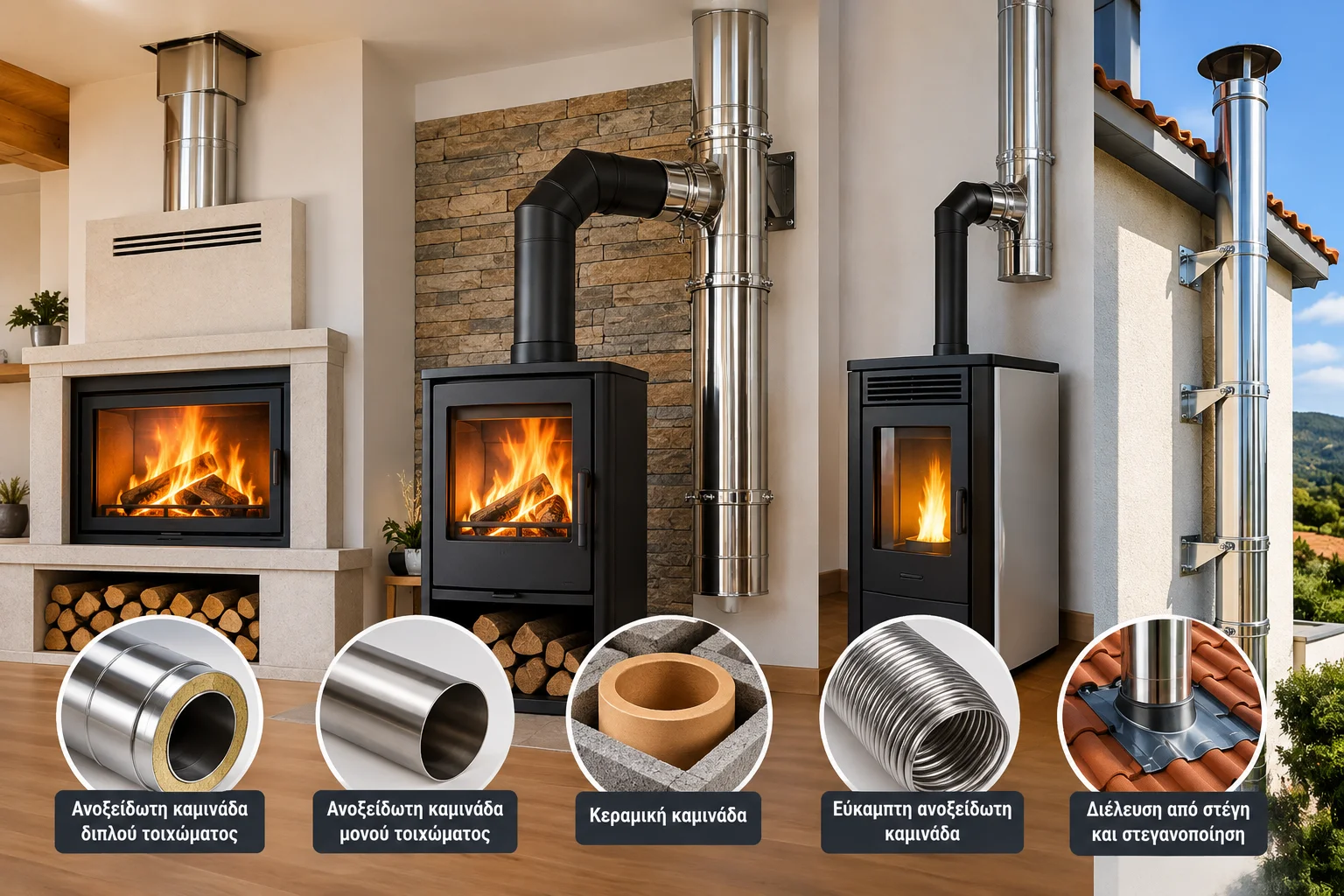
Chimneys for Fireplaces, Wood Stoves and Pellet Appliances: Complete Selection and Installation Guide
A fireplace and wood stove chimney is one of the most important components of any solid-fuel heating installation. Similarly, pellet stoves and pellet boilers require flue systems designed for their particular operating characteristics.
A correctly selected chimney does much more than discharge smoke outdoors. It affects chimney draft, combustion stability, deposit formation, condensation and, most importantly, building safety.
Several solutions are available, including single-wall and twin-wall stainless steel chimneys, ceramic chimney systems, rigid flue liners and flexible stainless steel liners for certain renovation applications.
However, not every chimney product is suitable for every heating appliance.
Chimney selection must be based on the system's technical classification, the appliance manufacturer's instructions and the actual operating conditions.
This guide examines the main differences between chimney systems, the essential selection criteria and the installation mistakes that should be avoided.
1. What Is the Purpose of a Chimney in a Solid-Fuel Heating System?
Burning wood or pellets produces hot combustion gases that must be discharged safely and reliably to the outside atmosphere.
The chimney is part of the complete combustion and flue gas evacuation system.
Its performance depends on several interacting factors:
Flue gas temperature.
Flue gas mass flow and velocity.
Internal chimney diameter.
Effective chimney height.
Bends and changes of direction.
Thermal insulation.
Wind conditions.
Combustion air supply.
Pressure losses throughout the system.
An incorrectly designed chimney can cause problems even when the heating appliance itself is high quality and properly maintained.
A chimney should therefore be assessed as part of the overall heating installation, rather than as an isolated pipe.
2. Open Fireplace Chimneys: What Should You Know?
Traditional open fireplaces operate differently from enclosed fireplace inserts.
Because the combustion chamber is open to the room, significant volumes of air may enter the fireplace and must be accommodated by the smoke evacuation system.
The chimney should be evaluated together with:
Fireplace opening dimensions.
Firebox geometry.
Smoke chamber design.
Chimney cross-section and height.
Combustion air availability.
Wind exposure.
Building pressure conditions.
Why Does an Open Fireplace Produce Smoke Indoors?
Possible causes include insufficient chimney draft, unsuitable fireplace geometry, inadequate combustion air or negative pressure inside the building.
An excessively large or small chimney cross-section can also affect performance.
Increasing the chimney diameter is not always the correct solution.
A professional assessment should examine the complete smoke evacuation path, including the fireplace opening, smoke chamber and chimney termination.
3. Chimneys for Fireplace Inserts
Fireplace inserts and enclosed fireplaces have defined technical operating requirements.
Manufacturers generally specify conditions relating to:
Flue gas outlet connections.
Permitted chimney diameter.
Required chimney draft.
Operating temperatures.
Combustion air supply.
Safety clearances.
The chimney must be suitable for the specific appliance, not merely for the broad category of fireplaces.
Particular attention is required where an insert is enclosed within a fireplace surround containing insulation, decorative finishes or structural materials.
These components must be compatible with the expected temperatures and required installation clearances.
4. Wood Stove Chimneys: Essential Requirements
A wood-burning stove generally has an enclosed combustion chamber and defined chimney draft requirements.
The chimney must safely evacuate combustion products under different operating conditions, including start-up, normal heating and changes in output.
Important parameters include:
Nominal heat output.
Flue gas temperature.
Flue gas mass flow.
Required draft pressure.
Connecting flue configuration.
Fuel characteristics.
Should the Chimney Diameter Match the Stove Outlet?
The stove outlet diameter is an important reference, but it does not replace proper chimney sizing.
Reducing the diameter without technical justification may increase pressure losses.
Conversely, an excessively large chimney cross-section may encourage flue gas cooling and reduce draft performance.
The final selection must comply with manufacturer instructions and the relevant technical assessment.
5. Pellet Stove Chimneys: What Makes Them Different?
Pellet stoves and pellet boilers do not necessarily have the same flue requirements as conventional wood-burning stoves.
Many pellet appliances use a combustion exhaust fan.
Consequently, pressure conditions inside the flue may differ from those found in a natural-draft wood stove installation.
The chimney must be suitable for:
Expected operating temperatures.
The required pressure class.
Possible wet operating conditions.
Corrosion exposure.
Joint tightness.
Inspection and cleaning requirements.
Can a Wood Stove Chimney Be Used for a Pellet Appliance?
Not without confirming its suitability.
Even when two systems have the same diameter, their pressure, sealing and condensation requirements may differ substantially.
The proposed use must be permitted by the chimney's technical classification and the appliance manufacturer's instructions.
Does a Pellet Stove Need Gas-Tight Flue Connections?
Where the appliance and flue operate under positive pressure, suitable joint tightness is particularly important.
Connections must use compatible components designed for the applicable pressure and temperature classes.
Ordinary pipes or improvised sealants are not substitutes for an approved flue system.
6. Stainless Steel vs Ceramic Chimneys
Choosing between stainless steel and ceramic chimney systems depends on the intended application, installation route, construction constraints and technical requirements.
Neither material is universally superior.
Stainless Steel Chimneys
Stainless steel chimney systems are widely used in both new installations and renovations.
Potential advantages include:
Modular construction.
Availability of different fittings.
Flexibility in routing.
Insulated systems for suitable external installations.
Relatively low structural weight compared with some masonry-based systems.
However, selecting the appropriate stainless steel grade and technical classification is essential.
The general description stainless steel or inox is not enough to establish suitability.
Ceramic Chimneys
Ceramic chimney systems are used in suitable constructions and may offer particular thermal and chemical resistance characteristics, depending on their classification.
They may feature:
A ceramic internal flue liner.
Integration into a prefabricated chimney system.
Suitability for particular new-build applications.
Availability of systems for different operating classes.
Suitability depends on the complete certified system, not only on the ceramic liner material.
Comparison Table
Criterion | Stainless Steel Chimney | Ceramic Chimney |
|---|---|---|
Construction | Usually modular metal components | Ceramic liner within a suitable system |
Renovation suitability | Often a practical option | Depends on construction constraints |
External installation | With an appropriate certified system | With a suitable complete construction |
Weight | Generally lower | Often higher |
Condensation resistance | Depends on material and classification | Depends on system classification |
Solid-fuel suitability | Requires appropriate classification | Requires appropriate classification |
The correct comparison is between specific certified chimney systems, rather than between two materials in isolation.
7. Single-Wall or Twin-Wall Chimney?
The distinction mainly concerns construction and thermal behaviour.
Single-Wall Systems
An appropriate single-wall pipe may be used as a connecting flue or as a liner in certain applications.
However, it must not automatically be treated as suitable for any external route or building penetration.
Insulated Twin-Wall Chimneys
An insulated twin-wall chimney normally includes:
An inner flue liner.
A thermal insulation layer.
An outer metal casing.
This construction can help maintain flue gas temperature and reduce heat transfer to the surrounding environment.
However, insulation does not eliminate required clearances from combustible materials.
Installation must follow the specific system manufacturer's instructions.
8. Flexible Stainless Steel Chimney Liners: When Are They Used?
Flexible stainless steel liners are used in certain applications involving the relining of existing chimneys.
They may be an option when the geometry of an existing flue makes the installation of rigid liner sections difficult.
However, not every flexible liner is suitable for fireplaces, wood stoves or pellet appliances.
What Must Be Checked?
The technical assessment should consider:
Intended product application.
Temperature classification.
Pressure classification.
Wet or dry operating suitability.
Corrosion resistance.
Solid-fuel compatibility.
Soot-fire resistance where required.
Installation and cleaning instructions.
Can a Flexible Liner Be Used as an Exposed External Chimney?
Such use must not be assumed acceptable without explicit manufacturer approval and an appropriate product classification.
Many flexible liners are intended specifically for use inside existing chimney structures.
The permitted application must be confirmed from the manufacturer's technical documentation.
9. How Is the Correct Chimney Diameter Selected?
Chimney diameter influences gas velocity, pressure losses and flue gas temperature.
A chimney that is too narrow may create excessive flow resistance.
A chimney that is too wide may encourage flue gas cooling and adversely affect draft.
Correct sizing requires consideration of:
Appliance technical specifications.
Flue gas temperature and mass flow.
Required operating pressure.
Effective chimney height.
Route geometry.
Installation conditions.
Manufacturer instructions.
Where required, a thermal and fluid dynamic calculation should be performed using the appropriate standard.
There is no single chimney diameter that is correct for every fireplace or wood stove with the same nominal output.
10. How Tall Should a Chimney Be?
Chimney height influences natural draft, but it is not the only determining factor.
The required configuration depends on:
Appliance characteristics.
Flue gas temperature.
Chimney diameter.
Pressure losses.
Building location.
Roof geometry.
Nearby obstructions.
Wind exposure.
A chimney that is too short may provide insufficient draft.
However, increasing chimney height without assessing the complete installation is not always the correct solution.
The chimney termination must satisfy the applicable requirements and relevant manufacturer instructions.
11. How Do Bends and Horizontal Sections Affect Performance?
Changes of direction introduce additional pressure losses.
Their effect depends on fitting geometry, diameter and flow conditions.
Numerous elbows or long connecting sections can make reliable operation more difficult.
Complex routes may also restrict access for inspection and cleaning.
The design should provide a suitable route, compatible fittings and adequate maintenance access.
There is no universal permitted number of bends that applies to every chimney installation.
12. Why Is Chimney Insulation Important?
Thermal insulation can reduce flue gas cooling as combustion products travel through the chimney.
This can be particularly important in certain external installations or routes exposed to low ambient temperatures.
Excessive cooling may affect draft and encourage condensation.
However, the need for insulation and the appropriate insulation system depend on the application.
Insulating materials must not be added arbitrarily around a flue without an approved installation arrangement.
13. External Chimney or Internal Chimney?
Each configuration presents different technical requirements.
Internal Chimney Route
An internal route may reduce exposure to outdoor temperatures.
However, special attention is required at:
Floor penetrations.
Structural components.
Fire compartments.
Combustible materials.
Inspection and maintenance points.
External Chimney Route
An external chimney can be practical during renovation or where a suitable internal shaft is unavailable.
Important considerations include:
Thermal insulation.
Mechanical support.
Wind loading.
Thermal expansion.
Chimney termination location.
Weather resistance.
The selection should not be based solely on the lowest initial cost or shortest installation route.
14. What Is Soot-Fire Resistance?
Solid-fuel combustion can produce combustible deposits inside the chimney.
Under certain conditions, these deposits may ignite.
A chimney's technical classification may therefore include information about soot-fire resistance.
European classifications include designations such as:
G: Soot-fire-resistant classification.
O: Classification without soot-fire resistance.
The required classification depends on the intended application.
A suitable soot-fire resistance classification does not eliminate the need for cleaning and maintenance.
15. Which Chimney Certification Markings Matter?
A chimney's technical designation may provide information about:
Temperature class.
Pressure class.
Wet or dry operating conditions.
Corrosion resistance.
Material characteristics.
Soot-fire resistance.
Clearance from combustible materials.
For example:
T: Temperature classification.
N/P: Negative- or positive-pressure classifications.
W/D: Wet or dry operating suitability.
G/O: Soot-fire resistance classification.
These designations describe different characteristics and should not be considered individually.
The complete chimney classification must be compatible with the appliance and the intended operating conditions.
16. Common Chimney Selection Mistakes
Choosing a Chimney Based Only on Diameter
Two pipes with identical diameters may have completely different technical classifications.
Using an Unsuitable Pellet Flue System
An exhaust fan may create pressure and tightness requirements different from those of a natural-draft system.
Installing Single-Wall Pipe in an Unsuitable Location
A connecting flue pipe should not be used arbitrarily as a complete external chimney.
Selecting a Flexible Liner Without Checking Its Classification
A flexible stainless steel liner must be approved for the intended application.
Ignoring Safety Clearances
Required distances from combustible materials must follow the specific system's classification and installation instructions.
Connecting to an Old Chimney Without Inspection
An existing chimney may contain deposits, damaged components or an unsuitable cross-section.
Failing to Provide Cleaning Access
Inspection and maintenance access should be considered during the initial design.
17. When Does an Existing Chimney Need Relining?
Installing a suitable internal liner may be considered when an existing chimney no longer meets the requirements of a new heating appliance.
Possible reasons include:
Unsuitable internal cross-section.
Deteriorated chimney walls.
Gas-tightness problems.
Incompatibility with new operating conditions.
Changes in fuel type or heating appliance.
Depending on the application, the solution may involve a rigid or flexible liner.
However, the product must be suitable and its use must be permitted within the intended chimney construction.
The existing chimney should be inspected before any modification is undertaken.
18. How Should a Solid-Fuel Chimney Be Maintained?
Wood-burning and pellet chimney systems require regular inspection and cleaning according to their operating conditions and manufacturer instructions.
Deposits can affect:
Available internal cross-section.
Chimney draft.
Appliance operation.
The risk of soot ignition.
Cleaning frequency depends on fuel quality, appliance use, combustion conditions and chimney configuration.
Connections, support brackets, inspection openings and visible signs of deterioration should also be checked.
Where there is evidence of combustion gas leakage or unsafe operation, the appliance should remain out of service until professionally assessed.
19. Which European Standards Apply to Chimney Selection?
Depending on the product and application, relevant European standards include:
EN 1443: General chimney requirements and classification.
EN 1856-1: Requirements for metal chimney system products.
EN 1856-2: Requirements for metal flue liners and connecting flue pipes.
EN 13063: Series of standards for system chimneys with clay or ceramic flue liners, according to the relevant product.
EN 13384-1: Thermal and fluid dynamic calculation methods for chimneys serving one combustion appliance.
EN 15287-1: Design, installation and commissioning requirements for chimneys within its scope.
The applicable editions, product documentation and national regulations must be verified for each installation.
Frequently Asked Questions
Which Chimney Is Best for a Wood Stove?
The best option is a system suitable for the specific stove, its operating temperatures, the proposed route and the relevant fire safety requirements.
No single chimney product is ideal for every wood-burning stove.
Can I Use the Same Chimney for Wood and Pellet Appliances?
Only if the chimney classification and the relevant appliance instructions permit the intended use.
An identical diameter does not establish compatibility.
This does not mean that two appliances may automatically operate on the same shared flue.
Is a Stainless Steel or Ceramic Chimney Better?
Both can be suitable depending on the application.
The decision should be based on the certified properties of the complete system and the installation requirements.
When Is a Twin-Wall Chimney Necessary?
An insulated chimney system may be appropriate for certain external routes or other applications requiring specific thermal performance.
Selection depends on the design and manufacturer instructions.
Can I Install a Flexible Stainless Steel Liner in an Old Fireplace Chimney?
Only if the flexible liner is suitable for the appliance, fuel and operating conditions, and the existing chimney has been inspected.
How Tall Should a Wood Stove Chimney Be?
The required height depends on appliance characteristics, diameter, route, pressure losses and termination location.
There is no single height that applies to every installation.
Why Does My Wood Stove Chimney Accumulate Soot?
Deposits are influenced by fuel quality, combustion conditions, flue gas temperature and chimney configuration.
Correct operation, inspection and cleaning are essential.
Can a Pellet Stove Chimney Operate Under Positive Pressure?
Yes, depending on the appliance and system configuration.
Where positive-pressure operation is expected, the chimney must have the appropriate pressure classification and compatible gas-tight joints.
Is Professional Inspection Required Before First Use?
The installation should undergo the required commissioning and safety checks by an appropriately qualified professional before normal operation.
Conclusion
Choosing the correct chimney for a fireplace, wood stove or pellet appliance requires evaluating much more than pipe diameter and construction material.
Different appliances have different temperature, pressure, draft and tightness requirements.
Stainless steel and ceramic chimney systems can both provide suitable solutions when their technical classifications match the application.
Flexible stainless steel liners may also be appropriate for certain renovation projects, but they must not be used indiscriminately.
The correct chimney is one that has been selected, sized and installed for the specific appliance and actual operating conditions, with full consideration of applicable safety requirements.
Technical References
EN 1443 — Chimneys: General requirements.
EN 1856-1 — Chimneys: Requirements for metal chimneys — Part 1: System chimney products.
EN 1856-2 — Chimneys: Requirements for metal chimneys — Part 2: Metal flue liners and connecting flue pipes.
EN 13063 — Chimneys: System chimneys with clay/ceramic flue liners.
EN 13384-1 — Chimneys: Thermal and fluid dynamic calculation methods — Part 1.
EN 15287-1 — Chimneys: Design, installation and commissioning — Part 1.
Final selection and installation must follow the applicable regulations, manufacturer documentation and relevant product requirements.