
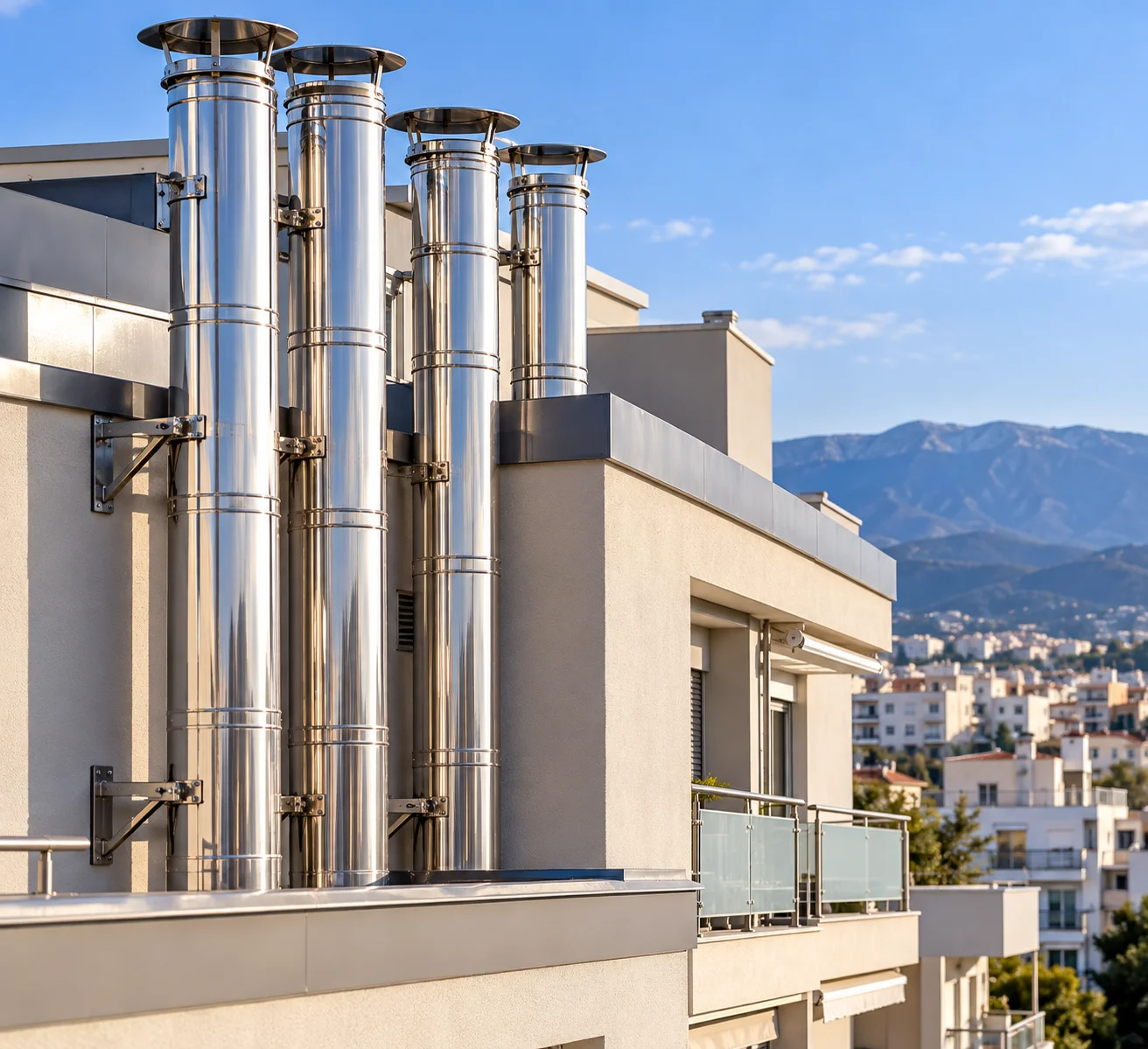
Chimneys in Apartment Buildings: Shared Flues, Multiple Appliances and Technical Requirements
Chimneys in apartment buildings are an essential part of heating installations and the safe evacuation of combustion gases.
An apartment building may have a central chimney serving a communal boiler, separate chimneys for individual appliances, or a specially designed collective flue system serving multiple appliances.
These arrangements are not technically interchangeable.
A chimney designed for a particular boiler cannot automatically be considered suitable for connecting additional appliances.
Similarly, the presence of a shared vertical shaft inside a building does not necessarily mean that all flues installed within it form a single shared chimney.
Safe operation depends on system design, appliance compatibility, correct sizing, flue gas tightness and maintenance accessibility.
What Is a Shared Chimney?
The term shared chimney is commonly used to describe a flue forming part of a building's communal installations.
However, two different technical arrangements must be distinguished.
A Communal Chimney Serving One Appliance
An apartment building with central heating may have one communal boiler and one chimney serving that boiler exclusively.
The chimney belongs to the building's common heating installation, but it does not serve several independent appliances.
A Collective Chimney Serving Multiple Appliances
Other installations use specially designed systems that receive combustion gases from several appliances.
In these cases, system performance must be assessed both when all appliances are operating and when only one or some of them are running.
Connecting multiple appliances introduces additional technical requirements.
What Types of Chimneys Are Found in Apartment Buildings?
The most common configurations include the following.
1. Central Boiler Room Chimney
This chimney serves the boiler of the central heating installation.
It may be a metal chimney, a masonry structure with a suitable internal liner, or another approved system.
Its suitability depends on the boiler, fuel, operating temperatures and pressure conditions.
2. Individual Chimneys for Apartments
Each apartment or appliance may have its own independent flue.
Several flues may run through the same vertical service shaft without being interconnected.
Sharing an installation space does not mean that combustion gases flow through a common passage.
3. Collective Flue Gas Evacuation Systems
These systems are specifically designed to serve multiple appliances through shared flue sections.
They require an appropriate configuration, compatible appliances and calculations covering the expected operating conditions.
4. Chimneys for Fireplaces and Solid-Fuel Appliances
Some apartment buildings have separate chimneys for fireplaces or wood-burning stoves.
Connecting multiple solid-fuel appliances to a shared flue must not be assumed permissible without specific design, technical documentation and compliance with applicable requirements.
Can Two Boilers Be Connected to the Same Chimney?
The answer is yes, but only when the shared connection is permitted and the system has been designed for it.
Having sufficient physical space or a seemingly large chimney diameter is not enough.
The possibility of connecting two boilers depends on:
Boiler types.
Manufacturer instructions.
Flue gas temperatures.
Flue gas mass flow rates.
Operating pressure conditions.
Part-load operation.
System tightness.
Risk of flue gases flowing towards an inactive appliance.
Condensate management.
Connecting a second boiler without a proper assessment can alter the flow conditions and create safety hazards.
Why Does a Shared Chimney Require Special Calculations?
When several appliances connect to a common flue, operating conditions depend on more than one fixed flue gas flow rate.
Different scenarios must be considered, including:
All appliances operating simultaneously.
Only one appliance operating.
Part-load operation.
Appliance start-up and shutdown.
Temperature changes.
Variations in pressure losses.
Pressure within the shared flue can change significantly.
If the system is incorrectly designed, combustion gases may flow towards another appliance connection.
For this reason, collective chimney sizing should not be based on rough estimates or visual inspection alone.
What Are the Requirements for a Shared Gas Boiler Flue?
Gas heating installations require particular attention because modern boilers may operate with fans, positive pressure and condensate production.
Specially designed collective flue systems may be used when the specific combination of appliances and components is permitted by the relevant technical documentation.
Important considerations include:
Boiler compatibility with collective flue operation.
Permitted operating pressure.
Flue gas tightness.
Prevention of unwanted reverse flow.
Correct combustion air supply.
Condensate management.
Use of approved terminals and connections.
Two gas boilers must not be connected to the same flue simply because they use the same fuel.
The complete system must be suitable for the intended arrangement.
What Happens When the Central Heating Boiler Is Replaced?
Replacing an older boiler may significantly change the operating conditions of the existing chimney.
For example, a new boiler may have:
Different flue gas temperatures.
Different flue gas flow rates.
Different pressure requirements.
Different condensation characteristics.
Different material requirements.
An existing chimney that performed adequately with the previous boiler may not be suitable for its replacement.
The compatibility of the entire flue system should be assessed before connecting the new appliance.
Can a Condensing Boiler Use an Existing Chimney?
Not without a technical assessment.
Condensing boilers operate under different conditions from many older heating installations.
The flue may require:
Suitability for wet operation.
Appropriate corrosion resistance.
Adequate gas tightness.
Compatibility with the expected operating pressure.
Condensate collection and drainage.
In some installations, a suitable flue liner may be installed within an existing chimney route, provided the arrangement is permitted and properly designed.
An old masonry chimney should not automatically be considered suitable for a modern condensing boiler.
Can Several Flues Be Installed in the Same Shaft?
A shared vertical shaft may accommodate several independent flues under suitable conditions.
However, the installation must account for:
Shaft dimensions.
Flue system suitability.
Required safety clearances.
Mechanical support.
Thermal expansion.
Inspection accessibility.
Fire protection requirements.
Compatibility with the existing building structure.
Additional flues should not be placed inside an existing shaft without evaluating the complete arrangement.
Apartment Building Chimneys and Fire Safety
A chimney may pass through several floors, technical spaces and structural elements.
This creates additional requirements for the protection of penetrations.
Particular attention should be given to:
Floor penetrations.
Ceiling penetrations.
Areas near combustible materials.
Service shafts.
Support locations.
Cleaning and inspection access points.
The fire resistance of relevant building elements and the required protection of penetrations must be maintained.
Using an insulated chimney does not automatically eliminate the building's fire protection requirements.
Flue Gas Tightness in Apartment Buildings
Flue gas tightness is a fundamental safety requirement.
A leak into a service shaft or enclosed technical space may affect more than one apartment.
Possible causes of reduced tightness include:
Damaged joints.
Incompatible components.
Corrosion.
Cracks.
Incorrect assembly.
Undocumented modifications.
In positive-pressure flue systems, the required level of tightness is particularly important.
Testing methods must be appropriate for the specific system and its operating conditions.
Who Is Responsible for Maintaining a Shared Chimney?
Responsibility depends on the ownership structure and technical status of the installation.
Relevant factors include:
Apartment building regulations.
Property ownership documents.
Whether the chimney is classified as communal or privately owned.
The heating installation it serves.
Applicable legal and regulatory requirements.
In a central heating installation, chimney maintenance is generally managed as part of the building's communal services.
However, a chimney should not automatically be classified as communal simply because it passes through a shared area.
Questions involving ownership, costs and modification rights may require examination of the relevant documents and legal advice.
Can an Apartment Owner Connect to a Shared Chimney?
Connecting a new appliance to an existing shared chimney is not simply a matter of adding another pipe.
Two separate issues must be assessed before any modification.
Technical Suitability
The chimney must be capable of serving the additional appliance without compromising the safety or operation of existing installations.
Permission to Modify the Installation
It must be established whether the proposed modification is permitted under the ownership arrangements, building regulations and applicable requirements.
Technical feasibility does not automatically provide the legal right to modify a communal installation.
What Should Be Checked Before a New Connection?
Before connecting another appliance, the following information should be collected:
Details of the existing chimney system.
Manufacturer instructions.
Chimney technical classification.
Requirements of the new appliance.
Chimney sizing information.
Condition of existing joints.
Inspection and maintenance accessibility.
Required approvals or administrative procedures.
If sufficient information about the existing installation is unavailable, a detailed inspection and new technical assessment may be necessary.
How Is a Shared Chimney Inspected?
A professional inspection may include:
Visual inspection of accessible sections.
Examination of flue connections.
Inspection of the chimney terminal.
Internal flue inspection where feasible.
Checks for corrosion and deposits.
Inspection of condensate collection and drainage.
Flue gas tightness testing where required.
Confirmation of compatibility with connected appliances.
Assessment of chimney sizing.
Inspection methods should be selected according to the chimney construction and operating conditions.
What Problems Commonly Occur in Shared Chimneys?
Flue Gas Backflow
This may be associated with pressure problems, insufficient draft or an unsuitable shared connection.
Condensation
Condensate may develop when the chimney is not suitable for the temperatures and operating conditions involved.
Corrosion
Corrosion may result from unsuitable materials, moisture or chemically aggressive condensate.
Loss of Tightness
Leaks may develop because of component deterioration or incorrect assembly.
Difficult Cleaning Access
Inadequate access can make inspection and maintenance more difficult.
Unauthorised Modifications
Additional connections, diameter changes and replacement of components without technical assessment may affect the operation of the entire system.
What Happens When an Apartment Changes Its Heating System?
Changing from central to individual heating, or replacing an existing appliance, may introduce new flue gas evacuation requirements.
The following should be examined:
Location of the new appliance.
Intended flue gas evacuation method.
Combustion air supply.
Suitability of any existing chimney.
Position and type of terminal.
Manufacturer requirements.
Applicable technical and administrative procedures.
Replacing an appliance does not mean that the previous chimney can be reused without assessment.
Which European Standards Apply to Shared Chimneys?
Depending on the system, relevant European standards may include:
EN 1443: General chimney requirements and classification.
EN 1856-1: Requirements for metal chimney system products.
EN 1856-2: Requirements for metal flue liners and connecting flue pipes.
EN 13384-1: Thermal and fluid dynamic calculation methods for chimneys serving one appliance.
EN 13384-2: Thermal and fluid dynamic calculation methods for chimneys serving more than one combustion appliance.
EN 15287-1: Design, installation and commissioning requirements for chimneys within its scope.
Additional product standards or requirements may apply to particular collective flue systems.
The applicable editions, national regulations and manufacturer instructions must be verified for each installation.
Frequently Asked Questions
Can Two Apartments Share the Same Chimney?
Only when the system is specifically designed to serve the connected appliances and complies with the applicable technical requirements.
Can I Connect a New Boiler to an Old Shared Chimney?
Not without assessing chimney compatibility, sizing and condition.
Can a Condensing Boiler Use an Old Masonry Chimney?
A suitable internal liner or another approved flue system may be required. The solution depends on the specific installation.
Who Pays for Cleaning a Communal Chimney?
The allocation of maintenance costs depends on building regulations, ownership arrangements and applicable legal requirements.
Is It Safe to Install Several Chimneys in One Shaft?
It may be safe when the arrangement has been properly designed and meets the requirements for support, fire protection and maintenance.
Can a New Connection Be Made Without an Engineering Assessment?
The need for a specific formal study or procedure depends on the installation and applicable regulations. In every case, technical suitability must be established before connecting the appliance.
Conclusion
Chimneys in apartment buildings may serve central heating installations, individual appliances or specially designed collective flue systems.
Each arrangement has different technical requirements.
Multiple appliances may share a flue only when the system is appropriately designed, compatible and technically documented.
Correct sizing, flue gas tightness, condensate management, fire safety and maintenance access are particularly important.
Before making a new connection or modifying an existing installation, both technical suitability and the right to carry out the modification must be verified.
Technical References
EN 1443 — Chimneys: General requirements.
EN 1856-1 — Chimneys: Requirements for metal chimneys — Part 1: System chimney products.
EN 1856-2 — Chimneys: Requirements for metal chimneys — Part 2: Metal flue liners and connecting flue pipes.
EN 13384-1 — Chimneys: Thermal and fluid dynamic calculation methods — Part 1.
EN 13384-2 — Chimneys: Thermal and fluid dynamic calculation methods — Part 2.
EN 15287-1 — Chimneys: Design, installation and commissioning — Part 1.
The applicable standards must be considered alongside national regulations and the technical documentation of the specific products and appliances.