
Single-Wall vs Double-Wall Chimneys: Differences, Benefits and How to Choose
Choosing the right chimney system is essential for the safe and efficient operation of a heating installation. Two common types of metal flue systems are single-wall and insulated double-wall chimneys.
Although they may appear similar, these systems differ significantly in construction, thermal insulation, flue gas behaviour and installation requirements.
The correct choice depends not only on cost or diameter but also on the heating appliance, fuel type, operating temperatures and chimney route.
What Is a Single-Wall Chimney?
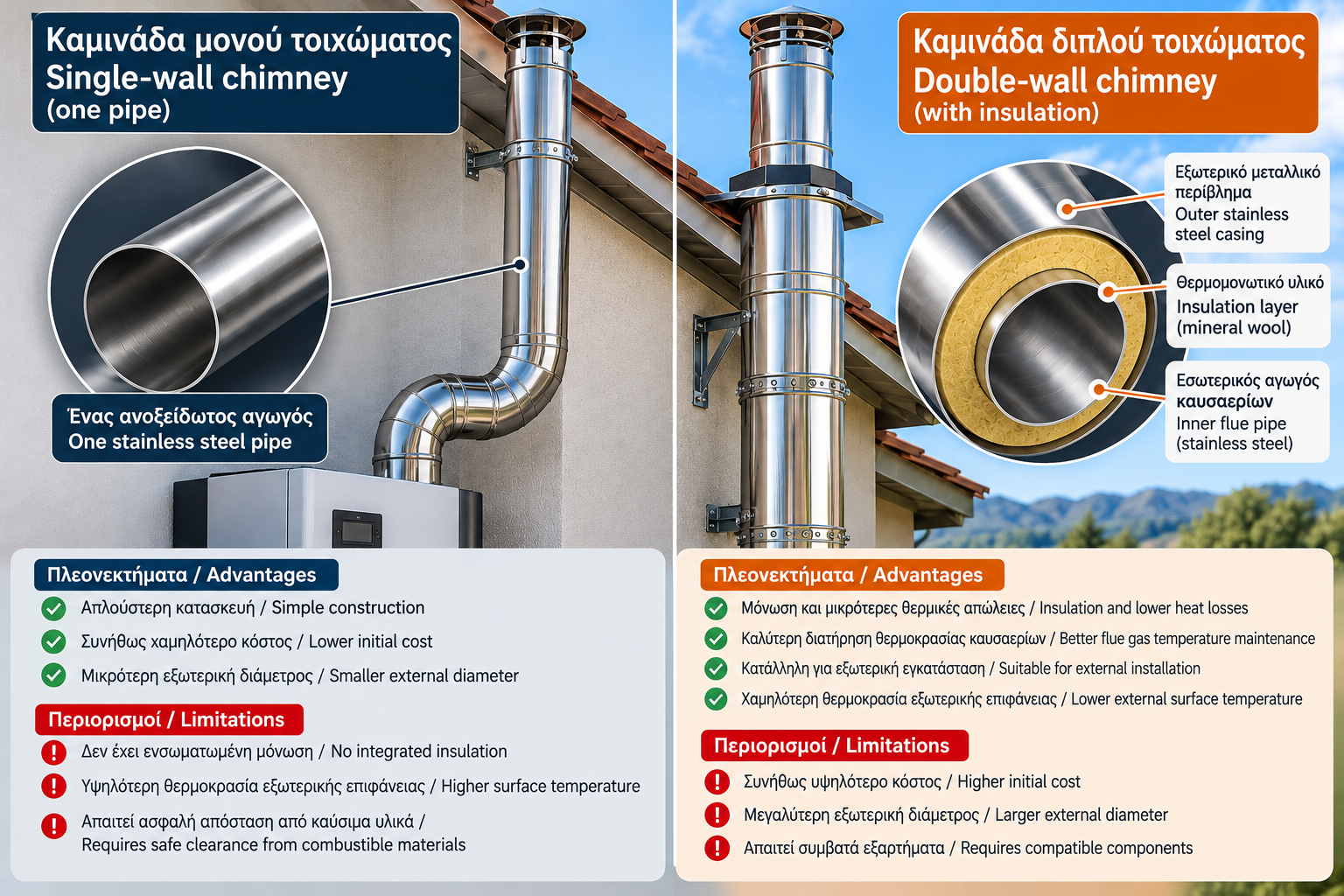
A single-wall metal chimney consists of one metal pipe, usually made of stainless steel, through which combustion gases are discharged.
It does not include an integrated thermal insulation layer.
Depending on the product’s certification and intended application, single-wall components may be used as connecting flue pipes between an appliance and a chimney, as liners inside existing chimney structures or as part of a suitable flue system.
Advantages of Single-Wall Chimneys
Simpler construction.
Generally lower initial cost.
Smaller external diameter.
Suitable for certain internal applications when correctly specified.
Limitations of Single-Wall Chimneys
Without integrated insulation, single-wall pipes may experience greater heat losses.
Their external surfaces can also reach high temperatures during operation.
For this reason, the required safety distances from combustible materials must always be maintained in accordance with the product’s declared performance and installation instructions.
What Is an Insulated Double-Wall Chimney?
An insulated double-wall chimney typically consists of three main components:
An inner metal flue pipe that carries combustion gases.
An intermediate layer of thermal insulation.
An outer metal casing.
The insulation reduces heat transfer from the flue gases to the surrounding environment.
This type of construction is commonly used for external chimney routes and installations where limiting heat loss is important.
It is worth noting that not all double-wall flue systems contain insulation. Some use an air gap between the inner and outer walls, including certain concentric air/flue systems.
Advantages of Insulated Double-Wall Chimneys
Reduced heat losses.
Better maintenance of flue gas temperature.
Often suitable for external installations when appropriately certified.
Generally lower external surface temperatures than comparable uninsulated pipes under similar operating conditions.
Limitations of Insulated Double-Wall Chimneys
Generally higher purchase cost.
Larger external diameter.
Requirement for compatible system components and supports.
Single-Wall vs Double-Wall Chimneys: Key Differences
Feature | Single-Wall | Insulated Double-Wall |
Construction | One metal pipe | Inner pipe, insulation and outer casing |
Integrated insulation | No | Yes |
Heat losses | Generally higher | Generally lower |
External surface temperature | Generally higher | Generally lower |
External installation | Requires specific assessment | Often suitable |
Initial cost | Generally lower | Generally higher |
These are general comparisons. Actual performance and permitted applications depend on the individual product’s classification, certification and installation requirements.
How Does Chimney Insulation Affect Performance?
Flue gas temperature affects both the thermal behaviour and flow conditions inside a chimney.
In natural-draught systems, the density difference between warm combustion gases and the surrounding outdoor air contributes to chimney draught.
Excessive cooling of the flue gases can reduce this density difference and affect the available draught pressure.
Thermal insulation helps limit cooling, but it does not guarantee adequate chimney draught by itself.
Chimney height, diameter, routing, flow resistance and appliance characteristics must also be considered.
Which Chimney Is Better for External Installation?
For many external installations, a properly certified insulated double-wall chimney is a suitable technical solution.
Its insulation helps reduce heat loss to the outdoor environment, particularly in cold weather.
However, the selection must account for:
Fuel type and heating appliance.
Flue gas temperature.
Operating pressure.
Corrosion resistance.
Expected condensate formation.
Soot-fire resistance, where applicable.
Required distances from combustible materials.
Structural support and weather exposure.
An insulated chimney is not automatically suitable for every heating appliance or installation.
What About Condensing Boilers?
Condensing boilers generally discharge flue gases at relatively low temperatures.
Their flue systems must be compatible with wet operating conditions and the expected pressure classification.
Depending on the appliance, suitable plastic, metal or concentric air/flue systems may be used.
Therefore, selecting a flue for a condensing boiler is not simply a choice between single-wall stainless steel and insulated double-wall stainless steel.
The boiler manufacturer’s approved flue configurations and installation instructions must take priority.
What Do European Standards EN 1856-1 and EN 1856-2 Specify?
The EN 1856 series establishes performance requirements for metal chimney products.
EN 1856-1
This standard covers metal system chimney products, including single-wall and multi-wall chimney systems.
EN 1856-2
This standard covers metal flue liners and connecting flue pipes.
A chimney product’s classification may include:
Temperature class.
Pressure class.
Condensate resistance.
Corrosion resistance.
Soot-fire resistance.
Minimum distance from combustible materials.
The final requirement is particularly important.
The presence of insulation does not eliminate the need to maintain the manufacturer’s declared safety clearances.
Common Mistakes When Choosing and Installing Chimneys
Choosing Based on Price Alone
A lower purchase price does not guarantee compatibility with the appliance or appropriate thermal performance.
Using an Uninsulated Pipe in an Unsuitable Location
Installing a single-wall pipe without assessing the installation conditions can create problems involving heat loss and fire safety.
Mixing Components from Different Systems
Components from different manufacturers should not be combined unless their compatibility is documented and the combination is approved.
Ignoring Safety Clearances
The chimney must maintain the required distances from timber structures, insulation and other combustible materials.
Incorrect Chimney Sizing
Selecting a chimney diameter solely from the appliance outlet size does not replace the necessary assessment of the complete flue installation.
Conclusion
Single-wall and insulated double-wall chimneys serve different installation requirements.
Single-wall components can be suitable for specific applications, including appliance connections and the lining of existing chimneys, provided they meet the relevant system requirements.
Insulated double-wall chimneys offer better heat retention and are commonly used for external chimney routes.
The final selection must be based on appliance characteristics, operating conditions, chimney routing and the manufacturer’s technical documentation.
Chimney design and installation should be carried out by appropriately qualified professionals in accordance with applicable safety requirements.
Technical References
EN 1856-1:2009 — Chimneys: Requirements for metal chimneys — Part 1: System chimney products.
EN 1856-2:2009 — Chimneys: Requirements for metal chimneys — Part 2: Metal flue liners and connecting flue pipes.
EN 13384-1 — Chimneys: Thermal and fluid dynamic calculation methods — Part 1.
EN 15287-1 — Chimneys: Design, installation and commissioning — Part 1.
Schiedel ICS — Twin-Wall Insulated System Chimney: Technical installation guidance.
The applicable editions of standards, national regulations and manufacturer-specific requirements should be verified for each installation.