
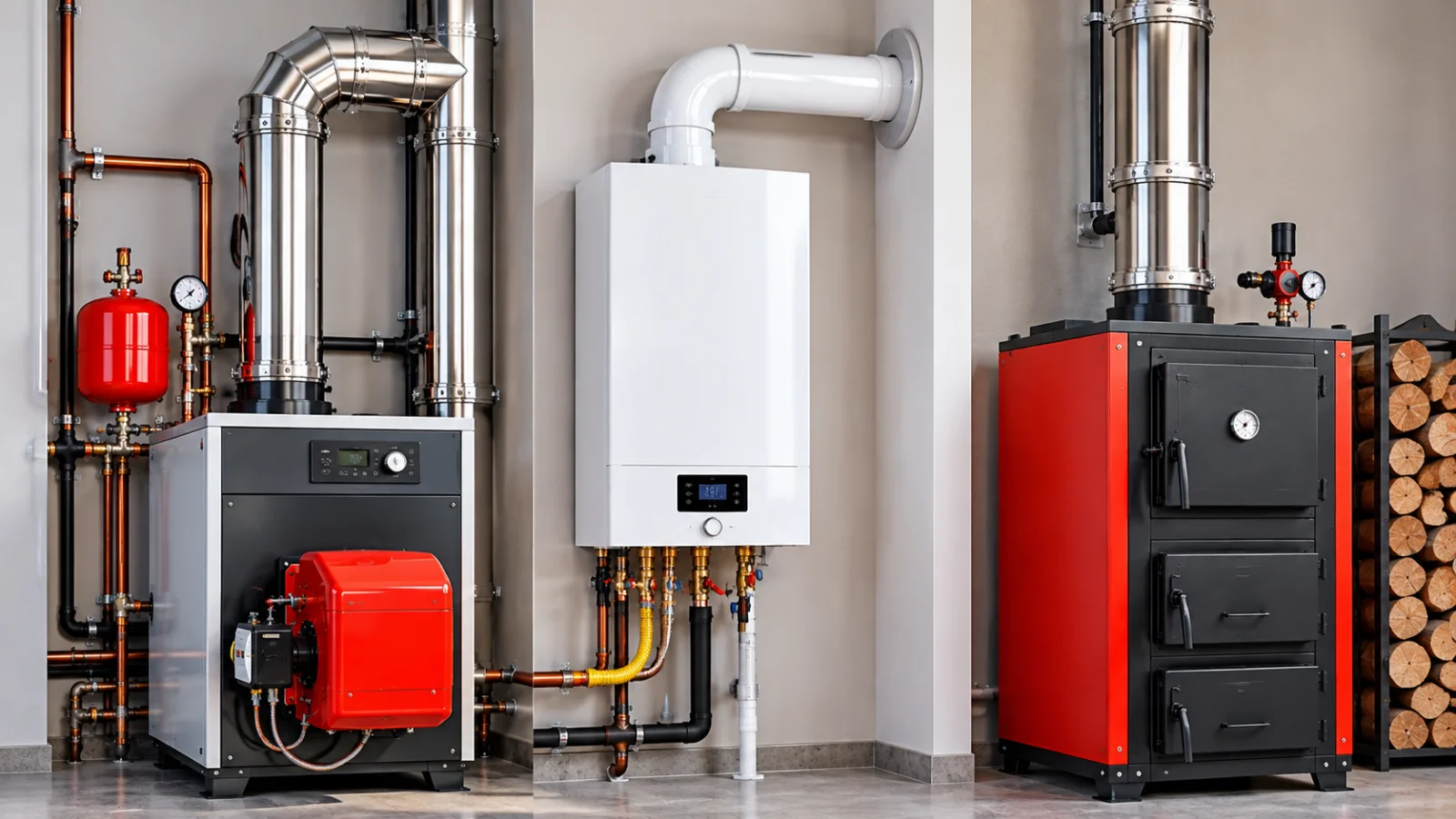
Chimneys for Oil, Gas and Solid-Fuel Boilers: What Are the Differences?
Choosing a chimney for a heating boiler involves much more than selecting a pipe diameter or matching the appliance's rated output.
Fuel type, flue gas temperature, operating pressure and the potential for condensate formation all influence the requirements of the flue gas evacuation system.
A conventional oil-fired boiler, a modern gas condensing boiler and a solid-fuel boiler may require substantially different chimney configurations.
The correct choice must therefore be based on the technical characteristics of the specific appliance and the documented suitability of the chimney system.
Why Do Chimney Requirements Differ?
Every combustion appliance operates under particular conditions.
The most important parameters include:
Flue gas temperature.
Flue gas mass flow rate.
Flue system operating pressure.
Potential for condensate formation.
Chemical composition of combustion products.
Risk of soot deposits igniting.
Method of supplying combustion air.
The chimney must have an appropriate performance classification and be installed according to the manufacturer's requirements.
1. Chimneys for Oil-Fired Boilers
Conventional oil-fired boilers generally operate with higher flue gas temperatures than modern condensing boilers.
However, actual temperatures depend on the appliance design, operating conditions and maintenance status.
Main Requirements
The flue system must be suitable for:
The expected flue gas temperature.
The intended operating pressure.
Exposure to oil combustion products.
Possible condensation conditions.
Cleaning and inspection requirements.
Corrosion resistance is particularly important because condensate from oil combustion may contain chemically aggressive substances.
Conventional Oil Boilers vs Oil Condensing Boilers
Not all oil-fired boilers require the same type of chimney.
An oil condensing boiler operates under different temperature conditions and requires a flue system suitable for wet operation and its intended pressure conditions.
Material selection must be supported by the product's documented performance and suitability.
2. Chimneys for Natural Gas Boilers
Natural gas boilers include different combustion technologies and flue system configurations.
An important distinction is between conventional boilers and condensing boilers.
Conventional Gas Boilers
Some conventional gas appliances use natural-draft chimney systems.
In these installations, operation depends on the available chimney draft pressure and the resistance of the flue route.
Correct sizing and an adequate combustion air supply are essential.
Gas Condensing Boilers
Modern condensing boilers frequently use a fan to evacuate combustion gases.
These flue systems may operate under positive pressure and in conditions where condensation occurs.
They therefore require appropriate:
Gas-tightness.
Pressure resistance.
Resistance to condensate.
Corrosion resistance.
Compatibility with the appliance.
Depending on the approved configuration, suitable plastic, metal or concentric air/flue systems may be used.
The boiler manufacturer's installation instructions must always be followed.
3. Chimneys for Solid-Fuel Boilers
Solid-fuel boilers may burn wood, pellets or other approved fuels.
Their operating conditions vary considerably according to appliance design.
A natural-draft wood boiler does not necessarily have the same chimney requirements as a pellet boiler equipped with a flue gas fan.
Main Requirements
Chimney selection must consider:
Maximum expected flue gas temperature.
Operating pressure.
Formation of soot and other deposits.
Soot-fire resistance, where required.
Accessibility for cleaning.
Required clearances from combustible building materials.
Solid-fuel combustion can produce soot and creosote deposits, particularly under unfavourable combustion conditions.
Regular maintenance is therefore an essential safety measure.
What About Pellet Boilers?
Pellet boilers often feature controlled fuel feeding and a flue gas fan.
This means the chimney must be selected according to the appliance's actual pressure and temperature conditions.
A chimney suitable for a traditional wood-burning stove is not automatically suitable for a pellet boiler.
4. Comparison of Chimney Requirements by Boiler Type
Parameter | Oil-fired boiler | Gas boiler | Solid-fuel boiler |
|---|---|---|---|
Flue gas temperature | Depends on technology | Often low in condensing models | Varies significantly by appliance |
Positive-pressure operation | Appliance-dependent | Common in condensing boilers | Possible in some appliances |
Condensate formation | Possible or intentional | Expected in condensing boilers | Depends on operating conditions |
Soot deposits | Possible | Usually limited during correct operation | Important consideration |
Soot-fire resistance | According to application | According to application | Often a critical requirement |
Suitable chimney material | Based on product classification | Based on approved system | Based on temperature and classification |
This table illustrates general differences and does not replace the technical specifications of the individual appliance.
5. Understanding Chimney Performance Classifications
The European standard EN 1443 establishes general requirements and performance classification principles for chimneys.
A chimney's technical designation may include several important characteristics.
Temperature Class
The temperature class identifies the product's declared operating temperature category.
Pressure Class
The pressure class identifies the pressure conditions for which the system has been assessed.
Condensate Resistance
The designation W indicates suitability for wet operating conditions, while D indicates dry operating conditions, according to the relevant classification.
Corrosion Resistance
The required corrosion resistance depends on the fuel, operating conditions and intended application.
Soot-Fire Resistance
The designation G indicates a soot-fire-resistant classification, while O indicates that the product is not classified as soot-fire resistant.
The complete designation must be considered, including any declared distance to combustible materials.
A chimney should never be selected based on a single classification characteristic alone.
6. Can the Same Chimney Be Used for Different Fuels?
Only when the specific chimney system has documented suitability for the intended applications.
The general description stainless steel chimney does not demonstrate compatibility with every fuel.
The following must be checked:
Complete product performance classification.
Permitted fuels and operating conditions.
Appliance requirements.
Chimney sizing.
Installation instructions.
Changing the fuel or replacing the boiler may require reassessment or replacement of the existing chimney.
7. Why Is Condensate Resistance Important?
Condensate forms when flue gas temperatures and operating conditions allow certain combustion products to condense.
Depending on the fuel, condensate may contain substances capable of causing corrosion.
Systems intended for wet operation require suitable materials, appropriate joint sealing and correct condensate management.
It is unsafe to assume that all stainless steel chimney products provide the same corrosion resistance.
8. How Is the Correct Chimney Diameter Determined?
Chimney diameter cannot be determined solely from fuel type.
For applicable single-appliance installations, thermal and fluid dynamic calculations may be carried out according to EN 13384-1.
The calculation considers:
Flue gas mass flow rate.
Flue gas temperature.
Pressure requirements.
Chimney height and route.
Pressure losses.
Thermal properties of the system.
For boilers using manufacturer-approved flue arrangements, including many condensing boilers, the permitted configurations and sizing limits specified by the manufacturer must be followed.
9. Common Mistakes When Selecting a Boiler Chimney
Assuming Any Stainless Steel Chimney Is Suitable
The steel grade alone does not establish suitability for a particular fuel or operating condition.
Ignoring Operating Pressure
A chimney designed for natural-draft operation is not automatically suitable for positive-pressure operation.
Overlooking Condensate Formation
Wet operation requires suitable product classification and correct condensate management.
Ignoring Soot-Fire Resistance
Where a soot-fire hazard is relevant, the chimney must have the required classification.
Keeping an Existing Chimney After Replacing the Boiler
A new boiler may operate at significantly different temperatures and pressures, making the existing chimney unsuitable.
10. Conclusion
The correct chimney for a boiler depends on considerably more than the fuel it burns.
Oil-fired, natural gas and solid-fuel boilers may operate with different flue gas temperatures, pressures and condensation conditions.
Proper selection requires assessment of the chimney system's complete performance classification, appliance requirements and actual installation conditions.
Chimney sizing and installation should be carried out by suitably qualified professionals in accordance with applicable standards, national regulations and manufacturer instructions.
Technical References
EN 1443 — Chimneys: General requirements.
EN 1856-1 — Chimneys: Requirements for metal chimneys — Part 1: System chimney products.
EN 1856-2 — Chimneys: Requirements for metal chimneys — Part 2: Metal flue liners and connecting flue pipes.
EN 13384-1 — Chimneys: Thermal and fluid dynamic calculation methods — Part 1: Chimneys serving one combustion appliance.
EN 15287-1 — Chimneys: Design, installation and commissioning — Part 1.
The applicable editions of these standards, national regulations and appliance-specific requirements should be verified before final chimney selection.