
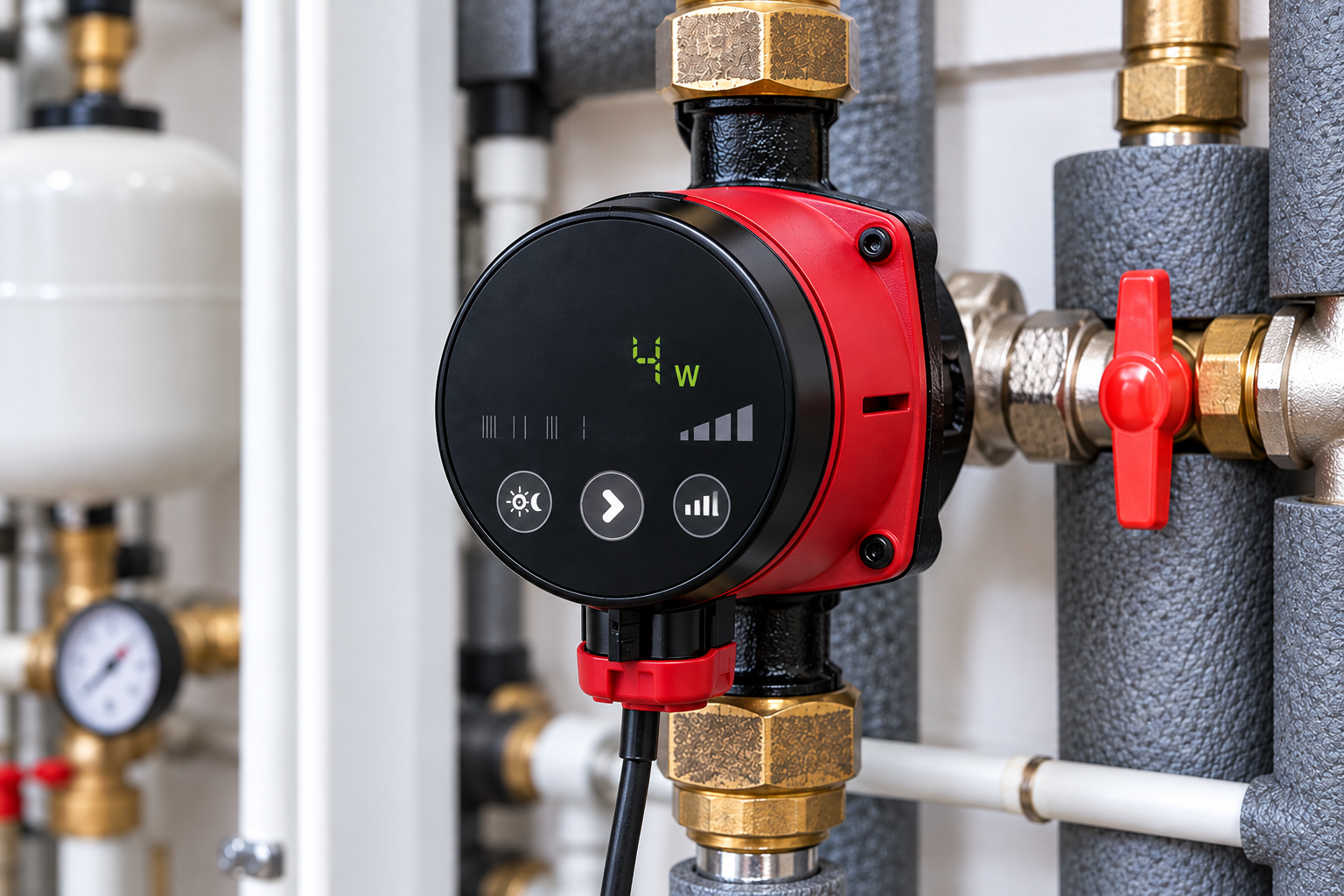
Electronic Heating Circulation Pumps: Settings, Operating Modes and Energy Savings
Modern electronic heating circulation pumps can adapt their operation to the hydraulic requirements of a heating system, often reducing electricity consumption and hydraulic noise.
Unlike older circulators with manually selected fixed speeds, many electronic models provide differential pressure control, variable-speed operation and automatic adaptation features.
However, the correct operating mode depends on the installation. A setting that works effectively in a radiator system may not be appropriate for underfloor heating or a heat pump circuit.
This guide explains the main electronic circulator operating modes and the factors that determine appropriate settings.
1. What Is an Electronic Heating Circulation Pump?
An electronic circulation pump is a water circulator equipped with an electronic motor control system.
Many modern high-efficiency circulators use permanent-magnet, electronically commutated motors, commonly referred to as ECMs.
Electronic control allows the pump to adjust rotational speed and, depending on the model, regulate differential pressure or other operating parameters.
The circulator does not generate heat. It moves water between the heat source and heating emitters, such as radiators or underfloor heating circuits.
2. How Does It Differ From a Conventional Circulator?
Older circulators commonly provide three manually selected speed settings.
Once a speed is selected, the pump operates along its corresponding performance curve without necessarily adapting to changing system demand.
An electronic circulator, by contrast, can adjust its speed in response to hydraulic conditions, depending on the selected control mode.
Potential advantages include:
Lower electricity consumption.
Improved adaptation to changing demand.
Reduced noise caused by excessive differential pressure.
More operating modes.
Operating information and fault diagnostics on certain models.
Actual energy savings depend on system characteristics, operating hours and settings.
3. What Is Proportional Differential Pressure?
Proportional differential pressure control is commonly identified as Δp-v or Proportional Pressure.
In this mode, the pump adjusts its differential pressure target in relation to flow, following the manufacturer’s control curve.
As required flow decreases, the target differential pressure generally decreases as well.
This mode is often suitable for radiator systems with thermostatic radiator valves, where water flow changes throughout the day.
Potential benefits include:
Reduced excessive pressure across valves.
Lower hydraulic noise.
Better adaptation to changing demand.
Reduced electrical consumption.
It is not the correct setting for every hydraulic system.
4. What Is Constant Differential Pressure?
Constant differential pressure control is commonly identified as Δp-c or Constant Pressure.
The pump aims to maintain approximately constant differential pressure, within its operating limits, as flow changes.
This mode may be useful in systems where relatively stable available differential pressure is desirable.
For example, it may be suitable for appropriately designed underfloor heating circuits with manifolds and changing demand.
However, suitability depends on the control valves, circuit arrangement and hydraulic design.
5. What Is Constant Speed or Constant Curve Operation?
In constant-speed or constant-curve operation, the pump follows a selected characteristic performance curve.
Differential pressure does not necessarily remain constant. It changes with flow and the operating point.
This mode may be useful in circuits requiring a defined hydraulic operating characteristic.
For example, certain heating equipment requires a minimum flow rate and a specific circulator operating strategy.
The setting should follow equipment requirements rather than focusing solely on electricity savings.
6. What Is Automatic Adaptation?
Some electronic circulators provide automatic adaptation features.
Depending on the manufacturer, the pump evaluates changes in operating conditions and adjusts its control curve within defined limits.
The objective is to provide appropriate hydraulic performance while limiting unnecessary energy use.
Automatic adaptation algorithms differ between manufacturers.
These features do not replace correct pump sizing, hydraulic balancing or minimum-flow requirements.
7. Which Setting Is Suitable for Radiators?
For radiator systems with thermostatic radiator valves, proportional differential pressure is often an appropriate starting point when recommended by the manufacturer.
As thermostatic valves close, total flow decreases. Reducing the differential pressure target can help limit valve noise and unnecessary electricity use.
For older systems without thermostatic valves, another control mode may be more appropriate.
The final selection depends on:
Hydraulic configuration.
Number and type of valves.
Required flow rates.
Pressure losses.
Manufacturer instructions.
8. Which Setting Is Suitable for Underfloor Heating?
Constant differential pressure may be appropriate for many underfloor heating systems with manifolds.
This is because maintaining relatively stable available pressure across individual circuits is often desirable.
However, the choice depends on:
Number of circuits.
Presence of thermal actuators.
Control valves.
Mixing units, where installed.
Hydraulic design requirements.
Constant differential pressure is not mandatory for every underfloor heating installation.
9. What About Circulators Used With Heat Pumps?
Heat pumps may require a specified minimum or nominal water flow rate for reliable operation.
Insufficient circulation can affect efficiency, equipment protection and operating performance.
In some systems, the circulator is controlled directly by the heat pump or operates according to commands from the control system.
Its operating mode should therefore not be changed arbitrarily.
Important considerations include:
Minimum flow requirements.
Installation instructions.
Required differential pressure.
Hydraulic configuration.
Integration with system controls.
10. Electronic Circulator Settings: Quick Guide
Proportional pressure (Δp-v): Variable demand → Often suitable for radiators with thermostatic valves.
Constant pressure (Δp-c): Approximately constant differential pressure target → Useful in suitable underfloor heating circuits.
Constant curve: Selected pump performance characteristic → Useful when a defined hydraulic response is required.
Automatic adaptation: Pump adjusts its control curve → Applicable where supported and recommended.
These examples are indicative. The correct mode depends on system design and manufacturer instructions.
11. How Much Electricity Does an Electronic Circulator Use?
Electricity consumption depends on actual electrical input power and operating hours.
The basic calculation is:
Energy (kWh) = Power (W) × Operating hours / 1,000
For example, if a circulator operates at an average input power of 20 W for 3,000 hours per year:
20 × 3,000 / 1,000 = 60 kWh/year
If an older circulator averages 70 W for the same period:
70 × 3,000 / 1,000 = 210 kWh/year
The difference is 150 kWh annually.
At an illustrative electricity price of €0.20/kWh, this corresponds to:
150 × 0.20 = €30 per year
This is a hypothetical example, not a guaranteed saving. Actual power consumption varies by model and operating conditions.
12. Common Settings Mistakes
Common mistakes include:
Selecting a mode without understanding the hydraulic system.
Choosing the lowest setting without checking flow requirements.
Operating at unnecessarily high differential pressure.
Ignoring heat pump or boiler flow requirements.
Overlooking unusual noise or fault codes.
Assuming automatic adaptation is suitable for every installation.
Correct adjustment must first ensure adequate circulation and then seek the lowest practical electricity consumption.
13. When Is Professional Assistance Needed?
A technician should assess the system when:
Some radiators do not heat properly.
Excessive noise occurs.
Fault codes appear.
Circulation problems develop.
The installation uses complex controls.
Required flow and pump head are unknown.
A qualified technician can evaluate operating conditions and select the appropriate pump control curve.
14. Frequently Asked Questions
What Is the Best Setting for an Electronic Circulation Pump?
There is no universal setting. The correct choice depends on hydraulic system design and equipment requirements.
What Does Δp-v Mean?
It refers to proportional differential pressure control, where the pressure target changes in relation to flow.
What Does Δp-c Mean?
It refers to constant differential pressure control, where the pump aims to maintain approximately constant differential pressure.
Is Automatic Mode Always Better?
Automatic adaptation can be effective in suitable applications, but it is not a universal solution.
Do Electronic Circulation Pumps Use Less Electricity?
Often yes, particularly when replacing an older circulator in a system with variable demand. Actual savings depend on operating conditions.
Can I Change the Settings Myself?
Only when permitted by the manufacturer and when the system requirements are understood. Otherwise, professional assessment is recommended.
Conclusion
Electronic heating circulation pumps provide flexible control of water circulation according to system demand.
Proportional differential pressure, constant differential pressure, constant-curve operation and automatic adaptation address different hydraulic requirements.
The correct setting should ensure adequate flow, reliable system operation and compatibility with the heating equipment while reducing unnecessary electricity use.
Technical References
Grundfos — Electronic circulator technical documentation: https://www.grundfos.com
Wilo — Circulator operating modes and installation manuals: https://wilo.com
Caleffi — Hydronic system engineering publications: https://www.caleffi.com
European Commission — Regulation (EC) No 641/2009 on ecodesign requirements for circulators and its amendments: https://eur-lex.europa.eu/eli/reg/2009/641/oj
Equipment-specific settings should always be verified against the official manual for the installed model.