
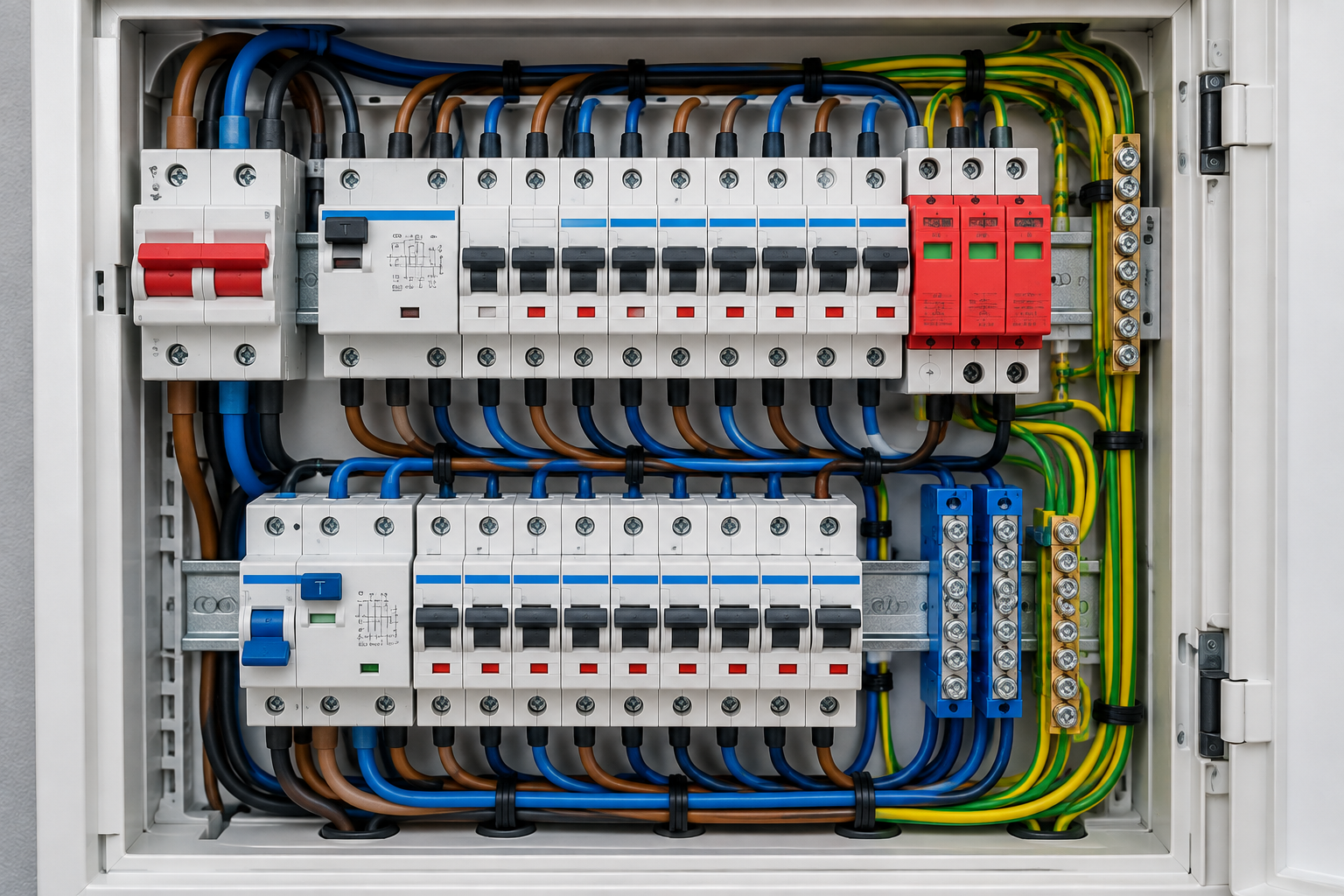
Home Electrical Distribution Board: Complete Guide to Components, Operation and Safety
The electrical distribution board is one of the most important parts of a home’s electrical installation. It distributes electricity to individual circuits while incorporating protective devices designed to reduce the risks associated with overloads, short circuits and electrical faults.
Most homeowners only interact with their electrical panel when a circuit breaker trips. However, the distribution board performs several essential functions that go far beyond switching circuits on and off.
What components are found inside a modern residential distribution board? What is the difference between a main switch, a miniature circuit breaker and a residual current device? And when should an older electrical panel be inspected or upgraded?
This guide explains the main components, operating principles and important safety considerations.
What Is an Electrical Distribution Board?
An electrical distribution board is an assembly of electrical equipment used to distribute, control and protect electrical circuits.
In a residential installation, it may supply separate circuits for:
Lighting.
General-purpose electrical sockets.
Electric water heaters.
Electric cookers and ovens.
Heat pumps.
Other equipment with specific electrical requirements.
The exact arrangement depends on the electrical design, the size of the property and the connected loads.
Not every home requires the same number of circuit breakers or the same protective devices.
What Are the Main Components of an Electrical Distribution Board?
A modern distribution board may contain several types of switching and protective equipment.
1. Main Switch
The main switch is used to isolate the electrical supply to the circuits or sections of the installation under its control.
Depending on the design, it allows the supply to the distribution board or a designated part of the installation to be disconnected.
An important distinction is that a standard switch-disconnector does not necessarily provide overload or short-circuit protection.
Its function is different from that of an overcurrent protective device.
2. Main Overcurrent Protective Device
Where required, a main overcurrent protective device helps protect the relevant part of the electrical installation.
This may be a circuit breaker, fuse or another suitable protective device.
Its selection depends on the supply characteristics, conductors and electrical system.
The main switch and main overcurrent protection may be separate components or combined within equipment designed for both functions.
3. Miniature Circuit Breakers (MCBs)
Miniature circuit breakers protect individual circuits against overcurrent.
They primarily respond to:
Overloads.
Short circuits.
Common markings include B10, B16, C16 and C20.
The letter indicates the instantaneous tripping characteristic, while the number represents the rated current in amperes.
The correct MCB must be selected according to the wiring system, connected loads and applicable protection requirements.
Installing a higher-rated circuit breaker does not increase the safe current-carrying capacity of the wiring.
4. Residual Current Devices (RCDs)
A residual current device is an important component of electric shock protection.
An RCD monitors the balance of current flowing through the active conductors of a circuit.
When the residual current meets the device’s specified operating conditions, the RCD disconnects the supply.
A conventional RCD does not provide overload or short-circuit protection unless these functions are incorporated into a combined device.
The presence of an RCD does not eliminate the need for appropriate earthing and other required protective measures.
5. Residual Current Breakers With Overcurrent Protection (RCBOs)
An RCBO combines residual-current protection with overcurrent protection.
It may be used to protect an individual circuit, depending on the installation design.
One potential advantage of appropriately distributed circuit protection is that a fault on one circuit can be isolated without necessarily interrupting all other circuits.
RCBO selection requires consideration of the earthing system, load characteristics and coordination with other protective devices.
6. Surge Protection Devices (SPDs)
Surge protection devices are designed to limit transient overvoltages.
Such overvoltages may be associated with lightning activity or switching operations within electrical networks.
Depending on the installation, Type 1, Type 2 or Type 3 SPDs, including combined devices, may be required.
Their selection must consider the applicable installation requirements and technical characteristics.
An SPD does not replace circuit breakers, RCDs or a complete external lightning protection system.
7. Neutral and Protective Earth Terminals
Distribution boards contain appropriate connection arrangements for neutral and protective conductors.
The neutral conductor (N) forms part of the normal electrical circuit.
The protective earth conductor (PE) forms part of the installation’s electrical safety system.
These connections must follow the earthing arrangement and distribution board design.
Arbitrary connections between neutral and protective earth are not permitted.
How Does a Home Electrical Distribution Board Work?
Electricity enters the installation and is distributed through suitable switching devices, protective equipment and conductors to individual circuits.
The distribution board provides the equipment required to control and protect these circuits.
For example:
If a circuit becomes overloaded, its overcurrent protective device may disconnect it.
If a short circuit occurs, an appropriately selected protective device must interrupt the fault current.
If residual current occurs, an RCD may disconnect the supply when its operating conditions are met.
If a transient overvoltage occurs, a suitable SPD may limit the voltage reaching connected equipment.
These are different protective functions and should not be confused.
Single-Phase vs Three-Phase Distribution Boards
Residential properties may have single-phase or three-phase electrical supplies.
Single-Phase Distribution Board
A single-phase installation is typically supplied by one phase and a neutral conductor, depending on the network arrangement.
It is widely used in homes where the electrical load requirements are suitable.
Three-Phase Distribution Board
A three-phase installation is supplied by three phases and, where applicable, a neutral conductor.
It allows suitable single-phase loads to be distributed across the available phases and can supply appropriate three-phase equipment.
The choice between single-phase and three-phase supply depends on the installation’s electrical requirements and the network connection conditions.
A three-phase supply is not automatically necessary or superior for every home.
How Are Electrical Circuits Organised Inside the Panel?
Proper circuit organisation helps with operation, maintenance and fault identification.
A distribution board may have separate circuits for lighting, sockets and specific electrical appliances.
The exact arrangement depends on the installation design.
Clear circuit identification is important.
Examples of circuit labels include:
Ground floor lighting.
Kitchen sockets.
Electric water heater.
Electric cooker.
Heat pump.
Accurate labelling helps users identify circuits and supports the work of qualified electricians.
How Many Circuit Breakers Should a Home Electrical Panel Have?
There is no universal number of circuit breakers suitable for every property.
The required number depends on:
Property size and intended use.
Expected electrical loads.
Number of individual circuits.
Protection requirements.
Special electrical equipment.
A small distribution board is not necessarily inadequate, and a large distribution board is not automatically safer.
Correct design, installation quality and compliance with applicable standards are more important than the number of devices.
When Does an Electrical Distribution Board Need Replacing?
Replacement or upgrading may be necessary when:
Protective devices are damaged or show signs of overheating.
Equipment deterioration affects safe operation.
Existing protection no longer meets the installation’s requirements.
Significant new electrical loads are being added.
Circuit distribution requires substantial modification.
Professional inspection identifies important safety deficiencies.
The age of a distribution board alone does not prove that replacement is necessary.
The decision should be based on its actual condition and the applicable technical requirements.
What Are the Warning Signs of a Faulty Electrical Panel?
Warning signs may include:
Burning smells.
Discoloured or deformed components.
Unusual overheating.
Repeated circuit breaker tripping.
Frequent RCD operation.
Crackling or electrical arcing sounds.
Visible enclosure damage.
If these symptoms appear, do not open the distribution board or touch internal components.
Arrange an inspection by a qualified electrician.
If smoke or fire is present, evacuate and contact emergency services.
Can You Add a Circuit Breaker Yourself?
No. Adding a circuit or protective device requires a proper technical assessment.
Relevant considerations include:
Available electrical supply.
Circuit wiring.
Expected electrical load.
Overcurrent protection.
Electric shock protection.
Short-circuit breaking capacity.
Compatibility of components.
Required testing after installation.
An unused space in a distribution board does not mean that any circuit breaker can safely be installed.
Electrical work inside a distribution board should be performed by an appropriately qualified professional.
What Is a Sub-Distribution Board?
A sub-distribution board is an additional electrical panel that supplies a designated part of an installation.
It may be used for:
Different floors of a building.
Separate utility areas.
Large residential properties.
Installations with specialised electrical loads.
A sub-distribution board requires suitable supply conductors, protective devices and coordination with the main distribution board.
What Does the IP Rating of an Electrical Panel Mean?
An IP rating describes the degree of protection provided by an enclosure against access to hazardous parts and ingress of solid objects and water, according to IEC 60529.
Different installation environments may require different levels of enclosure protection.
For example, an indoor distribution board installed in a dry location may have different enclosure requirements from equipment exposed to outdoor weather conditions.
The appropriate IP rating should be selected according to the installation environment and applicable requirements.
Appearance and cabinet dimensions alone are not sufficient selection criteria.
How Much Does Replacing an Electrical Distribution Board Cost?
The cost of replacement depends on several factors:
Single-phase or three-phase installation.
Number of circuits.
Type and quantity of protective devices.
Condition of the existing wiring.
Additional installation work.
Required measurements and verification.
There is no single replacement price that accurately represents every installation.
A reliable estimate requires an inspection and a detailed quotation from a qualified electrician.
How Often Should an Electrical Distribution Board Be Inspected?
The distribution board forms part of the electrical installation and should be included in the applicable inspection and verification procedures.
In Greece, periodic electrical installation inspections are associated with the regulatory requirements for the Electrical Installation Declaration, known as the YDE.
Inspection intervals depend on the category of installation and the applicable regulations.
Additional inspection may be necessary after significant alterations or when signs of electrical faults appear.
Frequently Asked Questions
What is the difference between a main switch and a main circuit breaker?
A main switch is used for isolation, while a circuit breaker provides overcurrent protection. Some devices combine both functions.
Is an RCD mandatory in a residential distribution board?
RCD requirements depend on the applicable electrical installation standards and the characteristics of the installation. RCDs are an essential protective measure in many modern residential circuits.
Can an electrical panel operate without surge protection?
Yes, but the ability to operate does not establish compliance with transient overvoltage protection requirements. The need for SPDs must be assessed according to the applicable standards.
Does installing a heat pump require a larger electrical panel?
Not necessarily. The available electrical supply, circuit protection and the specific heat pump’s requirements must be assessed.
Can I replace a miniature circuit breaker myself?
Replacing a protective device inside an electrical distribution board is electrical installation work and should be carried out by an appropriately qualified professional.
Is an old electrical panel safe if it has never caused problems?
The absence of visible faults does not prove that the panel meets all applicable safety requirements. Its condition should be assessed through appropriate inspection and testing.
Conclusion
The electrical distribution board is the central point for distributing and protecting a home’s electrical circuits.
Main switches, miniature circuit breakers, RCDs, RCBOs and surge protection devices perform different functions.
Correct selection and coordination are essential for safe installation operation.
A modern distribution board should not be judged simply by the number of devices it contains, but by its design, installation quality and verification of the required protective measures.
thermosphere.gr — Practical technical knowledge for safer electrical installations.
Disclaimer: This article provides general technical information and does not replace professional electrical design, installation, inspection or testing.
Technical References
IEC 61439-3 — Distribution boards intended to be operated by ordinary persons.
IEC 60364-4-41 — Protection against electric shock.
IEC 60364-4-43 — Protection against overcurrent.
IEC 60364-5-53 — Selection and erection of devices for protection, isolation, switching, control and monitoring.
IEC 60364-6 — Verification of electrical installations.
IEC 60529 — Degrees of protection provided by enclosures (IP Code).
ELOT 60364 — Requirements for electrical installations in Greece.