
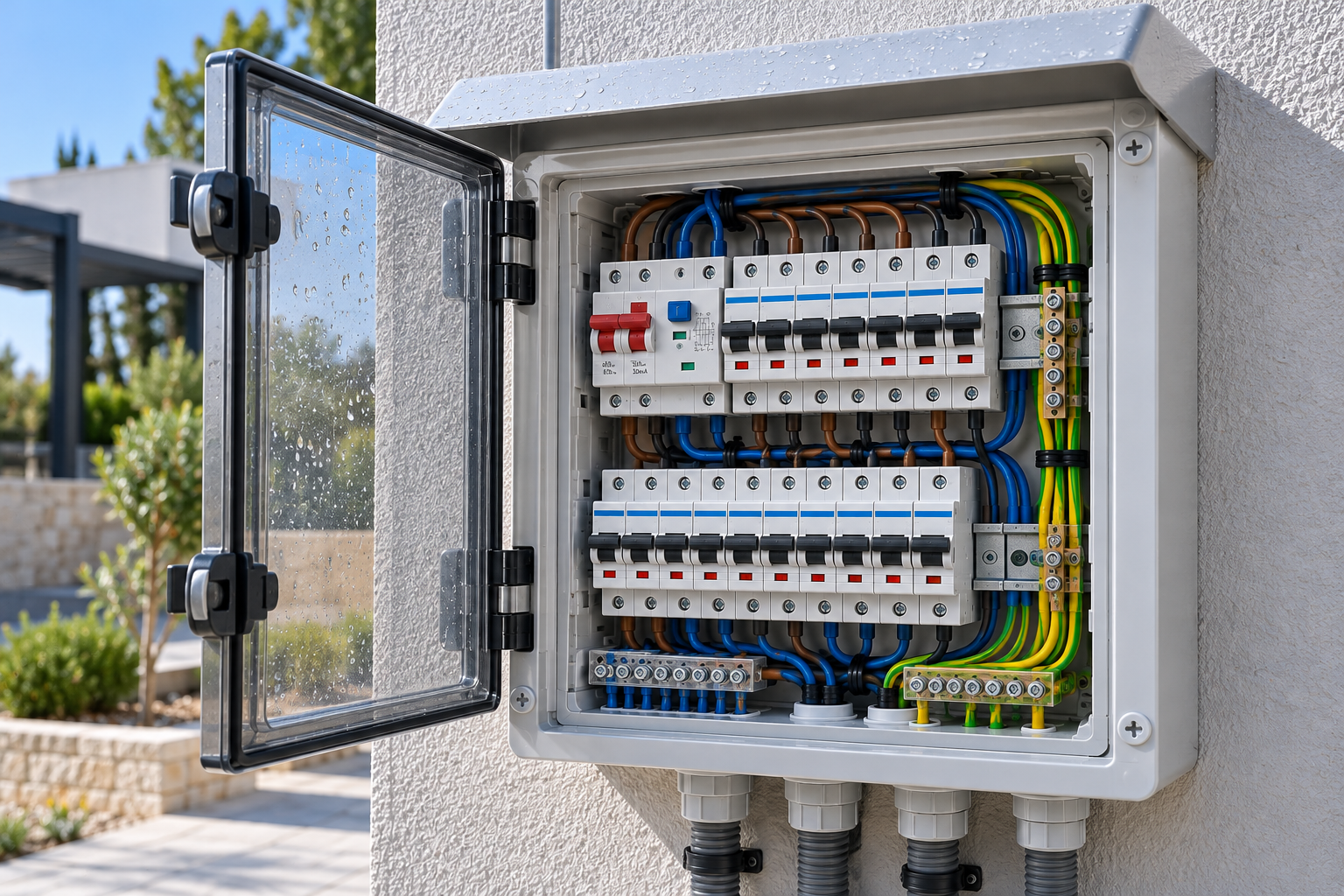
Outdoor Electrical Distribution Boards: IP Ratings, Weatherproofing and Safe Installation
An outdoor electrical distribution board is designed to distribute electricity and accommodate protective devices in locations exposed to environmental conditions that may be significantly different from those found indoors.
Outdoor electrical panels may be installed in gardens, courtyards, garages, technical areas, on exterior building walls or near mechanical equipment.
In these applications, selecting the right distribution board involves more than choosing an enclosure with enough space for circuit breakers.
Several environmental factors must be considered:
Rain and water exposure.
Humidity and condensation.
Dust and airborne particles.
Solar radiation.
Temperature variations.
Corrosion.
Mechanical impacts.
Accessibility for inspection and maintenance.
One of the most important enclosure characteristics is its IP rating, or Ingress Protection rating.
However, a high IP rating does not automatically make an electrical enclosure suitable for every outdoor installation.
This guide explains how IP ratings work, the differences between IP54, IP55, IP65 and IP66, how environmental conditions affect enclosure selection and the essential considerations for safe outdoor electrical installations.
1. What Is an Outdoor Electrical Distribution Board?
An outdoor electrical distribution board is an electrical distribution assembly designed and installed to operate under specified environmental conditions.
It may supply electrical circuits serving:
Outdoor lighting.
Garden socket outlets.
Water pumps.
Irrigation systems.
Mechanical equipment.
Garage installations.
Certain heat pump installations.
Other outdoor electrical equipment.
The suitability of the distribution board depends on the complete installation design.
Simply placing a standard indoor electrical panel inside an arbitrary box does not necessarily create a suitable outdoor installation.
The enclosure, internal components, cable entries, protective devices and operating conditions must all be compatible.
2. What Does an IP Rating Mean?
The IP classification, defined by IEC 60529, describes the protection provided by an enclosure against access to hazardous parts and the ingress of solid objects and water.
An IP code normally contains two characteristic digits.
For example:
IP65
The first digit describes protection against solid objects and dust.
The second digit describes protection against water.
First Digit: Protection Against Solid Objects
Digit | Basic Meaning |
0 | No specified protection |
1 | Protection against solid objects ≥50 mm |
2 | Protection against solid objects ≥12.5 mm |
3 | Protection against solid objects ≥2.5 mm |
4 | Protection against solid objects ≥1 mm |
5 | Dust-protected: dust ingress is limited so it does not interfere with satisfactory operation |
6 | Dust-tight |
Second Digit: Protection Against Water
Digit | Basic Meaning |
0 | No specified protection |
1 | Vertically falling water drops |
2 | Falling water drops when the enclosure is tilted up to 15° |
3 | Spraying water |
4 | Splashing water |
5 | Water jets |
6 | Powerful water jets |
7 | Temporary immersion under specified conditions |
8 | Continuous immersion under specified conditions |
An IP rating is not a general quality or durability score.
It describes protection under specific standardized test conditions.
It is also important to understand that an immersion rating does not automatically establish resistance to water jets.
Where both forms of protection are required, the appropriate combined rating or separate test evidence should be considered.
3. IP54 vs IP55 vs IP65 vs IP66: What Is the Difference?
These IP ratings are commonly encountered in electrical equipment enclosures.
IP Rating | Dust Protection | Water Protection |
IP54 | Dust-protected | Splashing water |
IP55 | Dust-protected | Water jets |
IP65 | Dust-tight | Water jets |
IP66 | Dust-tight | Powerful water jets |
IP54 Electrical Enclosures
An IP54 enclosure may be suitable for certain sheltered locations, provided the actual environmental conditions do not exceed its protection capabilities.
IP55 Electrical Enclosures
An IP55 enclosure provides protection against water jets and may be considered for specific outdoor applications.
IP65 Electrical Enclosures
IP65 provides dust-tight protection and resistance to water jets under the applicable test conditions.
It is commonly specified for outdoor enclosures, but suitability must still be assessed for the particular installation.
IP66 Electrical Enclosures
IP66 provides dust-tight protection and resistance to powerful water jets.
It may be appropriate for more exposed environments.
Important: IP66 does not mean an enclosure is suitable for permanent immersion, every type of high-pressure cleaning or unrestricted exposure to all environmental conditions.
4. Which IP Rating Is Suitable for an Outdoor Electrical Panel?
There is no single IP rating that is suitable for every outdoor electrical installation.
The correct selection depends on the actual exposure conditions.
Covered Balcony
A covered balcony may provide some protection from direct rainfall.
However, wind-driven rain, humidity and temperature variations must still be considered.
Exterior Building Wall
An enclosure installed on a fully exposed exterior wall may experience rainfall, dust, solar radiation and significant temperature changes.
The enclosure must be suitable for these conditions.
Garden
Garden installations may be exposed to rain, irrigation water, soil, dust and accidental mechanical impacts.
Garage
The appropriate enclosure depends on whether the garage is enclosed, partially open or exposed to water and dust.
Heat Pump Technical Area
The enclosure selection must account for equipment location, manufacturer requirements and actual environmental conditions.
An appropriate IP rating should therefore be selected through an assessment of external influences rather than simply choosing a rating based on the name of the installation location.
5. Is an IP65 Electrical Enclosure Completely Waterproof?
No.
An IP65 enclosure provides a specified level of protection against dust and water jets under standardized testing conditions.
It does not necessarily mean that:
The enclosure can be submerged in water.
It can withstand every high-pressure cleaning process.
Condensation cannot form inside it.
It has unlimited resistance to ultraviolet radiation.
Its IP rating will remain unchanged after any modification.
Actual protection also depends on correct installation, suitable cable entries and the condition of seals and other enclosure components.
A product’s declared IP rating must not be interpreted as protection against every possible environmental hazard.
6. Plastic vs Metal Outdoor Electrical Enclosures
Outdoor electrical enclosures are manufactured from different materials.
Each material has advantages and limitations.
Plastic Enclosures
Depending on their construction, plastic enclosures may offer:
Low weight.
Resistance to certain corrosive environments.
Electrical insulating properties.
Convenient installation.
However, their suitability for outdoor use depends on their resistance to UV exposure, temperature and mechanical stress.
Not every plastic enclosure is suitable for prolonged exposure to direct sunlight.
Metal Enclosures
Metal enclosures may offer:
High mechanical strength.
Suitability for demanding applications.
Different installation and configuration options.
However, corrosion resistance depends on the material, coating and environmental conditions.
Metallic parts may also require appropriate protective bonding according to the enclosure design and applicable electrical requirements.
There is no universally superior enclosure material.
Selection should be based on the installation environment and technical specifications.
7. How Does Sunlight Affect an Outdoor Electrical Panel?
An electrical enclosure exposed to direct sunlight may develop high internal temperatures.
This is particularly important because circuit breakers, RCDs and other electrical components have specified operating temperature limits.
Excessive temperatures may affect:
Equipment performance.
Permissible current loading.
Component service life.
Plastic materials.
Seals and gaskets.
Thermal conditions must be evaluated during enclosure selection and electrical design.
Shading may be beneficial in some installations, provided it does not create problems with ventilation, accessibility or other operating requirements.
A weatherproof enclosure is not automatically suitable for every temperature condition.
8. Moisture and Condensation: Why Can They Occur Inside a Weatherproof Enclosure?
Moisture is an important concern in outdoor electrical installations.
Even an enclosure with a high IP rating can experience internal condensation.
This may happen when temperature and humidity conditions change.
For example, an enclosure may heat up during the day and cool down at night.
Under suitable conditions, moisture in the internal air can condense on cooler surfaces.
Condensation can affect electrical equipment and may contribute to deterioration.
How Is Condensation Managed?
Depending on the application, suitable solutions may include:
Enclosures designed for the expected environmental conditions.
Manufacturer-approved pressure compensation or ventilation accessories.
Appropriate condensation management components.
Suitable positioning and thermal design.
Periodic professional inspection.
Any condensation control measures must be compatible with the enclosure and its required protection rating.
Drilling arbitrary holes in a weatherproof enclosure can compromise its ingress protection.
9. Why Are Cable Entries Important?
Cable entries are critical to maintaining enclosure protection.
Unsuitable fittings or installation methods may allow water or dust to enter.
The design should consider:
Cable gland compatibility with the cable.
The required protection rating of the fittings.
Enclosure manufacturer instructions.
Mechanical cable retention.
Proper sealing.
Installation orientation.
A manufacturer’s IP rating for an empty enclosure does not automatically guarantee the same protection for the completed electrical assembly after cables and accessories have been installed.
The installed configuration must preserve the required degree of protection.
10. Does an Outdoor Electrical Panel Need RCD Protection?
Outdoor electrical circuits may have particular protection requirements because of their operating environment and intended use.
Protective device selection depends on:
The earthing arrangement.
Circuit characteristics.
Equipment type.
Installation conditions.
Applicable electrical standards.
Many outdoor circuits require additional protection using appropriately selected residual current devices.
However, RCD type, sensitivity and arrangement must be determined according to the actual installation requirements.
An RCD does not replace:
Proper earthing.
Overcurrent protection.
Suitable wiring.
Appropriate enclosure protection.
Correct installation and verification.
Electrical protection must be considered as a complete system.
11. Outdoor Electrical Panels for Heat Pumps
Heat pumps may include outdoor equipment with electrical supply requirements that must be considered during installation design.
However, having an outdoor heat pump unit does not automatically mean that a separate outdoor distribution board is required.
The equipment may be supplied through a suitably designed circuit from the main distribution board or another appropriate arrangement.
If an outdoor distribution board is used, the design must consider:
Enclosure suitability.
Water and dust protection.
Operating temperatures.
Electrical protective devices.
Maintenance access.
Heat pump manufacturer instructions.
The electrical supply must be designed according to the equipment’s actual electrical specifications.
A heat pump’s thermal output should not be confused with its electrical input power.
12. Outdoor Electrical Panels for Gardens and Irrigation Systems
Gardens may contain electrical circuits supplying:
Lighting.
Water pumps.
Irrigation systems.
Outdoor socket outlets.
Control and automation equipment.
Water exposure and humidity require particular attention.
The enclosure must be installed in a suitable location and provide protection appropriate to the environmental conditions.
Mechanical damage, cable routing and accessibility should also be considered.
An outdoor panel should not be installed in a location where flooding or other foreseeable hazards may compromise safety.
13. Why Does a Coastal Environment Matter?
Coastal locations may expose electrical equipment to salt-containing air.
This can increase corrosion risk, particularly where moisture and contaminants are present.
Potentially affected components include:
Metal enclosures.
Screws and fasteners.
Hinges.
Mounting hardware.
Electrical contacts if contaminants enter the enclosure.
In coastal environments, material selection and corrosion resistance become particularly important.
An IP rating does not, by itself, certify resistance to salt-laden environments.
Additional material specifications or corrosion-resistance testing may be relevant.
14. What Is an IK Rating?
In addition to IP protection, some electrical enclosures carry an IK rating.
The IK classification, defined by IEC 62262, describes the degree of protection against external mechanical impacts.
For example, an enclosure installed in a garage or an area where accidental impacts are possible may require suitable mechanical strength.
IP and IK describe different characteristics.
A high IP rating does not automatically mean an enclosure has high impact resistance.
Both characteristics should be considered where relevant.
15. How Should an Outdoor Electrical Panel Be Maintained?
Outdoor electrical distribution boards should be inspected according to their operating conditions, manufacturer instructions and applicable requirements.
Professional inspections may assess:
Enclosure condition.
Seals and gaskets.
Hinges and locking mechanisms.
Cable entries.
Signs of moisture.
Corrosion.
Thermal damage.
Protective device condition.
Circuit identification and labelling.
A property owner may visually observe the outside of the enclosure for obvious damage.
However, internal electrical inspection, testing and maintenance should be performed by appropriately qualified professionals.
If water ingress, smoke, sparking or a strong burning smell is observed, the installation requires urgent professional attention.
Do not open or touch potentially hazardous equipment.
16. Common Mistakes When Selecting Outdoor Electrical Enclosures
Choosing an Enclosure Based Only on Its IP Rating
Temperature, UV exposure, corrosion and mechanical conditions are overlooked.
Using Unsuitable Cable Glands
Cable entries do not maintain the required protection.
Ignoring Solar Heating
The enclosure is installed where internal temperatures may exceed equipment operating limits.
Overlooking Condensation
The design does not account for possible internal moisture.
Selecting Unsuitable Materials
Corrosion resistance, UV durability or mechanical strength are not adequately considered.
Poor Installation Location
The enclosure is difficult to access safely or exposed to avoidable hazards.
Inadequate Electrical Protection
The weatherproof enclosure is incorrectly treated as a substitute for proper electrical protective measures.
These mistakes can affect both the reliability and safety of the installation.
17. Frequently Asked Questions
Is IP65 suitable for outdoor use?
It may be suitable for many outdoor applications, but final selection depends on water exposure, temperature, UV radiation and other environmental conditions.
Is IP66 better than IP65?
IP66 provides a higher level of protection against water jets. However, it is not automatically superior in every other characteristic or necessary for every installation.
Can an electrical panel be installed on a balcony?
Yes, provided suitable equipment is selected and applicable installation requirements are met.
Can moisture form inside an IP65 enclosure?
Yes. Internal condensation may occur even in enclosures with high ingress protection ratings.
Does an outdoor electrical panel need a protective canopy?
Not always. Additional protection or shading may be beneficial depending on environmental conditions and manufacturer requirements, but it does not replace the need for a suitable enclosure.
Does a heat pump require a separate outdoor electrical panel?
Not necessarily. The electrical arrangement depends on the installation design and the equipment manufacturer’s instructions.
Can holes be drilled into a weatherproof electrical enclosure?
Modifications must follow the enclosure manufacturer’s approved methods and use suitable components. Unapproved openings can compromise ingress protection.
Is a plastic or metal outdoor electrical panel better?
Neither material is universally better. Selection depends on mechanical strength, corrosion resistance, electrical protection and environmental conditions.
Is IP66 suitable for underwater installation?
No. IP66 specifies protection against powerful water jets, not immersion. Submerged installations require an appropriate assessment of immersion protection and other operating conditions.
Conclusion
Choosing an outdoor electrical distribution board requires more careful consideration than selecting an enclosure for a typical indoor location.
The IP rating is an important factor, but it is not the only one.
Rain, humidity, condensation, sunlight, temperature variations, corrosion and mechanical impacts must all be assessed.
A suitable outdoor distribution board should combine an appropriate enclosure, compatible accessories, correct electrical protective devices and professional installation.
Thermosphere.gr — Technical knowledge for safer and more efficient installations.
Disclaimer: This article provides general technical information and does not replace professional electrical design, installation, inspection or testing.
Technical References
IEC 60529 — Degrees of protection provided by enclosures (IP Code).
IEC 62262 — Degrees of protection provided by enclosures for electrical equipment against external mechanical impacts (IK Code).
IEC 61439-3 — Distribution boards intended to be operated by ordinary persons.
IEC 60364-5-51 — Selection and erection of electrical equipment: Common rules and external influences.
IEC 60364-5-52 — Selection and erection of wiring systems.
IEC 60364-5-53 — Devices for protection, isolation, switching, control and monitoring.
IEC 60364-6 — Verification of electrical installations.
ELOT 60364 — Requirements for electrical installations in Greece.