
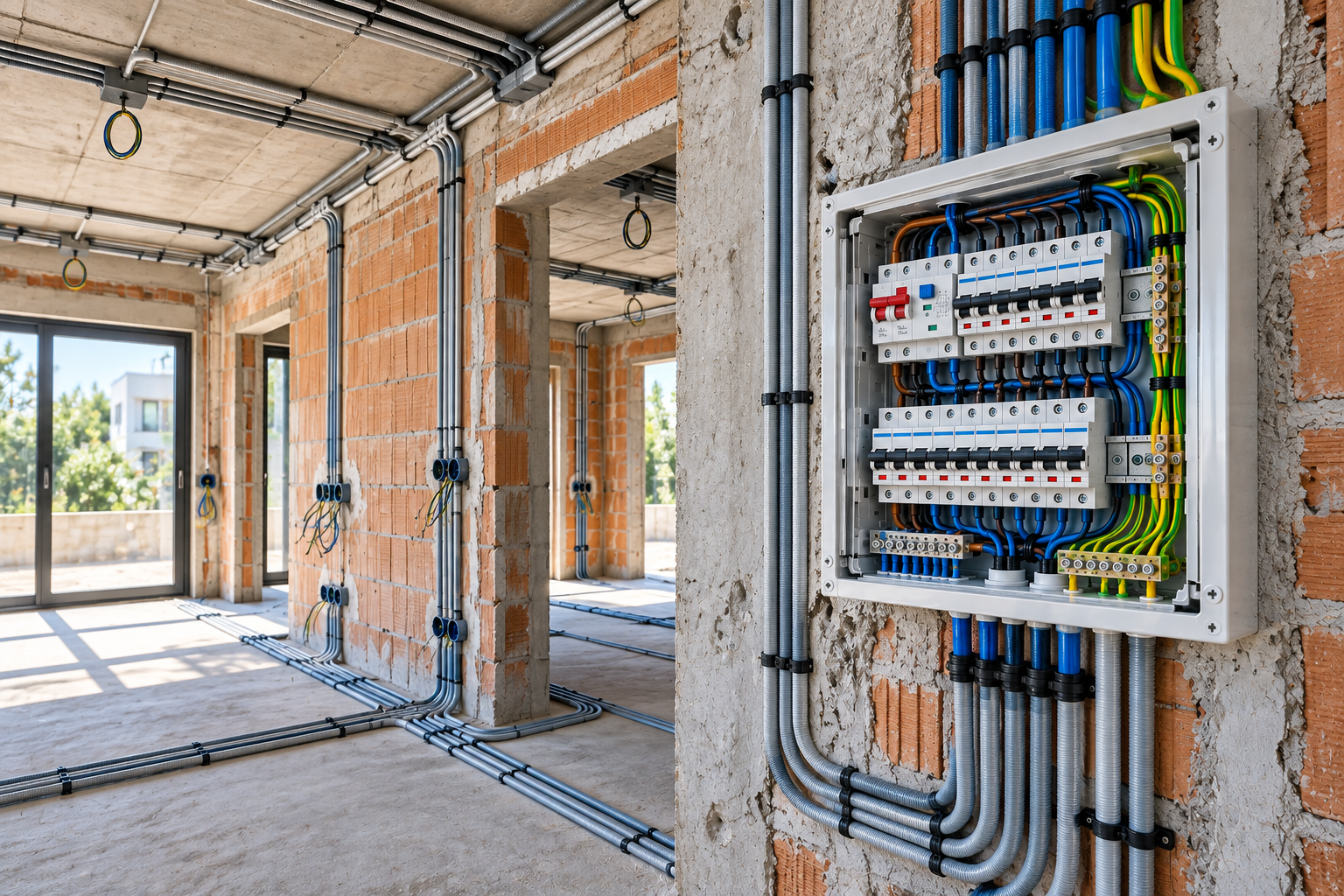
Residential Electrical Installation: Complete Guide to Wiring, Circuits and Safety
A residential electrical installation is one of the most important technical systems in a home. It supplies electricity to lighting, socket outlets, household appliances, heating equipment and other devices used every day.
A modern electrical installation must combine safety, functionality, sufficient electrical capacity and the ability to accommodate future requirements.
Proper design involves much more than installing cables and positioning electrical outlets. It requires electrical load assessment, circuit organization, protective device selection, earthing arrangements and appropriate inspection and testing.
Special attention is necessary in bathrooms and other locations where water or moisture introduces additional electrical safety considerations.
This guide explains the main components of a residential electrical installation, the principles of electrical design, essential safety measures and common mistakes that should be avoided.
1. What Does a Residential Electrical Installation Include?
A residential electrical installation consists of interconnected electrical equipment and circuits.
Its main components include:
The incoming electricity supply.
The main electrical distribution board.
Lighting circuits.
Socket outlet circuits.
Circuits supplying household appliances.
Electrical conductors and cables.
Conduits and cable routing systems.
Junction and connection boxes.
Switches and socket outlets.
Electrical protective devices.
Earthing and protective bonding systems.
All these components must operate as part of a coordinated system.
The quality of an individual component does not guarantee the safety of the complete installation.
2. How Is a Residential Electrical Installation Designed?
Electrical design begins with an assessment of the building and its expected electricity requirements.
Important factors include:
The size and layout of the property.
The number of rooms.
Lighting requirements.
The number and location of socket outlets.
Household appliances.
Space heating and domestic hot water systems.
Potential heat pump installation.
Electric vehicle charging requirements.
Possible future extensions.
The electrical design should accommodate both current and reasonably foreseeable future needs.
For example, a house built today may later require an electrical supply for a heat pump or an electric vehicle charger.
Considering these possibilities during the initial design may reduce the need for extensive modifications later.
3. Single-Phase vs Three-Phase Electrical Installations
Residential buildings may use single-phase or three-phase electricity supplies.
Single-Phase Installation
In Greece and many European countries, the nominal voltage between a phase conductor and neutral is 230 V.
A single-phase installation can meet the needs of many households, depending on the available supply capacity and electrical loads.
Three-Phase Installation
A three-phase installation uses three phase conductors.
In a typical European low-voltage system, the nominal voltage is:
400 V between phases.
230 V between phase and neutral.
A three-phase supply may be appropriate for homes with higher electrical demand or equipment requiring three-phase power.
Which Is Better?
Neither arrangement is universally better.
The appropriate choice depends on:
Total electrical demand.
Appliance specifications.
Available supply capacity.
Future requirements.
Local distribution network conditions.
The decision should be based on a professional electrical assessment.
4. How Are Electrical Circuits Organized?
A residential electrical installation is divided into individual circuits.
Circuit separation helps distribute electrical loads and provides appropriate protection and control.
Typical circuits may include:
Circuit | Purpose |
Lighting | Supplying lighting fixtures |
General socket outlets | Supplying household appliances |
Electric cooker | Supplying cooking equipment |
Water heater | Domestic hot water production |
Washing machine | Supplying the appliance |
Heat pump | Supplying heating equipment |
Outdoor circuits | Garden lighting and outdoor equipment |
This table is illustrative.
Not every appliance necessarily requires a dedicated circuit.
Circuit arrangements depend on equipment power requirements, operating conditions, manufacturer instructions and applicable electrical standards.
5. How Are Electrical Cables Selected?
Electrical cables transfer electricity from the distribution board to individual loads.
Their selection depends on several factors:
Design current.
Conductor cross-sectional area.
Conductor material.
Insulation characteristics.
Installation method.
Ambient temperature.
Cable grouping.
Circuit length.
Permissible voltage drop.
Overcurrent protection requirements.
Cable size should not be selected using a single general rule without considering installation conditions.
For example, the same conductor cross-sectional area may have different permissible current-carrying capacities depending on how it is installed.
Cable types, conductor sizes and selection criteria will be covered in a separate Thermosphere.gr article.
6. What Is Voltage Drop?
When electrical current flows through conductors, a voltage drop occurs because of their electrical resistance and, where relevant, impedance.
Voltage drop depends on:
Cable length.
Electrical current.
Conductor cross-sectional area.
Conductor material.
Operating temperature.
Load characteristics.
Excessive voltage drop can affect the performance of electrical equipment.
Electrical design must ensure compliance with applicable voltage-drop requirements.
7. What Is the Purpose of an Electrical Distribution Board?
The electrical distribution board is the central point for distributing electricity to the home’s circuits.
It contains devices used for:
Switching and isolation.
Overload protection.
Short-circuit protection.
Protection against electric shock.
Surge protection where required.
Typical components may include:
Main isolating switches.
Miniature circuit breakers (MCBs).
Residual current devices (RCDs).
Residual current circuit breakers with overcurrent protection (RCBOs).
Surge protective devices (SPDs).
Correct device selection and coordination are essential for electrical safety.
A modern distribution board alone does not guarantee that the entire electrical installation is safe.
8. What Is an RCD and Why Is It Important?
A residual current device, commonly called an RCD, monitors the difference between currents flowing through the relevant live conductors.
When its operating conditions are met, it can disconnect the electrical supply.
Appropriately selected RCDs provide an important protective measure in many electrical installations.
However:
An RCD does not replace protective earthing.
An ordinary RCD does not provide overload protection.
It does not compensate for incorrectly sized wiring.
It cannot prevent every possible electric shock.
The correct RCD type, rated residual operating current and arrangement depend on the installation and connected equipment.
9. Why Is Earthing Essential?
Earthing is an essential element of electrical protection.
Its role is closely related to fault-current management and the operation of suitable protective devices.
The effectiveness of protection depends on the earthing arrangement and overall electrical design.
Important elements include:
Protective conductors.
Main protective bonding.
Continuity of protective conductors.
Suitable protective devices.
Required measurements and verification tests.
A socket outlet with an earth contact does not automatically prove that the installation has an effective protective earthing system.
Professional testing is necessary to verify the relevant protective measures.
10. Bathroom Electrical Installations: Why Is Extra Protection Necessary?
Bathrooms require particular attention because water and electrical equipment may be present in close proximity.
Moisture and contact with water can increase the risk of electric shock.
For this reason, electrical installations in locations containing a bath or shower are subject to specific requirements.
These are addressed in IEC 60364-7-701 and the applicable national electrical installation rules.
What Are Bathroom Electrical Zones?
Bathroom electrical zones are defined according to the position and geometry of the bath or shower.
The requirements may affect:
Which electrical equipment may be installed.
Socket outlet locations.
Protection against water ingress.
Protection against electric shock.
Permitted electrical supplies and equipment.
The exact zone boundaries and equipment requirements depend on the applicable edition of the standard and national regulations.
It is not safe to assume that a socket outlet is permitted simply because it appears to be some distance from a shower.
What Should Be Considered in a Bathroom?
Electrical design should assess:
Appropriate RCD protection.
Protective earthing.
Required protective bonding.
Suitable lighting fixtures.
Switch and socket locations.
Appropriate IP ratings.
Special requirements for electrical appliances.
Can a Socket Outlet Be Installed in a Bathroom?
Whether a socket outlet is permitted depends on its position, the room configuration and applicable requirements.
Electrical outlets must not be installed arbitrarily near a bath or shower.
A qualified electrician must assess the proposed location.
11. Electrical Installations in Kitchens
Kitchens often contain several electrical appliances with significant power requirements.
Typical equipment includes:
Electric ovens.
Electric hobs.
Refrigerators.
Dishwashers.
Small kitchen appliances.
Extractor hoods.
Electrical design must account for expected appliance operation and manufacturer requirements.
Socket outlets and electrical connections must also be positioned appropriately, considering exposure to water and heat.
12. Electrical Installations for Heat Pumps
Heat pumps are increasingly used for residential heating.
Their electrical supply must be designed according to the actual equipment specifications.
Important considerations include:
Supply voltage.
Maximum electrical current.
Protective device requirements.
Manufacturer instructions.
Auxiliary electric heaters.
Available supply capacity.
A heat pump with a thermal output of 12 kW does not necessarily consume 12 kW of electrical power.
Thermal output and electrical input are different quantities.
The correct electrical supply must be determined using the manufacturer’s electrical data.
13. Electrical Installations for Electric Vehicle Charging
Electric vehicle charging can introduce significant additional electrical demand.
Installing a charging point requires assessment of:
Available electrical capacity.
Charging power.
Cable selection.
Protective devices.
Installation location.
Possible load management requirements.
Electric vehicle charging installations are subject to specific requirements, including those addressed in IEC 60364-7-722.
A conventional household socket outlet should not automatically be considered suitable for every electric vehicle charging application.
14. How Is Electrical Installation Safety Verified?
Electrical safety cannot be assessed through visual observation alone.
Professional verification may include:
Visual inspection.
Protective conductor continuity testing.
Insulation resistance measurement.
Verification of protection against electric shock.
RCD testing.
Polarity checks where applicable.
Other required electrical measurements.
Review of installation documentation.
The specific inspection and testing procedures depend on the installation and applicable requirements.
Verification must be performed by an appropriately qualified or authorized electrical professional.
15. What Is the Greek Electrical Installation Declaration (YDE)?
In Greece, the Ypefthyni Dilosi Egkatastati (YDE) is an official electrical installer’s declaration associated with the documentation and verification of electrical installations.
The relevant procedure involves the required inspection records, documentation and declarations under the applicable Greek regulatory framework.
Submission requirements and periodic inspection intervals depend on the installation’s use and current regulations.
The YDE should not be treated as a purely administrative formality.
It is connected to the verification and documentation of the electrical installation.
The YDE procedure, inspection requirements and supporting documents will be examined in a dedicated article.
16. Common Residential Electrical Installation Mistakes
Inadequate Circuit Planning
Electrical circuits are not designed to accommodate the actual needs of the household.
Incorrect Cable Selection
Conductors are selected without fully considering current-carrying capacity and installation conditions.
Unsuitable Protective Devices
Circuit breakers or RCDs are not properly matched to the circuits they protect.
Inadequate Earthing
The effectiveness of electrical protective measures is not properly verified.
Improvised Electrical Extensions
Additional loads are connected without assessing the existing installation.
Unsuitable Equipment in Wet Locations
Special electrical safety requirements are overlooked.
Missing Documentation
Circuit identification and installation records are incomplete or outdated.
Insufficient Inspection and Testing
The installation is placed into service without the necessary verification.
These issues can compromise electrical safety and reliability.
17. When Should a Residential Electrical Installation Be Upgraded?
An electrical installation upgrade may be considered when:
Existing wiring or equipment shows deterioration.
Electrical faults occur repeatedly.
Major new electrical loads are introduced.
A property undergoes renovation.
An electrical inspection identifies deficiencies.
A different electricity supply arrangement is required.
The installation no longer meets the building’s needs.
The age of an installation alone does not prove that complete replacement is necessary.
A professional assessment should determine the extent of any required work.
18. Frequently Asked Questions
How Many Electrical Circuits Does a House Need?
There is no universal number. Circuit requirements depend on the property, connected loads and electrical design.
Does Every Room Need Its Own Circuit Breaker?
Not necessarily. Circuit arrangements depend on electrical demand and applicable design requirements.
Must All Wiring Be Replaced in an Older House?
Not automatically. The existing installation should be inspected to determine its condition and suitability.
Is RCD Protection Necessary?
RCD requirements depend on applicable standards and circuit characteristics. Proper residual current protection is an important part of electrical safety.
Can I Install a Socket Near a Shower?
Electrical equipment near baths and showers is subject to special restrictions. A qualified electrician must assess the location.
Does a Heat Pump Require Three-Phase Electricity?
Not always. Heat pumps are available with different electrical supply requirements.
Can an EV Charger Be Added Without Upgrading the Electrical Panel?
This depends on available electrical capacity, the existing installation and the charger’s requirements.
How Often Should a Residential Electrical Installation Be Inspected?
Mandatory inspection intervals depend on the installation’s use and applicable national regulations. Additional inspection may be necessary after faults or significant modifications.
Conclusion
A residential electrical installation should be designed as a complete technical system.
Cable selection, circuit organization, protective devices, earthing and verification procedures are interconnected aspects of electrical safety.
Particular attention is necessary in bathrooms and other locations where water is present, as well as in homes with significant electrical loads.
Proper design, professional installation and appropriate verification contribute to a safer and more reliable electrical system.
Thermosphere.gr — Technical knowledge for safer and more efficient installations.
Disclaimer: This article provides general technical information. It is not a DIY electrical installation guide and does not replace professional electrical design, installation, inspection or testing.
Technical References
ELOT 60364 — Requirements for electrical installations in Greece.
IEC 60364-4-41 — Protection against electric shock.
IEC 60364-4-43 — Protection against overcurrent.
IEC 60364-5-52 — Selection and erection of wiring systems.
IEC 60364-5-53 — Devices for protection, isolation, switching, control and monitoring.
IEC 60364-6 — Verification.
IEC 60364-7-701 — Locations containing a bath or shower.
IEC 60364-7-722 — Supplies for electric vehicles.
HEDNO (DEDDIE) — Official information on electrical installation declarations (YDE) in Greece.